A Canadian coal phase-out

Both The Globe and Mail and The New York Times are reporting on recent comments from Jim Prentice, Canada’s minister of the environment, about phasing out coal-fired electricity in Canada:

“The concept is that, as these facilities are fully amortized and their useful life fully expended, they would not be replaced with coal.”

That is certainly necessary, but may not be sufficient to achieve Canada’s domestic emission reduction targets. Indeed, if the world as a whole is to get onto an emissions path consistent with avoiding dangerous climate change, it will probably be necessary to scrap some existing coal plants before the end of their working lives.

About 18% of Canada’s current greenhouse gas emissions are from coal-fired electricity, with facilities in Ontario (about 25% of the total), Alberta (about 47%), Saskatchewan, Nova Scotia, and New Brunswick.

Limiting total historical human emissions

Osterer's sign

The BBC recently published an article that goes together well with two of my earlier posts. Like my post on how many greenhouse gasses humanity can safely emit and my post on the (absent) long-term future of the fossil fuel industry, it highlights how preventing catastrophic climate change obliges humanity to keep a significant proportion of all available fossil fuels in the ground. The BBC piece cites an article in Nature which argues that we must leave 75% of the remaining fossil fuels untouched, if we are to avoid dangerous climate change.

What this highlights is how the world has two great stocks of carbon, between which humanity is generating an ever-increasing flow: (a) the stock of fossil fuels, containing carbon dioxide that hasn’t been in the atmosphere since the Eocene period 30 – 50 million years ago, and (b) the stock of carbon dioxide currently in the atmosphere, trapping ever-more energy from the sun. If we are to live in a world without massive disorder, displacement, and upheaval by the end of the century, we need to start closing the spigot from (a) to (b), even though it will mean leaving a lot of usable fuel underground.

That will take more restraint than humanity has been able to muster for any collective project so far.

Transnational activism and the 2005 Gleneagles summit

Claire Leigh, a friend of mine and colleague from the Oxford M.Phil program, has published an article based on her thesis in Cosmopolis: Independence and transnational activism: lessons from Gleneagles. It may be of particular interest to the many readers of this blog who are interested in effecting political change through civil society, protest, and mass action.

The full text doesn’t seem to be available on the site, but those whose universities have print or electronic subscriptions to journals may be able to access it.

Climate risk ‘pyramid’ from US polling data

Graffiti murals in the ROM

Back during the 2008 election, many eyes were glued to fivethirtyeight.com: the statistics-oriented website of a baseball analyst turned electoral statistician. A couple of days ago, the man who runs the site posted an interesting diagram based on polling data about climate change (n=2,164). Basically, it shows that ever-decreasing numbers of people expect harm from climate change, the closer to them it would appear. For instance, more people expect it to harm plants and animals than people, and more people expect it to harm those in developing countries than those in the US.

All told, I think the trend is an accurate reflection of the most likely outcomes from climate change. It seems highly likely, for instance, that future generations will suffer more than this one. Nonetheless, the chart does a good job of demonstrating just how hard it is to get people to accept immediate sacrifices in order to protect long-term climate stability: they are not fully exposed to the risks, and they have ample opportunity to fob them off on others, so as to avoid making changes in how they live their own lives and how the political and economic systems in their states operate.

While I think the pyramid is basically correct when it comes to the relative magnitude of harm that will likely occur in each area, what it doesn’t convey is that the absolute level of harm would still be unacceptable, across the board, in the absence of strong climate policies. Continuing to emit greenhouse gasses at present levels until the end of the century will almost certainly cause massive harm to those living in the United States and other rich countries. It may not be as bad as the harm that would be visited on future generations and poorer countries, but it is more than serious enough to justify devoting a significant fraction of society’s resources to building a carbon neutral future.

There is some more discussion of the pyramid over at ZeroCarbonCanada.

Emissions permits for new entrants

One proposed element for a cap-and-trade system is holding back some permits for ‘new entrants.’ Basically, this would mean preemptively grandfathering emissions from certain types of new facilities. Depending on how it was done, it seems like it could be either environmentally beneficial or harmful. If the overall cap for any year is set below the level of emissions last year, on a downward trajectory compatible with stabilizing concentrations at a safe level, reserving some credits for new entrants would force other firms to bid for fewer permits, raising prices and increasing the number of mitigation activities that are worth undertaking. Conversely, if this is used as an excuse to increase the cap, it might impede the transition to a low-carbon future.

There is also the issue of complexity. It seems likely that special treatment for new entrants will lead to weird Enron-style accounting trickery. The more complicated a carbon pricing scheme becomes, the easier it is to do hidden favours, and the harder it is to transparently assess what is going on.

Cap-and-trade by the EPA

Blue bike, red rack

According to a legal analysis from the Institute for Policy Integrity (PDF), the Waxman-Markey bill currently holed up in a Congressional committee isn’t the only way the United States might get a cap-and-trade system in the next year or so. In the wake of the recent ‘endangerment finding, the IPI analysts conclude that the Environmental Protection Agency (EPA) has sufficient authority under the Clean Air Act to create a cap-and-trade system all by itself, without Congressional input:

If Congress fails to act, President Obama has the power under the Clean Air Act to adopt a cap-and-trade system that auctions greenhouse gas allowances. President Obama also has the power under the Clean Air Act to implement an executive agreement at the international level, rendering Senate approval of a climate treaty unnecessary. EPA’s first priority must be to meet its legal obligations without impeding the work being done in Congress. But if Congress fails to act decisively, then putting those powers to use will be an essential stop‐gap to avoid complete inaction on climate change.

While the threat is unlikely to be realized (the EPA would probably feel like they are overstepping themselves), it might be a useful stick with which to drive action in Congress. The Republicans on the relevant committee are all resolutely opposed to Waxman-Markey, but might find their thinking altered in the event that cap-and-trade became an inevitability, with the option of either their involvement in design or their total sidelining.

Incidentally, the fact that not a single Republican on the House Energy and Commerce Committee is considered likely to support the bill demonstrates what a dinosaur party they really are. The world is finally starting to move on climate change mitigation, with the United States playing a critical role in that development. To simply make themselves into obstacles – denying the science and obstructing the political process – demonstrates that the Republican leadership just doesn’t have a handle on what is arguably the most critical issue of the contemporary era.

Obama’s Earth Day speech

It is heartening to see that Barack Obama has at least rhetorically accepted the fact that the fossil fuel industry has no long-term future:

Now, the choice we face is not between saving our environment and saving our economy. The choice we face is between prosperity and decline. We can remain the world’s leading importer of oil, or we can become the world’s leading exporter of clean energy. We can allow climate change to wreak unnatural havoc across the landscape, or we can create jobs working to prevent its worst effects. We can hand over the jobs of the 21st century to our competitors, or we can confront what countries in Europe and Asia have already recognized as both a challenge and an opportunity: the nation that leads the world in creating new energy sources will be the nation that leads the 21st-century global economy.

More from this speech is available on the Climate Progress blog.

While it is important to make people aware of the dire threat posed by climate change, and the gross immorality of not dealing with it, it is also vital to stress the opportunities associated. Foremost among them is the chance to shift society from dependence on harmful and dwindling stocks of fossil fuels to clean and inexhaustible renewable forms of power.

Biofuels and nitrous oxide

In theory, biofuels are an appealing climate change solution. They derive the carbon inside them from atmospheric CO2 and their energy from the sun. They can be used in existing vehicles and generators, and store a lot of energy per unit of volume or weight. The raw materials can be grown in many places, without massive capital investment. Of course, recent history has given scientists and policymakers an increasingly clear understanding of the many problems with biofuels. A report (PDF) from Scientific Committee on Problems of the Environment (SCOPE) of the International Council for Science (ICSU) concludes that, so far, biofuel production has actually produced more emissions than using fossil fuels would have. Partly, this is on account of the nitrous oxide emissions associated with the use of artificial fertilizers in agriculture. Over a 100 year period, one tonne of nitrous oxide causes as much warming as 310 tonnes of carbon dioxide. Corn produces especially large amounts of nitrous oxide, because it has a shallow root system and only takes in nitrogen for a few months each year.

It is possible that better feedstocks, agricultural techniques, and biofuel production processes will eventually make these fuels ecologically viable. Not all transportation can be electrified, and there will probably always be industrial processes that require petroleum-like feedstocks. Nonetheless, it must be recognized that the world has been going about biofuel production in the wrong way. That is something that should be borne in mind particularly by the citizens of states that are lavishing government support on them, both in the form of subsidies and by mandating that they comprise a certain proportion of transportation fuels.

Counting greenhouse gas emissions

Wood frame in a garden

Greenhouse gas emissions figures, as dealt with in the realm of public policy, are often a step or two removed from reality.

For instance, reductions in emissions are often expressed in relation to a ‘business-as-usual’ scenario, by governments wanting to flatter the results of their mitigation efforts. That means, instead of saying that emissions are X% up from last year, you say that they are Y% down from where they would have been in the absence of government action. Since the latter number is based on two hypotheticals (what emissions would have been, and what reductions arose from policy), it is harder to criticize and, arguably, less meaningful.

Of course, the climate system doesn’t care about business-as-usual (BAU) projections. It simply responds to changes in the composition of the atmosphere, as well as the feedback effects those changes induce.

The second major disjoint is between the relentless focus of governments on emissions directly produced by humans, compared with all emissions that affect the climate. For example, drying out rainforests makes them less biologically productive, leading to more greenhouse gasses in the atmosphere. Similarly, when permafrost melts, it releases methane, which is a powerful greenhouse gas. It is understandable why governments don’t generally think about these secondary emissions, largely because of the international political difficulties that would arise if they did. Can Canada miss its greenhouse gas mitigation targets because of permafrost melting? Who is responsible for that melting, Canada or everyone who has ever emitted greenhouse gasses? People who have emitted them since we learned they are dangerous?

While the politics of the situation drive us to focus on emissions caused by voluntary human activities (including deforestation), we need to remain aware of the fact that the thermodynamic balance of the planet only cares about physics and chemistry – not borders and intentionality. When it comes to “avoiding dangerous anthropogenic interference in the climate system” we need to remember to focus on both our absolute level of emissions (not their relation to a BAU estimate) and to take into account the secondary effects our emissions have. Doing otherwise risks setting our emission reduction targets too low, and thus generating climate change damage at an intolerable level.


2007 Canadian emissions data

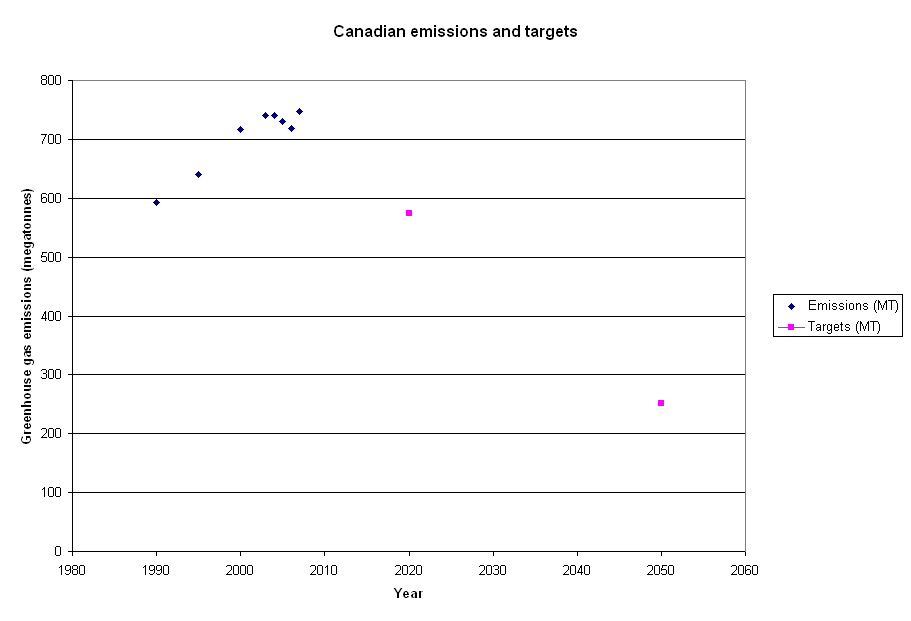
Back in May 2008, the figures for Canada’s 2006 emissions were released. They were made into a graph for a previous post. Now that the 2007 figures are available, the chart can be extended to show the 4% jump in emissions, putting Canada 26.2% above its 1990 level of emissions and 33.8% above its Kyoto Protocol target. In order to meet our target of cutting to 20% below 2006 levels by 2020, we will need to cut Canadian emissions by around 170 MT during the next eleven years.

Canadian 2007 GHG emissions and targets

The causes of the increase are also described:

“Between 1990 and 2007, large increases in oil and gas production – much of it for export – as well as a large increase in the number of motor vehicles and greater reliance on coal electricity generation, have resulted in a significant rise in emissions.”

Between 1990 and 2007, emissions rose by a total of 155 million tonnes (MT). 143 of those were from energy industries, including transportation and the oil sands. By contrast, residential emissions have basically been flat since 1990.