Dealing with space junk

O-Train end station, Ottawa

Junk in space is an increasingly severe problem, as both the quantity of useless debris and the number of useful satellites increases. Aside from international censure, there isn’t especially much that can be done at present to punish those who make the problem worse, as China did when they blew up one of their satellites in 2007.

A good international approach to mitigating the problem might resemble the following: an international agreement among space-faring states to avoid the production of such debris, coupled with a penalty system for situations in which it occurs. The money from the fines could be put into an insurance fund. Then, when collisions take place between unmanned satellites or manned space vehicles, some level of compensation could be paid out of that fund.

Setting up such a system would require the support and goodwill of quite a number of states. Nonetheless, it might help make the regions of space closest to our planet somewhat more orderly and well-governed.

Monbiot now conditionally supporting nuclear

Andrea Simms-Karp: camera cyclops

In his book Heat, George Monbiot rejects nuclear fission as a low-carbon source of electricity: arguing that it is unacceptably dangerous, and that we could make do without it. In a recent column on his website, he makes it clear that he has joined the ranks of those willing to reluctantly consider nuclear, on the simple grounds that he is so deeply concerned about climate change.

He does, however, have some conditions:

  1. Its total emissions – from mine to dump – are taken into account
  2. We know exactly how and where the waste is to be buried
  3. We know how much this will cost and who will pay
  4. There is a legal guarantee that no civil nuclear materials will be diverted for military purposes.

The first of these is important, but a fairly low hurdle. If there wasn’t good evidence that the life cycle emissions of nuclear are low (though they are not zero), it wouldn’t be getting the kind of attention it has been. The second matter is mostly a matter of not-in-my-backyard (NIMBY) syndrome. Nobody wants a nuclear waste dump in their area, though everyone knows that a safe dump will basically resemble: a deep and well-sealed hole in some very geologically stable rock. The fourth requirement may be a reasonable bar for states with pre-existing nuclear weapons capability, but it is a bit much to expect from states that lack that capacity and face threatening neighbours. In all likelihood, more civilian nuclear power will mean more states with nuclear weapons, a few decades out.

The third issue is the most uncertain: the cost of nuclear power. Regrettably, no government out there actually has the spine to make polluters pay the true cost of their carbon dioxide emissions. Likewise, no government seems to be willing to forego the political opportunities involved in subsidizing technologies like nuclear fission and carbon capture and storage. In all probability, more nuclear will result in taxpayers and electricity consumers subsidizing the mistakes of governments and energy utilities. It may also produce a clunky, dangerous, and expensive infrastructure that was slower to come online and less effective than focusing on conservation, efficiency, and renewables would have been. All that being said, the inevitable costs may be justified as a precaution. If it does become brilliantly clear to the public that climate change requires urgent action – to the extent that people are willing to accept the rapid decommissioning of coal plants – having nuclear as an option might be an important way to facilitate the route forward. Given the risks of climate change, its low-carbon status may also be worth the inevitable accidents and contamination.

I admit that this is an issue where my thoughts remain divided. That being said, barring some big unforeseen change, I think we can definitely expect to see Canada’s nuclear reactors replaced with new ones, during the next few decades, at the very least. The post later today will provide some further thinking on the issue.

Business-as-usual estimates from MIT

Shoe art

Researchers at MIT have updated their climatic models and reached conclusions generally in line with the Hadley Centre in the UK, in terms of the amount of warming that would occur by 2100 under a business-as-usual case, in which no significant emissions reductions are achieved:

[T]here is now a nine percent chance (about one in 11 odds) that the global average surface temperature would increase by more than 7°C (12.6°F) by the end of this century, compared with only a less than one percent chance (one in 100 odds) that warming would be limited to below 3°C (5.4°F).

It is difficult to express how enormous a change 7°C would be. Conservative estimates of the point at which anthropogenic climate change should be considered ‘dangerous’ tend to cluster around the 2°C target adopted by the European Union, and others. As the MIT model suggests, a world that does not mitigate emissions may face a 99% probability of experiencing average warming a full degree above that target.

When politicians talking about climate change say that they ‘accept the science,’ people should be asking them if these kinds of projections are part of the science they accept. If so, they ought to be asked why they are treating climate change with such an utter lack of seriousness, concentrating far more on matters of fleeting political concern. In retrospect, it seems that people three or four generations from now will judge our current leaders largely on the basis of their failure to respond effectively to this threat.

Cool Tools on The Deniers

I was disappointed by a recent entry in the Cool Tools blog – a place that normally highlights useful stuff like little tripods. Their post on the 16th, which got re-posted on Boing Boing, was about Lawrence Solomon’s book: The Deniers: The World Renowned Scientists Who Stood Up Against Global Warming Hysteria, Political Persecution, and Fraud – And those who are too fearful to do so. The post argued that since science is advanced by those who question current beliefs, we should encourage those who question the reality of anthropogenic climate change.

It is regrettable that the mistaken impression endures that the key tenets of climatic science are still disputed by the scientific community as a whole. Greenhouse gasses unambiguously cause warming, and humanity is unambiguously releasing those gasses. While we certainly need critical thinking to advance climatic science (there is much left to learn about feedbacks and the internal dynamics of the climate system) the kind of people who deny the existence or seriousness of climate change are not engaged usefully with the scientific discussion. In most cases, they tell stories that contradict one another (it’s not happening, it’s not caused by greenhouse gasses, it is likely to be beneficial, it is all China’s fault, etc). In most cases, I also don’t think they are genuine in their approach: they are united by the desire to avoid government regulation of greenhouse gasses, not by a substantive disagreement about what is happening in the world.

Given the strength of entrenched interests opposed to climate change regulation, people willing to add confusion to the debate will always be able to find financial support. That is, at least, until society as a whole finally appreciates that their arguments are self-serving and wrong.

OC Transpo and atheism

In case anyone needed yet another reason to dislike OC Transpo, it seems they have decided not to allow a group of atheists to run the same bus ads that have been displayed in London and elsewhere. The ads read: “There’s probably no God. Now stop worrying and enjoy your life.”

The ads will be running in Toronto and Calgary, though they have been rejected in Vancouver, Victoria, Kelowna, Halifax, and London.

Naturally, it would be unthinkable for bus companies to refuse a similarly innocuous banner promoting a particular religious organization.

Canadian content requirements for the internet?

Apparently, the Canadian Radio-television and Telecommunications Commission (CRTC) is considering Canadian content requirements for the internet. While I do support the existence of public broadcasters, I have never felt the same way about Canadian content rules for television or the radio. To me, they seem parochial and unnecessary; why does it matter whether people want to watch shows or listen to music that originated elsewhere?

Of course, the internet idea is even more dubious. Unlike radio and television, where you get to choose between channels but have no input into what each one is putting out, the internet lets you choose each film or song individually. As such, enforcing Canadian content requirements is both more intrusive and less practically feasible.

I remember when there were high hopes that the internet would be free from this sort of petty governmental manipulation. Unfortunately, with all the censorship, dubious monitoring, and other governmental shenanigans happening now, it isn’t surprising that yet another government agency wants to assert its regulatory influence over what happens online.

Hearings begin on Tuesday, with the aim of reviewing the current policy of not regulating content on cell phones and the internet.

Climate change and Australia’s brushfires

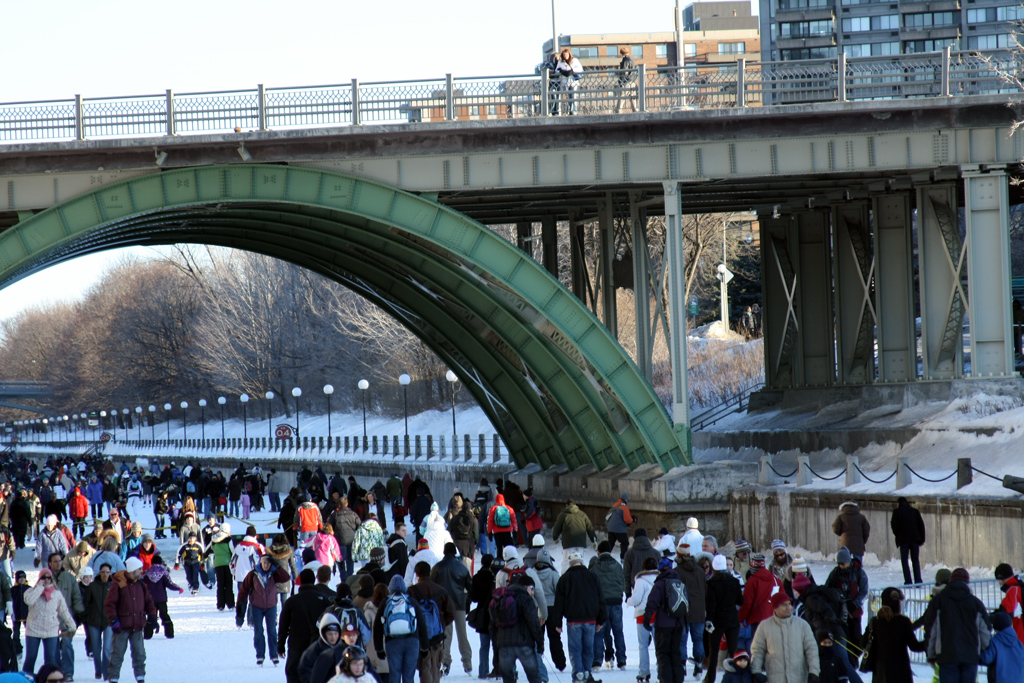
Skating on the Rideau Canal, Ottawa

Scientists frequently condemn journalists for being too quick to assert that particular events either support or call into question anthropogenic climate change. Indeed, reporting responsibly on the issue can be challenging. One the one hand, one cannot ignore the long-term contribution climate change makes to the frequency and severity of events; on the other, one doesn’t want to propagate the false idea that the accuracy or inaccuracy of climatic science hinges on a small number of extreme events of local weather trends.

A recent RealClimate post considers the case of Australia’s terrible recent brushfires. It considers a century worth of evidence on Australian brushfires, examining the importance of maximum temperatures, relative humidity, wind speed, and drought factors. Climate change trends are pushing in the direction of higher average temperatures and reduced rainfall. In the end, it comes to a measured by sobering conclusion:

While it is difficult to separate the influences of climate variability, climate change, and changes in fire management strategies on the observed increases in fire activity, it is clear that climate change is increasing the likelihood of environmental conditions associated with extreme fire danger in south-east Australia and a number of other parts of the world.

That may not be the kind of conclusion that translates easily into a headline for a popular newspaper, but it is the sort that we need to consider when making public policy on both climate change mitigation and adaptation.

The fourth report of the Intergovernmental Panel on Climate Change (IPCC) concluded back in 2007 that:

An increase in fire danger in Australia is likely to be associated with a reduced interval between fires, increased fire intensity, a decrease in fire extinguishments and faster fire spread. In south-east Australia, the frequency of very high and extreme fire danger days is likely to rise 4-25% by 2020 and 15-70% by 2050.

Those fires will naturally contribute to positive feedbacks within the climate system, as heat-induced dryness prompts the fire-induced emission of greenhouse gasses previously bound up in forests and grasslands.

A responsible position on carbon capture

Stairs and shadows

People reading this blog might get the mistaken impression that I am fiercely opposed to carbon capture and storage (CCS) technology. That is definitely untrue. There are few things that would be more helpful than safe, cheap, and effective CCS. It would ease the transition to a zero-carbon global economy, and it would allow for the actual removal of CO2 from the atmosphere, through the growing and burning of biomass.

All that said, it is deeply inappropriate for planners to count emissions reductions from anticipated future CCS in their plans, as the government of Alberta has done to an extreme extent. The technology is in its infancy. Indications to date suggest that it will not be as cheap as its biggest boosters hope. It may not be able to store carbon permanently or safely. Carbon capture certainly cannot do anything to mitigate emissions from mobile sources, making fossil fuel operations that generate fuels for them problematic.

On the basis of these concerns, I suggest that the following elements are important in any responsible consideration of CCS, from a public policy standpoint:

  1. Emissions reductions from CCS should not be estimated until information on the costs and effectiveness of commercial operations are known.
  2. It should not be assumed that CCS will allow high carbon activities such as burning coal or harvesting the oil sands to continue.
  3. While some public funding for CCS may be justifiable (especially investigations into using it with biomass fuels), industry groups that are predicting heavy usage of the technology should bear most of the development and implementation costs.
  4. CCS doesn’t make coal ‘clean.’ Even if it reduces CO2 emissions by 80-90%, coal will still be a climatically unsustainable technology. There are also a large number of environmental hazards associated with coal mining, coal ash, and so forth. Coal will probably never be clean, and will certainly never be clean just because it has CCS bolted on.
  5. Likewise, CCS cannot redeem the oil sands.
  6. We must develop alternative plans, in case CCS proves to be ineffective, unsafe, or unacceptably expensive.

As I have said before, we are in the Wright Brothers era of CCS technology, and it is far too soon to project whether it will be an important stabilization wedge or an expensive flop. It is definitely too early to be estimating the specific quantities of emissions that will be averted by as-yet-nonexistent technologies at unknown future dates.

If emissions are going to peak and descend to safe levels, we are going to need a lot of stabilization wedges: efficiency, protected and enhanced forests, zero-carbon electricity and fuels, and more. If we want to have a strategy that can survive the failure of a few major initiatives, that means we need extra wedges for contingency. As such, we probably can’t reject technologies like CCS and the increased use of nuclear fission out of hand.

The oil sands, coal, and new regulations

'Blackburn' sign

The sheer determination of Canada’s current government to protect the oil sands by undermining Obama’s climate policy is considerable. Most recently, they have been arguing that oil sands extraction operations should be treated in the same way as American coal plants, and thus partially or fully protected from expensive new regulations.

For one thing, an ideal climate policy would drive the rapid replacement of existing coal plants with renewable sources of energy. For another, coal plants that were given free credits in some kind of ‘grandfathering’ system would be pre-existing facilities, built before climate concerns were as acute as they are now. A decent climate policy absolutely needs to prevent the construction of new coal power plants. If someone demonstrates safe, effective, and economical carbon capture and storage, that requirement may relax somewhat but, for the moment, we cannot assume that coal has a place in our next-generation energy mix.

Given the ambitious plans for expansion, the oil sands are much more like new coal plants than like old ones. As such, they should face the same tough rules as new facilities. Special exemptions may serve the short-term interests of some individuals and companies, but allowing the oil sands to develop along their present course is very much against the long-term interests of Canadians.

Congressional reports on Wikileaks

Wikileaks – a website that has been discussed here before – has performed a significant public service, by making nearly 7,000 reports prepared by the American Congressional Research Service publicly available. The documents are non-secret, and were paid for with a billion dollars of taxpayer money. Prior to the Wikileaks action, they were not available to the general public. The research service is meant to be a non-partisan office that provides factual information and analysis to inform political decision-making.

Topics covered in the reports include Israel’s relationship with the United States, abortion, China, weapons proliferation, and many others.