Considering the future of oil

Compact fluorescent lamp post

People frequently mention how, in the 17th and 18th century, lobster was so abundant in the eastern United States that it was used as a staple food for orphans, servants, and prisoners. Supposedly, Massachusetts passed a law restricting it to being served at most twice a week.

In the era of lobster scarcity, this seems incredible to us. The same basic ideas can be usefully applied to petroleum. There is a good case to be made that petroleum prices will continue to rise dramatically in the medium to long term on the basis of growing demand and flat or declining production. If that proves true, oil will be the new lobster. Where prior cheapness made it the fuel of choice in all kinds of applications, cost will gradually squeeze it out from everywhere something cheaper can do the trick. I am mostly talking about liquid petroleum here, but a similar market dynamic is likely to arise with natural gas (though it is tougher to export overseas), or even coal.

People used to grind up lobster to use as fertilizer for gardens. The oil equivalent is probably using petroleum to generate constant baseload electricity for the grid. Oil costs more to transport, burns less efficiently, and is much more import-dependent than natural gas. Oil for electricity is one of those uses that people generally switch from as soon as a viable opportunity arises. Barring some isolated communities and autocratic petro-states, I doubt anyone will be generating electricity from the grid using oil in a few decades’ time.

Moving up the value chain, there are two big ways in which oil is used: as a high-density source of energy and as a feedstock for industrial processes. In both cases, higher prices will start to produce substitution in areas where alternatives are possible. Electric lawnmowers are quieter and a whole lot less toxin-spewing than their gasoline counterparts; similarly, plug-in hybrids and all-electric vehicles are the best option for those city-dwellers who continue to demand a private vehicle.

Where only oil will do

At the top of the value chain are applications where nothing but oil will do. A fancy restaurant cannot serve a heap of flavoured tofu and call it lobster, though frozen dinner companies do something similar all the time. The essential uses for oil will ultimately relate to the two fundamental properties described above: energy density and chemical makeup.

The foremost essential market for the first remains aircraft. Ground transportation to migrate towards electric. Hopefully, someone will also be able to come up with a biofuel that solves more problems than it creates. Ships can return to coal or sails, or even be outfit with marine nuclear reactors. Planes – for the foreseeable future – will need to continue burning mostly kerosene.

The chemistry of oil makes it the basis for most of our plastics, but it is difficult for a non-expert like me to determine the degree to which that is the result of its historically low price. Certainly, permanently higher prices for oil will lead to some changes in the plastics industry. If prices rise, people will use less and will substitute less costly materials. Where possible, people will also make plastics from things other than oil. It seems likely, however, that there will be at least a few industrial processes where only oil will do.

Broader impacts

When it comes to prices for refined petroleum fuels, the world is broadly divided into three groups of states. There are those where oil has long been relatively expensive, such as in Western Europe. There are those where oil has been moderately subsidized, creating a mild culture of entitlement, such as the United States. Finally, there are those where subsidies are extreme. Gasoline in many European states is well above $2.00 a litre; in the United States, it remains around $1.00; in Iran, it is $0.09 and in Venezuela just $0.05.

In many countries within the third group, subsidies are already a huge expense. Iran may produce a lot of oil, but it refines relatively little into gasoline. As such, it needs to import gasoline in order to provide it to its citizens for pennies. A good number of them will then be tempted to re-export it and pocket the difference. That temptation can only grow in a world of ever-more-expensive oil. Governments then find themselves in the awkward position of having to either cut a popular and stabilizing policy or somehow finance a growing drain on the public purse.

While it is extremely difficult to predict what the overall effects of continually rising oil prices would be, two conclusions do seem highly probable. Firstly, uses of oil that produce little value or which could easily switch to another fuel will be priced out of the oil-buying market by high margin options with few substitutes. Secondly, more stress will develop in relation to wildly different prices for refined fuels, especially when it comes to states like Iran that subsidize domestic consumption heavily.

[Update: 8 March 2010]. BuryCoal.com is a site dedicated to making the case for leaving coal, along with unconventional oil and gas, underground.

Oil prices and American politics

Robert Rapier, a petroleum engineer and blogger, recently posted an ‘Open Letter to Our Next President.’ He has recently been doing a good job of showing why ideas like a summer gas tax holiday or suing OPEC for the right to buy oil at the price we want are wrong-headed popularity stunts. He has also been doing a good job of highlighting the degree to which current petroleum prices are largely the product of long-term trends. If more and more people want ever-more oil, at the same time as existing fields are producing flat or declining yields and new discoveries are not keeping pace, prices are certain to keep rising.

The question is whether one of those four pillars will be eroded. It is possible we will finally get a handle on per-capita oil demand, and start along the long road to renewable energy use. It is also possible that economic conditions will reduce the growth in world demand for oil as people in India and China are forced to grow richer more slowly than at present. It is possible that new technology will significantly increase yields from existing oil fields for some period of time. Finally, it is possible that big new finds will keep the (planet destroying) party going a bit longer for everybody.

It is time to start thinking much more seriously about the possibility than none of those ‘outs’ will materialize.

Romm’s fourteen wedges

Red spraypaint

Joseph Romm, whose book I reviewed previously, has a new blog post up outlining what would be necessary to stabilize global concentrations of greenhouse gasses below 450 parts per million of CO2 equivalent. It is explained in terms of ‘stabilization wedges’ – each of which represents a reduction of one gigatonne (billion tonnes) below business as usual projections. In total, he says 14 are necessary by 2050 and suggests the following list:

  1. One wedge of vehicle efficiency — all cars getting 60 mpg, with no increase in miles traveled per vehicle.
  2. One of wind for power — one million large (2 MW peak) wind turbines.
  3. One of wind for vehicles — another 2000 GW wind. Most cars must be plug-in hybrids or pure electric vehicles.
  4. Three of concentrated solar thermal — about 5000 GW peak.
  5. Three of efficiency — one each for buildings, industry, and cogeneration/heat-recovery for a total of 15 to 20 million gwh.
  6. One of coal with carbon capture and storage — 800 GW of coal with CCS.
  7. One of nuclear power — 700 GW plus 10 Yucca mountains for storage.
  8. One of solar photovoltaics — 2000 GW peak (or less PV and some geothermal, tidal, and ocean thermal).
  9. One of cellulosic biofuels — using one-sixth of the world’s cropland (or less land if yields significantly increase or algae-to-biofuels proves commercial at large scale).
  10. Two of forestry — End all tropical deforestation. Plant new trees over an area the size of the continental U.S.
  11. One of soils — Apply no-till farming to all existing croplands.

No government anywhere has this level of ambition today. Just providing the nuclear wedge would require building 26 new plants a year, as well as ten geological repositories the size of Yucca Mountain. Providing the carbon capture wedge will require building a quantity of infrastructure capable of putting the same volume of CO2 into the ground as we are presently removing, when it comes to oil.

Romm does an excellent job of showing what a huge and civilizational challenge climate change really is. At the same time, while there is no technical reason for which fourteen wedges is impossible, one certainly doesn’t have the sense that anything like the necessary level of political will exists today. President Bush’s ludicrous announcement that the US will try to stop emissions growth by 2025 is closer to the mainstream of thinking in most places. At least a few people would rather doom future generations to an inhospitable planet than buckle down and make these changes.

Once again, we are left with the question of what might convince people to change. If fourteen wedges are what’s required, it seems virtually impossible that the rosy ‘it will all pay for itself’ possibility will play out. It is hard to imagine anything short of a catastrophe providing the necessary motive force, and it will take a catastrophe that unites the world in common effort, rather than divides it in fear or suspicion.

In short, the situation does not leave a person feeling optimistic.

The Black Swan

Dirty machinery

Nassim Nicholas Taleb‘s The Black Swan: The Impact of the Highly Improbable is an unusual, excellent book with broad applicability. In particular, those concerned with finance or the use of mathematics in social disciplines (politics, economics, international relations, etc) should strongly consider reading it. They will probably find it uncomfortable – as it demonstrates how their ‘rigorous’ disciplines are built on sand – but they will be wiser people if they can accept that.

Taleb’s main point is that life is dominated by improbable events of huge consequence. This is obscured to us for a number of reasons: not least, because we are able to look back and construct plausible after-the-fact stories about why things turned out the way they did. Because we fail to appreciate how explosively improbable the world is, we leave ourselves far more vulnerable than our predictions suggest. Indeed, the biggest thing Taleb attacks is the very notion that we can make good predictions about the future. ‘Black Swans’ are those improbable events of massive consequence which we are able to rationalize after the fact, though we could not have predicted them before. They can be negative (the sudden collapse of a bank) or positive (the amazing success of an obscure book). They relate to the way in which the world is skewed towards extremes when it comes to things like income or the importance of a publication.

Taleb’s book consists of an odd combination of anecdote, mathematics, scholarly and literary references, personal history, and diatribes. Throughout, one has the impression of engaging in conversation with an unusually fascinating fellow – albeit one who takes special pleasure in cutting down those who disagree with him (the text ignores no opportunity for mocking and insulting economists and financial analysts, in particular).

The lessons Taleb says one should draw from an appreciation of Black Swans are noteworthy and sensible. First, we should maximize our chances of getting lucky and finding a positive Black Swan. In investment terms, that means making lots of small bets on long shots that might really pay off. In life more generally, it basically means trying new things – visiting the restaurant you never normally would, going on the blind date, seizing the opportunity to meet with the big shot publisher to explain your book idea. Second, we should minimize our exposure to negative Black Swans that can wipe us out. That means definitely avoiding standard financial instruments like mutual funds, distrusting any risk assessment based on the bell curve, and appreciating that blue-chip stocks might collapse despite decades of steady growth. His overall financial prescription is to put whatever you are unwilling to lose in US government bonds, while using the rest to make long-shot speculative bets.

It would be very interesting to see Taleb’s ideas applied directly to International Relations (the capital letters mean ‘IR the discipline’ rather than IR the phenomenon) or climate change. Within IR, there are a few dissenters who appreciate just how inappropriate all the statistics and quantitative methods being trotted out really are. They would find Taleb’s book to be confidence-boosting, whereas the number obsessed IR scholars concentrated in the United States would probably respond to it with as much anger as hedge fund managers.

When it comes to climate change, the Black Swan idea seems relevant in several ways. First, it creates a healthy scepticism about projections: whether they are for economic growth, greenhouse gas emission levels, or greenhouse gas reductions associated with certain policies. Secondly, it reveals how fallacious it is to say: “Humanity muddled through so far, therefore we can handle climate change just like any previous crisis.” Thirdly, it sheds light on scenario planning in the face of possible disastrous outcomes with unknown probabilities attached.

It is safe to say that anybody interested in how history is written or how people try to come to grips with an uncertain future will find something of value in this text. At the very least, the colourful asides provide plenty of mental fodder. At the very most, appreciation for Black Swans might significantly alter how you live your life.

Nuclear subsidy simile

Countries that build nuclear reactors are, in some ways, like parents whose children run lemonade stands. The children get the ingredients for free and sell them for less than they are worth. Parents are usually willing to pay the difference, because they like to see their children hard at work. People who actually want lemonade for the lowest possible price would do best to find the kids with the least sense and the most generous parents.

Bastiat on subsidies

Meaghan Beattie in a playground

Anyone who spends time thinking about public policy might benefit from reading Frédéric Bastiat‘s final essay: “What Is Seen and What Is Not Seen,” published in 1850. Many of the sections – such as those concerning people employed by the armed forces, and those on state subsidies for the arts – are surely as valid now as 150 years ago.

Bastiat also provides a concise rebuttal of the kind of ‘job creation’ argument frequently employed by governments:

Let us get to the bottom of things. Money creates an illusion for us. To ask for co-operation, in the form of money, from all the citizens in a common enterprise is, in reality, to ask of them actual physical co-operation, for each one of them procures for himself by his labor the amount he is taxed. Now, if we were to gather together all the citizens and exact their services from them in order to have a piece of work performed that is useful to all, this would be understandable; their recompense would consist in the results of the work itself. But if, after being brought together, they were forced to build roads on which no one would travel, or palaces that no one would live in, all under the pretext of providing work for them, it would seem absurd, and they would certainly be justified in objecting: We will have none of that kind of work. We would rather work for ourselves.

That is, indeed, an excellent mental test of public worth. If we were all brought together to build a museum that will be widely admired and universally enjoyed, we will not feel cheated of our labour. If we were brought together to build some white elephant – an international airport for a tiny town, a bridge to nowhere, and anti-ballistic missile shield – we would feel duly resentful for not having employed our labour for better purposes.

The essay features a spirited defence of middlemen, which is well worth reading. The story told about rent seeking and protectionism is also admirably clear and engaging:

Mr. Protectionist was going to resign himself sadly just to being free like everyone else, when suddenly he had a brilliant idea.

He remembered that there is a great law factory in Paris. What is a law? he asked himself. It is a measure to which, when once promulgated, whether it is good or bad, everyone has to conform. For the execution of this law, a public police force is organized, and to make up the said public police force, men and money are taken from the nation.

If, then, I manage to get from that great Parisian factory a nice little law saying: “Belgian iron is prohibited,” I shall attain the following results: The government will replace the few servants that I wanted to send to the frontier with twenty thousand sons of my recalcitrant metalworkers, locksmiths, nailmakers, blacksmiths, artisans, mechanics, and plowmen. Then, to keep these twenty thousand customs officers in good spirits and health, there will be distributed to them twenty-five million francs taken from these same blacksmiths, nailmakers, artisans, and plowmen. Organized in this way, the protection will be better accomplished; it will cost me nothing; I shall not be exposed to the brutality of brokers; I shall sell the iron at my price; and I shall enjoy the sweet pleasure of seeing our great people shamefully hoaxed.

It is a point especially well made as the American electoral season continues to encourage less and less sensible statements from leading candidates, when it comes to trade.

McCain is wrong to suggest gas tax cuts

Following up on ‘hurricane insurance for all,’ John McCain has a new bad idea: suspending gasoline taxes over the summer. There are lots of reasons for which this is a bad move. Gasoline taxes are a partial recognition of the ways in which the price at the pump doesn’t include all the costs associated with driving: from road construction to keeping troops in Saudi Arabia. Also, it is important for people to realize that, in the long run, they will be paying ever more for gasoline. This is the result of three major phenomena: decreasing output from oil fields as they reach maturity, increasing demand from fast-growing states, and the increasing trend towards internalizing externalities associated with fossil fuel use. Creating a temporary dip in prices will obscure the broader message, while encouraging harmful behaviour.

If anything, the US presidential candidates should be sending a strong signal that the era of inexpensive gasoline in the United States is over. People should be bearing that in mind not only when they decide what sort of car to buy, but when nationwide efficiency standards are being set and urban transportation infrastructure decisions are being made.

Choosing nuclear

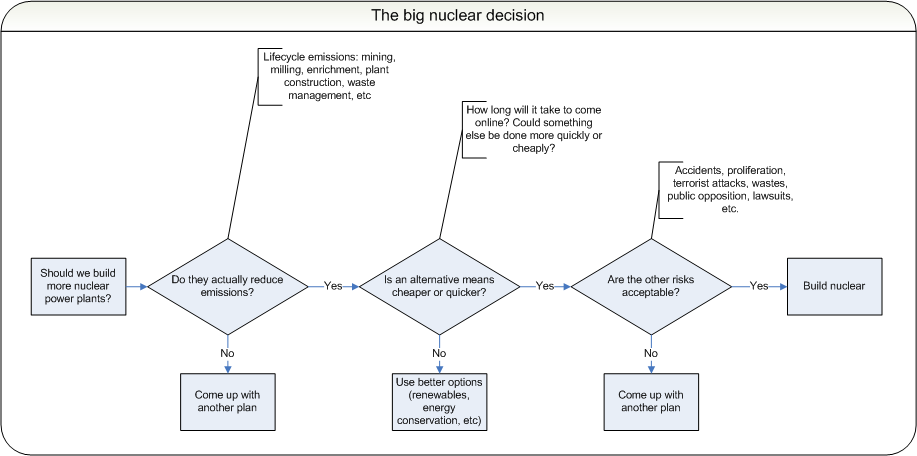
Nuclear flowchart

The flowchart above illustrates one process through which we could collectively evaluate the desirability of nuclear power, given the potential risks and benefits associated with the technology. In my personal opinion, the answer to the first question is probably “yes,” though perhaps not to as large a degree as commonly believed. The second and third questions are much more up in the air, and necessarily involve uncertainty. We cannot know exactly what will be involved in building a massive new nuclear architecture before it is done; similarly, it cannot be known with certainty what would result from choosing conservation and renewables instead.

As for the third question, there are major questions about risk evaluation and risk tolerance. If the world keeps running nuclear plants, it is a statistical certainty that we will eventually have another serious nuclear accident. No nuclear state is without its contaminated sites, and none yet has a geological repository for wastes.

This post definitely isn’t mean to settle the question initially posed, but rather to clarify thinking on the issue and dismiss the automatic logical leap from “climate change is happening” to “build more fission plants.”

Drugs for mental enhancement

Rusty bridge and steam pipes

A recent informal survey, conducted by Nature, suggests that large numbers of scientists are ‘doping’ with drugs that enhance their wakefulness and concentration. While the old joke holds that “a mathematician is a device for converting coffee into theorems,” drugs of choice have expanded to include Modafinil (Provigil) and Methylphenidate (Ritalin).

One in five respondents said they had used drugs for non-medical reasons to stimulate their focus, concentration or memory…

For those who choose to use, methylphenidate was the most popular: 62% of users reported taking it. 44% reported taking modafinil, and 15% said they had taken beta blockers such as propanolol, revealing an overlap between drugs. 80 respondents specified other drugs that they were taking. The most common of these was adderall, an amphetamine similar to methylphenidate.

I do not find this surprising. At a conference once, I met a young woman who pays her tuition by selling drugs usually prescribed for attention deficit disorder to fellow students at her Ivy League school.

It is not clear what kind of response is justified in the face of such anecdotal evidence. It is not obvious, prima facie, that the use of drugs is an inappropriate way to improve one’s mental function or academic output. People use all sorts of mechanisms – from physical activities to dietary modifications – to try to achieve the same end. Prescription drugs are thoroughly vetted for safety, though it is also fair to say that people self-prescribing are likely to make mistakes in terms of dosages and interactions with other substances. People make all kinds of sacrifices for success and it isn’t clear why it is obviously inappropriate for them to run the risks associated with altering their biochemistry. Given the degree to which success is related to self-esteem and contentedness, as well as the degree to which perceptions of failure associate with depression, it could arguably be better for one’s mental health to use whatever aids to success are available.

One legitimate concern is about a spiral effect. If honour roll students and leading researchers start becoming dependent on drugs to improve their focus, it might become difficult for anyone not doping to keep up. That could lead to situations in which people feel strongly pressured to do drugs as well. Of course, that strong pressure already exists in competitive academic environments. Still, there is reason to be especially wary when it is combined with psychoactive chemicals.

The questions suggested by the survey cannot be adequately addressed in a short blog post, but it does seem likely that they will be the subject of greater amounts of attention in the future. The competitive nature of the world, and the need to achieve things ever more rapidly, ensures that a market will exist for products that help people cope with both of those things. As with other unauthorized uses of drugs, the policies adopted by governments will affect things like price, availability, safety, and access to information and advice. Getting the balance right will be tricky.

Surveying the US and UK

This survey, comparing American and British attitudes on various subjects, contains some interesting bits of information. For instance, 2% of British people would be “angry” if their leader was an atheist, while 21% of Americans say they would be. Both sets of respondents are similarly negative when asked about a Muslim leader: 35% of Americans would be angry, compared to 34% of British people. Only 16% of Britains who believe in god also believe in hell, compared with 54% of Americans.

55% of Brits believe in anthropogenic climate change, compared to 49% of Americans, but neither country has citizens too keen on doing much about it. 79% of Yanks and 76% of Brits oppose higher gas taxes; half those polled in the UK oppose increased airline fares, compared with 67% of Americans. Opinions about nuclear are very similar in both states, with about 45% of people in favour of more stations and 30% opposed.

Asked to choose a new leader, the British respondents chose the following listing based on set options: Margaret Thatcher, Bill Clinton, Tony Blair, Ronald Reagan. Americans preferred Reagan and Clinton, with Thatcher and Blair as a near-tie. Americans are much keener on character than experience (ranked higher by 63% compared to 28%), while British respondents preferred experience by 50% to 39%. Americans are much more likely to distrust university professors (17% of respondents compared to 2% in the UK), while Brits are much keener on free trade (52% generally in favour, compared to 31% of Americans).

Both sets of respondents also seem to have a similar overall view of the future, with about 40% expecting the next generation to be worse off than they are, 27% expecting them to be better off, and 18% expecting things to remain about the same.