Conditional support for our troops

Ottawa commuters in the snow

Walking through the Rideau Centre yesterday, I came upon a cart selling t-shirts with various slogans on them. Beside the silly Che Guevara stuff was one shirt that caught my attention. In white letters on a red background it said “Support our Troops.” Under that were both a maple leaf and the flag of the United Nations.

It struck me as admirably post-nationalistic. We recognize the sacrifices made by members of the armed forces, but also that their conduct needs to be bounded by international law. While the sentiment is admirable, it sits uncomfortably with the reality of how ignorant most Canadians seem to be about what we are doing in Afghanistan. People really think we are mostly building bridges and distributing big bags of rice. The reality of the all-out war in which we are committed is very different.

That is not necessarily to say that we shouldn’t be fighting the Taliban along with our NATO allies; it is simply to highlight that Canadian governments manipulate the perception of Canada as a ‘peacekeeping nation’ to keep people from looking too closely at what our armed forces really do. The degree to which many people seem happy to continue to believe in the peacekeeping myth just because it makes them feel good is also problematic.

Reasons for vegetarianism

Reasons for vegetarianism

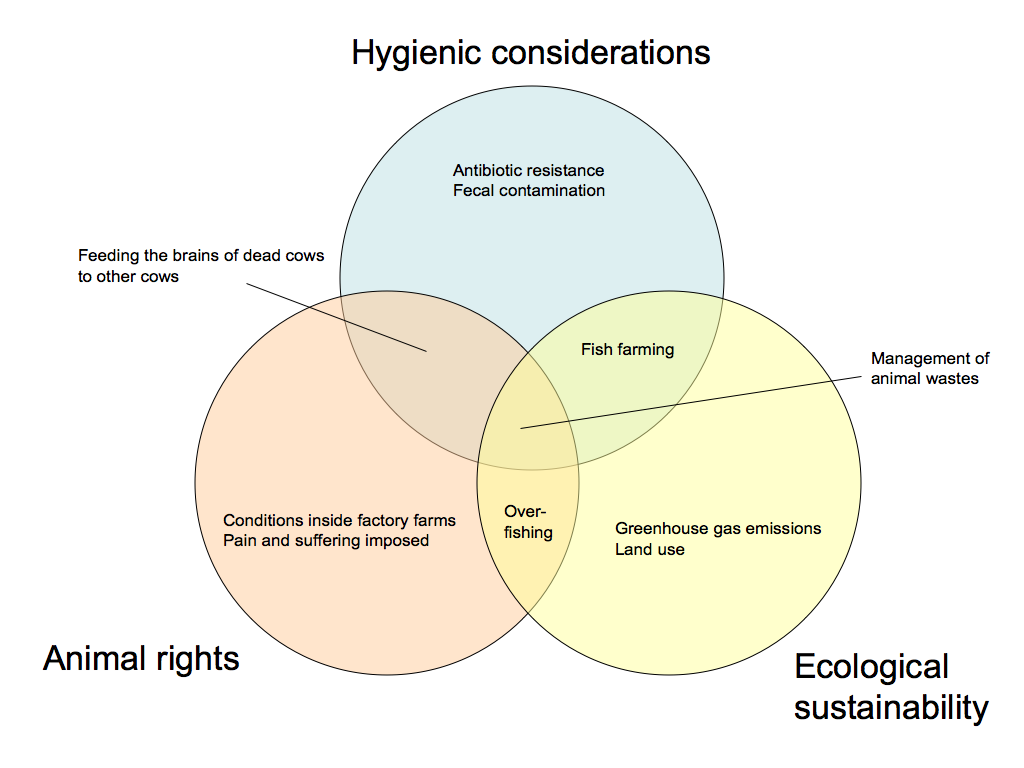
During the last few days, a number of people have asked about the reasons for which I am a vegetarian. As shown in the Venn diagram above, my reasons fall into three major clusters:

  1. Hygienic concerns
  2. Animal rights concerns
  3. Ecological concerns

Basically, the first category applies if you only think about your own immediate well being. If you are willing to consider the possibility that it is wrong to treat some animals in some ways, considerations in the orange circle start to apply. If you accept that we have general duties to preserve nature (or recognize that our long term survival depends on acting that way), issues in the yellow circle are of concern.

The specific issues listed are just examples. They are not exhaustive representations of all the problems in each area. Possible reasons for being vegetarian also exist outside these areas: for example, you can think it is wrong to eat meat when the grain used to fatten the animals could have alleviated the hunger of other humans.

A few issues are unambiguously in one area – for instance, the de-beaking of chickens is almost exclusively an ethical problem. The fact that no experimental laboratory could get ethical approval to treat their test subject animals in the way factory farmed animals are treated as a matter of course is telling. Some overlaps are ambiguous. Overfishing destroys the habitats of species I consider us to bear moral duties towards (such as whales and dolphins), even if the fish themselves can be legitimately used as means to whatever ends we have.

Naturally, different kinds of meat and processes of meat production do more or less well in each area. For my own sake, I think each of the three areas is sufficient in itself to justify vegetarianism. It is possible to imagine meat production that doesn’t have any of these problems, but it is an extreme rarity today and my appreciation for meat is not strong enough to justify the cost and effort of seeking it out. That said, I would be much happier if people who were going to consume meat made such choices, instead of helping to perpetuate the machinery of modern industrial farming.

Related prior posts:

Starting over from 1769

Milan Ilnyckyj in toque with comic book effect

In 1769, James Watt invented a steam engine that worked well enough to be widely adopted by industry. By doing so, he effectively kicked off the industrial revolution: with coal-fed steam engines emerging as the first alternative to animal power that didn’t depend on being beside a river or on a windy ridge. As the recently concluded conference in Bali shows, there were consequences of that invention and the series of successor ideas it kicked off that could not have been anticipated at the time (though Svante Arrhenius identified the possibility of CO2 causing anthropogenic warming back in 1896).

If we could do the whole thing over, what would we do differently? For the purposes of this thought experiment, imagine that we know about the ecological consequences of fossil fuel based industrialization, but we don’t have access to specific knowledge about how to build 21st century engines, power plants, etc. We know about ozone and CFCs, about heavy metal poisoning and nuclear waste. We do not know how to build a modern wind turbine or supercritical coal plant. We have just learned how to build Watt’s engine, and know nothing more.

I think it is virtually certain we would still choose to kick things off with coal and steam, even if we had the best interests of all future generations in mind. At the outset, the benefits of that kind of industrialization accrue both to those alive and to those who will come after. These benefits include many of the bits of technology that make our lives so much longer, healthier, and leisure-filled than those of the vast majority of our forebears. The idea that life in a pre-industrial society was somehow superior is plainly contradicted by archaeological data: you can argue that people were somehow happier while living with constant parasites and disease and dropping dead at thirty, but it is a lot more credible to argue the converse.

What, then, would we do differently? We would invest differently – putting a lot more effort into the earlier development of non-fossil options. We would probably try to limit population growth. Aside from some relatively minor cases like ozone depleting CFCs, it isn’t clear that we have made a great many straightforward ecological mistakes. Rather, the fundamental problem seems to be that of scaling: too much being demanded of the natural world, in conditions where individuals make choices that do not give due consideration to the welfare of their fellows and of future generations.

While future technologies like carbon capture and storage could play a significant role, the most important elements of an effective climate strategy have existed for a century. Fossil fuel generation capacity must be phased out and replaced with renewable options; transportation needs to to shift to low-carbon and eventually no-carbon forms; the forests and other carbon sinks must be protected and enhanced; and capacity to adapt to change must be developed. While the specific approaches we take in relation to these strategies could benefit from more knowledge about the future, their basic outline is already plain.

Now that we can no longer claim – as a society – to live in a state of deprivation, we have no excuse for continuing to rely upon the descendants of Watt’s machine.

A few thoughts on climate justice

Bell Canada warning sign

A couple of articles at Slate.com address the issue of ‘climate justice.’ This is, in essence, the question of how much mitigation different states are obliged to undertake, as well as what sort of other international transfers should take place in response to climate change. The issue is a tricky one for many reasons – most importantly because anthropogenic greenhouse gas emissions constitute a unique experiment that can only be conducted once. If we choose the wrong collection of policies, all future generations may face a profoundly different world from the one we inherited.

If we accept Stern’s estimate of a five gigatonne level for sustainable global emissions, that works out to about 760kg of carbon dioxide equivalent per person on Earth. Releasing just 36kg of methane would use up an entire year’s allotment, as would just 2.5kg of nitrous oxide. One cow produces about 150kg of methane per year. Right now, Canada’s per-capita emissions are about 24,300kg, when you take into account land use change. American emissions are about 22,900kg while those of India and China are about 1,800kg and 3,900 respectively. Because of deforestation, Belize emits a startling 93,900kg of CO2e per person.

The questions of fairness raised by the situation are profound:

  1. Should states with shrinking populations be rewarded with higher per capita emissions allowances?
  2. Should states with rising populations likewise be punished?
  3. Should developing states be allowed to temporarily overshoot their fair present allotment, as developed states did in the past?
  4. To what extent should rich states pay for emissions reductions in poor ones?
  5. To what extent should rich states pay for climate change adaptation in the developing world?

It may well be that such questions are presently unanswerable, by virtue of the fact that answers that conform with basic notions of ethics clash fundamentally with the realities of economic and political power. We can only hope that those realities will shift before irreversible harmful change occurs. Remember, cutting from 24,600kg to 760kg per person just halts the increase in the atmospheric concentration of CO2. The level of change that will arise from any particular concentration remains uncertain.

Another vital consideration is how any system of international cooperation requires a relatively stable international system. While it is sometimes difficult to imagine countries like China and the United States voluntarily reducing emissions to the levels climatic stability requires on the basis of a negotiated international agreement, it is virtually impossible to imagine it in a world dominated by conflict or mass disruption. It is tragically plausible that the effects of climate change could destroy any chance of addressing it cooperatively, over the span of the next thirty to seventy years.

Rejecting Canada’s new copyright act

As a student, I was constantly being called upon to support various causes, through means ranging from making donations to attending rallies. Usually, such activities have a very indirect effect; sometimes, they cannot be reasonably expected to have any effect at all. Not so, recent protest activities around Canada’s new copyright act: a draconian piece of legislation that would have criminalized all sorts of things that people have legitimate rights to do, such as copying a CD they own onto an iPod they own.

Defending the fair use of intellectual property has become a rallying point for those who don’t want to see the best fruits of the information revolution destroyed by corporate greed or ham-fisted lawmaking in the vein of the much-derided American Digital Millennium Copyright Act. At their most controversial, such acts criminalize even talking about ways to circumvent copyright-enforcement technology, even when such technology is being mistakenly applied to non-copyrighted sources: such as those covered by the excellent Creative Commons initiative or those where fair use is permissive for consumers. Watching a DVD you own using a non-approved operating system (like Linux) could become a criminal offence.

For now, the protests seem to have been successful. Of course, the temptation for anyone trying to pass a controversial law is to hold off until attention dissipates, then pass it when relatively few people are watching. Hopefully, that will not prove the ultimate consequence of this welcome tactical victory for consumer rights.

Related prior posts:

Feel free to link other related matter in comments.

Trains and buses

Electric meter

Commenting on the possibility of Seattle installing a streetcar system, Dan Savage has argued: “People like trains. People hate buses.” Though public transportation policy is hardly his area of expertise, he does understand how people think and he is able to express himself forcefully and directly. On some level, it is definitely true. I like trains and subways. In London, I took the subway all the time; not once did I ever take a bus. Taking the train from Oxford to London feels like a luxury; taking the bus feels like a jerky, tedious chore.

In Heat, George Monbiot argues that the solution is to make buses nicer: cleaner, newer, and with attractive add-ons like wireless internet. He also argues that inter-city buses should avoid city centres, with all the nightmares of traffic and fiddly intersections they inevitably involve. While that would improve point-to-point travel in the UK, it doesn’t really reveal the reasons for which buses are treated with everything from moderate dislike to outright disdain. Is it a class issue? Lisa Simpson called the bus “”the chariot of the poor and very poor alike.” Is it a practical matter of comfort and efficiency, as Monbiot describes? If so, can it be overcome through practical measures like those he suggests. Are buses doomed to forever be an inferior good?

It is generally recognized that increasing bus services is the cheapest way of expanding public transport – both in terms of capital considerations and overall lifetime costs. That said, if transit use is significantly hampered by the dislike people feel for buses, perhaps alternatives should be more strongly considered. Arguably, this is especially true when it comes to people who have the financial means to use a car instead. If they get driven off the public transit system as soon as they hit that level of affluence, the system remains dominated by users without a great deal of political influence. In an argument akin to those about two-tier healthcare, it is possible that the self-exclusion of the wealthy from the public system perpetuates mediocrity.

One way or another, we need to hope that the private vehicle is reaching its apex in human history. Even with the eventual development of electric vehicles and other low or zero-emission options, the sheer amounts of space and resources devoted to producing and maintaining private transportation infrastructure are probably not sustainable. Given that it will be politically impossible to drag people from their cars kicking and screaming, we need to think seriously about how to encourage voluntary shifts to public or non-motorized transport. Better bike infrastructure and public transit seems crucial tot that campaign.

No Arctic summer ice in 2012-13?

Rideau Canal with snow

According to a BBC article, some scientists are predicting the disappearance of all Arctic summer ice within five to six years. This projection is based on computer modeling by Wieslaw Maslowski and uses data that doesn’t even take into account the spectacular loss of Arctic ice last summer. Maslowski’s team has produced an estimated rate of loss much higher than those of other groups who have studied the issue, but he defends the quality of his modeling:

“We use a high-resolution regional model for the Arctic Ocean and sea ice forced with realistic atmospheric data. This way, we get much more realistic forcing, from above by the atmosphere and from the bottom by the ocean.”

Even the work of other teams suggests the loss of summer ice between 2040 and 2100: a very rapid climatic change, given how most forms of natural climatic forcing operate on the timescale of millennia

The progressive deterioration of the northern polar cryosphere is disturbing for a number of reasons. Because water absorbs more energy from sunlight than ice does, the loss of the icecap would accelerate global warming. It would also eliminate or substantially alter the lifestyles of those living in the north, as well as most Arctic species. That said, there is some chance that the sudden disappearance of the Arctic icecap would be dramatic and irrefutable enough to kick off much more serious global action to mitigate greenhouse gas emissions and prepare to adapt to the amount of change that is now inevitable. In a world where the Arctic vanished before our eyes, radical ideas like those of Monbiot may start seeming reasonable to a lot more people.

Boomtowns and bitumen

Haida sculpture

Since 1999, the population of Fort McMurray has nearly doubled. Primarily, this is on account of the oil sands: unconventional petroleum reserves whose exploitation is being driven by high prices and geopolitics. The demand for labour is dramatically increasing its price, both directly and indirectly. Apparently, inexperienced truck drivers can expect to make $100,000 per year. Shell has also just opened a 2,500 unit housing complex for its oil sands employees, part of their $12 billion in local infrastructure spending.

With oil around $90 a barrel and the atmosphere still being treated as a carbon dump, this is not terribly surprising. That said, such projects are certain to develop increasing momentum of their own. Once they bring enough jobs and money, they are hard for a provincial government to not support – especially if many of the environmental costs are being borne by people outside the province or by future generations. Internalizing environmental externalities through taxation or regulation becomes progressively more difficult as the incentive of certain parties to preserve the status quo increases. Such asymmetries are likely to give oil sands development a harmful legacy in terms of general policy development, in addition to its climate change effect and local environmental impacts.

Meat and antibiotics

Portraits in Ottawa

Quite a while ago, I wrote about connections between human disease and the factory farming of animals. Recently, some new observational data has supported the link between the two. In the Netherlands, a new form of the superbug MRSA has emerged. It is strongly resistant to treatment with tetracycline antibiotics: a variety heavily used on livestock. The animals need the drugs because they are kept in such appalling conditions (unhygienic and constrained) that they would get infections too easily otherwise.

Xander Huijsdens and Albert de Neeling found that 39% of pigs and 81% of pig farms in the Netherlands were hosts to the potentially lethal antibiotic resistant bacteria. People who came into contact with pigs were 12 times more likely to contract this form of MRSA than members of the ordinary population; those who come into contact with cattle are 20 times more susceptible. The strain has since been found in Denmark, France, and Singapore. A study conducted by the University of Guelph found the strain in 25% of local pigs and 20% of pig farmers.

Maintaining the effectiveness of antibiotics for the treatment of people is highly important for human welfare. Antibiotics are one of the major reasons why modern medicine is valuable: they help people die dramatically less often after childbirth and surgery than was the case before their development. They have also helped to make diseases that would formerly have been probable death sentences treatable. The fact that we are allowing farms to deplete their value so that they can produce meat more cheaply (by forcing more animals closer together in less clean conditions) seems profoundly unwise. In Pennsylvania, legislators have even banned farmers who produce hormone and antibiotic milk from saying so on their packaging – on the grounds that it would make consumers unduly worried about the other milk on offer.

Problems with government databases

LeBreton Flats in winter

By now, everyone has probably heard about the data loss debacle in the United Kingdom. The British government lost the child benefit records for 25 million people. These records include addresses, dates of birth, bank account information, and national insurance numbers. In total, 40% of the British population has been exposed to the risk of identity theft.

Obviously, this should never have happened. One government agency requested some anonymized data for statistical purposes. Instead, a different department sent them the whole dataset in an unencrypted format. Encrypting the discs would have made it nearly impossible for thieves to access the data; anonymizing the data would have made such theft unprofitable. The failure to do either is the height of idiocy, but it is probably what we need to expect from the civilian parts of government when it comes to data security. Security is hard; it requires clever people with good training, and it requires oversight to ensure that insiders are competent and not cheating. People who are naive and naturally helpful can always be exploited by attackers.

In response to this situation, two sets of things need to be done. The first is to correct the specific failures that cause this kind of problem: require encryption of sensitive documents in transit, limit who has access to such sensitive databases, and tighten the procedures surrounding their use. The second is to limit the amount of such data that is available to steal in the first place. That could involve using paper records instead of digital ones – making mass theft dramatically harder to accomplish. It may also involve not creating these kinds of huge databases, as useful as they may seem when working properly.

It is fair to say that there will always be people out there able to break into any information that a large number of civil servants have access to. This would be true even if all civil servants were capable and virtuous people, because a lot of the best computer talent is applied to breaking flawed security systems. Given that bureaucrats are human, and thus subject to greed and manipulation, the prospects for keeping a lid on government data are even worse. Acknowledging the realities of the world, as well as the principle of defence in depth, suggests that limiting the volume of data collected and held by all governments is an appropriate response to the general security risks highlighted by this specific incident.