Cognitive dissonance

One of the odd things about reading The Economist recently is seeing the extent to which their commitment to reason and the impartial consideration of scientific facts is clashing with their long-held views about economic growth. So far, their considerations of how ecological issues – especially climate change – impact their core philosophy has been fleeting and confined to the margins. This article on air travel is a good example.

Imagine, however, that they played some of the ideas through. What would their next Survey on Business look like if they really accepted that mass air travel is climatologically and morally unacceptable?

Heat: How to Stop the Planet from Burning

Ottawa wooden sculpture

During the past two years, I have been reading about climate change for several hours every day. During that span of time, I have read dozens of books and hundreds of articles. Quite possibly, none were as thought-provoking as George Monbiot’s Heat: How to Stop the Planet from Burning. If you are at all serious about understanding the issue of global warming, it is essential reading. He may not be right (indeed, it would be far preferable for him to be wrong) but he will definitely make you think.

His project is an ambitious one. Having decided that global temperatures must not be allowed to rise by more than 2°C on average, he works out what that would mean for Britain. Since British emissions per capita are way above the world average, a fair system would require much heavier cuts there than elsewhere. Canada’s per-capita emissions are even worse.

Here is a smattering of what he says will be required by 2030:

  • A power grid dominated by renewables and natural gas plants with carbon capture and storage.
  • Dramatically, dramatically tightened building regulations – making most houses either ‘passive’ in their non-use of heating or cooling or capable of producing their heat and power from piped-in hydrogen, possibly supplemented by solar.
  • Most private automobile travel replaced by a buses or non-motorized transport, both within and between cities.
  • An end to cheap air travel: no more low cost flights, with massive total cuts in the number of both short and long-haul flights.

The last is the result of a complete lack of alternative technologies that can deliver the kind of emission reductions required. Even if all other emissions were cut to zero, growth in air travel would make that one sector break his total limit by 2030.

Suffice it to say, Monbiot is not in the main stream of this debate. The Stern consensus is that climate change can be dealt with at moderate cost. Even if Monbiot’s ideas are entirely possible, in terms of engineering, one cannot help but doubt that any political party in a democratic state could successfully implement them. The impulse to defend the status quo may turn him into a Cassandra.

In fifty years, it is possible that people will look back at this book and laugh. Alternatively, It may be that they look back on Monbiot as one guy who had approximately the right idea while everyone else (Gore and company included) were in denial. The answer seems to depend upon (a) whether emissions need to be cut as much and as quickly as he thinks and (b) how bad it will actually be if they are not. It is pretty easy to do the math on the first of those, at least for any desired greenhouse gas concentration or temperature change. The latter is harder to assess. Regardless of which proves to be closer to the truth, this is a book I wholeheartedly endorse for anyone trying to keep abreast of the climate change issue.

Sustainability and the Prius

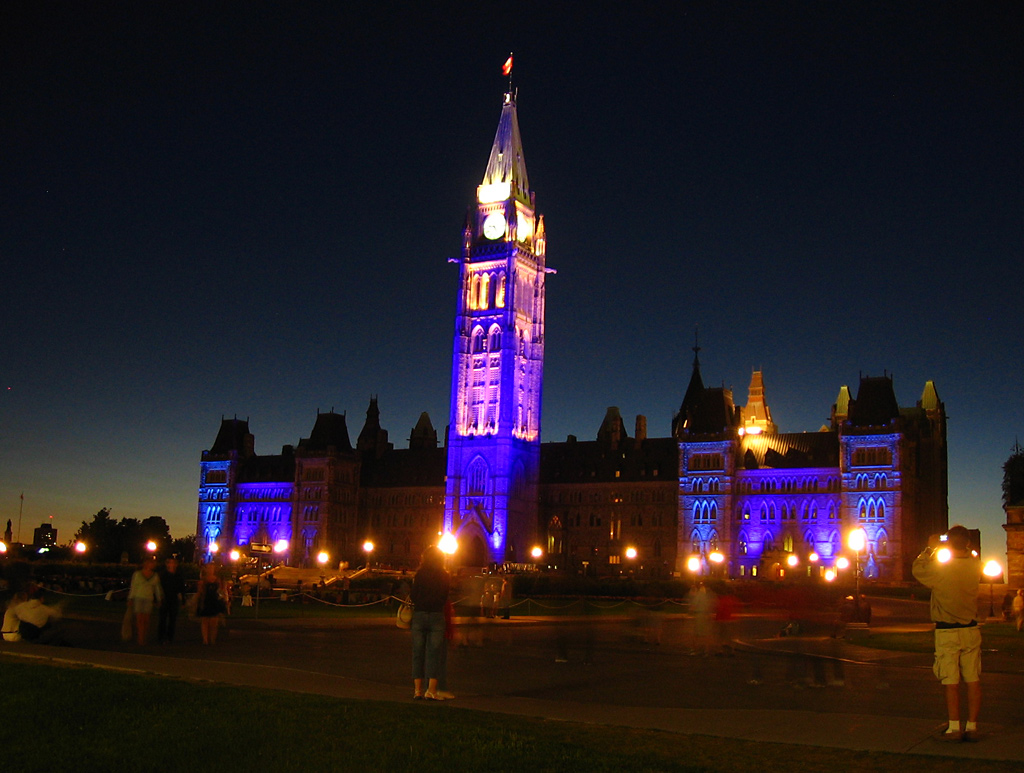
Canadian Parliament at night

One way or another, the Toyota Prius. is a symbolic vehicle. For some, it symbolizes how saving the planet can be relatively painless, enjoyable, and hip. You still get the same basic thing (the ability to zip around in a car) but without the guilt and with the important ability to lord it over the less environmentally responsible. Alternatively, the Prius is a symbol for the superficiality of the environmental commitments most people are willing to make. Seen in this way, it reveals how environmentalism is mere tokenism in many cases.

There are two arguments here which frequently become confounded. One is a first-order question about the ultimate sustainability of different energy systems. Is it sustainable to run internal combustion cars using cellulistic ethanol? What about plug-in hybrids charged using big nuclear fission plants? The answers to these questions are ultimately knowable to a high degree of specificity. For any given level of technology, answering them is simply a matter of applying chemistry and physics. The uncertainty therefore lies in estimations about what will be technologically possible at X or Y time.

The second-level argument is much more heuristic and intractable. There is the fundamentally liberal belief that environmental problems can be tackled fairly painlessly through a bit of cleverness and some new hardware. This is a view that takes the Prius as a positive symbol. At the other extreme is the conviction that only massive sacrifice can generate sustainability. The vision in Fight Club of people in rags pounding strips of leather on an abandoned superhighway captures this, and adherents would surely dismiss the Prius as a pathetic fig-leaf.

The latter argument seems to generate a lot more heated discussion, largely because the real meat of analysis on the former question lies in territory where most people cannot hold their own (who reading this could really calculate the efficiency of an energy grid based on photovoltaics, or of an industrial process for ethanol production from cellulose?). The latter debate requires only a will to participate, though it may not do much to leave us with an understanding of which view of the Prius is justified.

Responses to climate change scepticism

Thanks to a tip off from a new friend, I found this comprehensive collection of rebuttals written by Coby Beck and featured on the Grist website, which is itself well worth a look. The articles are sorted as follows:

  • Stages of Denial
  • Scientific Topics
  • Types of Argument
  • Levels of Sophistication

Whatever your beliefs, and whatever the case you want to make, you will find some points to engage with here.

Horizontally linked

I am trying to develop some informal connections with other people in North American who are working on climate change policy or research. In particular, I would like to get in contact with anyone studying feedback effects or policies that cities are adopting. Also, I would like to get in touch with people working within Canadian federal departments other than Environment, as well as people at the US Environmental Protection Agency.

PS. Harold Coward and Andrew J. Weaver’s book Hard Choices: Climate Change in Canada is worthwhile reading for those interested in Canadian climate change policy.

EasyJet, the new speakeasy?

For some reason, booking a trip a few days before it is going to happen makes it feel a lot more decadent. With regards to all this inexpensive air travel, you have to wonder how people in thirty years or so will look back on this period. It’s possible that it will be seen as a time of gilded luxury, with similar historical ‘lessons’ to those of the 1920s. It is also possible that it will be seen as just another step on the path to wherever humanity finds itself in 2037.

The psychology of my recent trips to places at the edges of Europe (Estonia, Turkey, Morocco) also bears consideration, though at a time when I don’t have to dash off to a meeting.

IR theory and human nature

Magdalen College, Oxford

One thing I have always disliked about international relations theory is the tendency to assert a view of human nature as simplistic and unchangeable. Often, I think this is more the result of short descriptions of theories becoming caricatures, rather than the product of theories that genuinely fail to appreciate how human behaviour is (a) malleable within broad limits and (b) critically influenced by context. Lots of fascinating recent psychology has been demonstrating the latter point. Malcolm Gladwell’s work is an entertaining and accessible example. So too, the work on behavioural economics that has been attracting so much attention.

I have a chart on my theory notes listing the major alternatives: Realism, Liberalism, Neoliberalism, Marxism, Feminism, and Critical Theory. In the column for ‘human nature’ the positions given are: ‘Fixed (essentially selfish)’, ‘Fixed (essentially selfish)’, ‘Fixed (essentially selfish)’, ‘Historically determined (corrupted by changeable)’, ‘Varies according to sub-model’, and ‘No fixed nature.’ Firstly, it seems like the issue of whether people generally behave selfishly or not isn’t sufficient to assert the existence of an essential human nature. Secondly, it seems like virtually all IR theories could pretty easily stretch to accommodate how people’s thinking and actions are conditioned by the environment in which they live. It seems like this is one of the major reasons for which neoliberals can continue to hope that conflictual elements of world politics will eventually give way to more cooperative ones. (Of course, we can also question whether the six traditions listed above constitute an appropriate taxonomy of IR theoretical approaches.)

The tendency to caricature I mention is another feature of IR. Because the discipline seeks to cover so much, it is often simplified to a dangerous extent. Key points are pulled out from historical situations ranging from the Peloponnesian War to the Cuban Missile Crisis, while theorists are often understood on the basis of a few quotes and bullet points. In any case, I have never found international relations theory to be a terribly useful or worthwhile enterprise. Both political theory and history have a lot more to say about the major issues involved, and both seem to have a more defensible approach to dealing with them.

Aside: Richard Rorty, American philosopher and inventor of the concept of ‘ironic liberalism,’ died today.

PS. The sore throat and aggressive cough I picked up on the Walking Club trip is still very much with me. I hope it doesn’t distract those around me too much during the exams tomorrow.


Climate change and the G8 meeting

All Souls, Oxford

Who would have thought – three or four years ago – that climate change would become the central focus of a G8 meeting? While the situation certainly demonstrates the problems that remain to be overcome (both American unwillingness to accept emission caps and the need to incorporate large and rapidly developing economies like India and China into such a system), the level of attention being directed at the problem is very welcome.

The sad fact is that Canada has the worst record of any G8 state, when it comes to the gap between our Kyoto commitment and our present level of emissions. For a state that prides itself on being a responsible global citizen, this is hardly a position that is tenable in the long term.

When Canada ratified Kyoto, we committed ourselves to emissions 6% below the 1990 level, achieved by 2012. At present, Canadian emissions are about 26% over. The United States, by contrast, is only about 16% above 1990 levels. The only G8 state on track to meet its commitment because of policy efforts is Britain. Germany has cut emissions, but not yet by as much as they pledged. Russia has much lower emissions, but it is on account of the collapse of their economy after 1989, rather than any self-restraint. Indeed, Russia ends up in the odd position of being able to sell credits for emissions that would never have occurred anyhow (the so-called ‘hot air’).

Global emissions continue to grow at a rate even higher than the most pessimistic option modeled by the IPCC. Indian and Chinese emissions are each up by about 100% since 1990. Everyone need to do better. Hopefully, the ongoing gathering of political energy will make that come to pass.

[Update: 7 June 2007] Unsurprisingly, the G8 seem to be developing a fairly toothless joint statement on climate change.

How risky is climate change?

Milan’s watch and iBook

On his blog, Lee Jones posted a link to this book review. Basically, the argument is that people are (a) exaggerating the dangers of climate change and (b) using climate change as an excuse to pursue other ends. I would not deny either claim. The Intuitor review of The Day After Tomorrow is evidence of the first, and more can be found in many places. Of course, their review of An Inconvenient Truth suggests that not everyone is guilty of misrepresentation. As for smuggling your own agenda into discussions about climate change, I suspect that is equally inevitable. The question of how to behave justly in response to climate change is fundamentally connected to the history of economic development.

In an unprecedented move, I feel compelled to quote my own thesis:

While the IPCC has generated some highly educated guesses, the ultimate scale of the climate change problem remains unknown. On account of the singular nature of the earth, it is also somewhat unknowable. Even with improvements to science, the full character of alternative historical progressions remains outside the possible boundaries of knowledge. As such, in a century or so humanity will find itself in one of the following situations:

  1. Knowing that climate change was a severe problem, about which we have done too little
  2. Believing that climate change was a potentially severe problem, about which we seem to have done enough
  3. Believing that climate change was a fairly modest problem, to which we probably responded overly aggressively
  4. Observing that, having done very little about climate change, we have nonetheless suffered no serious consequences.

Without assigning probabilities to these outcomes, we can nonetheless rank them by desirability. A plausible sequence would be 4 (gamble and win), 2 (caution rewarded), and then 1 and 3 (each a variety of gamble and lose). Naturally, given the probable variation in experiences with climate change in different states, differing conclusions may well be reached by different groups.

As such, what it means to make informed choices about climate change has as much to do with our patterns of risk assessment as it does with the quality of our science. Exactly how it will all be hashed out is one of the great contemporary problems of global politics.

No crime to gobble

In the United States, there is a Presidential tradition of pardoning turkeys. Of course, it is dubious whether the turkeys had committed any capital offenses requiring a pardon beforehand. At least the tiger executed recently in British Columbia had done something that may have been criminal if done by a human. Birds of the genus Meleagris seem guilty of nothing more than being rather unusual looking.

The White House has an official photo gallery of presidents performing the ceremony. I like the shot of Truman. George Bush Senior seems oddly distanced from the proceedings. There is something a bit sick about “representatives of the turkey industry” presenting one bird to be spared in this way, while raising millions more in utterly degraded conditions and slaughtering them. It gives one a bit of insight into why Grant Hadwin wanted to cut down the one tree in B.C. being protected by the logging industry, while they were clear-cutting the rest of the province.