A market for kidneys?

In an somewhat extreme demonstration of their commitment to free markets, The Economist has come out in favour of allowing people to sell their kidneys (subscription required). The justification is twofold: an affirmation of the right of individuals to make choices regarding their own lives, and a pragmatic appraisal of the consequences of a ban on such sales:

With proper regulation, a kidney market would be a big improvement on the current, sorry state of affairs. Sellers could be checked for disease and drug use, and cared for after operations. They could, for instance, receive health insurance as part of their payment—which would be cheap because properly screened donors appear to live longer than the average Joe with two kidneys. Buyers would get better kidneys, faster. Both sellers and buyers would do better than in the illegal market, where much of the money goes to the middleman.

Regardless of such arguments, I think this position is wrong. Unlike illegal drugs – where the sheer impossibility of preventing production and sale forms the basis for a strong argument for legalization on harm-reduction grounds – it does seem as though the surgical profession can be regulated to the extent that illicit kidney transplants can be made very rare. Clearly, there is an international dimension to consider, but that doesn’t seem like an insuperable obstacle to the effective prevention of illicit transplants in most cases.

On the philosophical side, it is true that in a liberal society the onus is on governments to justify restrictions of individual liberty. In this case, it seems like a strong case can be made. The idea that you can legitimately give consent to sell a kidney ignores the fact that most of those who would do so would presumably have their hands forced by especially dire financial circumstances. The case is not absolutely clear-cut, largely because many such inequalities already exist, but it does not seem legitimate to add to that number.
Partisanship and politics

I read an article by Wells Tower in this month’s issue of Harper’s called “The Kids are Far Right” that seemed primarily meant to terrify readers with anecdotes about conference rooms crammed full of teenage conservative partisans. Many of the passages did have a chilling effect upon me, but I think the piece is more important for what it reveals about conviction, deliberation, and the nature of political consensus that for the direct observations included.

The most difficult kind of politics to deal with theoretically is the variety based upon a zero-sum consensus on who is right, and who can impose their views. Under such an order, the key elements of certain issues are no longer really under discussion: people have taken positions and are preparing to fight it out as can best be managed. While I intuitively feel as though it’s important for there to be a real discussion, there is no escaping the desperate twinge that accompanies reading about people who want to auction the national parks to timber companies, take education entirely out of the hands of government, and who believe that the greatest injustice relating to Hurricane Katrina was the police taking away some people’s guns. “Live and let live” is not a dictum that can be applied when the contest is over institutions and resources that are in contention between dissenting groups, especially when they are likely to be used to force certain modes of living upon the ‘losers’ of the political struggle.

People who adopt the kind of xenophobic, militaristic, and anti-government perspective highlighted in the Harper’s article seem, to me, outside the sphere in which political discussion can take place. That said, they probably feel likewise about people who believe that in an ideal world, natural resources would be managed internationally, that nobody in a well-ordered society has reason to own a personal firearm, or that governments should get out of the business of defining who can or cannot get married.

There is considerable attraction in the idea of moderation: both as something with inherent value and a mechanism for convincing the undecided. That said, regardless of your political leanings there are things about which it is intolerable to argue feebly. To be forceful, honest, and convincing in expressing moral and political views is profoundly difficult in a partisan environment. When surrounded by those who agree, the danger is that of slipping into the kind of irresponsible certainty that the Harper’s article indirectly accuses the conservative conference of fostering. When surrounded by those with a profoundly different view, the danger is to mount an overly insular and reactionary defence. In either case, the difficulty of dealing with profound differences of opinion is underscored.

Paul Martin on economic governance

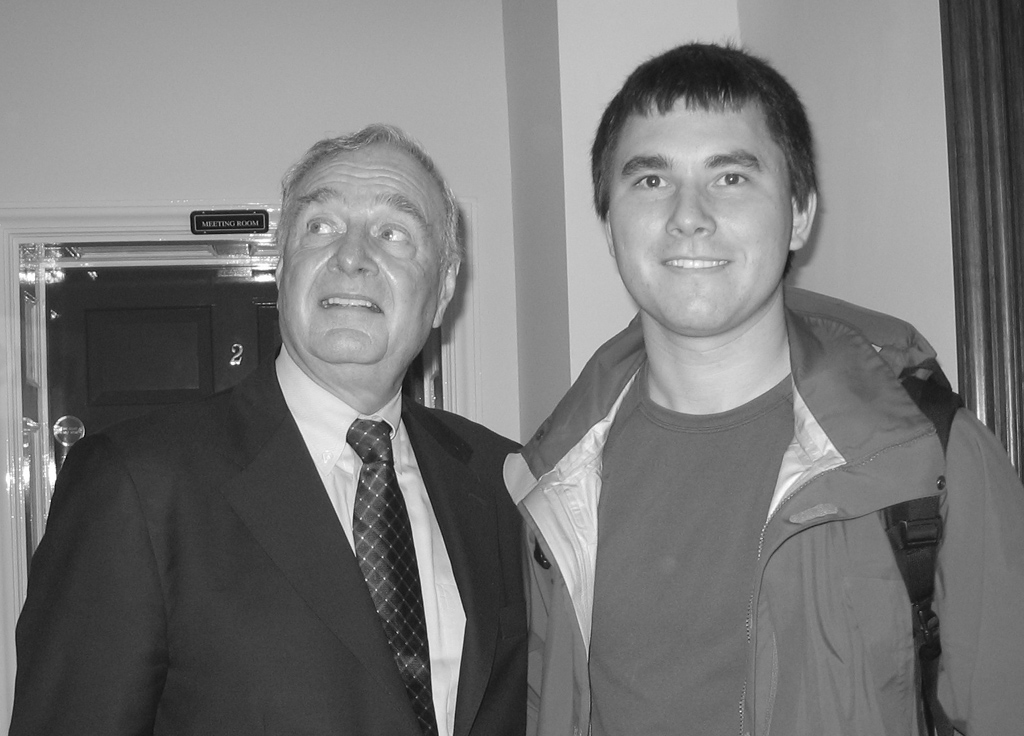
Paul Martin and Milan Ilnyckyj

Former Canadian Prime Minister Paul Martin’s talk was candid, informative and engaging. At a Global Economic Governance Program seminar, he covered a very diverse collection of issues: from China’s hunger for natural resources to the regulation of multinational corporations. I have never seen the room so packed, and the questions were excellent. He managed to get some good laughs, as well. In response to my question about climate change, he said, in part:

“Climate change has long since been recognized as caused by human activity principally.

The net effect is going to be devastating.

Prince Edward Island will disappear; Toronto won’t. That’s a disaster on both sides

That would make a great headline back home, wouldn’t it?”

Generally, he was very open, but there were certainly a few notable questions ducked. He declined to endorse a candidate for the Liberal leadership race when asked, for instance. People should feel free to have a look at my transcript, in which I have tried to quote directly wherever I could type fast enough.

PS. As today’s photo demonstrates, there is a downside to having a camera that takes 2-3 seconds to charge and fire its flash.

Thesis flowchart: data to action

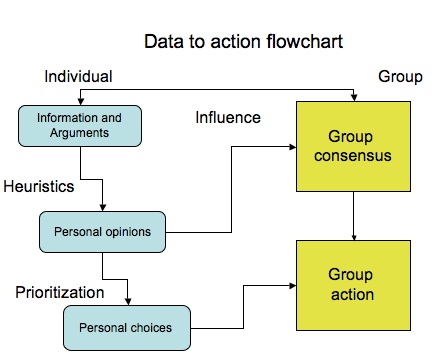
One thing the thesis should definitely include is flowcharts. They make it easier to disentangle what is going on in complex relationships, both by clearly showing what phenomena are connected, and by suggesting the direction(s) in which causality runs. Here is one that I came up with, regarding the relationship between personal consensus (the position a person reaches after having thought a question through and reached an answer that satisfies them internally) and group consensus:

Data to action flowchart

The starting point is the data presented to the individual. This consists both of empirically observed phenomena and of representations of truth made by others. There is an internal dynamic here. For instance, a person who has been reading a lot about global warming might be prejudiced towards interpreting an unusually hot summer in their part of the world as evidence for that trend. This is partly captured in the two-way arrow with group consensus, but it is also a matter of internal cognition.

Both empirical data and arguments (both logical and those based on other kinds of rationality) are transformed into personal opinions through the applications of heuristics. Examples of heuristic reasoning devices include:

  1. Conceptions about which individuals and groups provide trustworthy information
  2. Conceptions about what kind of evidence is strong or weak (for instance, opinions on the use of statistics or anecdotes)
  3. Particular facts that are so thoroughly believed that they become a touchstone against which other possibilities are rejected

This is not a comprehensive listing, but it gives an idea of the kind of mechanisms within a single person that are at work when forming opinions.

The link from personal opinions to personal choices is not a simple linear one. A second category of heuristics exist that do not determine what is considered true. Instead, they determine which opinions are important; specifically, they determine which opinions are important enough to deserve action.

Two major types of personal choices are represented in this model. Those in the box ‘personal choices’ could be called direct actions. This would include something like buying a hybrid car or boycotting a company. Within the arrow between personal opinions and group consensus lies the other kind of action: namely advocacy actions, in which an individual tries to convince other individuals or groups to adopt the same position the original individual has already reached. That feeds into the “information and arguments” boxes for other people, as well as contributing to the group phenomenon of consensus.

Group action is thus both the sum of personal choices, and the product of public deliberation leading to institutional or societal choices. Here again, a process of prioritization takes place.

An adapted version of this diagram could be constructed for scientists and for non-scientists. The biggest difference would be that scientists can engage in a broader project of empirical examination, thus contributing in a different way to the information and arguments being presented to others. They may well also employ different kinds of heuristics, when forming personal choices.

Carbon offsets

Bug on a flower

Cycling home with a £5 quarter-kilo of Fair Trade coffee, I found myself thinking about carbon offsets. These are financial instruments in which an individual or group pays someone else to reduce the carbon emissions they would otherwise have produced, so as to offset the buying individuals own carbon emissions. Al Gore used them to make the production of An Inconvenient Truth carbon neutral. They were also used by The Economist to make their Survey on Climate Change (Subscription required) carbon neutral. At the end of the opening article, they explain:

This survey, which generated about 118 tonnes of carbon dioxide from flights, car journeys, paper production, printing and distribution, has been carbon-neutralised through the Carbon Neutral Company. The cost was £590; the money was spent on capturing methane from an American mine.

According to the calculator at climatecrisis.org (the site set up by Al Gore to accompany his book and film), my annual carbon emissions are about 1.6 tons, including two trans-Atlantic flights a year. Not having a car and living in a shared dwelling makes a big difference, even if all our power is coming from the huge coal plant at Didcot.

At the rate The Economist paid, I could offset that for £8. It might be a worthwhile thing to include in my thesis. My only problem with it all is that it is hard to tell which of the many websites that sell offsets actually provide what they claim. There has been a kerfuffle recently about dodgy wind power cards. Does anyone know of a reputable place where I can offset those 1600 kilos of carbon? This site looks like a possibility.

Obviously, paying for the offsetting of your own carbon isn’t an adequate response to the issue of climate change (any more than buying Fair Trade coffee is an adequate response to global poverty), but it couldn’t hurt. It is also a potentially useful demonstration of how seriously you take the problem

[Update: 5:00pm] According to the company The Economist used, one round-trip flight from London to Vancouver generates 1.7 tonnes of CO2. As such, it would seem appropriate to offset at least four or five tonnes a year, to cover electricity, heating (however St. Antony’s does it), and travel.

Thesis case studies, justification for

The Stockholm Convention on Persistent Organic Pollutants and the Kyoto Protocol are both attempts at a multilateral solution to a previously unknown transboundary environmental problem. The reasons for which these case studies are useful for accessing fundamental questions about the science-policy relationship are several:

  1. Each agreement addresses an environmental problem that only recently became known.
  2. Each deals with a problem that is essentially transboundary, and requires concerted effort to resolve.
  3. Each involves scientific uncertainty, both about the material effects of the problem in the world and about the different characteristics of possible approaches for dealing with it.
  4. Each involves normative and distributional issues, with regards to groups that benefit or are harmed by the application of the agreement.

As such, each represents the outcome of a dialogue between stakeholders and experts. The former group is concerned with securing their interests, or those of their principles, such as they are understood at the time of interaction. The basis upon which this group operates is that of legitimacy: either implicitly held among those representing themselves, or transferred through a process, agreement, or institution to a representative whose legitimacy is premised upon advocacy.

The latter group is concerned with the generation and evaluation of data. Understood broadly here, ‘data’ are claims about the ontological nature of the world. This includes claims that are rigorously verifiable (such as those about the medical effects of certain pollutants) as well as those involving considerable interpretation (such as the meaning of international law).

The groups are not mutually exclusive, and many individuals and organizations played an overlapping role in the development of the agreements. Through the examination of these two case studies, as well as related matters, this thesis will engage with the interconnections between expertise and legitimacy in global environmental policy making, with a focus on agreements in areas with extensive normative ramifications.

Development, equity, and the WTO

My opinion of the World Trade Organization has probably shifted more than that for any other international institution, during the course of university study. The conception of the WTO as some sort of monolithic and powerful body, forcing countries to do things against their will does not seem like an accurate one. Where such pressures do exist, they are more parallel to the WTO (caused and driven by the preferences of member states) than self-arising from within. The inability of the WTO to enforce its rulings on trade – save through the highly problematic vehicle of allowing the country sinned against to raise its own tariffs – seems to underscore how weak the organization really is.

Naturally, all of the above assumes that free trade is generally a good thing. While there are undeniably problems – some of which can be well expressed using an economic framework of analysis – there are myriad advantages to global economic integration. Globalization needs to be modified so as to operate better as a process that aids in poverty reduction; likewise, it needs to become more environmentally balanced. With the Doha Round utterly stalled it isn’t clear how the WTO could contribute to either aim, a reasonable case can be made that it is at least not worsening either. A rules-based system like the WTO seems to hold out at least the possibility of a more just relationship between rich and powerful states and those that are poor. While the system is highly imperfect in practice, it does seem to have a small net positive effect.

All that said, since I need to argue that the WTO is a bad thing for developing countries this Thursday, I should start looking at the most eloquent and well defended expressions of the the position.

People interested in economic issues should have a look at Trade Diversion: a blog run by Jonathan Dingel, an M.Phil student in economics.

Thesis presentation upcoming

Tree and sky, abstract

This coming Wednesday, I am to present my thesis plan to a dozen of my classmates and two professors. The need to do so is forcing further thinking upon exactly what questions I want to ask, and how to approach them. The officially submitted title for the work is: Expertise and Legitimacy: the Role of Science in Global Environmental Policy-Making. The following questions come immediately to mind:

  1. What do the differences between the Stockholm Convention on POPs and the Kyoto Protocol tell us about the relationship between science and environmental policy?
  2. What issues of political legitimacy are raised when an increasing number of policy decisions are being made either by scientists themselves, or on the basis of scientific conclusions?
  3. How do scientists and politicians each reach conclusions about the nature of the world, and what sort of action should be taken in it. How do those differences in approach manifest themselves in policy?

The easiest part of the project will be writing up the general characteristics of both Stockholm and Kyoto. Indeed, I keep telling myself that I will write at least the beginning of that chapter any time now. The rest of the thesis will depend much more on examination of the many secondary literatures that exist.

The answers that will be developed are going to be primarily analytic, rather than empirical. The basis for their affirmation or refutation will be logic, and the extent to which the viewpoints presented are useful for better understanding the world.

Points that seem likely to be key are the stressing of the normative issues that are entangled in technical decision making. Also likely to be highlighted is the importance of process: it is not just the outcome that is important, when we are talking about environmental policy, but the means by which the outcome was reached. Two dimensions of the question that I mean to highlight are normative concerns relating to the North/South divide and issues in international law. The latter is both a potential mechanism for the development and enforcement of international environmental regimes and a source of thought about issues of distribution, justice, and responsibility that pertains to these questions.

I realize that this is going to need to become a whole lot more concrete and specific by 2:30pm on Wednesday. A re-think of my thesis outline is probably also in order. I should also arrange to speak with Dr. Hurrell about it soon; having not seen him since the beginning of term, there is a certain danger of the thesis project drifting more than it ought to. Whatever thesis presentation I ultimately come up with will be posted on the wiki, just as all of my notes from this term have been, excepting those where people presenting have requested otherwise.

First electoral response

My cloudy-headed morning-after analysis of the midterm election: American voters disapprove of many aspects of the Republican project, as well as the character of Republican government. That said, the Democrats are still seen more as a protest vote than as a viable alternative in and of themselves. That, and not the victory in the House, should be what the Democrats take from this election. It is also what should provide the motivation for their development in the years approaching the 2008 presidential contest.

They need to become less of an anti-party, and more of an obvious party of government. Partly, that will require choosing a leader less wooden and gaffe-prone than John Kerry. More importantly, it involves closing ranks, deciding on a policy platform, and selling it to the American people. Given the circumstances, it does not seem like the Democrats have much of a mandate for dedicating their time in Congress to investigating the misdeeds of the previous one. While some of that is clearly required, it should not distract them overly from tasks more relevant to their increased mandate.

As for the Republicans, this election looks like evidence that they have not been wholly discredited. It is a chance to learn a bit of humility and bipartisanship, building on their organizational strengths in the run-up to 2008.

Discussion of any of the above points, or related ones, is much encouraged. I will check in after my short trip to London.

Fight for the Senate

Background

In the contest for the Senate in the 2006 midterm elections, eight races stand out as unusually important: (incumbent in italics)

  • Pennsylvania: Rick Santorum (R) v. Bob Casey
  • New Jersey: Bob Menendez (D) v. Tom Kean
  • Montana: Conrad Burns (R) v. Jon Tester
  • Virginia: George Allen (R) v. James Webb
  • Ohio: Mike DeWine (R) v. Sherrod Brown
  • Tennessee: Bob Corker v. Harold Ford
  • Missouri: Jim Talent (R) v. Claire McCaskill
  • Rhode Island: Lincoln Chafee (R) v. Sheldon Whitehouse

The first is a likely Republican loss, while it will be a fight for the Democrats to hold the second. As of the final polls before the election, the remaining six races are up in the air. To win a majority, Democrats need a swing of six seats.

I have written previously about the importance of the Senate in this race.

Breaking news

As of 2:30am, the Daily Kos (a partisan Democrat site) is reporting that the Democrats have gained three seats in the Senate. They need six for a majority.

More cautiously, The New York Times is only showing that they have certainly taken one of the six most contested seats: New Jersey.

Pollster.com is showing 49 Senate seats going Republican, 47 going Democratic, and four still up in the air. In the event of a tie in the Senate, the Vice-President gets to cast the deciding vote.

[Update: 2:50am] The New York Times is now reporting Democratic victories in the Pennsylvania and Ohio Senate races as well. Either Democrat Lamont or Independent Lieberman is basically certain to win Connecticut. For those who haven’t been following the news, Joe Lieberman lost the Democratic primary, largely due to his support for the Iraq war and the perception that he is overly close to the Bush administration.

[Update: 3:15am] The NYT and Daily Kos now agree that the Democrats have picked up Ohio, Pennsylvania, and Rhode Island. They also held seats in Maryland, Michigan, Minnesota, and New Jersey. It also seems that Ned Lamont has conceded to Joe Lieberman in Connecticut.

[Update: 3:40am] Up by three, with four still in play and Virginia looking like the Republicans will hold it, I am going to take another shot at going to sleep. The Republican candidate is leading by 5% in Tennessee, with 66% reporting. In Virginia, they are leading by 1%, with 94% reporting. In Missouri, they are leading by 10%, with 24% reporting. There are still no reports from Montana. Given that the Democrats would need to win all but one of these races, things are not looking terribly good, as far as their chances of a Senatorial majority go.

Election nights have certainly become a lot more exciting in the past few years.

[Update: 8:00am] Well, there you have it. The smart money was on a victory in the House and a narrow failure to win a majority in the Senate, just as most friends who I polled informally yesterday guessed. The Republicans took both Montana and Virginia, as listed above in my collection of crucial races.

Given the circumstances, I would not say that this is an impressive showing for the Democrats. They clearly need to become a lot more coherent and well organized before 2008. That said, I would say that the real priority for the American electoral system is to fix the many problems with electronic voting systems.

I wonder how this new Congressional balance will affect government over the next two years. That is something to ponder during my upcoming coach ride to London.

[Update: 9 November 2006] It seems that the race still isn’t over. More commentary as it emerges. The Democrats have taken Montana, with Virginia still up in the air.

[Update: 12:15pm 9 November 2006] It seems that Virginia has gone to the Democrats as well. That gives them a majority in the Senate. The moral of the story: don’t call things too early.