Nomenclature

Whoever names Israeli operations in Lebanon must have a real sense of irony:

Operation Peace for Galilee: Israeli invasion of Lebanon in 1982, in support of Maronite Christian militias. Initially presented by Ariel Sharon as a plan to advance 40km into Lebanon, it was apparently always meant to go as far as Beirut.

Operation Accountability: A week-long invasion of southern Lebanon in 1993.

Operation Grapes of Wrath: A series of air and artillery strikes in 1996, designed as an assault against Hezbollah. Admist the 20,000 shells fired into Lebanon was one that killed 118 Lebanese civilians who were sheltering in a UN base.

Regardless of the validity of Israeli arguments about a strong retaliatory response being the only way to prevent future kidnappings and attacks, ongoing Israeli actions appear increasingly out of proportion to their ostensible provocations. Hopefully, some means will be found soon to rein in the situation.

Frontier justice

In other depressing news, there are apparently two Americans: Daniel Strauss and Shanti Sellz, who are being charged for transporting three illegal migrants trying to cross the US-Mexico border to a hospital, when they were dying of thirst. They face up to 15 years in prison and $500,000 in fines.

Legally, the case seems quite clear cut. The defence of necessity allows you to break the law when doing so serves some over-riding purpose. Someone with a suspended license can drive their critically injured child to the hospital, then get off the charge of violating the suspension by claiming that is was necessary to avert a far greater evil. Preventing three people from dying in the desert obviously overrides questions about the legality of assisting those attempting to migrate illegally.

What is most ironic is that the people prosecuting this case would almost certainly defend themselves as Christians – given that the prosecution can only be motivated by a desire for political point-scoring, and not being religious in America is politically suicidal. For would not Jesus himself have argued that if you come across a man dying of thirst in the desert, it is your Christian duty to report him to the proper authorities?

It amazes me that neighbouring democratic states with an increasing number of economic and institutional connections can nonetheless completely fail to accord the most basic ethic of due consideration to each other’s citizens. The prosecutors should be ashamed of themselves, and these charges should be summarily dismissed.

PS. Amnesty International has a campaign on this.
It is also being discussed on MetaFilter.

Violence around Israel

As is so often the case, it is only with the greatest of dismay that one can read headlines from the Middle East at the moment. What baffles me is that I cannot see what anyone hopes to gain from this looming conflict. Kidnapping Israeli soldiers is a good way to provoke massive retaliation (or provide justification for attacks planned before the kidnapping). At the same time, what Israel really hopes to achieve through incursions into Gaza and Lebanon is unclear. Almost certainly, there actions are further imperiling the hostages. The only comprehensible reasoning I can come up with is that the Israelis fear that anything less than a massive response to these kidnappings would encourage more.

The prospect of large-scale violence in the region, including considerable loss of life, is increasingly real. I am suspect that covert diplomatic efforts are being made on the part of the United States and others to urge greater restraint upon Israel, though a public condemnation seems pretty unlikely.

The only possible solution in the region is normalized relations between Israel, its neighbours, and a viable Palestinian state comprising the great majority of the West Bank and Gaza. The prospects of that point being reached are in the process of receding far off into the distance. And we can really do is hunker down for more bloodshed, while watching the oil producing nations (including Canada) rub their hands together in greedy anticipation of the further windfall from turmoil-boosted prices ahead.

[Update]: The Economist on this (requires subscription)
Patrick Porter on Israel and Lebanon (via OxBlog)

Fish paper publication upcoming

I may be delerious because it’s 6:30am, but this seems pretty unambiguous:

I really enjoyed the piece you wrote on EU policies regarding fishery sustainability off the coast of West Africa. I’d like to work with you to prepare your piece for publication in [the MIT Internatinal Review].

You mentioned on your cover letter that you would be willing to “re-focus it in the most appropriate direction and summarize other sections.” This will probably comprise the bulk of our work together, as your piece was very well written to begin with.

An excellent bit of news by which to start the day. I am off to London.

Thesis development

Talking with Dr. Hurrell about the thesis this evening was rather illuminating. By grappling with the longer set of comments made on my research design essay, we were able to isolate a number of interwoven questions, within the territory staked out for the project. All relate to science and global environmental policy-making, but they approach the topic from different directions and would involve different specific approaches and styles and standards of proof.

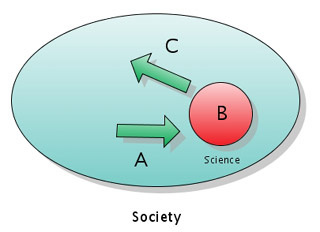
Thesis idea chart

The first set deal with the role of ‘science’ as a collection of practices and ideals. If you imagine society as a big oval, science is a little circle embedded inside it. Society as a whole has a certain understanding of science (A). That might include aspects like objectivity, or engaging in certain kinds of behaviour. These understandings establish some of what science and scientists are able to do. Within the discipline itself, there is discussion about the nature of science (B), what makes particular scientific work good or bad, etc. This establishes the bounds of science, as seen from the inside, and establishes standards of practice and rules of inclusion and exclusion. Then, there is the understanding of society by scientists (C). That understanding exists at the same time as awareness about the nature of the material world, but also includes an understanding of politics, economics, and power in general. The outward-looking scientific perspective involves questions like if and how scientists should engage in advocacy, what kind of information they choose to present to society,

The next set of relationships exist between scientists and policy-makers. From the perspective of policy-makers, scientists can:

  1. Raise new issues
  2. Provide information on little-known issues
  3. Develop comprehensive understandings about things in the world
  4. Evaluate the impact policies will have
  5. Provide support for particular decisions
  6. Act in a way that challenges decisions

For a policy-maker, a scientist can be empowering in a number of ways. They can provide paths into and through tricky stretches of expert knowledge. They can offer predictions with various degrees of certainty, ranging from (say) “if you put this block of sodium in your pool, you will get a dramatic explosion” to “if we cut down X hectares of rainforest, Y amount of carbon dioxide will be introduced into the atmosphere.”

The big question, then, is which of these dynamics to study. Again and again, I find the matter of how scientists understand their legitimate policy role to be among the most interesting. This becomes especially true in areas of high uncertainty. The link from “I know what will happen if that buffoon jumps into the pool strapped to that block of sodium” to trying to stop the action is more clear than the one between understanding the atmospheric effects of deforestation and lobbying to curb the latter. Using Stockholm as a ‘strong case’ and Kyoto as a ‘weak case’ of science leading to policy, the general idea would be to examine how scientists engaged with both policy processes, how they saw their role, and what standards of legitimacy they held it to. This approach focuses very much on the scientists, but nonetheless has political saliency. Whether it could be a valid research project is a slightly different matter.

The first big question, then, is whether to go policy-maker centric or scientist centric. I suspect my work would be more distinctive if I took the latter route. I suspect part of the reason why the examiners didn’t like my RDE was because they expected it to take the former route, then were confronted with a bunch of seemingly irrelevant information pertaining to the latter.

I will have a better idea about all of this once I have read another half-dozen books: particularly Haas on epistemic communities. Above all, I can sense from the energy of my discussions with Dr. Hurrell that there are important questions lurking in this terrain, and that it will be possible to tackle a few of them in an interesting and original way.

Lecture in the Taylorian

Graffiti near the Oxford CanalThe lecture today on Canada-US security and defence cooperation went well; it could even be a solid demonstration of the preferability of lecturing over research. I did talk overly quickly, burning through my forty-five minute presentation in just over half an hour, but the questions were good and I think I fielded them pretty well. The fear of going overtime can generate unwanted haste. I did manage to avoid a frequent error I’ve made in the past, namely that of getting lost in my own notes. It’s easier to avoid when you really know the material you’re covering, and the notes are for structure, rather than content.

A presentation on a topic like this is always a political act. On that basis, I think I struck the right note. I took the more truthful bits of the ‘staunch and eternal allies’ premise sometimes hammered upon by Canadian politicians under fire from the US and mixed it with some of the more essential elements of the ‘importance of legitimacy and international law’ scolding that with which we tend to fire back. All in all, I think it was reasonably balanced and candid. Wearing my NORAD pin – with Canadian and American flags on it – probably contributed positively to my ability to represent myself as someone who genuinely wants a friendly and constructive relationship between the two countries, and has considerable respect for both.

Lecturing itself was quite enjoyable, despite the associated anxiety. With a bit more practice and confidence, I think that I could get very good at this, indeed.

Privacy and power

Canada’s Privacy Commissioner has released an excellent report, highlighting some of the disturbing trends that he sees as ongoing. Rather than paraphrase, I will quote one of the best sections extensively:

It is my duty, in this Annual Report, to present a solemn and urgent warning to every Member of Parliament and Senator, and indeed to every Canadian:

The fundamental human right of privacy in Canada is under assault as never before. Unless the Government of Canada is quickly dissuaded from its present course by Parliamentary action and public insistence, we are on a path that may well lead to the permanent loss not only of privacy rights that we take for granted but also of important elements of freedom as we now know it.

We face this risk because of the implications, both individual and cumulative, of a series of initiatives that the Government has mounted or is actively moving toward. These initiatives are set against the backdrop of September 11, and anti-terrorism is their purported rationale. But the aspects that present the greatest threat to privacy either have nothing at all to do with anti-terrorism, or they present no credible promise of effectively enhancing security.

The Government is, quite simply, using September 11 as an excuse for new collections and uses of personal information about all of us Canadians that cannot be justified by the requirements of anti-terrorism and that, indeed, have no place in a free and democratic society.

I applaud both the Commissioner’s comments and his willingness to take such a firm and public stance. As I’ve said dozens of times now: terrorists are dangerous, but governments fundamentally much more so. They can cloak themselves in secrecy and are imbued with a level of power that permits them to do enormous harm, whether by accident or by design. Compared with the excesses and abuses committed by governments – Western democratic governments included – terrorism is a minor problem.

I recommend that all Canadians read the report in its entirety. I found the link via Bruce Schneier’s excellent security blog.

Present at the creation

The Globe and Mail – Canada’s big left-leaning national paper – has a surprisingly funny poll running today: “U.S. President George W. Bush turns 60 on Thursday and Prime Minister Harper will be in Washington to help him celebrate. What gift should the PM bring?”

  1. Four fabulous British-made submarines [a reference to our submarine fleet: four diesel-powered subs better suited to re-fighting the Battle of the Atlantic than modern naval operations]
  2. A belt buckle carved from softwood lumber [reference to a long running trade dispute where the US was ruled against both by NAFTA panels and the WTO, but refused to drop its illegal policy]
  3. Don Cherry [colourful Canadian hockey commentator, infamous for wearing really bad suits]
  4. Seal skin seat covers for Air Force One [those cute little harp seals are basically a license for Greenpeace to print money]
  5. A copy of Stompin’ Tom’s Greatest Hits [not a musical personage I can ever recall hearing, but one of those things Easterners, or possibly an earlier generation, are likely to think of as very Canadian]
  6. The Montreal Expos. Oh, wait….

My vote? I say go with the belt buckle. He will probably wear it while clearing brush. A running tally of the results is here.

The Salmon of Doubt

One more promising bit of academic news, from the MIT International Review:

Your paper is indeed still being considered (congratulations!), having made it through a particularly rigorous selection process. You will receive a more formal note to this effect in the forthcoming days.

This is, of course, the eternal fish paper, still passing through journal selection processes on its way to eternity. So much time has now passed since I wrote that paper that it feels like a familiar alien life-form that has been observing me continuously, but which I can only properly recognize when it glances at me in a certain way. Needless to say, this is an odd relationship to have with a piece of your own work.

I am very cautiously optimistic. If the paper gets through to publication, it will be my first published work in a journal not run by the University of British Columbia.

Research design essay blasted

I just got the feedback on my research design essay, and it is enormously less positive than I had hoped. The grade is a low pass and there are two written statements included: one that is fairly short and reasonably positive, the other longer and far more scathing. It opens with “[t]his research design is not well thought out.” Both comments discuss the Stockholm Convention and Kyoto Protocol as though they are the real focus of the thesis; by contrast, they were meant to be illustrative cases through which broader questions about science and policy could be approached.

The shorter comment (both are anonymous) says that “the general idea behind the research is an interesting one” while the longer comment calls the cases “well-selected… [with] fruitful looking similarities and differences.” The big criticisms made in the longer comment are:

  1. The nuclear disarmament and Lomborg cases are unnecessary and irrelevant.
  2. I haven’t selected which key bits of the Kyoto negotiations to look at.
  3. My philosophy of science bibliography is not yet developed.
  4. Not enough sources on Kyoto or Stockholm are listed. Too many are scientific reports.

It blasts me for not yet having a sufficiently comprehensive bibliography, and for the irrelevance the commenter sees in the nuclear weapons and Lomborg examples. The whole point of those is to address the question of what roles scientists can legitimately take, and how the policy and scientific communities see the role of science within global environmental policy making. The point is definitely not, as the comment seems to assume, to compare those cases with Stockholm and Kyoto. Taken all in all, this is hands-down the most critical response to anything important I have written for quite a number of years.

To me, it seems like the major criticism is that the thesis has not been written yet. I mention being interested in the philosophy of science, insofar as it applies, but have not yet surveyed the literature to the extent that seems expected. The same goes for having not yet selected the three “instances or junctures” in the Kyoto negotiations that I am to focus on.

As is often the case when I see something I was quite confident about properly blasted, I am feeling rather anxious about the whole affair – to the point, even, of feeling physically ill. I always knew there was a lot more work to be done – a big part of why I have decided to stay in Oxford over the summer – but I expected that the general concepts behind the thesis plan were clear enough. The long comment definitely indicates that not to be the case. I can take some solace in what Dr. Hurrell has said. He has more experience with environmental issues than probably anyone else in the department and has also had the most exposure to the plotting out of my particular project. Of it, he has said: “[the] Research Design Essay represent[s] an excellent start in developing the project and narrowing down a viable set of questions to be addressed.” Still, I would be much happier if the examiners had said likewise.

The major lesson from all this is to buckle down, do the research, and prove them wrong for doubting the potential and coherence of this project. The issue is an important one, even if it is more theoretical and amorphous than many of the theses they will receive. A simple comparison of Kyoto and Stockholm would be enormously less interesting.