Gardiner on climate ethics and moral corruption

In A Perfect Moral Storm: The Ethical Tragedy of Climate Change, Stephen Gardiner addresses the argument that a green energy revolution could be an exciting opportunity that benefits the lives of those who are alive today as well as those in future generations.

He characterizes this perspective as potentially interesting empirically, but largely unimportant ethically. It would be good if we could solve climate change while benefitting ourselves, but we have a moral obligation to address it even if doing so requires sacrificing things that we value in our own lives.

Generally speaking, Gardiner’s strongest point is that we are strongly psychologically disinclined to take responsibility for our contribution or to do anything about it. Because we have an intense desire to persist in climate-altering behaviours, we are willing to accept logically weak arguments for why we ought not to do anything, why we have already done enough, why the problem will solve itself, etc. He refers to this as “moral corruption”. In my experience, this self-justifying and self-deceptive behaviour is especially evident when people try to justify activities that (a) contribute very substantially to their personal carbon footprint, and which are (b) basically entirely voluntary and recreational.

On political ‘science’

As a consequence of returning to school, I am asked several times a day about what my field of study is. This is a touch awkward, as I have never really believed in the ‘science’ part of ‘political science’. I don’t think political phenomena can generally be effectively studied using quantitative methods. Indeed, I would be a lot more comfortable in a discipline with a name like ‘politics, philosophy, and economics’.

Thankfully, I can often dodge the ‘science’ part by saying that I study ‘environmental politics’. Those with a strong interest in academic taxonomy will sometimes persist in questioning until I name a discipline that is formally recognized at this institution, but most people seem content to accept ‘environmental politics’ as a field of study.

There is science involved in this area of research, certainly, but it pertains mostly to how the physical world responds to human choices, not to attempts to understand human interaction and institutions numerically. The interaction between carbon dioxide and electromagnetic radiation can be well-explained mathematically – the relationship between what scientists know and how governments behave, much less so.

Massey College at the end of summer

Massey College is full of luxurious silence. At night, it is usually only possible to hear the water flowing into the pond in the main quad and the chirp of a few insects. The contrast with a room overlooking College Street is excessive, and the new transition has been a reminder of how important a home’s acoustic surroundings are for determining how pleasant or unpleasant it is to occupy.

We will see if the place becomes less tranquil as more of the junior fellows move in. For now, I am enjoying the ease with which I can pretend I am in rural Vermont, rather than the middle of Canada’s most sprawling metropolis.

It’s also remarkable to be living in a building designed by a single person (and a British Columbian) with the clear purpose of serving as a home for a group of young scholars. Some of this is revealed in tiny details, like how the desk chairs in the studies tuck elegantly against the side of the desk, or how the lamp behind the bed is designed to be easily turned on or off by a person reading. To get myself thinking about communal and intentional forms of living, I have been reading the Rule of Saint Benedict. It contains some good advice for people and communities in general, though I am glad not to be living in a place where supreme obedience to an abbot and scripture is a central part of life. Rather, the main aim will be to devote myself to scholarly work – research and writing.

Differing physiologies

I have a tip for people whose non-air-conditioned apartments become tryingly hot during the summer: get a cactus. Now, when I wake up in the morning thinking: “Argh! It’s simply too hot in here to possibly get restful sleep!” I am simultaneously reminded that at least the conditions are well-suited to the health and growth of my friend in the family Cactaceae.

Working on climate change

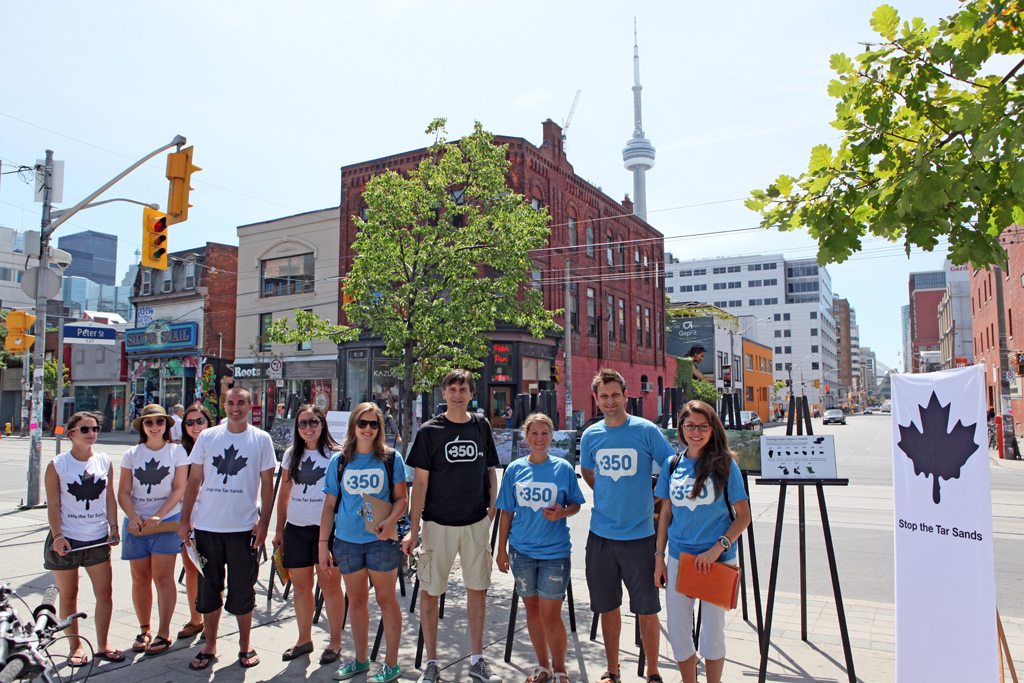
I was out all day today with volunteers devoting their time to sharing the message about climate change and encouraging others to take action.

If the science is right, this is a critical time. These are the years in which humanity will either choose to abandon fossil fuels or choose to commit itself to catastrophic climate change. As such, there may be no more important topic to be working on.

That’s even more likely given how few people are actually doing it. Compare the amount of effort devoted to addressing humanity’s most important problem with the amount of effort devoted to putting up advertising, fancy hairdos, driving dirt bikes, or watching television. The fight for the future of the planet is being waged between a handful of activists and a set of massively profitable fossil fuel companies, while a largely apathetic mass of people mostly ignores it.

Norway’s response to terrorism

A year after Norway’s terrorist attack, I’d say the Norwegians are demonstrating the appropriate way to respond to terrorism: by refusing to be terrorized.

“There have been no changes to the law to increase the powers of the police and security services, terrorism legislation remains the same and there have been no special provisions made for the trial of suspected terrorists.

On the streets of Oslo, CCTV cameras are still a comparatively rare sight and the police can only carry weapons after getting special permission.

Even the gate leading to the parliament building in the heart of Oslo remains open and unguarded.”

I wish Canada and the United States had been courageous enough to follow this model, instead of doubling down on the military-industrial complex approach. Rather than responding to terror with courage and resilience, we have been driven by fear to create huge and unaccountable security states that are ultimately more dangerous than terrorist groups.

Illuminated timepiece and memento mori

After five years in The Service That Must Not Be Named – and with just a few days left before I leave to resume my studies – I got myself the Marathon Watch Company’s imaginatively-named General Purpose Quartz w/ Date, Type I, Class 1 watch as a kind of retirement gift to self.

The major distinguishing characteristic of the watch is the way in which it uses tritium-filled tubes for illumination. At each hour marker, as well as on the hour and minute hand, there are tiny tubes of phosphor-coated borosilicate glass containing a minute volume of radioactive tritium. This allows it to be easily read in conditions of total darkness. The tritium atoms are constantly undergoing beta decay and turning into helium-3. This process produces an electron with about 5.7 keV of energy and an electron anti-neutrino. The electrons hit the phosphors, causing the glow. The watch glows with radioactive fire, using the transmutation of hydrogen into helium for energy. It also produces antimatter that zips easily through the planet.

While I hadn’t intended it this way, the strongest impression from wearing the watch is that it is a memento mori – a token that reminds a person of their inevitable death. There are a few reasons for this. Most obviously, the tritium decay occurs with a half-life of about 12.32 years. Every time that span passes, the glow becomes half as bright. Ordinarily, watches highlight the circularity of time; we wake and sleep at similar times most days, pay our bills at the end of the month, and so on. The decay of the tritium is a reminder that time runs in only one direction, and there is no undoing what is in the past.

Tritium itself also has some rather ominous associations. For one thing, the gas in the watch was probably made in a nuclear reactor through the irradiation of lithium. For another, tritium is an integral component in modern nuclear weapons: both in the core of ‘boosted’ fission weapons and in the secondary stage of Teller-Ulam configuration thermonuclear weapons. On a more practical level, if the tritium leaks out from the glass tubes and forms tritiated water, it probably wouldn’t be especially good for a person to ingest.

I am pleased with the unexpected thoughts brought on by the watch. Too often, I think, we ignore the reality of our mortality and the urgency of the present moment. It’s easy for life to become routine and automated, with relatively trivial tasks occupying our time alongside relatively trivial thoughts. Being frequently reminded about the unidirectional nature of time – and about some of the terrors of the world – seems to force us to concentrate on what we want to do before we fade and expire.

Alain de Botton and Schopenhauer on status

In the course of a very interesting lecture on status, author Alain de Botton draws attention to the inappropriate way in which we often accord undue importance to the casual views of uninformed strangers.

In the course of his discussion, he quotes a scathing passage from 19th century German philosopher Arthur Schopenhauer:

“We will gradually become indifferent to what goes on in the minds of other people around us when we start to acquire an adequate knowledge of the superficial, futile, and stupid nature of many of their thoughts – of the narrowness of their views, of the paltriness of their sentiments, and of the perversity of their opinions. The Earth quite simply swarms with people who are not worth talking to.”

The view is a misanthropic one, but it is a useful reminder of the excessive tendency people often have to assume the opposite: that the views of other people are generally well-reasoned and informed, that they are accurate and worth influencing in our favour. Closely connected to this is to seek the approval of those who we really have no reason to want to impress.

The essential corollary to this is that we mustn’t overestimate our own capabilities. Just as we should pay little regard to the casual views of a stranger on a complex subject requiring specialized knowledge for comprehension, we need to maintain internal awareness about which of our own views are grounded upon a rigorous evaluation of the subject matter, and which are mere guesses backed up by our intuitions or scanty background knowledge.

Alcohol licenses

Today I read the first half of Marc Lewis’ Memoirs of an Addicted Brain – a fascinating combination of a personal memoir of a drug-laden life and a scientific description of the neurochemistry of common psychologically active drugs. I have also been watching ‘Boardwalk Empire‘, which explores some other elements of the societal treatment of drugs.

It occurred to me that perhaps the world would be a better place if there was a licensing system for alcohol use akin to the system for driving. Instead of just gaining the right to drink at a set age, we could require people to take a class in high school and pass an exam. The license would be subject to temporary or permanent revocation in the event that a person was causing harm to others though alcohol use. For example, people convicted of driving drunk could have their alcohol licenses suspended or terminated.

It’s an idea that could theoretically be extended to other psychologically active drugs. By educating people, it would allow people to make more informed choices. The revocable licenses would also help maintain the balance between respecting the right that people have to make use of their own bodies with the obligation that people have to avoid harming others. It could also bring in a bit of much-needed state revenue.