
Obama and Romney on fossil fuels

President Barack Obama and Mitt Romney both think their best odds of winning the election arise from a full-throated endorsement of fossil fuels, with no mention of climate change:

Mr Obama’s energy policy goes beyond a new-found enthusiasm for oil and gas. He has even borrowed a phrase from the McCain-Palin campaign—“All of the above” (rather than “Drill, baby, drill”). “Most of the above” is more accurate. And it may hurt him. Clean Air Act rules administered by the Environmental Protection Agency (EPA) are accelerating the retirement of coal-fired power stations while cheap gas eats away at coal’s share of electricity generation. This is the main reason that Kentucky and West Virginia, once states where the Democrats were competitive, have swung firmly to the Republicans. Mr Romney is far friendlier to coal mining, an industry he praises for employing 200,000 people. He wants to develop coal aggressively and roll back the environmental regulations that have battered it.

Hopefully both candidates are lying. That is fairly plausible when it comes to coal, which Mr. Romney also sought to restrict as governor of Massachusetts. The perceived need to pander to the coal industry is revealing. The immediate benefits of coal production – in the form of profits and jobs – completely overpower the reality that coal kills vast numbers of people through air pollution and threatens the entire world through climate change.
Justin Trudeau’s depressing perspective on the oil sands

Now running for the leadership of the Liberal Party, Justin Trudeau said something especially depressing today:

“There’s not a country in the world that would find 170 billion barrels of oil under the ground and leave them there. There is not a province in this country that would find 170 billion barrels of oil and leave it in the ground.”

Days after Thomas Mulcair expressed support for an east-west oil sands pipeline, Trudeau’s comments demonstrate how virtually the entire spectrum of Canadian political opinion favours imposing dangerous and potentially catastrophic climate change on future generations, because today’s politicians cannot bear to forego the short-term profits associated with oil sands extraction. At a time when climate science is making it increasingly clear that we are putting humanity’s very existence at risk, our politicians lack the courage or the imagination to propose much other than the status quo: banking fossil fuel profits while ignoring the long-term consequences of our choices.

The ‘phone’ part of the iPhone can be very distracting

Sometimes, I wish I could uninstall the ‘Phone’ app from my iPhone. It’s amazing to be able to access email and websites from anywhere, without needing to rely on the availability of WiFi. It’s less amazing for people to be able to initiate immediate verbal communication with me at any time of day or night.

Between working as a TA and taking courses, I think it’s pretty difficult for doctoral students in the first couple of years to do much substantive reading and thinking about their thesis topic. In order to counter that, I am trying to do what I can to reduce the number of apparently urgent items popping up in my attention stream.

I wish the iPhone was a bit more granular in terms of which services you can turn off. It’s great that the iPhone has an ‘airplane mode‘ that kills both access to the cellular network and access to WiFi. It’s also great that you can turn on airplane mode with WiFi enabled (for internet access with no phone calls or text messages). I wish you could allow the phone to use the cellular network for email and web browsing but disable it for text messages and phone calls.

On political ‘science’

As a consequence of returning to school, I am asked several times a day about what my field of study is. This is a touch awkward, as I have never really believed in the ‘science’ part of ‘political science’. I don’t think political phenomena can generally be effectively studied using quantitative methods. Indeed, I would be a lot more comfortable in a discipline with a name like ‘politics, philosophy, and economics’.

Thankfully, I can often dodge the ‘science’ part by saying that I study ‘environmental politics’. Those with a strong interest in academic taxonomy will sometimes persist in questioning until I name a discipline that is formally recognized at this institution, but most people seem content to accept ‘environmental politics’ as a field of study.

There is science involved in this area of research, certainly, but it pertains mostly to how the physical world responds to human choices, not to attempts to understand human interaction and institutions numerically. The interaction between carbon dioxide and electromagnetic radiation can be well-explained mathematically – the relationship between what scientists know and how governments behave, much less so.

Even without growth, climate change is a problem

Over at Forbes, Tim Worstall has written something rather silly about climate change:

“This might look like very bad news, that economic growth has pretty much come to an end as an important phenomenon. On the other hand we could regard it as pretty good news as well: for it means that we no longer have to worry about climate change.”

When we talk about economic growth, we are talking about gross domestic product: the sum of all the transactions that happen in an economy in a year.

Climate change isn’t caused by GDP directly, but rather through the burning of fossil fuels. What matters is how much fossil fuel gets burned, not what the size of the economy is. Even with a shrinking economy, climate change is a huge problem if we continue to get the bulk of our energy from oil, gas, and coal. Conversely, a strongly-growing economy built on nuclear or renewable sources of energy could see rising GDP with falling greenhouse gas pollution.

In The Bridge At the Edge of the World James Gustave Speth summarizes our predicament:

“How serious is the threat to the environment? Here is one measure of the problem: all we have to do to destroy the planet’s climate and biota and leave a ruined world for our children and grandchildren is to keep doing exactly what we are doing today, with no growth in the human population or the world economy.”

Our challenge is to find a way to leave most of the Earth’s remaining fossil fuels underground. Reducing our emphasis on economic growth may help with that, but it is not sufficient. It may not even be necessary, if we are successful at building prosperous economies based on zero-carbon sources of energy.

Working on climate change

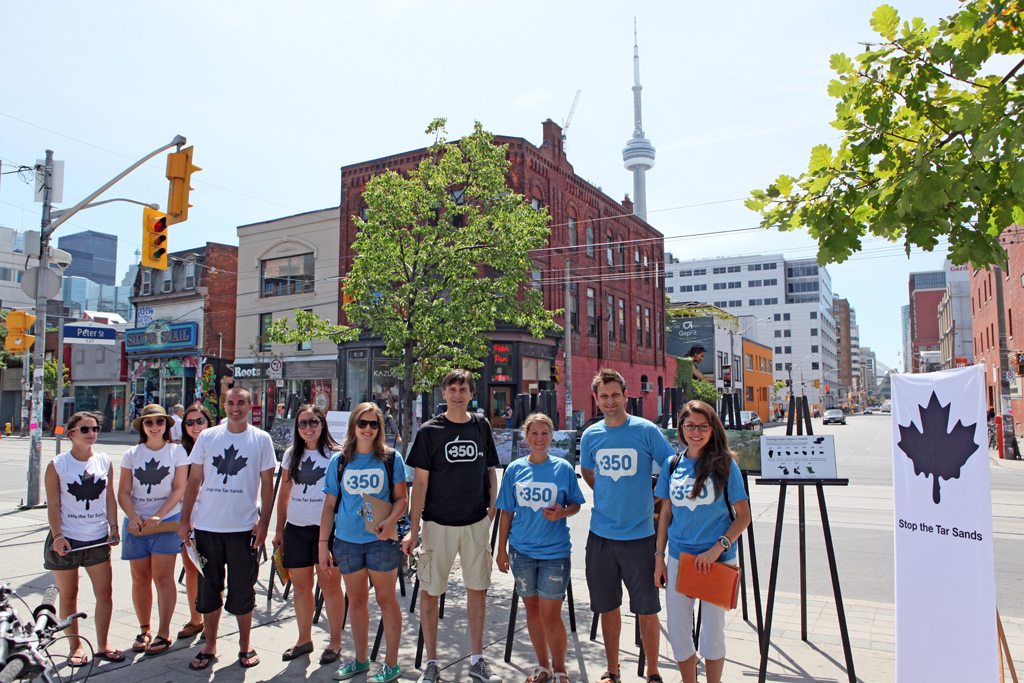
I was out all day today with volunteers devoting their time to sharing the message about climate change and encouraging others to take action.

If the science is right, this is a critical time. These are the years in which humanity will either choose to abandon fossil fuels or choose to commit itself to catastrophic climate change. As such, there may be no more important topic to be working on.

That’s even more likely given how few people are actually doing it. Compare the amount of effort devoted to addressing humanity’s most important problem with the amount of effort devoted to putting up advertising, fancy hairdos, driving dirt bikes, or watching television. The fight for the future of the planet is being waged between a handful of activists and a set of massively profitable fossil fuel companies, while a largely apathetic mass of people mostly ignores it.

Web servers are vulnerable machines

Imagine you have rigged up an unusual machine, like a home-made steam engine or a centrifuge. Even if it seemed to be working smoothly, it’s not the sort of thing you would want to leave unattended. It’s quite likely that doing so would break the machine, and quite probably cause damage to nearby property or people.

It’s important to remember that a web server is a pretty sophisticated machine. An entry served up by a WordPress blog is quite a different thing from a printed newspaper article or even a static HTML page. When you view a WordPress page, there is a dynamic interplay between your web browser and the web server. You request particular content and WordPress uses PHP scripts to pull together the necessary data from MySQL databases. The same is true for other dynamic content management systems (CMS), like Joomla or MediaWiki. Underneath all this, there is Apache HTTP Server and whatever operating system the server is running.

All this PHP and MySQL work creates openings for attackers. These can never be completely eliminated, though maintaining an updated version of your CMS and being careful about things like passwords and file permissions is important.

What may be most important, I think, is changing the perception of what kind of machine a web server is. You cannot assume that it will continue to obediently do what you want if you leave it alone. It is quite possible that some malicious human or robot will find a crack, take control of it in whole or in part, and then use it for nefarious tasks like sending spam or joining a botnet. If you aren’t paying any attention to things like your server logs, you might never even know that your site has been compromised.

In short:

  1. If you run a webserver, be aware that it is a constant target for attack.
  2. It is wise to take precautions, like promptly updating software and choosing strong passwords.
  3. Keep an eye open for unauthorized activity.
  4. Have backups in place for recovery after an attack.

Practice safer blogging!

Free speech online

The internet is one of the places where people in free societies get to exercise their right to free speech. It’s also a place where a lot of private communication takes place, and where the protection of the right to privacy is a constant struggle.

For those reasons, I suggest people consider joining groups that work to protect our rights as citizens online, like the Electronic Frontier Foundation.

Also, remember that the only way to preserve rights is to use them. Make use of your right to engage in political speech online (maybe a little anonymity too).

Third rule of the internet

Following up on rules one and two, it seems appropriate to add a third: “You should probably worry more about being attacked online by your own government than by any other organization”.

This is really an extension of the point about how governments are more dangerous than terrorists and how institutions of armed power need oversight.

Based on the open source intelligence available, we have to assume that governments all over the world are constantly monitoring the activity of their citizens online, for reasons both reasonably benign and exceedingly nefarious. It is worth remembering that even if the official purpose of a surveillance program is acceptable, it can be abused by anyone who gains access to it for purposes that may be very dubious. Hackers and rogue government agents are well positioned to use internet surveillance to rob or blackmail people, for instance. It is also worth remembering that data is not only being monitored in real time; it is also being archived for unknown future purposes.

Tools for privacy

Thankfully, we do have some tools to make this ubiquitous surveillance more difficult to carry out. You probably cannot encrypt your hard drive well enough to protect the contents if government agents grab it, but you can encrypt your online communications sufficiently well to make it at least challenging to decrypt them. The more people streaming gigabytes of data via encrypted HTTPS connections, the less feasible it is to archive and crack internet traffic taken all in all.

You can also use tools like Tor. People should be willing to assert their right to anonymous communication.

Politics by spin in Canada

Olivier De Schutter, the right to food envoy of the United Nations, recently released a report highlighting how many Canadians suffer from food insecurity. In response, Canada’s health minister Leona Aglukkaq described him as “ill-informed” and “patronizing”.

To me, this response seems like part of a worrisome trend in Canada. Instead of thinking about real problems, our government obsesses over negative media coverage related to those problems. It’s not malnutrition or worsening climate change or tortured detainees that are the problem, but rather critical media coverage on these sorts of issues. Rather than trying to fix problems, effort seems to be disproportionately dedicated to silencing critics and producing counter-spin.

It doesn’t help that opposition parties generally use every bit of negative media coverage as a means of hammering ineffectually at the government. What they need to realize is that our current government is largely an accident arising from the nature of our electoral system. With one party on the right and four on the left (counting the solitary Green), elections tend to favour the more unified ideology.

Just as the government should re-dedicate itself to governing for the benefit of Canadians, the opposition should dedicate itself forming an electable party through one or more mergers.