A bad new copyright bill

Canada’s proposed new copyright act is unacceptably poor, most importantly because of its treatment of Digital Rights Management (DRM). Under the new law, circumventing any such system – no matter why – is against the law. This means that if the company that sold you a song decides to stop letting you access it, you are out of luck. Under the new law, it would be a crime to copy music from a DRM-protected CD that you bought to an iPod that you own, with an associated fine of $20,000.

The law would also mean that organizations like libraries cannot have any confidence in their future ability to use digital materials today and people with disabilities will not be able to use technology to make protected works more accessible. It would make it a crime for me to use VideoLAN player to watch DVDs I bought in Europe, just because people selling DVDs have decided to use monopolistic regional codes to boost profits. Indeed, it would criminalize the distribution of VideoLAN itself.

It must be remembered that the purpose of copyright law is to serve the public good, not copyright holders. We allow copyrights because they create a legal environment in which it is possible to profit from a good idea. As a result, copyright protections help to ensure that people are furnished with new and high quality music, books, etc. By failing to protect the legitimate needs of consumers, this bill fails to enhance the public interest. As such, it deserves to be opposed and defeated.


Selling ‘clean coal’

Milan Ilnyckyj in The Manx pub

In the spirit of the laughable ads from the Competitive Enterprise Institute, there is a new offering from the coal industry. The strategy seems to be shifting from “there is no reason to believe in climate change” to “anything that would harm the fossil fuel industry would cause unacceptable harm to consumers.”

‘Clean coal’ will always be a non-sensical statement, given the environmental damage done by coal mining, the toxic emissions, and greenhouse gasses. Even with carbon sequestration, coal will be a dirty way of generating power. Furthermore, it seems unlikely that coal in combination with carbon capture and storage will be a source of cheap energy. As the cancellation of FutureGen due to cost overruns suggests, clean coal isn’t cheap.

Border guards and copyright enforcement

According to Boing Boing, Canadian border guards may soon be in charge of checking iPods and other devices for copyright infringement. If true, the plan is absurd for several reasons. For one, it would be impossible for them to determine whether a DRM-free song on your iPod was legitimately ripped from a CD you own or downloaded from the web. For another, this is a serious misuse of their time. It would be a distraction from decidedly more important tasks, like looking for illegal weapons, and probably a significant irritant to both those being scrutinized and those waiting at border crossings.

Hopefully these rumours of secret plans – also picked up by the Vancouver Sun are simply false.

Organ harvesting and natural revulsion

In a macabre tribute to utilitarian principles of welfare maximization, New York City is getting a special ambulance to collect, protect, and convey the organs of the suddenly deceased. The idea of being harvested for organs certainly makes people squeamish; most of us don’t like being reminded that we are basically delicate bags of goo. That being said, the opportunities to save lives here should trump our feelings of discomfort, just as they do in all manner of other uncomfortable medical procedures, from prostate examinations to pap smears.

Our feelings of revulsion are largely intuitive throwbacks to a world before we understood the nature of contagion and disease. Arguably, they are an increasingly useless (possibly even harmful) collection of caveman instincts.

Historical emissions and adaptation costs

Emily at a coffee shop in Kensington Market, Toronto

It is widely acknowledged that developing countries will suffer a great deal from climate change. They are vulnerable to effects like rising sea levels and increased frequency and severity of extreme weather. They also have more limited means available to respond, as well as other serious problems to deal with. Providing adaptation funding is therefore seen as an important means of getting them on-side for climate change mitigation. It could be offered as an incentive to cut emissions.

That being said, there is a strong case to be made that developing countries should not need to do anything in exchange for adaptation funding. Making them do so is essentially akin to injuring someone, then demanding something in return for the damages they win against you in court. The historical emissions of developed states have primarily induced the climate change problem; as such, developing states suffering from its effects have a right to demand compensation.

Very roughly, the developed world as a whole is responsible for about 70% of emissions to date. The United States has produced about 22% of the anthropogenic greenhouse gasses in the atmosphere; Western Europe is responsible for about 17%; Canada represents something like 2% of the total. It can be argued that – by rights – states like Bangladesh and Ghana should be dividing their total costs for adaptation and sending the bill to other states, on the basis of historical emissions.

That being said, it is only fair to say that developed states are only culpable for a portion of their total emissions, on account of how the science of climate change was not well understood until fairly recently. Exactly where to draw the line is unclear, but that doesn’t especially matter since developing states simply don’t have the power to demand adaptation transfers on the basis of past harms. States that developed through the extensive use of fossil fuels will continue to use the influence they acquired through that course of military and economic strengthening to make others bear most of the costs for their pollution.

The monarchy and Canada’s citizenship oath

Sign at a bookstore, Toronto

When my mother became a citizen of Canada, I remember noting the absurdity of the citizenship oath:

I swear (or affirm) that I will be faithful
and bear true allegiance to Her Majesty
Queen Elizabeth the Second, Queen of Canada,
Her Heirs and Successors, and that I will faithfully
observe the laws of Canada
and fulfil my duties as a Canadian citizen.

The monarchy is a sad reminder of Canada’s imperial past, not something that should be at the heart of becoming a Canadian citizen. It would be far better to have those who are becoming citizens assert their support for the Constitution, democracy, and the rule of law only, rather than giving such prominent treatment to an irrelevant legal hangover. To paraphrase Monty Python: supreme executive power derives from a mandate from the masses, not from some farcical tradition of bloodline descent.

It is certainly an excellent thing that the monarchy has been pushed to the symbolic edge of Canadian law and society, represented by mere remnants like a titular governor general, the queen on currency, and legal conventions like Regina v. Whoever for legal cases. That being said, it makes sense in this day and age to finally eliminate the trappings of family-line rule and become a proper republic. Of course, there are those who disagree.

Ducks are distractions

The continuing furor over the 500 ducks that died in a toxic oil sands tailing pond seems like an excellent demonstration of the capacity of people to utterly miss the point. Oil sands extraction has converted a vaste swathe of boreal forest into toxic wasteland, speckled with tailings ponds up to 15 square kilometres. The Pembina Institute has asserted that: “Despite over 40 years of oil sands development, not a single hectare of land has been certified as reclaimed under Government of Alberta guidelines.” In addition to that, there is the water use and the greenhouse gas emissions.

To look at this and have your attention dominated by a few unlucky birds seems like the height of myopia.

Standardizing cell phone chargers

Backhoe

Forgetting my cell phone charger in Toronto has already resulted in a week of weak connectivity. It need not be so. While it must be a gold mine for cell phone shops and manufacturers, the absurd proliferation of charger types is clearly an anti-competitive practice.

A government keen to protect consumers and boost overall economic efficiency would do the following:

  1. Require that all cellular phones be rechargeable using a standard connector.
  2. Ideally, that connector should be mini-USB (second from the left), capable of transferring both power and data.
  3. Require that adapters be sold for all phones made in the past five years, and that the cost of the adapters equal just the cost of shipping and manufacture.

As long as any charger could be plugged into any phone and provide power, firms would be free to compete in designing and building chargers that connect to electrical outlets, car cigarette lighters, or whatever other source of power seems fitting.

The intervention in the market is justified for the same reason as with all standards: it produces societal welfare without adverse effects. It replaces self-serving confusion generated by private firms with an ordered approach that makes sense for everyone. It is not as though there is any major innovation which can occur with cell phone chargers. At root, they are just plastic-wrapped wires that run from a socket to a circuit board. Having fewer types – and making them go obsolete less frequently – would also reduce the usage of energy and materials in manufacturing, as well as the number of (potentially toxic) plastic trinkets populating landfills worldwide. A standard would allow people to share chargers, as well as permit buses and trains to have universal charging stations available.

Something similar could be done for laptop computers. Cell phones and laptops are both ubiquitous elements of modern life and commerce. Just think how many productive hours are needlessly lost because each manufacturer wants to ensure that last year’s charger cannot be sold to someone buying this year’s phone.

Embassy artwork

Ugly statue outside the American Embassy, Ottawa

The city of Ottawa is quite well provisioned with public art. Some pieces, like the wooden spiral in the park near the mint, are quite charming. The piece above, located in the US embassy compound, is probably the worst of the lot.

As you can see, the sculpture looks a bit like a balloon animal where the balloons have been replaced by black steel beams and the angles have been randomly altered by twenty or thirty degrees. Sitting within a perimeter fence that never contains a visible human, the statue also symbolizes how faceless and harsh the whole compound is.

While concerns about security are obviously of enormous importance for an American diplomatic facility, nothing about them seems fundamentally at odds with good taste. A less ghastly bit of art, and an embassy that somehow demonstrates that the United States is a nation full of people basically just like Canadians rather than an imposing neo-military facade, might be a start along that road.

P.S. In the spirit of fairness, it should be noted that the British High Commission is equally externally unpopulated and far more lacking in architectural virtue.

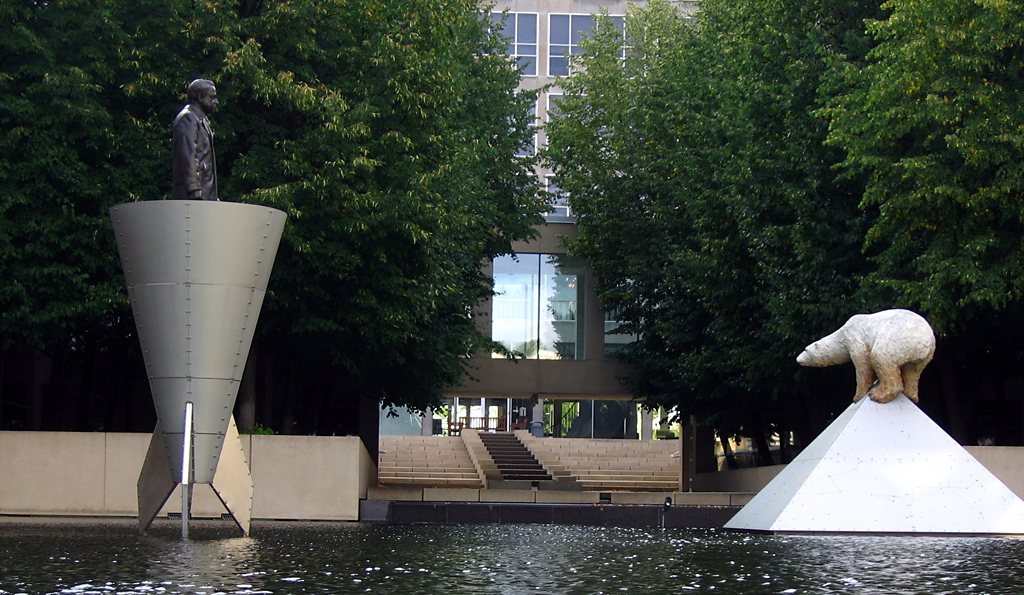
P.P.S Two other statues notably for their oddness and lack of aesthetic appeal are the strange rocket ship / polar bear statue at the building formerly intended to become city hall and the giant evil spider outside the National Gallery.

The Aragorn Fallacy

Stencil chicken

Watching films, I find myself very frequently annoyed with what I shall call The Aragorn Fallacy. The essence of the fallacy is to equate importance with invulnerability, especially in the face of random events.

Consider a battle that employs swords, spears, and bows and arrows. To some extent, your skill reduces the likelihood of getting killed with a sword (unless you are among the unfortunate individuals who find their line pressed into a line of swordsmen). No conceivable battlefield skill makes you less vulnerable to arrows (or bullets) once you are in the field of fire. As such, mighty King Aragorn is just as likely to be shot and killed as some forcibly drafted peasant hefting a spear for the first time. Sensible military leaders realize that their role is not to serve as cannon fodder, and that they needlessly waste their own lives and those of their men by putting themselves in such positions.

Of course, people will object, there have been military leaders who ‘led from the front,’ put themselves at points of great danger, and went on to high achievement. The problem with this view is that it completely ignores all the young would-be Rommels and Nelsons and Pattons who got felled as young captains or lieutenants by a stray bit of shrapnel or gangrene in a wound produced by a stray bit of barbed wire. With a sufficiently large starting population, you will always end up with examples of people who were reckless but nonetheless survived and thrived. The foolish conclusion to draw from this is that recklessness is either justified or likely to produce success.

Clearly, storytelling and life are different things. We admire superhuman heroes who shake off bullets and arrows like awkward drops of water. We may rationally accept that nonsense like throwing all your best commanders into the front line of a battle is strictly for the movies. The fallacy here is less that we believe these things to be true, and more that we feel them to be excellent. The grim fact that war is a brutal and largely random business sits poorly with our general affection for the things.