
Prospects for Mars colonies

I have long been skeptical about the prospects for off-world human colonies. Given that the International Space Station is the most expensive thing we have ever built and it is entirely reliant on supplies from Earth, it would be a gigantic leap just to make a self-sustaining closed life support system. Beyond that are many other obstacles, from radiation to Mars’ reduced gravity and even interpersonal conflict.

George Dvorsky has written an article with details on many of these challenges, which also quotes Louis Friedman on the psychological and philosophical implications of extraterrestrial expansion as an unlikely prospect:

If humans can’t make it to Mars, it means we’re destined to be “a single-planet species,” he said. What’s more, it suggests extraterrestrial civilizations might be in the same boat, and that the potential for “intelligent life to spread throughout the universe is very, very gloomy,” he told Gizmodo.

“If we can’t make it to a nearby planet with an atmosphere, water, and a stable surface—which in principle suggests we could do it—then certainly we’re not going to make it much beyond that,” said Friedman. “But if we’re doomed to be a single-planet species, then we need to recognize both psychologically and technologically that we’re going to have live within the limits of Earth.”

There’s a case to the made that the principal role that Mars is now playing for humanity is as some kind of faint hope that we can wreck the Earth and still somehow survive. That’s probably not healthy on any level. Having a crazy, desperate backup plan isn’t a substitute for a credible plan that doesn’t disregard or sacrifice almost everything humanity has ever valued. Furthermore, to degrade the Earth to the point where it no longer supports people would be an act of vandalism and malice toward the rest of life so severe that it would raise grave questions about whether it would be good for any life form, including us, for people to continue to survive.

Open thread: 2019 federal election

The CBC is reporting on polling results pertinent to this fall’s federal election: CBC News poll takes snapshot of Canadians ahead of fall election.

They say the cost of living was the top concern identified, followed by climate change. This suggests a familiar Canadian dynamic: being notionally concerned about climate change, but rejecting action on the necessary scale because of a perceived threat to short-term economic growth and personal financial well-being.

This integrated nicely with Andrew Scheer’s Conservative climate plan, which follows the traditional formula of expressing concern about climate change, proposing only speculative and painless long-term measures to deal with it while insisting that the fossil fuel industry can keep growing, and vaguely hoping that the rest of the world will solve the problem while Canada changes little and continues to actively make it worse.

There’s so much about this election that is depressing: how Trudeau and his government have done a poor job but remain the only non-abominable party with a chance of winning, how the discussion on the left will largely remain a squabble about blocking each other which the progressive parties cannot overcome, and ultimately Canada being carried forward by inertia and the defenders of the status quo into an unliveable and chaotic future.

Let’s get past hypocrisy

With the Trudeau cabinet’s approval of the Trans Mountain extension everyone is talking abut hypocrisy: “The day before they passed a climate change emergency resolution and now they are approving a pipeline for the dirty tar sands: the hypocrisy!” The trouble is, arguments based on accusations of hypocrisy often don’t hold up logically. “Al Gore flies a lot, therefore we shouldn’t implement his recommended climate policies.” That example shows how absurd the logical argument is. Either a policy like a carbon tax is a good idea or not, and that has nothing at all to do with any of Al Gore’s choices. What the allegation lets us do is find a basis for seeing those we disagree with as morally inferior, and then dismissing them rather than engaging (with approval or with criticism) with one proposed course of action or another. By the same token, whether the pipeline approval happened after a climate declaration or a day of celebration for petroleum science doesn’t really affect whether it’s the right course of action. Emphasizing the link misleads instead of informing us.

Hypocrisy is also an unproductive rationale because it takes as given that the most morally important choices we make are our personal behaviours, and especially consumer choices. There’s a whole kingdom of profit-driven “ethical” retail which wants people to believe that the soap you buy and the food you choose to eat is the most important part of your political activity in the world. That’s not true when it comes to climate change: whether individuals engage in or disclaim consumerism will not change our energy systems at the societal level, where and how we produce raw materials, or what becomes of our waste. The only way to get our carbon dioxide catastrophe under control is through coordinated action at the political level. Personal behaviour is irrelevant, and yet the emphasis on hypocrisy makes it seem central.

This isn’t an argument that assertions of hypocrisy are never relevant to policy discussions, but a pair of cautions about their shortfalls. Hypocrisy accusations are more often a way to change the subject than a reasoned and informed response to an argument or proposal, and emphasizing them inflates the misplaced importance of consumer choice which liberal consumerist environmentalism is based on. Let’s discuss policies on their merits and avoid letting ourselves get distracted by the idiosyncratic features of those who propose them.

Previous discussions of how accusations of hypocrisy in response to climate change are misguided:

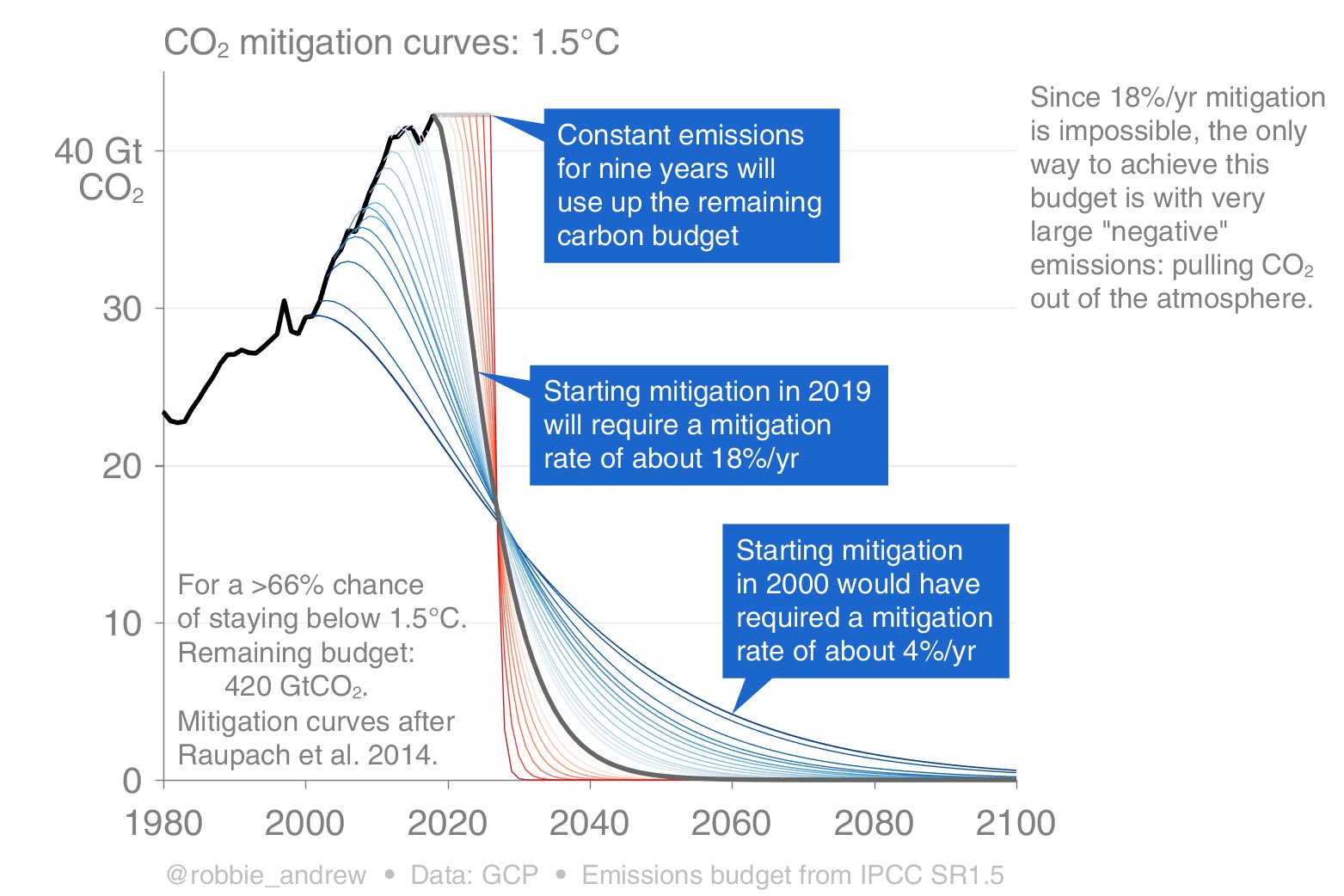
Delaying climate action is the most expensive thing we will ever do

Figure from my 2009 blog post, showing why delaying the global peak year for greenhouse gas pollution emissions means having to cut emissions much faster in the 2020s and 2030s to achieve the same temperature target:

Emissions pathways to give 75% chance of limiting global warming to 2ºC

Tweeted by Greta Thunberg today:

All this delay mutually reinforces the risks of catastrophes. People keep investing in fossil fuels, so they have more to lose from decarbonization. We keep putting off emission cuts, meaning that their eventual rate will need to be much more draconian than if we had started promptly when the risk of catastrophic climate change became well-recognized in the 1990s. We’re committing ourselves to more severe climate change effects, meaning more forced relocation, severe droughts, extreme weather events, and adaptation costs in general measured in both wealth and lives. We’re missing the chance to build global cooperation and overcome the parochial one-country-mindset mentality that makes global environmental problems into collective action problems.

twitter’s an addictive land of trolls

I have written before about the cognitive and emotional (and insomniac) downsides of checking the news too often. It seems worth re-emphasizing how twitter is a worst-case scenario in this regard, at least for people more interested in developments in matters of public interest than developments in the lives of friends and acquaintances, where facebook is untouchable.

With twitter it’s possible to use any internet-connected device to get an endless stream of updates and — crucially — little decisions for as long as you want at any time of day. It’s an exercise perfectly crafted to short-circuit longer term planning, even at the scale of turning off your phone to get a night’s rest before a busy day tomorrow. Every tweet presents the cognitive task of interpreting the content; determining whether it contains any factual, ethical, or political claims; and then evaluating that content in light of what the user believes and what, if anything, they are trying to accomplish through engagement online. Even for fairly passive users, every tweet involves the decision of whether to publicly ‘like’ or ‘retweet’ it, forcing your brain to engage decision-making circuitry more often and immediately than when reading a news article or book. Of course the real addictive prompts come from the social features: the notifications that someone has ‘liked’ or responded to your tweet. That engages all the emotional machinery which we use to socialize with others, maintain or alter our beliefs about the world, and protect out own self-esteem. It also embodies the slot machine logic of unpredictable and variable responses to the same action, ranging from someone amazing expressing agreement or saying something clever in response to your message to the depredations of the most hateful trolls.

Twitter often exposes me to content which I subsequently wish I could unsee, including particularly blockheaded claims and arguments which tend to re-emerge with a sense of frustration and anger in the shower the next day. The platform isn’t entirely without virtues — it can provide useful or at least engaging up-to-the-minute information and analysis on ongoing events, it allows users to engage directly with people who would otherwise be inaccessible, and perhaps it does sometimes direct people to good quality information they wouldn’t otherwise see. At the same time, it’s the venue for the least pleasant interactions in my life and it’s a repository of almost limitless idiocy and unkindness.

I have resolved for now to “cut off the time wasters quickly. They can’t be won over and whatever value there is in publicly refuting their arguments doesn’t justify the time and stress commitment”. There’s really no alternative strategy possible, since the platform is so full of people who (a) aren’t debating in good faith (b) can never be convinced or won over and (c) only get nastier with repeated interaction. They can take decades of meticulously collected, analyzed, and reviewed scientist and ‘refute‘ it with a silly accusation about the scientist or the person referencing them, a conspiracy theory, or an disreputable source which is nonetheless equally accessible online. Maybe very early on engaging with them helps draw some of the undecideds who are silently observing toward well-supported beliefs, but that almost certainly ceases to be true once your back and forth with that person has become one of your top ten present-moment sources of annoyance and irritability.

Our appalling legacy

There’s another dire warning from the IPCC: Final call to save the world from ‘climate catastrophe’

There seems little reason to hope that people will react differently to this one than to the 1990, 1996, 2001, 2007, and 2014 reports.

Our collective future is a massive ethical blindspot. People who wouldn’t think about missing a pension contribution or not enrolling their kids in an enriched learning program are collectively deciding by default to ravage the planet which we all depend on, and our political and economic institutions are acting almost exclusively to encourage that outcome.

The right’s anti-carbon-tax hostility

A carbon tax is a liberty-respecting, economically efficient mechanism to help address the threat of climate change and build a sustainable, prosperous society. It ought to be welcomed and supported by policy-savvy fair-minded conservatives who want to live up to their ideals while stewarding the integrity of the planet for future generations.

Meanwhile in Canada: UCP Leader Jason Kenney and Ontario Premier Doug Ford to hold anti-carbon tax rally in Calgary

Conspiracy theories among climate change activists

Climate change activists often (plausibly) assert that “the science is settled” and present themselves as the informed contrast to people whose lack of scientific understanding or manipulation by fossil fuel actors has left them with the false belief that climate change isn’t happening.

At Toronto’s smallish Rise for Climate march on Saturday, I saw at least four people who were trying to convince people that chemtrails from aircraft are actually secret nefarious geoengineering by governments. Along with a large banner with pictures of aircraft chemtrails and frightening claims, they were distributing a colour handout:

It’s a bizarre document. It claims that chemtrails (themselves a conspiracy theory that has been around for many years) are a secret “form of climate change mitigation” via solar radiation management (SRM). It also claims, however, that “SRM aerosol cloud canopies trap more heat than is deflected by SRM programs”, so the supposed chemtrail program actually makes climate change worse. It also claims that along with the chemtrails “associated microwave transmission atmospheric manipulation” is “decimating the ozone layer”. It’s a fever dream re-interpretation of contemporary environmental politics, marrying an old conspiracy theory with new concerns about the real potential technology of geoengineering by solar radiation management. They throw in that the geoengineering chemtrails cause autism, along with allergies and dementia, and claim that the program “was fully deployed immediately after WWII”.

It’s crazy from top to bottom, from the claim that the secret program is somehow “illegal” to the contradictory claims that the program is “officially denied” but also that there are “countless official documents which confirm” it. It’s also a bit ironic given how self-conscious the public conversation about geoengineering has been, including about whether any sort of testing could produce unwanted side-effects and how any geoengineering ought to be governed.

When you lose trust in formal sources of information like governments and scientific bodies, it becomes impossible to have an informed position on climate change. The internet is full of nonsense, as everyone expects, and the environmentalist movement includes many who are highly credulous when it comes to claims that they are inclined to believe, whether those are about health and nutrition or about government conspiracies.