U of T summer gym fees

A small but indicative example of how the University of Toronto doesn’t prioritize the welfare of its students is the way in which the gym access included in student fees during the fall and winter terms is cut off in the summer, requiring students to pay a per-facility fee to keep using it. This is especially bad for grad students, since they are likely to be around during the summer and also likely to be impoverished, since U of T’s exceptionally stingy funding packages usually provide nothing during the summer (though full-time work on your research project is still the tak of PhD students) and there are few TA positions available.

Given the demonstrated benefits of fitness and exercise, the significant psychological challenges of grad school, and the millions it spends on fancy new buildings it seems like it would be much more sensible for U of T to make gym access a year-round service for year-round students.

In any case, I went to the attractively faux-Gothic gym in Hart House yesterday and found that my fitness has degraded less than expected since my wrist injury pulled me out of Judo. My mind has been full of worries lately and 90 minutes alternating between elliptical and rowing machines was a considerable help.

I should make a point of going at least twice a week as a Judo replacement.

Civil disobedience as a climate change activism tactic

Friday’s episode of “The Current” discussed the case of Michael Foster who — after warning the pipeline control centre to shut off the pumping stations — turned a valve to shut down the flow of bitumen through the Keystone pipeline in North Dakota. It’s a very self-conscious act of civil disobedience, with Foster sending video to the company in real time showing that the shutdown was imminent and discussing beforehand his expectation that he would be convicted of a crime (transcript / MP3).

Few who take climate change seriously would see this action as unjustified. Canada should have started shutting down the oil sands decades ago and should never have developed them to their current size. There is much debate, however, on the effectiveness of such actions. Their logic depends on influencing external actors: either the general public or the legal system.

Fairly recently my friend Stuart was involved in a non-violent direct action blocking automobile access to Heathrow airport. The objective was essentially “consciousness raising” (he said it was to “stir up the national debate about Heathrow”), that the willingness of activists to put themselves in legal jeopardy would make people accept how terribly unethical our casual use of air travel is.

In the Heathrow case, it’s hard for me to imagine that outcome. Air travellers are stressed and deeply entitled. They feel totally justified in complaining about any inconvenience, and I doubt more than a trivial number would reconsider the broad context of their air travel use when exposed to an action like this.

The situation discussed in the pipeline shutdown case podcast seems to offer a little more hope, largely because of the opportunity to use the legal proceedings as a vehicle for public education. Pipeline companies are already seen as villains by many, and the public and the courts may be more sympathetic to the value of disrupting them than of disrupting the air travel of ‘normal’ people. That said, the courts are a bad mechanism for trying to change climate policy for several reasons: they tend to defer to elected politicians on questions of policy, they can prohibit specific things but rarely order broad outcomes, and rulings requiring broad policy changes are often ignored.

We don’t have good options though. The general public are entitled, selfish, and determined to defend the status quo even when it imposes catastrophe on others. It’s common to say that they are apathetic, but I think that’s a misdiagnosis; it’s less that people have accepted the need to act but are unwilling to do so personally and more that they are constantly acting to support the system that is destroying nature and the prospects of all future human generations. They are unwilling to change their lives or their politics nearly enough or nearly quickly enough to avoid climate catastrophe. No political party in Canada, the U.S., or U.K. has a serious plan to meet the Paris Agreement targets, much less to actually avoid dangerous climate change. And so, in an unprecedented situation and with no good options, activists are trying what’s available and sacrificing their freedom to do so.

One of the most insightful comments about climate change is George Monbiot’s observation that:

[The campaign against climate change] is a campaign not for abundance but for austerity. It is a campaign not for more freedom but for less. Strangest of all, it is a campaign not just against other people, but against ourselves.

No matter how strong the scientific consensus and how undeniable the real-world evidence becomes, nothing so far has convinced people to take action even slightly commensurate with the scale of action required, and people turn all their intellectual and rhetorical skills to justify that inaction (such as by pointing to the other good things they do). Overcoming those psychological responses may be just as important as breaking the power of the fossil fuel industry in a global campaign that can keep us from imposing so much suffering on future generations that we threaten the very ability of human civilization to endure.

Related:

Leadership lacking

The Bagehot column on the U.K. in this week’s Economist contains some of the harshest language I have seen them use, about the Theresa May government trying to implement Brexit, saying: “Britain is ruled by an incestuous clique of frenemies who delight in turning even the most serious issues into melodramas”.

It’s worrisome that so many of the world’s most important countries seem to be badly led at present. Likewise, at a time when we need to be thinking beyond narrow national interests and building an equitable low-carbon global energy system, instead people are defining their allegiances more and more narrowly and expending their energy on unworthy causes and petty conflicts.

Burning up the planet to stay cool

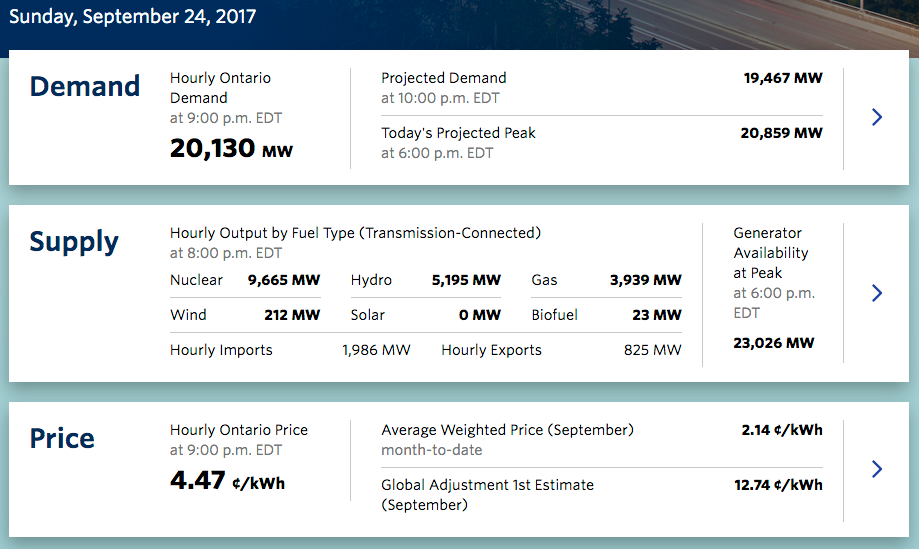
Sticky with humidity after 9pm, electricity demand in Toronto must be crazy right now.

The Independent Electricity System Operator has data for the whole province:

Back in April 2005, province-wide electricity use was 14,890 megawatts: 62% nuclear, 19.3% hydro, 13.5% wind, 4.6% gas.

This connects to lots of climate change questions. Can we really afford not to build new nuclear infrastructure, if we are at all serious about cutting emissions? Can renewables get big enough fast enough to make a difference, or will we be relying on gas with all of its climate problems?

Will the world stay rich enough and electricity cheap enough to keep using air conditioning to stay comfortable? Will places like Phoenix and Texas remain habitable? Also, remember that all the air conditioned cars and trucks are cooling themselves by burning gasoline, not relying on the electricity grid.

Young people and political involvement

Howard Dean recently made some interesting comments about young people and U.S. politics:

“They’re very independent-minded. They don’t like politics. And they mistrust institutions,” Dean said in his characteristically matter-of-fact style. “I think our problem as Democrats is, we’re the head of the oldest party in the West, and this party is an institution that looks incredibly unattractive; not because of our ideology, ’cause that is attractive, and that is why they always vote for Democrats. But the Democratic Party means nothing to them because it’s an institution built by people like me who’s 40 years older than them.”

Dean believes the Republican Party blew a chance with these young voters. “The Republicans had a shot at these guys because these young folks are libertarian economically,” he said, “but the Republicans are so cast in racism and anti-feminism and all these other things that these young folks value.” And Dean’s assessment of the leadership of the GOP was withering. “Leadership in the ultimate is telling your own people that they have to do something that they don’t want to do,” he said. “There’s no leadership at all in the Republican Party. None. Zero. They’re all terrified of their monster that they’ve created, which relies on xenophobia and racism and all these other unpleasant-isms.”

I think it’s true that there is a conflict between generations, and that politics generally serves the old and rich. It’s hard to see a way out of that when the functioning of politics as usual makes young people apathetic more often then apoplectic.

If everyone could see 50 years into the future, I think young people would have the highest voter turnout instead of the lowest, and that older people would start making choices that will not so gratuitously burn up the futures of their children and grandchildren.

Freedom and living expenses

George Monbiot’s career advice for aspiring journalists may apply at least as much to civil servants and academics:

You want to be free? Then first you must learn to be captive.

The advisers say that a career path like this is essential if you don’t want to fall into the “trap” of specialisation: that is to say, if you want to be flexible enough to respond to the changing demands of the employment market. But the truth is that by following the path they suggest, you are becoming a specialist: a specialist in the moronic recycling of what the rich and powerful deem to be news. And after a few years of that, you are good for little else.

This career path, in other words, is counter-educational. It teaches you to do what you don’t want to do, to be what you don’t want to be. It is an exceptional person who emerges from this process with her aims and ideals intact.

Even intelligent, purposeful people almost immediately lose their way in such worlds. They become so busy meeting the needs of their employers and surviving in the hostile world into which they have been thrust that they have no time or energy left to develop the career path they really wanted to follow. And you have to develop it: it will not happen by itself.

Summary: go right toward what you think is important, and learn to live cheaply.

Alcohol’s societal role

In many ways, the treatment of ethanol in societies like Canada is exceptional.

It’s the only powerfully psychoactive drug top-end hotels and restaurants will provide you in unlimited quantities as long as you can pay. It’s the only drug that large groups of strangers routinely use to the point of inebriation together, in contexts ranging from weddings to club meetings to fancy dinners at universities. In places like Ontario where it is sold by the government, the government actively advertises it, while simultaneously notionally trying to prevent unhealthy use (which is probably any use, despite self-serving studies that purport to show health benefits from moderate consumption of this known carcinogen).

The societal burden of ethanol is spectacular. The Economist notes:

Between 2006 and 2010, an average of 106,765 Americans died each year from alcohol-related causes such as liver disease, alcohol poisoning and drunk driving—more than twice the number of overdoses from all drugs and more than triple the number of opioid overdoses in 2015… The percentage of Americans who met the criteria for alcohol-use disorder (AUD) in the DSM-IV—a psychiatric handbook that uses questions such as, “In the past year, have you found that drinking—or being sick from drinking—often interfered with taking care of your home or family?” to diagnose alcoholism—jumped from 8.5% of Americans in 2001-02 to 13% in 2012-13, or nearly 30m people. By comparison, 2.6m are estimated to have prescription-opioid and heroin addictions… Analysis by Phillip Cook, a professor at Duke University’s Sanford School of Public Policy, published in 2007 suggested that whereas 30% of Americans did not drink at all in 2001-02, 10% of Americans—or about 24m—had an average of ten drinks a day. He believes such habits would not look different today.

The Washington Post reported recently on a study which concluded that one in eight Americans meets the diagnostic criteria for alcohol use disorder, adding: “Stunningly, nearly 1 in 4 adults under age 30 (23.4 percent) met the diagnostic criteria for alcoholism.”

I think a few responses to this are prudent:

  1. Alcohol advertising should be banned in areas including billboards, print media, and television
  2. Plain packaging requirements like those used for tobacco may be prudent to try
  3. Alcohol corporations should pay a significant share of the cost of treatment for alcohol dependence and alcohol-induced chronic health conditions, and treatment availability should be greatly expanded
  4. Alcohol licenses should be experimented with, which could be revoked for those imposing risk or harm on others
  5. We should support research into less damaging substances which could play a similar social role, like the alcohol-replacing benzodiazepine David Nutt is searching for
  6. Combat the ideological dogmatism in the treatment system, including the idea that total abstinence is the only goal to pursue or that AA-style 12-step programs should be a mandatory part of treatment

Related:

Arming Saudi Arabia

I find the debate about Canadian arms companies selling weapons and vehicles to Saudi Arabia a little perplexing. The media coverage seems to turn on the question of whether the arms and equipment are being used to oppress the civilian population of Saudi Arabia. I find this perplexing because there seems to be ample evidence that oppression at home and abroad is the main business of the Saudi government, and that anybody selling them anything should expect it to be used that way.

On one hand, it’s appealing that moving to non-fossil fuel sources of energy could undermine countries like Saudi Arabia. On the other, it’s frightening to think what would happen to the region in a future where nobody wants or is willing to use their oil.

Activism as being a catalyst

When we think about global trends, we tend to focus on their importance and how rapidly things are changing. China’s economic rise, along with massive economic development and urbanization around the world, all have unambiguous importance, though we will endlessly disagree about how they will interact and few of us will live long enough to feel confident we saw the final outcome (there are major limits to knowledge and prediction).

If one makes a sincere effort to understand what is happening in the world and feels compelled to try to encourage some of the best possible outcomes, given the state of the world right now, perhaps it makes sense to think in terms of which trends you hope to speed up and which you hope to inhibit.

The key question in effectiveness has to be: am I / are we making a difference in terms of an important objective.

So perhaps it makes sense to think about being a catalyst or accelerant (to choose a more obviously violent analogy) hoping to create as substantial a ∆ifference as possible in the final chemical equilibrium.

Sometimes working for the ACLU is fun

Step 1: British comedian John Oliver produces an absurd segment about coal CEO Bob Murray:

In it, Oliver acknowledges Murray’s history of litigiousness toward critics and challenges him to do his worst.

Step 2: Murray sues Oliver for defamation in West Virginia circuit court

Step 3: As reported in Slate, Jamie Lynn Crofts of the American Civil Liberties Union of West Virginia files one of the world’s funnier legal documents in the form of an amicus brief to the court

As John Stuart Mill said about freedom of speech in general: “Strange it is that men should admit the validity of the arguments for free speech but object to their being ‘pushed to an extreme’, not seeing that unless the reasons are good for an extreme case, they are not good for any case”.

Political speech, news reporting, and satire all deserve special protection in the public interest. Hopefully this whole back and forth will discourage those who face criticism in the future from seeking to suppress it through the courts of a free society.