Minimum temperatures

Door bolt

Most of the climate change discussion has centred on global mean temperatures, but it is also important to consider minimum temperatures. The degree to which winters are properly cold has important effects: notably, on the distributions of pests and disease. The temperature a species can tolerate serves as a limit to its expansion, so warm winters can help undesirable creatures to spread into new areas. This is akin to how it is important for a course of antibiotics to kill 100% of the target bacteria. If it does not, a fullblown new infection is likely, once the drugs are discontinued.

The ranges of ants and bees have been extending northward in Europe and North America. Likewise, the populations of ticks carrying Lyme Disease and malarial mosquitoes have been shifting northward, along with those carrying Dengue Fever and Japanese encephalitis. This is part of a general trend in which species being displaced by climatic changes (See: Thomas Lovejoy notes). The fact that whole ecosystems do not move northwards and to higher altitudes at the same rate causes further problems, as predation relationships are disrupted.

These kinds of higher level effects are likely to become better understood as further research is carried out. The depth of information has already increased a great deal: the fourth IPCC report, which is in the process of being released, is based upon a review of more than 1,000 academic studies. The Third Assessment Report, in 2001, was based on about 100.

PS. The trio of WordPress sites have been upgraded to version 2.1.3. If you spot any problems, please let me know.

Scientists and remedies: brainstorming

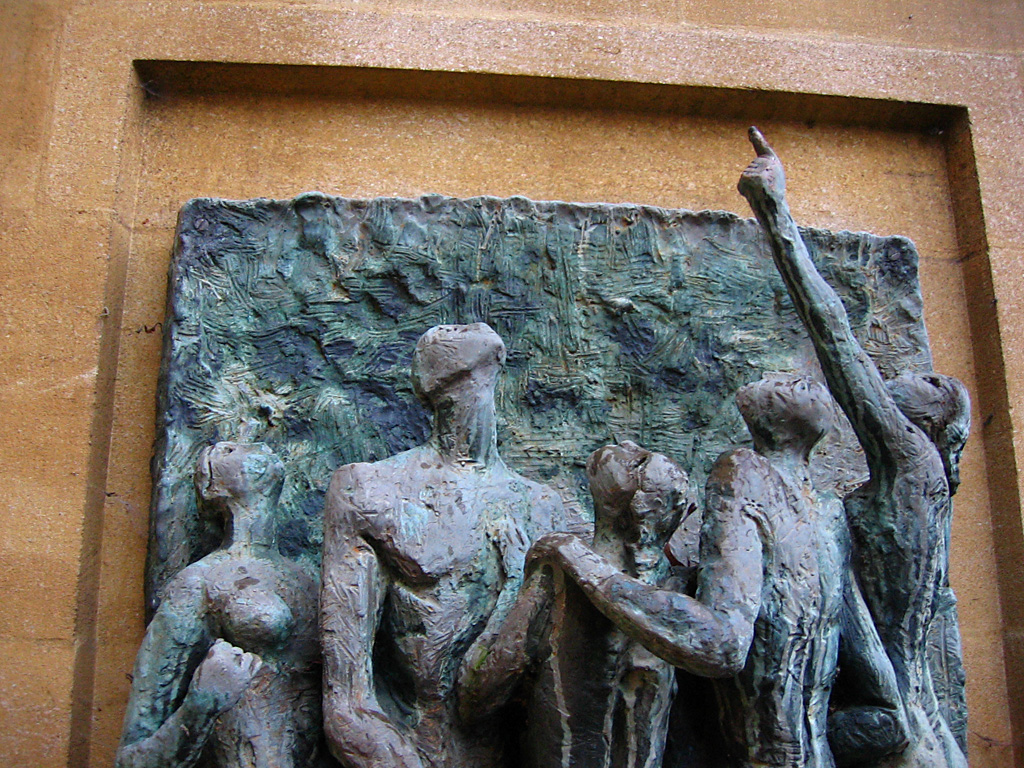
Statue in Nuffield College, Oxford

Tonight, I am brainstorming connections between scientists and remedy design. Addressing environmental problem basically seems to revolve around changing the intensity with which an activity is being carried out (ie. fish or cut down trees at the rate of regeneration) or finding substitutes (using solar power instead of natural gas power). Both kinds of solutions involve some critical imputs from scientists. Not surprisingly, my focus here is on types of actions that pertain specifically to my case studies.

I have come up with the following. Does anything else spring to mind?

Technological development

Development of:

  1. Alternative chemicals to replace ones that have been problematic (for instance, CFCs and POPs)
  2. Alternative mechanisms for energy generation, storage, and transmission
  3. Energy-using technologies that are more efficient
  4. Plant varieties that require fewer pesticides
  5. Mechanisms for the disposal or long-term storage of unwanted by-products
  6. Less polluting mechanisms for waste disposal

Predictions

Anticipating the consequences of:

  1. Continuing to behave as we have been
  2. Adopting one or another alternative approach
  3. The combination of our impact upon the world with possible natural changes, such as major volcanic eruptions

Providing information about uncertainty:

  1. How good are our predictions?
  2. If they do fail, in what ways might it occur (what is not included in the models?)
  3. What kinds of uncertainty are out there (ie. magnitude of effects, distribution of effects, etc)

Predictions about technological development:

  1. What will the state of environmentally relevant technologies be in X years?
  2. Is it better to invest in the best technology we have now, or continue research and wait (partly an economic question)

Big ideas about the world

Establish and describe the limits of nature:

  1. Is this a factual or ideological exercise?
  2. The same facts could justify differing views
  3. Some ideologies have elements that can be pretty effectively undermined by science (ie. eugenics)

How should we treat uncertainty?:

  1. Are there categories of risk that it is more ‘rational’ to worry about?
  2. When does it make sense to ‘wait and see’ and when does it make sense to act in a precautionary way?

Naturally, those last few items extend into territory that is not obviously scientific. One big question about the social role of scientists is the extent to which they do or should contribute to such hybrid debates, with both empirical and ethical dimensions. Also, there is the question of whether they do or should do so ‘with their scientist hats on’ or whether they are no different from any other actor, once they have strayed from their area of core competence.

Law and science

Studies serve for delight, for ornament, and for abilities

Another intersection between science and policy is embodied in a recent report (PDF) from the Science Select Committee of the British Parliament on the relative harmfulness of different legal and illegal drugs. Notably, the survey ranks alcohol and tobacco as being more harmful than illegal drugs including cannabis, LSD, and ecstasy.

Setting aside methodological issues, the survey does reveal some ways in which our response to scientific information is conditioned by pre-existing understandings and practices. Why society feels that it should permit an adult to drink or smoke as much as they choose to (though not in public or before driving) but that it must actively forbid the use of some other substances has no clear logical basis. Any argument that can be used to justify legal tobacco (free individual choice, etc) could be just as easily applied to other substances on the select committee’s list. While scientific and ethical arguments can be made to bolster various positions, it seems that sheer momentum is the main determinant of policy.

I would be willing to guess that some prescription drugs – especially the anti-depressants given ever-more-readily to children and teenagers – would rank quite unfavourably, if subjected to the same type of analysis.

Climate change feedback effects

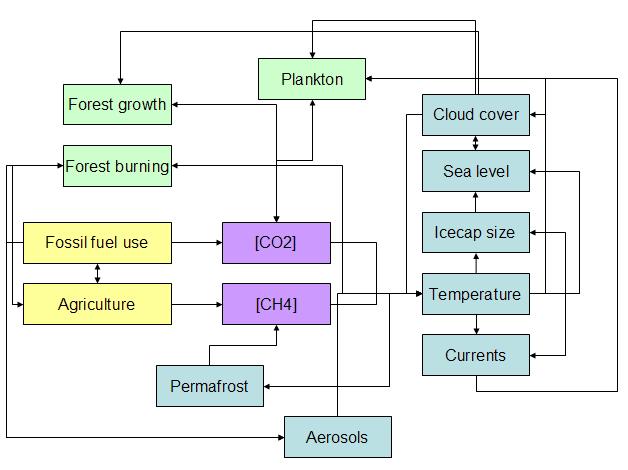
Starting with an index card full of items to include, I tried to make a map of basic feedbacks relating to climate change. I got this far, then decided that it probably cannot be done in two dimensions, except perhaps on a really massive sheet of paper:

Selected climate feedbacks

Note: a chemical formula in [square brackets] indicates the concentration of that substance.

Consider, for instance, a single pathway of effects. Agriculture uses fossil fuels, which produce CO2. The CO2 raises global temperature, affecting global cloud cover in an uncertain way. The cloud cover affects temperature, by reflecting more or less solar radiation back into space. It also affects the rate of forest and plankton growth (as does the original increase in CO2).

All told, you need to account for phenomena in the following domains: atmosphere (gas concentrations, cloud effects), hydrosphere (ocean density, temperature, currents), cryosphere (ice and glacier levels, permafrost), and biosphere (plant growth, forest fires). Add to that feedbacks within human behaviours (agriculture and forest burning, for instance) and feedbacks between anthropogenic and non-anthropogenic sources of climate change, such as volcanic eruptions (lithosphere) and changes in orbits and solar output. Doubtless, I have overlooked and forgotten many relevant effects, also.

My hat goes off to the producers of general climate models (GCMs) that have started to incorporate the most important of the linkages shown above. These complex dynamic systems are tricky things, not easily dealt with through the general tendency in science to break questiond down and understand them bit-by-bit.

Oceanic microorganisms

St. Cross College chapel

One of the most interesting points repeatedly discussed in Bill Bryson’s A Short History of Nearly Everything is the astonishing variety of microbial life that exists on earth. Regardless of how you arrange your taxonomy, there is far more variety in single-celled life than in the more familiar multicellular variety. What’s more, it seems that single-celled creatures may be more diverse in the ways they carry out essential biological tasks like energy collection, movement, and communication.

One of the more interesting bits of research being done right now is the work of Craig Venter through the Global Ocean Sampling Expedition. Using samples taken from seawater from around the world and ‘scattershot’ techniques of genetic sequencing, some new information about that variety has been uncovered. This one program has tripled the number of genes that have been sequenced by humanity (from three to nine million). For instance, the project discovered a great deal about a class of messenger molecules called kinases. Previously, they were believed to consist of a single family of proteins, used by plants and animals. Now, nineteen new families have been discovered, all in bacteria.

In every age, there is a certain temptation to think we have most of the basic knowledge about how the world works mapped out. Projects like this help to reveal just how much there is left to come to grips with.

PS. Those curious about some of the ongoing debates in biology should have a look at two Wikipedia entries: Kingdom and Taxonomy. Some of that Kingdom-Phylum-Class-Order-Family-Genus-Species stuff we all learned in high school is coming under challenge, at the same time as there is a big schism between those seeking to categorize organisms by similarity in structure and those intent to do so on the basis of tracking genetic progressions.

Climate change and the Amazon

Tonight, I saw a public lecture associated with the Oriel College conference: Climate change and the fate of the Amazon. Notes on Thomas Lovejoy’s presentation have been posted on my wiki. Most of it was stuff that I had heard or read before in multiple places, but it will be useful to have another source to cite on a few issues, for the thesis.

The issue of biodiversity also really drives home the instrumentalist v. inherent value perspectives on nature. If golden toads provide no concrete benefit to human beings, should we be concerned about them going extinct. If we are, what level of resources is it sensible to devote, given the myriad other problems that exist?

Compressed air for mobile energy storage

Oriel College chapel

All of a sudden, the air car concept is popping up everywhere. I hadn’t head of it before someone left a comment yesterday. Now, it is on Metafilter, Slashdot, and YouTube.

I must admit that the prospect of a $7,500 car that can run for 200-300km on $3 worth of compressed air sounds pretty amazing. Of course, the compressed air would just be a storage mechanism for energy generated in other ways. The advantage over hydrogen and fuel cell systems of biodiesel could lie in lower infrastructure costs. Installing compressors in homes and service stations already connected to the electrical grid is a lot cheaper than developing a whole new hydrogen infrastructure, leaving more money to direct towards genuinely renewable sources of energy. The compressors could also be powered directly by wind or water turbines, as well as solar power systems. As for biodiesel, once you factor in the energy required to grow the crops and process them, as well as the inefficiency of internal combustion engines and the continued reality of toxic emissions, it doesn’t seem like a hugely alluring prospect to anyone but corn farmers.

While it is unlikely that one technology will allow us to overcome fossil fuel dependence, it does seem sensible to think that something like this could be part of the mix. Especially if the energy being used to compress the air is coming from a renewable, non-greenhouse-gas-emitting source, these cars could make a big difference in the developing world. They could also help tackle urban air pollution, such as the kind plaguing Beijing.

PS. I got today’s photo of the day in Oriel College, as part of my initiative to photograph each college at least once. While there, I discovered a sizable conference on climate change ongoing, about which I had heard nothing. This goes to show just how many people are working on the issue, both here at Oxford and more generally.

IPCC summaries

Pretty much everyone has read news coverage on climate change, but it seems that relatively few people have read anything the IPCC has actually written. I recommend looking over the 21 pages of the Summary for Policymakers for the Fourth Assessment Report (PDF). It addresses a number of topics covered in the media, from global dimming to variations in solar output.

While few people who read it are personally qualified to gauge its accuracy, and even those who could would need the information from the full report text, it is nonetheless worthwhile to look at the source, rather than the versions processed by the BBC or the New York Times.

For those wanting to track what has changed over the last six years, within the IPCC’s conclusions, have a look at the surprisingly brightly coloured Summary for Policymakers from the Third Assessment Report. Note that, unlike the full reports, the summaries are vetted line-by-line by representatives from member governments.

Equilibrium ruminations

Ceiling in Green College tower

Working on chapter three, I have been talking a lot about different kinds of equilibria, and what implications they have for environmental policy. Uncertainty about which sort we are dealing with – as well as the critical points of transition between them – make it exceptionally difficult to consider global environmental problems in cost-benefit terms.

Stable equilibria

One common view of the characteristics of natural equilibria is that they are both stable and singular. An example is a marble at the bottom of a bowl. If you push it a bit in one direction or another, it will return to where it was. Many biological systems seem to be like this, at least within limits. Think about the acid-base conjugate systems that help control the pH of blood, or about an ecosystem where a modest proportion of one species gets eliminated. Provided you like the way things are at the moment, more or less, such stable equilibria are a desirable environmental characteristic. They allow you to effect moderate changes in what is going on, without needing to worry too much about profoundly unbalancing your surroundings.

Unstable equilibria

Of course, such systems can be pushed beyond their bounds. Here, think about a vending machine being tipped. Up to a certain critical point, it will totter back to its original position when you release it. Beyond that point, it will continue to fall over, even if the original force being exerted upon it is discontinued. Both the vertical and horizontal positions of the vending machine are stable equilibria, though we would probably prefer the former to the latter. For a biological example, you might think of a forested hillside. Take a few trees, wait a few years, and the situation will probably be much like when you began. If you cut down enough trees to lose all the topsoil to erosion, however, you might come back in many decades and still find an ecosystem radically different from the one you started off with.

Multiple equilibria

The last important consideration are the number of systems where there are a very great many equilibrium options. One patch of ocean could contain a complex ecosystem, with many different trophic levels and a complex combination of energy pathways. Alternatively, it could feature a relative small number of species. The idea that we can turn the first into the second, through over-fishing, and then expect things to return to how they were at the outset demonstrates some of the fallacious thinking about equilibria in environmental planning.

The trouble with the climate is that it isn’t like a vending machine, in that you can feel the effect your pushing is having on it and pretty clearly anticipate what is going to happen next. Firstly, that is because there are internal balances that make things trickier. It is as though there are all sorts of pendulums and gyroscopes inside the machine, making its movements in response to any particular push unpredictable. Secondly, we are not the only thing pushing on the machine. There are other exogenous properties like solar and orbital variations that may be acting in addition to our exertions, in opposition to them, or simply in parallel. Those forces are likely to change in magnitude both over the course or regular cycles and progressively over the course of time.

How, then, do we decide how much pushing the machine can take? This is the same question posed, in more economic terms, when we speculate about damage curves.


Presenting science

When thinking about the social roles of scientists, it is helpful when they come out and speak on the subject directly. As such, an article in the BBC headlines feed for today is interesting. Basically, it is about some scientists who feel that it is both misleading and a tactical error to play up the catastrophic possibilities of climate change. One, Professor Paul Hardaker from the Royal Meteorological Society, argues:

“I think we do have to be careful as scientists not to overstate the case because it does damage the credibility of the many other things that we have greater certainty about,” he said.

“We have to stick to what the science is telling us; and I don’t think making that sound more sensational, or more sexy, because it gets us more newspaper columns, is the right thing for us to be doing.

“We have to let the science argument win out.”

The first thing to note about this is the implicit position that it is up to scientists to actively tune what they say to the audience they are addressing. This is done for the explicit reason of retaining “credibility” and thus influence. What is suggested, furthermore, is that scientists basically know what is to be done (even if that is more research, for the moment) and that they should be saying the right things in public to keep things on the right track.

Of course, science cannot tell us how much risk we want to bear. While runaway climate change – driven by methane release, for example – may not be a probable outcome, the very fact that it is possible may be sufficient to justify expensive preventative measures. Science can likewise tell us what areas and groups are most likely to be affected, but hardly requires one or another course of action in response. Bjorn Lomborg has famously argued that general increases in foreign aid are the best thing the developed world can do for the developing world, so that the latter will be richer by the time the major effects of climate change manifest themselves.

The position of scientists is a somewhat paradoxical one. In the first place, their influence is founded upon their supposedly superior ability to access and understand the world. Their credibility relies upon being relatively neutral reporters of fact. When they begin dealing with data at the kind of second-order level embodied in the above quotation, they are seeking to increase their influence in a way that can only diminish the original source of their legitimacy. In an area like the environment this is inevitable, but it does render invalid the idea that science, in and of itself, can guide us.