Evaluating existing climate change information

This may strike some people as abstract, but perhaps it will be of interest to someone.

Assume, to start with, that climate change is a major threat to humanity and that concerted global effort is required to deal with it. In that case, I see two possibilities:

  1. If all of humanity and all human knowledge were put in an abstract place together and given all the time they needed to educate one another, consider the data, and deliberate, they would come to a conclusion that strong climate change mitigation action ought to be undertaken.
  2. Even with all our current information and unlimited time, this conclusion could not be widely endorsed. It may, however, be the case that the people in this abstract space would reach the conclusion that we must act, if only they had some new information that we have not yet observed or collected.

Part of the answer involves the depths of human ideological and theological beliefs. If there are people who can never be shaken in their belief that the world is benevolent and concerned about humans, they could never be convinced otherwise by education or information. Part of the answer may have to do with the overall relationship in human beings between perceived risks and the willingness to take precautionary action. That said, I am convinced that an impartial assessment of climate science and the situation we are in would lead most any rational human being to endorse a precautionary approach.

I am similarly convinced that people in my ideal case would eventually overwhelmingly support aggressive mitigation actions. I don’t think human beings would be happy to expose all future generations to the risk of misery and possible extermination, just so they can avoid a transition to renewable energy that would be necessary regardless of climate change, and which can probably be accomplished for a few percent of GDP, spread over many years.

Of course, the real world is very different from my little imagined experiment. Time is important here. If climate change deniers can keep the public confused for another 20 years, that will have a huge impact, even if they could eventually have been unmasked as self-interested charlatans in my infinite-time case. Time can also work to our advantage, however. Striking new information can come to light and, in so doing, it can have an effect on what beliefs and priorities people hold faster than old information would be able to do in an education-and-discourse manner. For example, if we were to observe a drought of unprecedented scale and severity, it might have a big impact on the willingness of people to endorse the kind of high-level policies and actions necessary to curb the harmful influence of human beings on climate (or perhaps not).

What do you think? Would people reach a consensus in favour of strong mitigation action, given all the information and infinite time? If not, what further information might they require? In either case, what is the effect of the differences between my ideal infinite-time case and the real world, in which our choices in the next couple of decades will do much to determine where the climate ends up?
Xyloexplosive devices

The funniest videos to watch backwards are those in which entropy increases a lot: things like explosions and toppling dominoes, where it is completely obvious that the order of the video frames has been reversed. By contrast, something like a bouncing ball is pretty boring to watch backwards.

Tom Stoppard’s play Arcadia features some good discussion of entropy, and reactions that cannot be reversed. It is easy enough to stir jam into pudding, but impossible to unstir it back out. In addition to showing us something about the nature of time in our universe, it is a decent metaphor for why human regret can be counterproductive. You can’t unstir the pudding, after all.

Enterprising geeks have cooked up an entertaining new way to rapidly increase the entropy of a bunch of popsicle sticks or tongue depressors. It’s like a more energetic version of dominoes, and well worth a look both forwards and backwards.

Seeking certainty about climate change

I have written before about the problem of what can and cannot be known about climate change, given that we only have one planet to experiment on, and our simulations will never be accurate beyond question. Here is another expression of the same basic idea. I am trying to figure out the most effective way to convey this information to people who don’t think we should be taking aggressive action on climate change.

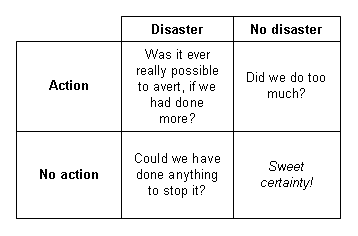
This chart shows four possible situations that humanity could find itself in, 100 years or so from now. Either climate change has been disastrous or it has not been, and we either took strong action to deal with it or we did not:

As you can see, there is only one situation in which we can be absolutely sure we made the right choice. Even that is a bit ambiguous, though. Imagine the decision isn’t about climate change but about Russian Roulette. If we are alive after the game, but we did choose to play, can we really be said to have behaved prudently? The sheer fact that the chamber didn’t turn out to be loaded doesn’t mean that we were intelligent to run the risk, back when we didn’t know that for sure.

Imagine two snakes, both of which look very similar. One is deadly venemous, and the other is benign. If the best information we have at hand suggests that there is a good chance we are dealing with the venemous one (say, because we are in the region where it usually lives), the prudent thing is certainly to behave as though the snake may be venemous. Even if you learn later that it was not, nobody will think you were a fool for acting that way. The climate science we have now is providing good reasons to think that we are dealing with a deadly snake of a problem.

In short, the science will never be settled in the sense that it will tell us exactly what to do. All it can do is become clear enough to make the prudent choice obvious to most people.

Degrees of frost

For practicality, you can’t beat the Celsius temperature scale. Were it not for the stubbornness of Americans, the weird Fahrenheit alternative (initially established with ice, brine, and an armpit) would be long-gone. For scientists, the Kelvin scale lets you represent temperature appropriately for thermodynamic calculations, and helpfully retains the same unit size as Celsius.

I would have thought the case would be closed there, but Bill Streever’s book made me aware of a more romantic-sounding alternative: degrees of frost. This temperature measure – a favourite of penguin-egg-gatherer and Antarctic explorer Apsley Cherry-Garrard – measures how many degrees it is below the freezing temperature of water.

Naturally, I prefer the Celsius version, though it sounds a bit less dramatic. Right now, it is a completely tolerable -4˚C in Ottawa. That’s just four degrees of frost – nothing to compared to the 60.8 degrees of frost experienced by Cherry-Garrard. The worst I’ve seen in Ottawa is about thirty degrees of frost, during my first frozen winter in Ottawa. Wind chill, incidentally, is not really a very scientific thing.

China and other developing states

Leaked Chinese documents claim that Canada and other developed nations have “connived” in a “conspiracy to divide the developing world.” It’s not surprising that China wants to be treated in the same way as extremely poor developing states, from whom no costly action is expected. At the same time, we just cannot afford to treat China and India like Mali or Guinea. The kind of climate future generations will live in is being affected strongly by choices made in Beijing and Delhi. That needs to be recognized – as does the need for India and China to accept emissions curbs.

This isn’t to say that India and China don’t have any claim to special treatment. Their per-capita and historical emissions are both low. That being said, the special treatment they receive cannot take a form that allows them to pursue the sort of high-carbon development track they have been. Unfair as it may be, they are going to need to develop primarily on the basis of low- and zero-carbon forms of energy (at the same time as developed states are aggressively cutting back on fossil fuel use) or we will get into a situation where it becomes very difficult to imagine how catastrophic climate change could not occur.

The great majority of the world’s emissions come from a dozen or so countries. Getting them on track towards carbon-neutrality is essential. That isn’t the case when it comes to small and very poor states who can be brought in line later without serious consequences. There is no need to be conspiratorial about it, but China and India really must be divided from the rest of the developing world.

RealClimate on IPCC errors

RealClimate has put out a comprehensive assessment of the various errors that have come to light in the IPCC AR4 – IPCC errors: facts and spin. It includes the Himalayan glaciers claim, sea level in the Netherlands, African crop yields, disaster losses, Amazon dieback, and the ‘gray literature’ controversy.

They highlight the distortions the media has perpetuated in reporting these stories, as well as provide an assessment of whether climate science remains sound, in spite of these errors and controversies:

In some media reports the impression has been given that even the fundamental results of climate change science are now in question, such as whether humans are in fact changing the climate, causing glacier melt, sea level rise and so on. The IPCC does not carry out primary research, and hence any mistakes in the IPCC reports do not imply that any climate research itself is wrong. A reference to a poor report or an editorial lapse by IPCC authors obviously does not undermine climate science. Doubting basic results of climate science based on the recent claims against the IPCC is particularly ironic since none of the real or supposed errors being discussed are even in the Working Group 1 report, where the climate science basis is laid out.

To be fair to our colleagues from WG2 and WG3, climate scientists do have a much simpler task. The system we study is ruled by the well-known laws of physics, there is plenty of hard data and peer-reviewed studies, and the science is relatively mature. The greenhouse effect was discovered in 1824 by Fourier, the heat trapping properties of CO2 and other gases were first measured by Tyndall in 1859, the climate sensitivity to CO2 was first computed in 1896 by Arrhenius, and by the 1950s the scientific foundations were pretty much understood…

All of these various “gates” – Climategate, Amazongate, Seagate, Africagate, etc., do not represent scandals of the IPCC or of climate science. Rather, they are the embarrassing battle-cries of a media scandal, in which a few journalists have misled the public with grossly overblown or entirely fabricated pseudogates, and many others have naively and willingly followed along without seeing through the scam.

Unfortunately, it remains clear that a large amount of damage has been done by these media misrepresentations (both active and passive). They have helped to sap the energy that existed, pushing for meaningful climate policies. And they have given those trying to actively delay mitigation efforts much more fodder to confuse the public and encourage inaction.

BuryCoal.com

In brief, I am starting a new group blog at BuryCoal.com. It exists primarily to make the case for leaving coal and unconventional fuels underground, where they cannot harm the climate.

The reading I have done in the last year has highlighted a few important perspectives for me, when it comes to climate change. The most important thing is humanity’s total cumulative emissions. As such, it is not enough just to use fossil fuels more efficiently. We need to stop using them long before they run out: particularly, before the world’s massive reserves of coal and unconventional fossil fuels are tapped. The warming that would arise from burning all the coal, oil sands, shale oil, and methane clathrates would be far greater than that caused by burning conventional oil and gas.

Government plans that include serious restrictions on the use of coal and unconventional fossil fuels have a chance at being compatible with avoiding dangerous climate change, while those that treat this as a side issue do not.

In order to spread the word about the importance of leaving coal and unconventional fossil fuels in the ground, I have launched a new website at BuryCoal.com. It will be accepting submissions on all matters relating to coal and unconventional fossil fuels, including extraction, air and water pollution, climate change impacts, politics and activism, and more. I don’t think there is any other site out there with its main focus on the message that these fuels must be left in the ground, for the sake of improving our chances of experiencing catastrophic or runaway climate change, and on account of the other benefits that accompany moving beyond them. Those include reduced pollution and destruction of habitat, as well as reduced dependence on fossil fuels which will inevitably run out anyhow.

I would really appreciate if visitors to this site would do three things to help with the new project:

  • Please read and comment on the entries on the new site
  • Please let other people know about it
  • If you have something to say on a topic within the subject area, please submit a contribution

The kind of world our grandchildren and great grandchildren end up living in will depend a great deal on what proportion of these fuels we dig up and burn. BuryCoal.com has been established to be the antithesis to “Drill, Baby, Drill” and make a forceful and well-reasoned case for leaving all that carbon safely underground, while moving to a zero-carbon, renewable global energy system that can sustain human prosperity and civilization indefinitely.

Blog on the psychology of denial

Climate Change Denial is a group blog that really impresses me. It is focused on the question of where climate change denial comes from, and why it has been so successful at diminishing public support for effective climate change policies.

One especially good post is about how climate change campaigners may be in denial themselves, about the scope and seriousness of the problem and the difficulty of addressing it in the time we have left.

It is a site I will continue to read with interest.

Johnny Appleseed and our present predicament

The first version of the song ‘Johnny Appleseed‘ I learned was the secularized version, in which Appleseed thanks ‘the Earth’ for giving him the things he needs: “the sun, and the rain, and the appleseed.” He concludes that “the Earth is good to [him].”

Later, I learned that this is a stripped-down version of a Christian song about ‘the Lord’ being good to Appleseed. I can understand why this song wasn’t sung at the province-run Outdoor School I briefly visited, but I have to say in retrospect that it makes more sense. It is at least internally coherent to thank a conscious, benevolent entity for giving you things you need. By contrast, it makes very little sense to thank ‘the Earth’ for anything. The Earth is a 5.97 x 10^24 kg ball of iron that has existed for about 4.54 billion years. For most of its history, it would not have been at all hospitable to Appleseed, or any other human.

Indeed, for most of its remaining history, Earth is likely to be terribly hostile to human beings. The carbon cycle may cease, when erosion overcomes volcanoes, killing everything. The sun may become a red giant, burning away the oceans and atmosphere. Much sooner than either of those, human beings may kick off a runaway greenhouse effect, killing ourselves and maybe even all life.

That is the rub. In this day and age, we shouldn’t be thanking the uncaring Earth for bounty. We should be thanking other human beings for not quite killing us yet, often despite their best efforts to destabilize the climate, kill off species, and poison the air and water. The dangerous implication of the thin-soup version of Johnny Appleseed is that the planet itself somehow determines whether or not any particular person gets the things they need. This is demonstrably less and less true.

In conclusion, it is increasingly pointless to thank or condemn any abstract entity for what happens to people. To an ever-greater extent, what happens to people depends on what those people and other people decide to do. As a result, libertarianism is dead, and we really need to learn how to live together.

‘Rotten’ multi-year ice

Because of the tilt of the Earth, the polar regions will always be cold in the winter. What is changing in the Arctic is the amount of ice that can endure through the summer months. Ice that has survived two winters is said to be ‘multiyear’ ice. Because more salt has been forced out from it, it is harder than younger ice. That makes it more durable, as well as a greater hazard to ships. While the decline in the overall extent of Arctic sea ice has been dramatic, the decline in the extent of multiyear ice has been even more so. This animation shows it vanishing over the past 30 years.

Furthermore, at least some scientists believe that most of the melting taking place has been from the bottom, and anecdotal reports from people operating icebreaking ships suggest that the multiyear ice still out there isn’t the same thing as what existed before. It is riddled with brine channels and weaker, and sometimes just consists of a thin layer of young ice covering small chunks of old ice. As such, it is more vulnerable to melting. This weak and vulnerable ice can provide a false impression of strength, when viewed from space. David Barber, Canada’s Research Chair in Arctic System Science at the University of Manitoba, has explained to Parliament that “we are almost out of multiyear sea ice in the northern hemisphere.”

While the loss of sea ice may be welcome to those seeking a transpolar shipping route, or the chance to drill for oil and gas, it is definitely bad news for the charismatic megafauna with lifestyles critically dependent on sea ice. Seals need it in order to rear their pups, while polar bears need it to hunt seals. The total loss of summer sea ice would probably spell the doom for both species in the wild.