The seductiveness of the bell curve

Cat vandalism

Among the statistically inclined, there are few more elegant bits of mathematics than the bell curve or ‘normal’ distribution. At the centre, you have the most predictable outcome for any variable: say, the amount of food you eat on the average day. Higher and lower numbers close to the mean are still quite probable, but each possibility gets less and less likely as you move farther out. While you probably vary your food intake by hundreds of grams a day, it is rarer to vary by kilograms and quite rare to vary by tens of kilograms.

The reason the bell curve in particular is so charming is that it gives us the opportunity to assign probabilities to things. For instance, we can take the mean weight of airplane passengers, the standard distribution in the population (a measure of how much variation there is), and come up with a statement like: “99.9% of the time, this plane will be able to seat 400 people and have sufficient power to take off.”

That being said, there are big problems with assuming that things are like bell curves. For one, they might not be ‘unimodal.’ We can imagine a bell curve as being like a mountain of probability, where the peak is the mean and the slopes on either side represent less probable outcomes. Some distribution ‘mountains’ have more than one peak, however. A distribution of the heights of humans, for instance, has a male and female peak. If we took the male peak as the mean and tried to predict heights based on the standard deviation for the whole sample, we would find that there are a lot of unexpectedly short people in the sample (women).

Another big problem is that the peak might not be symmetrical. Consider something like the amount of money earned in an hour by a reckless gambler or stock broker. On one side of his average earnings are all the below-average instances, which are probably many. On the other side, the slope may taper off. On a few extremely lucky hours, they might earn dramatically more than is the norm, and do so in a way not mirrored in the shape of the distribution on the other side. Assuming that the distribution is like a bell curve will make us assign too low a probability to these outcomes.

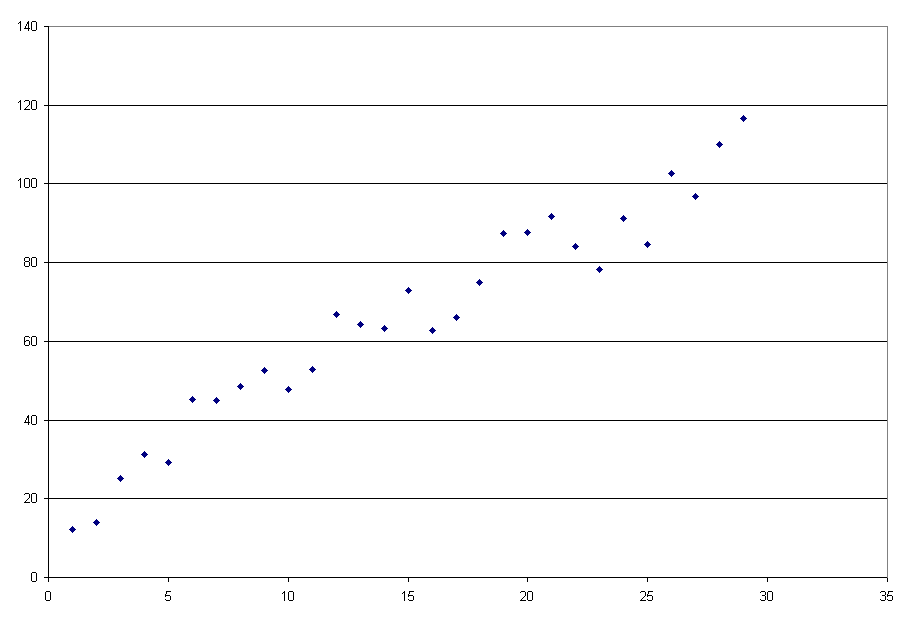
The last problem I am going to talk about now is a venerable one, commonly associated with Bertrand Russell. Imagine you see a trend line that jitters around a bit, but always moves upwards. Asked what is likely to happen next, you would probably suggest a jump comparable to the mean increase between past intervals. Too bad the data series is grams of food being eaten by a turkey per day, and tomorrow is Thanksgiving. You might have a beautiful bell curve showing the mean food consumed by the turkey per day, but it might all fall apart because something that undergirded the distribution changed. Those whose pensions were heavily based on Enron stock have an acute understanding of this.

When their use is justified, bell curves are exceptionally useful. At the same time, using them in inappropriate circumstances is terrifically dangerous. Just because a stockmarket fall of X points is five standard deviations greater than the mean does not imply that it will happen 0.00005733% of the time, despite what bell curve equations and relatively soft-headed statistics instructors might tell you.

Odds guessing experiment

One of the subtle pleasures associated with reading this blog is the occasional opportunity to be experimented upon. Today is such a day.

Instructions:

  1. Read all these instructions before actually completing step two.
  2. Flip a coin.
  3. Please actually flip a coin. People who choose ‘randomly’ in their heads do not actually pick heads and tails equally. If you don’t have a coin use this online tool.
  4. If it landed heads, click here.
  5. If it landed tails, click here.
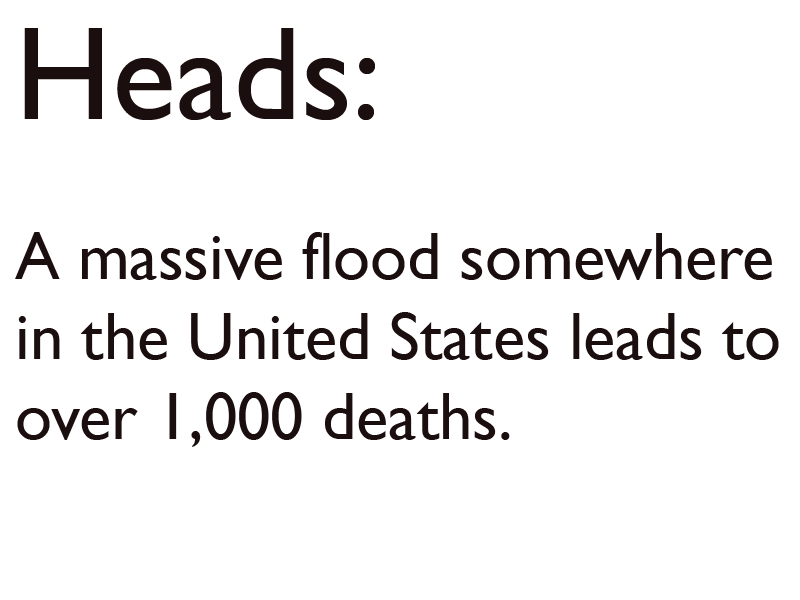
  6. When you click one of the links above, you will see a description of an event.
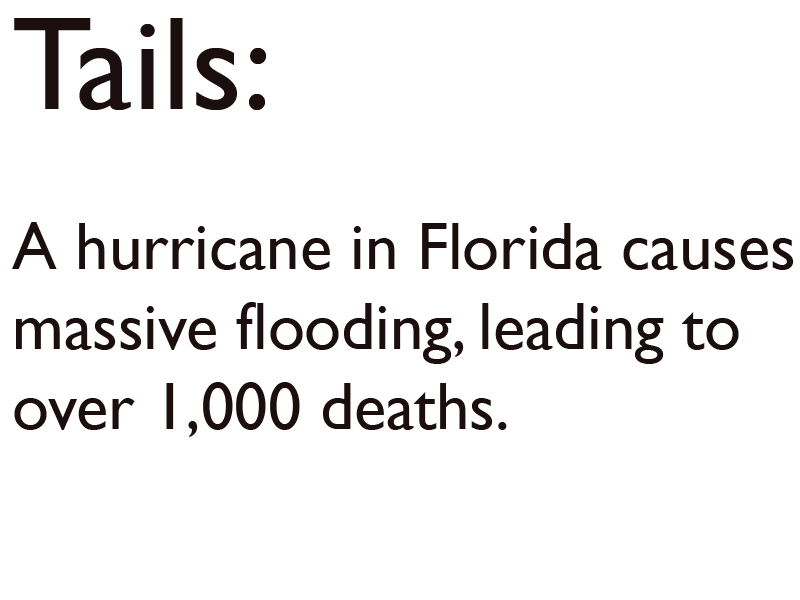
  7. Before looking at the comments below, estimate the probability of the event you see described happening in the next year.
  8. Write that as a comment, indicating whether you are answering the heads question or the tails question.

When you are done, you are naturally free to read the other question and the comments left by others.

Even if you don’t normally comment, please do so in this case. I want to get enough responses to permit a statistical comparison.

Choosing nuclear

Nuclear flowchart

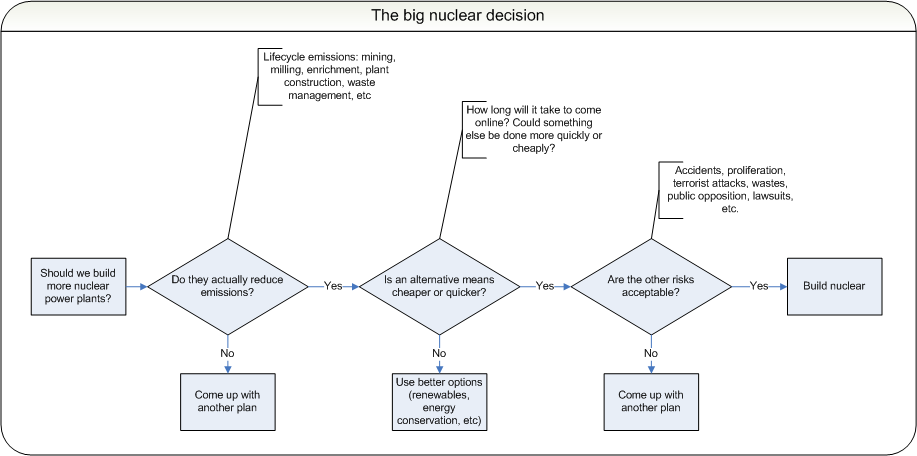
The flowchart above illustrates one process through which we could collectively evaluate the desirability of nuclear power, given the potential risks and benefits associated with the technology. In my personal opinion, the answer to the first question is probably “yes,” though perhaps not to as large a degree as commonly believed. The second and third questions are much more up in the air, and necessarily involve uncertainty. We cannot know exactly what will be involved in building a massive new nuclear architecture before it is done; similarly, it cannot be known with certainty what would result from choosing conservation and renewables instead.

As for the third question, there are major questions about risk evaluation and risk tolerance. If the world keeps running nuclear plants, it is a statistical certainty that we will eventually have another serious nuclear accident. No nuclear state is without its contaminated sites, and none yet has a geological repository for wastes.

This post definitely isn’t mean to settle the question initially posed, but rather to clarify thinking on the issue and dismiss the automatic logical leap from “climate change is happening” to “build more fission plants.”

Vat-grown meat

Beijing Olympic Protest

As discussed previously, meat eating is problematic in terms of the environment, animal welfare, and human health. One mechanism through which one of those concerns can be eliminated – and the others potentially mitigated – is to remove animals from the equation. This week saw the world’s first international conference on the industrial manufacture of meat. Arguably, that is what the beef, pork, and chicken industries already do but, in this case, the meat is to be grown in industrial bioreactors instead of inside animals that are subsequently killed.

It should be noted from the outset that there are some problems that this approach absolutely will not solve. It will always take more energy to sustain a meat diet than a plant diet, whether that energy is going into cows or industrial processes. Similarly, large amounts of energy use associated with transportation and refrigeration would be undiminished in the face of in vitro meat production. Given that plants will probably always be a feedstock to the process, concerns about water and fossil fuel use in agriculture, as well as fertilizer and pesticide runoff, remain in place. That said, it is possible that vat grown meat could be marginally more efficient, since calories would not be directed towards growing skeletal or nervous systems. Big vats would also have a higher volume to surface area ratio than animals, making it less energy intensive to keep warm.

The major problem vat-grown meat could solve is animal welfare, though that is probably the reason for avoiding meat that most people find least compelling. Even most vegetarians drink milk and eat eggs, most of which is produced under conditions equally awful for the animals. Arguably, vat grown meat would still be a kind of ethical violation – not because any animals suffer, per se, but because the whole concept is somehow monstrous and demeaning to nature.

All told, this doesn’t seem like much of a solution. The way slaughterhouse animals exist already approximates the character of an industrial meat factory. There is also little reason to believe that firms that happily feed all manner of drugs and hormones to animals would not similarly manipulate huge tanks full of artificial fat and muscle. As such, any hygienic concerns about factory farmed animals would probably translate readily to vat-grown meat.

The relevance of any of this is fairly questionable, given that vats are currently capable of producing the very lowest quality kind of meat (fodder for ground meat and nuggets) and can only do so at a financial cost higher than industrial agriculture. For all intents and purposes, we have already built industrial bioreactors on the skeletons of livestock. Shifting those to steel drums, as an alternative, will only make sense if the economics swing strongly in that direction for some reason.

Drugs for mental enhancement

Rusty bridge and steam pipes

A recent informal survey, conducted by Nature, suggests that large numbers of scientists are ‘doping’ with drugs that enhance their wakefulness and concentration. While the old joke holds that “a mathematician is a device for converting coffee into theorems,” drugs of choice have expanded to include Modafinil (Provigil) and Methylphenidate (Ritalin).

One in five respondents said they had used drugs for non-medical reasons to stimulate their focus, concentration or memory…

For those who choose to use, methylphenidate was the most popular: 62% of users reported taking it. 44% reported taking modafinil, and 15% said they had taken beta blockers such as propanolol, revealing an overlap between drugs. 80 respondents specified other drugs that they were taking. The most common of these was adderall, an amphetamine similar to methylphenidate.

I do not find this surprising. At a conference once, I met a young woman who pays her tuition by selling drugs usually prescribed for attention deficit disorder to fellow students at her Ivy League school.

It is not clear what kind of response is justified in the face of such anecdotal evidence. It is not obvious, prima facie, that the use of drugs is an inappropriate way to improve one’s mental function or academic output. People use all sorts of mechanisms – from physical activities to dietary modifications – to try to achieve the same end. Prescription drugs are thoroughly vetted for safety, though it is also fair to say that people self-prescribing are likely to make mistakes in terms of dosages and interactions with other substances. People make all kinds of sacrifices for success and it isn’t clear why it is obviously inappropriate for them to run the risks associated with altering their biochemistry. Given the degree to which success is related to self-esteem and contentedness, as well as the degree to which perceptions of failure associate with depression, it could arguably be better for one’s mental health to use whatever aids to success are available.

One legitimate concern is about a spiral effect. If honour roll students and leading researchers start becoming dependent on drugs to improve their focus, it might become difficult for anyone not doping to keep up. That could lead to situations in which people feel strongly pressured to do drugs as well. Of course, that strong pressure already exists in competitive academic environments. Still, there is reason to be especially wary when it is combined with psychoactive chemicals.

The questions suggested by the survey cannot be adequately addressed in a short blog post, but it does seem likely that they will be the subject of greater amounts of attention in the future. The competitive nature of the world, and the need to achieve things ever more rapidly, ensures that a market will exist for products that help people cope with both of those things. As with other unauthorized uses of drugs, the policies adopted by governments will affect things like price, availability, safety, and access to information and advice. Getting the balance right will be tricky.

Some carbon capture similes

The media is full of talk about carbon capture and storage (CCS). At the same time, there are only four facilities in the world where it is done. None of them resemble a conventional coal-fired power plant.

As a result, our cost projections for the technology are far more speculative than is commonly acknowledged. It is like we are in the era of the Wright Brothers, and we are trying to sort out the economics of running a major airline.

As I have said before, we had better hope that CCS works, if only because so many different climate change mitigation plans depend on it. At the same time, we really need to acknowledge that there is some chance that it simply will not work, and we will need to find those megatonnes of reduction somewhere else.

That uncertainty also pertains to questions about building more coal power plants. Building them today – with the hope that CCS will eventually become available – is highly irresponsible. It might be compared to jumping out of a plane and hoping you can sew yourself a parachute before you hit the ground.

Thoroughly impressed by TED

Steel girders and sky

Initially drawn in by the Al Gore video, I have been watching lots of the films from the TED conference, and being impressed by many of them. I am more impressed than ever by cephalopods, and some of my idle curiosity about how ants decide what to do has been satisfied. I also learned about some new reasons for which we should be wary about the long-term use of antidepressant drugs.

Putting these short lectures online is an excellent way of demonstrating the power of the internet to distribute ideas. Even for those of us who would balk at flying to California to attend some very neat talks, fiber optic links provide a low-carbon alternative.

Thermonuclear weapon design

A common misunderstanding about thermonuclear weapons (those that employ tritium-deuterium fusion as well as the fission of uranium or plutonium) is that most of the extra energy produced comes from fusion. In fact, the great majority comes from additional fission encouraged by neutrons produced by the fusion reaction. Each atom that undergoes fission generates 180 million electron volts (MeV) of energy, equivalent to 74 terajoules per kilogram. Tritium-deuterium fusion produces only 17.6 MeV per incident, though the materials that undergo fusion are far less massive than those that undergo fission.

The general functioning of a modern thermonuclear bomb (Teller-Ulam configuration) is something like the following:

  1. A neutron generator bombards the plutonium pit of the primary (fission device).
  2. Exploding-bridgewire or slapper detonators initiate the high explosive shell around the pit.
  3. The pit is compressed to a supercritical density.
  4. The pit undergoes nuclear fission, aided by the neutron reflecting properties of a shell made of beryllium, or a material with similar neutron-reflection properties.
  5. The fission process in the primary is ‘boosted’ by the fusion of tritium-deuterium gas contained in a hollow chamber within the plutonium.
  6. The x-rays produced by the primary are directed toward the secondary through an interphase material.
  7. Within the secondary, heat and compression from the primary induce the production of tritium from lithium deuteride.
  8. Tritium and deuterium fuse, producing energy and high-energy neutrons.
  9. Those neutrons help induce fusion within a uranium-235 pit within the secondary (called the spark plug). Layers of uranium-235 may alternate with layers of lithium deuteride, and the whole secondary may be encased in a sphere of uranium-235 or 238. This tamper holds the secondary together during fission and fusion. Uranium-235 or 238 will also undergo fission in the presence of neutrons from fusion.

Throughout this process, the whole device is held together by a uranium-238 (depleted uranium) case. This is to ensure that the reactions proceed as far as possible before the whole physics package is blasted apart.

One important security feature can be built into the detonators that set off the explosive shell around the primary. By giving each detonator a fuse with a precisely set random delay, it is possible to ensure that only those who know the timing of each detonator can cause the bomb to explode as designed. If the detonators do not fire in a very precisely coordinated way, the result is likely to be the liquefaction of the plutonium core, followed by it being forced out of the casing as a fountain of liquid metal. Nasty as that would be, it is better than the unauthorized detonation of the weapon.

The detonators are also an important safety feature since their ability to cause very stable explosives to detonate means that the high explosive shell can be made of something that doesn’t detonate easily when exposed to shock or heat. That is an especially valuable feature in a world where bombs are sometimes held inside crashing planes, and where fires on submarines can prove impossible to control.

Al Gore at TED

Safety sign

The Technology Entertainment Design Conference takes place annually in Monterey, California. At the most recent one, Al Gore presented an updated version of his climate change slideshow, made famous by his film An Inconvenient Truth.

It seems a bit remarkable for me that when I first saw that film in Oxford, I wasn’t yet convinced about the full extent of the threat of climate change. Since then, I have devoted the majority of my time and attention to this issue. If you have not done so yet, I encourage you to watch the video linked above, and perhaps read some of the posts in my climate change index.

It is not unrealistic to say that climate change will be the defining issue of the next century, and possibly far beyond. Gaining a strong understanding of it is the least we can do as educated people today.

Hurricanes and climate change action

Bike beside the Rideau Canal in spring

At several points in the past, I have mentioned the possibility that the majority of people will not be willing to accept serious action on climate change until at least one big, unambiguously climate related disaster has taken place. The same point is made in Joseph Romm’s book but, whereas I have speculated that it could be vanishing icecaps or large-scale climate induced human migration in Asia, he seems to think that Atlantic hurricanes striking the United States may make the difference.

There is good reason to find this plausible. The strength and frequency of hurricanes both have a lot to do with sea surface temperature (SST). While it isn’t feasible to attribute the occurrence or harmfulness of a particular storm to climate change, it is relatively easy to show a correlation between rising global temperature, rising SST, and more severe hurricanes. Simulations conducted by the U.S. National Oceanic and Atmospheric Administration Geophysical Fluid Dynamics Laboratory led to them concluding that “the strongest hurricanes in the present climate may be upstaged by even more intense hurricanes over the next century as the earth’s climate is warmed by increasing levels of greenhouse gases in the atmosphere.” Within decades, rising SSTs could make the kind of extraordinary hurricane seasons that have proliferated since 2000 the low end of the new scale.

This matters partly because a hurricane-climate change connection would affect Americans directly and very visibly. Insurance prices would rise further, at the same time as more areas became uninsurable and serious questions arose about whether to rebuild at all in some places. The cost trade-offs between insurance, protective measures like higher levees, and storm risk would be thrown into sharp relief. The perceived damages associated with climate change would also shift from being associated with people outside of North America at some distant point in the future to being both physically and temporally immediate.

Obviously, it would be better if serious measures to combat climate change (eliminating non-CCS coal, pushing hard on energy efficiency, building dramatically more renewable capacity, etc) could come about simply as the result of a reasoned assessment of the IPCC’s scientific conclusions and projected associated costs. If, however, it is going to take disasters before people and politicians are ready to embrace real change, we should hope that they will come early, carry a relatively small cost in human lives, and not exacerbate the problem of climate change in and of themselves, as fires and ice loss do.