The viability of cellulosic ethanol

Cat on Parliament Hill

Corn-based ethanol fuels have received a lot of welldeserved criticism lately. This includes criticisms that they take more fossil fuels to produce than they replace, that they have a marginal effect on total greenhouse gas emissions, and that they raise food prices and starve the poor. Ethanol defenders use two approaches to counter-attack. They claim that these problems are not as severe as reported, and they argue that corn ethanol is a necessary step on the road to cellulosic ethanol, which will be made from non-food crops grown in ways that don’t use fossil fuels intensively.

A recent post at R-Squared questions whether that transition will ever occur. Rapier argues:

Cellulosic ethanol, and by that I mean cellulosic ethanol in the traditional mold of what Iogen has been working on for years – will never be commercially viable.

If so, this is bad news for biofuels in general. Rapier points out problems including the large amount of lignin in biomass, the difficulties in transporting such quantities of biomass to refineries, and the energy use involved in drying the stuff out.

Additional criticisms of cellulosic ethanol can be found in a recent study from Iowa State University. According to their economic analysis, cellulosic ethanol will never be produced at the levels envisioned by the American Renewable Fuel Standard, and will only be produced in substantial quantities if it gets three times the subsidy already granted to corn ethanol:

Competition for land ensures that providing an incentive to just one crop will increase equilibrium prices of all. Also, at pre-EISA subsidy levels, neither biodiesel nor switchgrass ethanol is commercially viable in the long run. In order for switchgrass ethanol to be commercially viable, it must receive a differential subsidy over that awarded to corn-based ethanol.

Largely, this is on account of how growing any crop in massively increased quantities will affect factor prices for other crops: from land to labour to farm equipment.

There is no doubt about it, if technology is going to help us transition to a low-carbon society without giving up liquid-fuel driven transport, we are going to need to come up with some awfully clever new ideas.
Monuments for heretics

At University College, Oxford, you can see a large memorial to Percy Bysshe Shelley. Those who have seen The Saint may remember it as the place where the lead characters meet. Its presence is a bit odd, however, given that the college and university expelled him because he refused to deny writing a pamphlet called The Necessity of Atheism.

The Vatican is now aiming to do one better than University College, erecting a statue of Galileo close to the apartment where he was imprisoned in 1633 on allegations of promoting heliocentrism. His Dialogue Concerning the Two Chief World Systems can be read online.

Climate denial conference

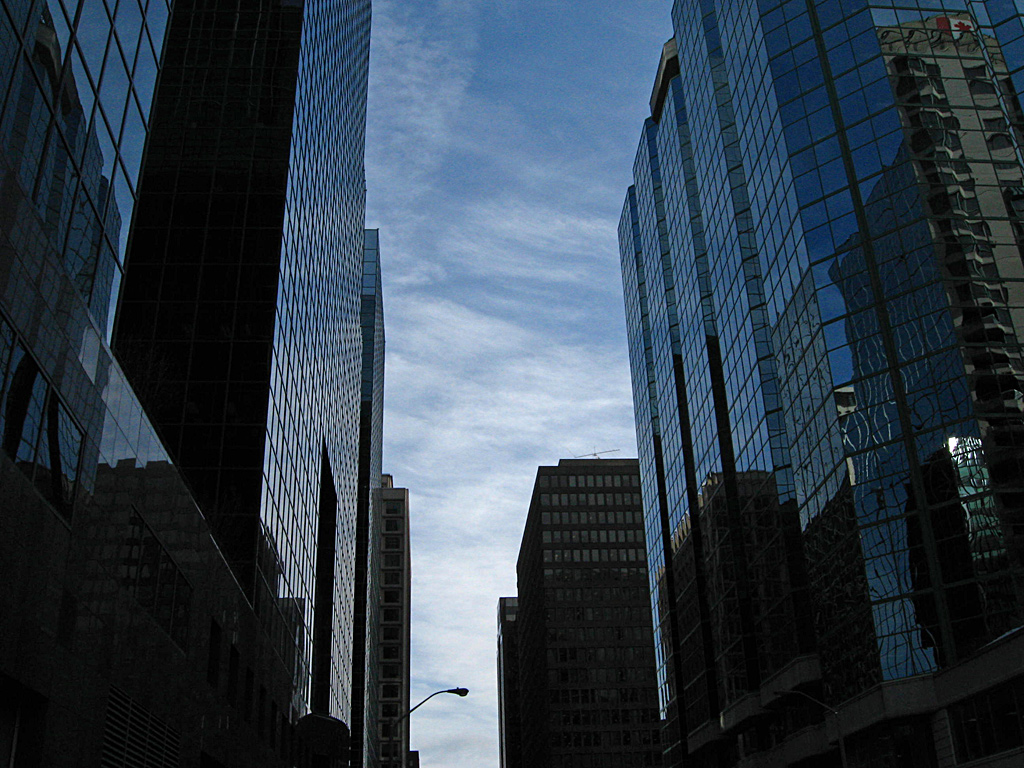
Ominous Ottawa skyline

On various climate blogs, there has been coverage recently about a climate change skeptic conference run by the American Heartland Institute. DeSmogBlog and Grist have been leading the scolding, though the mainstream media seems to have started to cotton on that these people are corrupt, frauds, or seriously misguided. The New York Times and Wall Street Journal both have pieces that are somewhat critical of the validity and motivation behind the conference.

You can argue all you like about what level of greenhouse gases in the atmosphere is represents a tolerable level of risk. You can likewise wade into many fascinating debates about paleoclimatology, climatic feedbacks, and technological development. Nobody has an especially good answer to the question of how climate change mitigation, development, and poverty reduction can be ethically balanced against one another. What you cannot do these days, while retaining your credibility, is deny that the human burning of fossil fuels is causing the planet to warm, and that the consequences of that warming are extremely likely to be harmful to human, plant, and animal life.

The whole thing reminds me of the laughable commercials produced by the Competitive Enterprise Institute. Here are some resources for countering the misguided or disingenuous arguments made by those who challenge the rigorously demonstrated elements of climate change science.

Big picture uncertainty

Buildings in central Ottawa

Climate change policy focuses on constant attempts to make guesses about the future: about economic development in rich states and poor, about patterns of technological evolution, about climatic responses to radiative forcing caused by changes in the gas mixture of the atmosphere. One cannot always evade the feeling that too many uncertainties are being layered. Consider, for instance, the possibility that hydrocarbon fuels will peak in world output within the next few decades. If that happened, most of our ‘business as usual’ economic projections would be badly wrong.

An even more ominous consideration relates to global conflict. When the world is generally doing well, it is devilishly hard to convince states to reduce their greenhouse gas emissions for the universal good. Imagine how hard it would be in a geopolitical environment based around rising tensions and the growing expectation of great power war. We make projections for 2100 without acknowledging that making it from now to then without such a war would be a historical aberration.

In the end, I suppose, cynicism does us little good. The vast majority of ordinary people – and of powerful people – will not believe in the disastrous potential consequences of climate change until they start to manifest themselves visibly. As such, agonizing about them just makes you more marginal to the debate that exists among those not kept awake by fear about the possibility for self-amplifying positive feedbacks in the climate system. We must do the best we can, avoid confusing engagement with the mainstream debate with genuine complacency, and hope that humanity possesses more wisdom than it has ever demonstrated before.

Post-2012 climate conference

The International Institute for Sustainable Development is running a two-day conference in Ottawa about post-2012 climate change policy. 2012 is the end of the first compliance period for the Kyoto Protocol, so ‘post-2012’ is shorthand for whatever international climate regime is to be the successor to Kyoto. Notes will be published on the wiki as they become available.

Notes from previous conferences are also available:

In Defense of Food

No parking sign

Having recently read and enjoyed Michael Pollan’s The Omnivore’s Dilemma, his newer book caught my eye this morning. I had seen a review contrasting it negatively with his prior work, but decided to take the plunge anyhow. I am glad I did. While there is less value added in terms of general knowledge, it is a much more practical guide to how the realities of contemporary food production affect the choices of conscientious modern omnivores.

The book does an excellent job of combining a good breadth of consideration with the production of manageable advice. Opening with “Eat food. Not too much. Mostly plants,” it elaborates those simple sentiments into a pretty good set of suggestions. Critically, ‘food’ refers only to things that would be recognized as such by people from a few hundred years ago. After going through the decidedly unnatural list of ingredients for a loaf of bread, Pollan declares that:

Sorry, Sara Lee, but your Soft & Smooth Whole Grain White Bread is not food and if not for the indulgence of the FDA [in not longer requiring the use of the word ‘imitation’] could not even be labelled “bread.”

Pollan does an excellent job of critiquing food science and the ‘nutritionism’ that reduces the complex chemistry of food and eating to simple affirmation or condemnation of individual chemicals and chemical classes, such as saturated fats. He provides a compelling description of the nature and evolution of the Western Diet, as well as the societal and economic reasons for its emergence and the health consequences that emerge from it.

In addition to discussing what to eat, Pollan provides some good tips on how. Basically, he suggests that people return to forms of eating more rooted in culture. Constant snacking, eating alone, and consuming massive portions are problematic even if the foodstuffs in question are relatively good. He also endorses gardening and cooking from scratch as ways of weeding out non-foods while also gaining more appreciation for the relationships involved in growth and eating.

Pollan provides a list of 24 bits of concise (and sometimes counterintuitive) advice. He provides some good tips on where and how to shop (avoid the centre of supermarkets – stick to the unprocessed foods at the edges). I was particularly delighted to learn about the strong case for how a glass of wine with dinner can do a fair bit to promote cardiovascular health. Since reading his previous book, I had already made some pretty significant dietary changes. Barring the occasional pot of Knorr soup, I have eaten virtually nothing that wasn’t “food” as he defines it. I have also been thinking a lot more about what I eat, where it comes from, how I prepare it, and so forth. Overall, the process has been meaningful and enjoyable.

It is pretty rare for me to buy a book and read it though in a day. The fact that I did with this one demonstrates both how engaging and accessible it is. For those wanting some sound dietary advice, rather than a more extensive discussion of the nature of various food systems, this book is well worth examining. I am planning to foist my copy onto as many people as possible.

Deceit and development

An interesting article in New York Magazine discusses the development of lying in children. While one might superficially expect truthfulness to be the greater virtue, deception is highlighted as the more advanced behaviour:

Although we think of truthfulness as a young child’s paramount virtue, it turns out that lying is the more advanced skill. A child who is going to lie must recognize the truth, intellectually conceive of an alternate reality, and be able to convincingly sell that new reality to someone else. Therefore, lying demands both advanced cognitive development and social skills that honesty simply doesn’t require. “It’s a developmental milestone,” Talwar has concluded.

This really isn’t too surprising. It is, after all, the development of strategic thinking that differentiates sophisticated actors from unsophisticated ones, and the ability to avoid revealing strategic vulnerabilities is crucial to effective action in many circumstances.

While parents probably feel as though their children should be willing to trust them with anything, they also need to appreciate the degree to which an ability to mislead is crucial to success in pretty much all significant engagements with strangers, and probably even colleagues and friends. After all, how many dates, weddings, or job interviews is a person liable to get through successfully without a strategic awareness of information and an ability to leverage it through everything from tactful suppression of facts or details to their outright misrepresentation.

Contraction and convergence

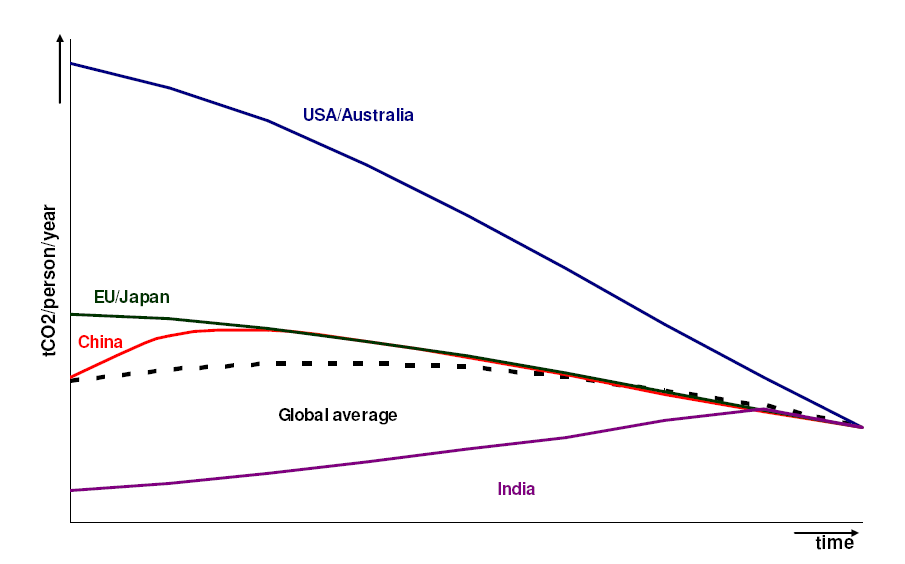
The interim version of the Garnaut Review (mentioned earlier) includes a numberless graph illustrating what the principle of contraction and convergence in per capita greenhouse gas emissions would resemble:

Contraction and convergence graph from the Garnaut Review

A few features are especially notable. The first is the relative trajectories in the opening years. States with very high per capita emissions, like Australia and Canada, would have to reduce emissions sharply right from the outset. Rapidly growing poor states like China would be allowed to grow until per capita emissions are comparable to those in relatively low emission developed states, such as the EU. Gradually, everybody’s per capita emissions become lower and more similar.

This approach becomes a lot more politically feasible when you take these lines to represent emission allocations rather than actual emissions. Developing states would have a choice about how to use the extra space allocated for their development. They could opt to use the allocation for their own emissions, allowing the growth of GHG emitting industry; alternatively, they could sell the allocations to more developed states at a globally established market price. That way, poverty reduction and development goals could be served at the same time as total GHG emissions trend towards a sustainable level. The big advantage of allowing global trading is that it should equalize the international marginal cost of abatement. In simple terms, that means that it will ensure that the emissions that can be avoided at the lowest cost will be addressed first, minimizing the overall cost of mitigation.

The Garnaut Review rightly highlights that it would be incredibly politically difficult to establish such an international regime. At the same time, it is probably also right to say that a general approach that embraces contraction and convergence has the best chance of stabilizing global greenhouse gas emissions at a level that avoids dangerous anthropogenic interference in the climate system, and does so in a way that minimizes total costs and manages the distribution of costs and benefits in an acceptably fair manner.

Ethics among the doomed

Discarded hubcap

There have been a number of arguments here before about how excess can be justified: specifically, how emitting more greenhouse gasses than is sustainable per-capita based on the present human population can be morally justified. A new logical possibility occurred to me today: it is possible that we are already doomed. By that, I mean that pretty much all aspects of life that we consider to be deeply meaningful or important are already destined to be obliterated as a result of past action or inevitable future actions. For instance, the amount of climate change already locked into the climate system as the result of lags and positive feedbacks may be sufficient to make human civilization untenable.

If this is true, it changes the dynamic somewhat. The standard view of climate change is that we are all on a big ship in the middle of the sea, completely isolated from any help, and a serious hull breach has occurred. If most of us work together selflessly, we can plug it and save the ship. There is, however, the logical possibility that the leak is so bad that even the complete commitment of everyone aboard will not stop the rising water, and will not save a single one among us.

If we have crossed that threshold of inevitability, we are released of our obligations to prevent the sinking of the ship. Of course, the extent to which the sinking was preventable or not can only be known after the fact. Either we find ourselves in the position of being saved, on the basis of whatever efforts were made, or we find ourselves in oblivion, in spite of whatever was done to encourage an alternative outcome.

Seed vault opening

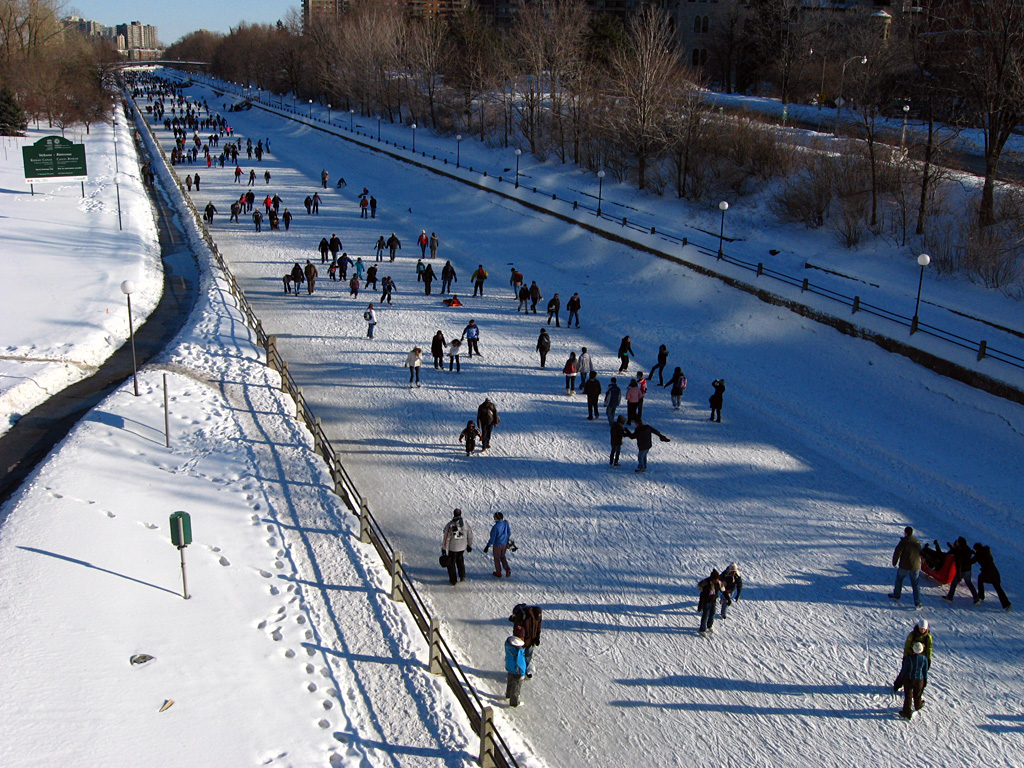
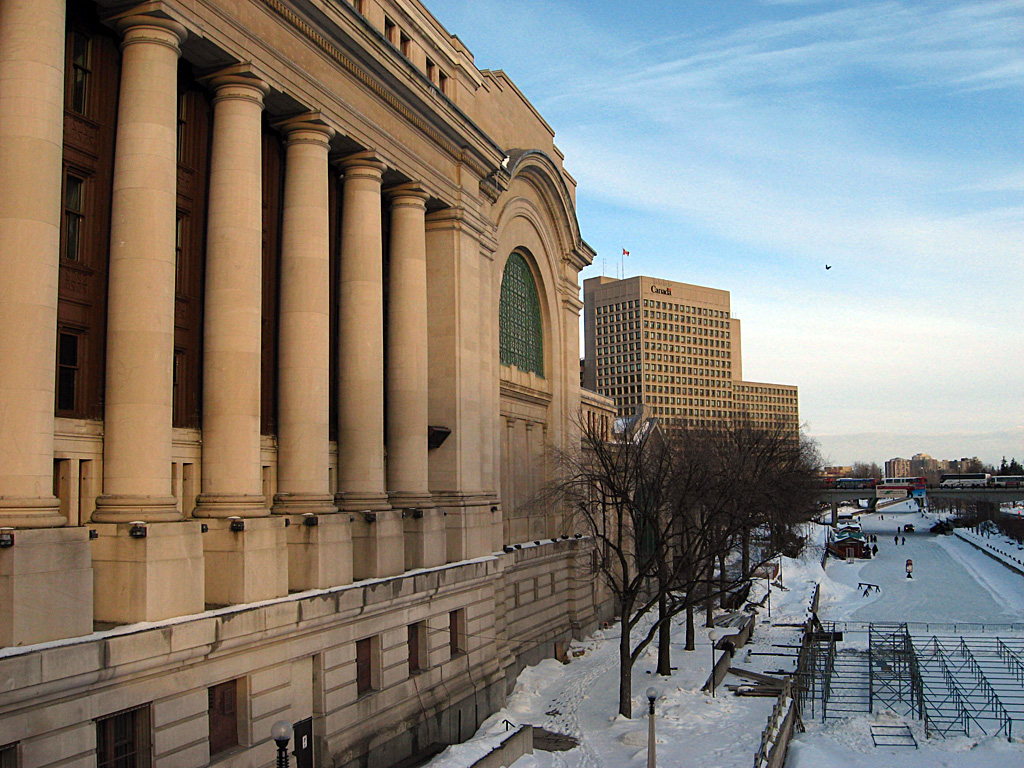
Skaters on the Rideau Canal

A particularly tangible sort of insurance policy is being initiated today, with the opening of the Svalbard Global Seed Vault. The underground facility is intended to protect the genetic diversity of plant species, in recognition of the risk that other seeds could be destroyed by a worldwide disaster. Eventually, the vault is meant to contain 4.5 million seed samples, deposited by governments from around the world.

The vault is buried 120m inside a sandstone mountain selected for remoteness, persistent cold, and lack of tectonic activity. The selection of a site 130m above sea level ensures that, even if all the world’s ice melts, it will not be submerged. The seeds will be kept at a temperature of -20 to -30 degrees Celsius using electrical power. In the event of a failure of refrigeration, several weeks would elapse before temperatures rose to the -3 degree temperature of the surrounding rock. The packaging of the seeds – along with their natural durability – should make at least some viable for long periods of time, even in the absence of refrigeration.

The $9.1 million project was financed by the Global Crop Diversity Trust. While there is no particular reason to believe that the world’s 1400 or so other seed banks would be universally unable to survive something like a nuclear war or a comet or asteroid impact, $9.1 million is probably a sensible expenditure when so many potentially vital species are to be protected. Less sensational disasters are also being insured against: from the destruction of national seedbanks through conflicts or errors to administrative blunders or localized natural disasters.

An interactive tour of the facility is accessible online.