
Category: Teaching
And gladly wolde he lerne, and gladly teche.
My fifth year of teaching
The capricious forces directing undergraduate teaching in political science have set me up for an extremely difficult term.
First, I was assigned to teach an hour’s $6 shuttle drive away, at the Missisauga campus. Second, my “tutorials” are starting with 30 students each. With only five tutorials in the entire course, this raises the question of how students can be meaningfully graded on participation.
Most seriously, they allocated all of my 210 teaching hours for the year to just this term. Since my fellow TAs are only doing half their hours this term, my huge surplus of hours must be dedicated to grading. This means I will be spending huge blocks of time grading the midterm and the essay — so much that it seems impossible within the standard turnaround time for exams and assignments. As a further vexation, all the grading must be done through tedious and fiddly online systems, rather than quickly and intuitively on paper copies.
At the same time, I am working hard with my committee to get my PhD project formally approved by the department, and to get research ethics approval. Judo aside (which ought to help remain sanity), this will be a term where further extras are essentially inpermissible.
Summer TA work at U of T
In each year of my PhD, I have applied for all the summer teaching assistant (TA) positions offered in the Department of Political Science (and, after second year, in the School of the Environment too). I never heard anything back as the result of my applications, including for frequently-advertised ’emergency’ positions and jobs in statistics courses which I expected to be less popular.
Today I had a brief conversation with a prof who I worked for in a fall and winter term and learned that virtually all summer TA jobs go to people who are beyond the 5-6 year span where U of T provides funding. Apparently, summer TA jobs all go to people who are in their 8th or 9th year, or otherwise well beyond the “funded cohort” and seniority is the overwhelming criterion used to select them.
It’s reflective of how U of T generally under-funds its graduate students, as well as how the quality of teaching provided to undergrads is clearly not a university priority.
Tutorial attendance
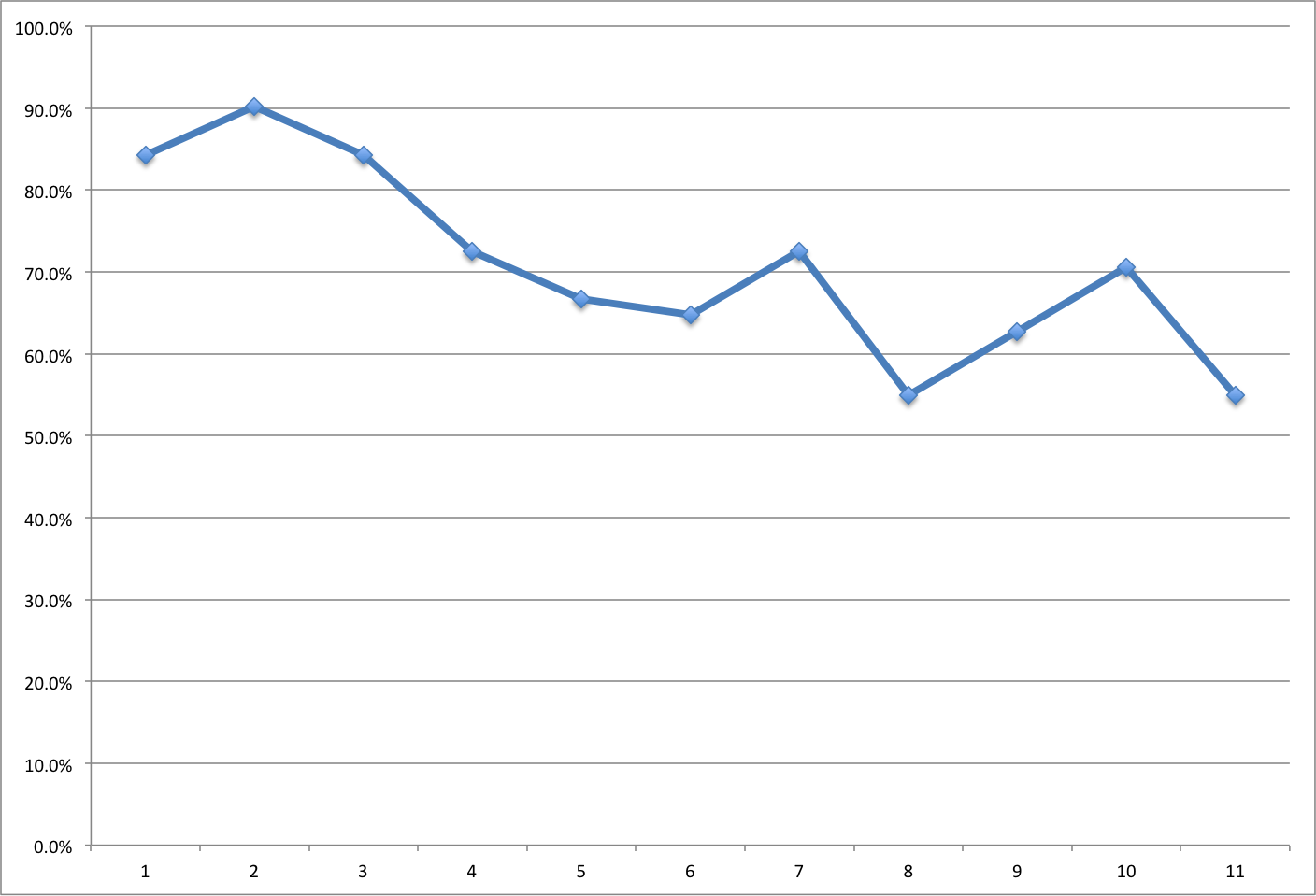
Having finally finished grading the second set of late essay assignments, I am now calculating the participation grades for my tutorials in the fall and winter term.
The profile of attendance across time isn’t as flat as one might like, but doesn’t look too dismal:
On Wednesday, I am invigilating the final exam, which we are then meant to mark in a week.
I desperately need to be working on my PhD proposal and research ethics protocol, but I also need to apply for a TA position or some other kind of summer job, just to contain the rate at which my PhD savings are being depleted by food and rent.
Toronto land recognitions
Land acknowledgements — in which people recognize the traditional territory of indigenous peoples on which they are assembled — are an important part of decolonization and indigenous reconciliation. This year, I included one in my handout for tutorial students.
There is not, however, a definitive recognition for downtown Toronto or the U of T area. I have head a wide variety of indigenous peoples recognized, most commonly the Anishinaabe, Haudenosaunee, and Wendat peoples, but often others as well, and sometimes with one or more of those excluded.
For the divestment Community Response, we used the Ryerson University land acknowledgement.
Recently, Massey College and the School of Public Policy hosted the Walter Gordon Symposium on the theme of responding to Canada’s Truth and Reconciliation Commission. The program for the conference included a land acknowledgement which is probably as well-researched and historically justified as any that is available for this area:
I would like to acknowledge this sacred land on which the University of Toronto operates. It has been a site of human activity for 15,000 years. This land is the territory of the Huron-Wendat and Petun First Nations, the Seneca, and most recently, the Mississaugas of the Credit River. The territory was the subject of the Dish With One Spoon Wampum Belt Covenant, an agreement between the Iroquois Confederacy and Confederacy of the Ojibwe and allied nations to peaceably share and care for the resources around the Great Lakes.
Today, the meeting place of Toronto is still the home to many Indigenous people from across Turtle Island and we are grateful to have the opportunity to work in the community, on this territory.
This acknowledgement can be found on a U of T libraries page about the indigenous history of Toronto. It notes that it was: “Revised by the Elders Circle (Council of Aboriginal Initiatives) on November 6, 2014”.
For my PhD research, the challenge of identifying which indigenous peoples have traditionally occupied any piece of territory from Texas to Oklahoma, to Kansas, to Nebraska, to South Dakota, to North Dakota, to Montana, to Saskatchewan, to Alberta to British Columbia is considerable. So too, the challenge of identifying any indigenous governance bodies that regulate academic research, and what sort of approval process each requires.
Free speech at universities
The Economist recently printed an article about free speech on university campuses in the U.S..
In particular, they contrast thedemands.org which they say “lists speech-curbing demands from students at 72 institutions” and the Chicago Statement which argues that “[c]oncerns about civility and mutual respect can never be used as justification for closing off discussion of ideas, however offensive or disagreeable”.
Generally speaking, I am extremely skeptical about curbs on the freedom of speech, even when they have plausible justifications. People don’t have a right not to be offended, and universities must provoke thinking in order to serve their purpose.
Operant conditioning
When I see people out walking dogs, I like reaching a hand out to the creatures and seeing their reactions. Usually the humans are happy about this and volunteer information about the dog’s name and breed. Occasionally, there are people who pointedly ignore me and yank hard on the leash to punish the dog for noticing me.
These people are bad animal trainers.
On the amazing AnimalWonders Montana YouTube channel, Jessi Knudson has done an amazing job of building relationships with a wide variety of animals. She is easily able to encourage a Brazilian prehensile-tailed porcupine to get into his crate for a veterinary appointment, and has taught a dog how to painlessly have its nails cut.
She has a video about clicker training: a form of operant conditioning where the sound of a click is used to teach an animal about the precise behaviour which you are tying to encourage or discourage.
She has two videos specifically about operant conditioning: Law of Effect and Operant Conditioning.
Learning more about operant conditioning seems potentially helpful when it comes to motivating climate volunteers, working with photographic subjects, and teaching students. When things are a bit less hectic, I will need to make a preliminary foray into the literature.
This year’s teaching
This is going to be my busiest year yet on the teaching and (especially) the grading side. I am working as a teaching assistant for the same second year Canadian politics course which I taught last year. This time the professor has decided to structure the tutorials as debates on topics like whether to change Canada’s electoral system or lower the voting age. Compared with the standard approach of discussing the readings, this seems likely to produce more student engagement.
I also got a job as a TA for the first year graduate environmental decision-making course which is part of all the collaborative programs U of T offers in environmental studies. I am told it’s quite unusual to be a TA in a graduate level course. I will mostly be grading, but I will also be delivering a lecture next Friday on EU fishery access agreements in West Africa.
This should all be comparatively feasible since I am not taking any courses in the fall term, though my main focus has to be on putting together my dissertation proposal and getting it through the necessary departmental and ethical reviews.
Threats of gendered violence at U of T
Anonymous threats of violence against women and feminists at the University of Toronto have appeared online recently.
In response, the women’s caucus of CUPE 3902 organized a demonstration against gendered violence.
Attendance histogram
With a couple lost to the CUPE 3902 strike, I taught twelve sets of tutorials this year.
The histogram below shows how many students attended more than any particular number of tutorials:
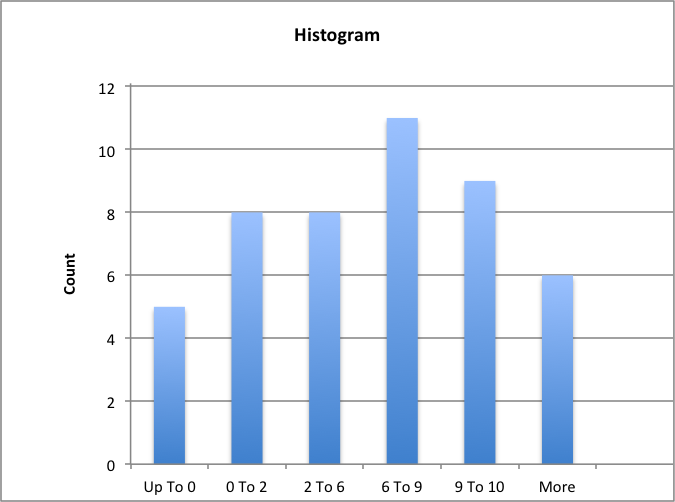
Any thoughts on the distribution? It looks approximately unimodal and symmetrical, with the largest number of students having attended six to nine of the twelve tutorials. Students were free to attend any tutorial they wished, but these numbers include students who missed their normal tutorial and attended an alternative one.
This histogram shows active participation in tutorials:
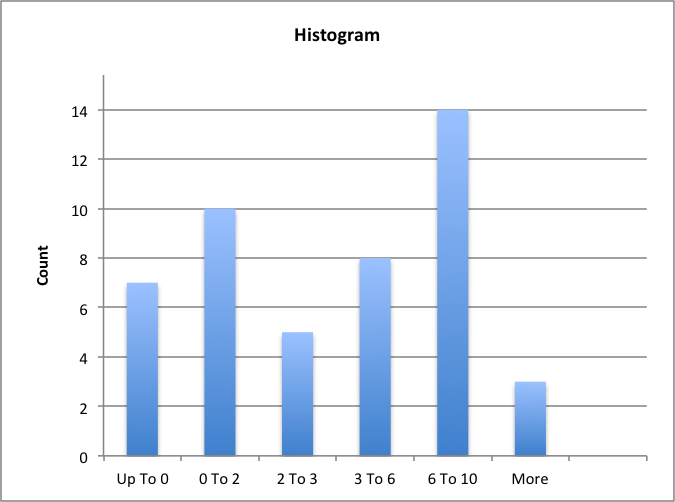
Students who contributed to the conversation either spontaneously or when prompted, or who demonstrated knowledge of the readings, were coded as ‘active’.
If I could change anything for next year, it would be to do more to shrink those first two categories in the participation chart.