Contesting city streets

Self-portrait with pink handlebars

At present, I am reading a book about how the ‘motor city’ emerged as the dominant North American standard. It is quite interesting, really. The fact that automobile promoters played a role in the demise of streetcars is well known. What seems to be less well known is how the very idea of urban streets was contested and ultimately redefined in the period between 1920 and 1930. At the beginning of that span, automobiles were seem as a deadly and dangerous new element in street life: particularly effective at killing children. Now, thanks to school safety campaigns devised during the transformative period, automobiles are recognized as the road-going default: the normal thing to find on urban streets.

Only 20% into the book, I cannot comment on it comprehensively. Still, I have the sense that the next such conflict may be between fossil fuel automobiles and greener options – particularly cyclists and transit.

Our personal experiences often leave us incapable of glimpsing the assumptions that underlie the way we live. Good historical writing gives one a sense of how things were seen before. So far, this book has been accomplishing that task well.

Artificial geothermal sites

Geothermal energy has generally been seen as limited to areas lucky enough to have hot water bubbling to the surface. Iceland, for instance, manages to produce about 19% of its electricity and about 90% of the heat for homes from geothermal sources (though they also manage to have higher per capita emissions than France or Spain). The Philippines manages to generate 25% of its energy from geothermal sources. One intriguing suggestion to broader the applicability is to create by design what plate tectonics has sometimes produce by chance. The idea is to drill two shafts into hot dry rock, pump cool water down one, and exploit the hot and high-pressure water coming up from the other. If successful, such techniques could make geothermal energy dramatically more widely available. One estimate holds that 100 gigawatts worth of engineered geothermal could be created in the United States by 2050, at a ‘commercially acceptable price.’

There are problems, of course. Our drilling expertise mostly relates to porous oil-bearing rocks: not the more solid sorts that would be between the shafts. There are also concerns that building artificial geothermal sites will destabilize the surrounding land. A project in Switzerland apparently caused a small earthquake back in 2006.

Hopefully, the technology will prove viable in some areas. The more renewable power options we have, the less we need fossil-fuel powered plants to balance the grid. Furthermore, the more different types of renewable energy are in use, the more resilient the system is to climatic changes and other shocks.

Carbon taxes abounding

Light with condensation

This month, the British Columbian carbon tax came into force. The tax is starting off at $10 per tonne, rising to $30 in 2012. The tax will be revenue neutral: with extra costs associated with greenhouse gas emissions being balanced overall by reductions in personal and corporate taxes. The approach seems well designed and economically sound, as well as likely to help B.C. move towards a sustainable low-carbon economy. It is quite a pity, therefore, that the provincial New Democratic Party has taken such a wrong-headed and opportunistic stance on the thing. Surely they must realize that their overall agenda of helping the poor and marginalized can only be accomplished alongside effective climate change mitigation action. It is the poor who have the least capability to adapt: to the effects of climate change, to harsher carbon pricing policies later, and to the ever-increasing prices of fossil fuels. As such, setting incentives early is an important mechanism for smoothing the transition.

At the same time as B.C. is moving forward, other jurisdictions are consolidating past actions. Norway is toughening the carbon tax they have had in place since 1991. Unfortunately, a fuel-price-induced backlash seems to be rising there too. If gasoline taxation continues to be the biggest public opinion stumbling block to carbon pricing, perhaps those who argue for its exclusion are correct. It is better to start the bulk of society on a low-carbon transition, leaving some sectors behind, than to have the whole project kept in limbo due to objections arising from short-term thinking.

While not a tax on carbon, it is interesting to note that American police departments are even imposing fuel surcharges on traffic tickets. The policy is prompted by high oil prices, rather than environmental concern, but it is an illustration of the ways in which fuel costs, economic activity, and government fiscal policy interact.

Carbon v. CO2

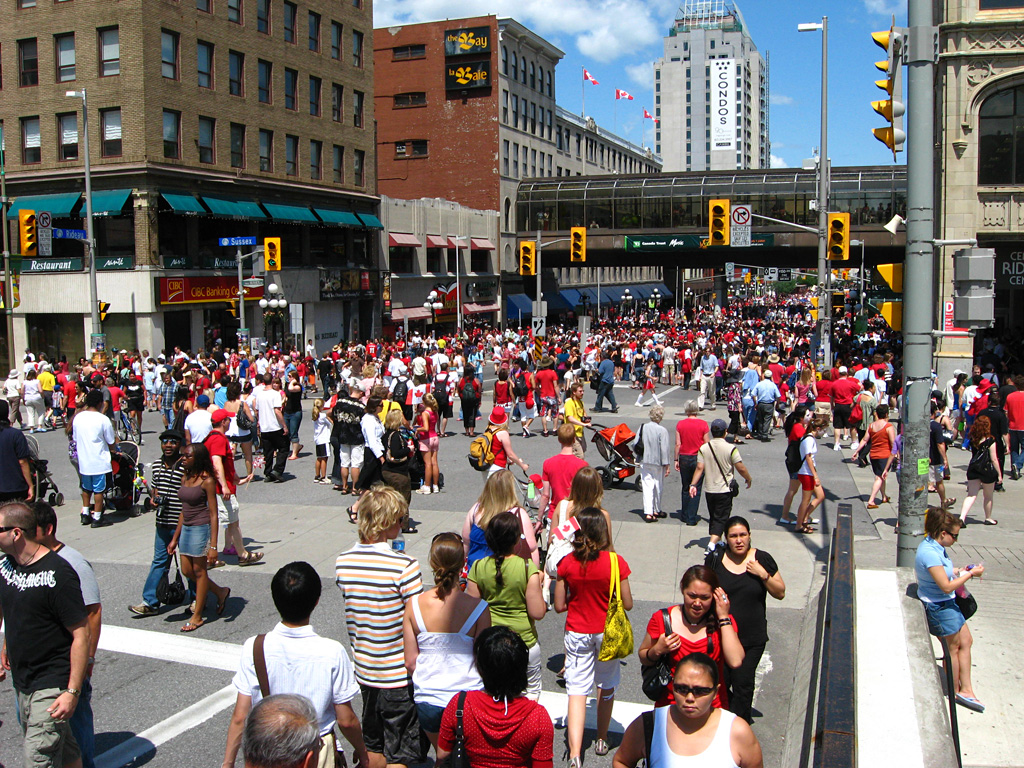
Rideau Street intersection, Ottawa

When it comes to carbon pricing, there is one slightly confusing element that should be clarified. Carbon taxes are sometimes expressed as a price per tonne of carbon dioxide (CO2), and sometimes as a price per tonne of carbon. One tonne of carbon is equivalent to 3.67 tonnes of carbon dioxide. As such, a price of $10 per tonne of carbon dioxide is equivalent to a price of $36.70 per tonne of carbon.

The reason for this is basic. One mole of carbon weighs 12 grams. (A mole is a quantity of matter equivalent to 6.02 x 10^23 molecules or atoms. It is like a much bigger version of a dozen.) Each oxygen in a molecule of CO2 contributes 16 grams. As such, a mole of CO2 weighs 44 grams, while a mole of carbon weighs 12. The ratio is 3.67 to one.

EU taxing aviation carbon

Canada Day 2008, Ottawa

The European Union has agreed to start integrating air travel into its emissions trading system. This is a big step, given how the industry has often been excluded from carbon pricing schemes – especially where international travel is involved.

Arguably, the biggest piece of news is that they want to charge non-EU carriers for emission permits when they enter EU countries. This is certainly going to kick up a stink in the WTO and other multilateral trading bodies. That being said, if a global regime of carbon pricing is not to be forthcoming, the regional arrangements will need mechanisms for ensuring that imports meet their standards.

Hashing out how such standards can be applied is sure to be a difficult and extended affair.

Pigs eat more fish than all of Japan

Apparently, 17% of wild-caught fish ends up getting fed to livestock. That’s pretty astonishing, given the increasingly dire state of global fish stocks, and it underscores the way in which most modern agriculture is fundamentally unsustainable.

As long as it is dependent on outside inputs where the supply is growing scarcer, it won’t be a mechanism for feeding humanity indefinitely.

Much better to leave those fish in the sea or, failing that, at least feed them to people.

Ice-free north pole in 2008?

Orange flower

Some scientists aboad the Canadian research icebreaker Amundsen are predicting that the North Pole may be ice-free for the first time in recorded history this summer. While this is not the same as saying the whole icecap will be gone, it does seem like the sort of thing likely to have symbolic resonance. At the very least, it becomes a bit harder to argue that no overall warming is taking place when huge chunks of the cryosphere start to vanish.

While there are good reasons to doubt whether this year will really see the pole bare, it is only really a matter of time:

[G]iven the rapid changes now evident in the Arctic, the ultimate fate of the North Pole—in fact, all permanent ice in the Arctic—may be all but assured. Almost all models have the Arctic completely ice free in the summer by 2100.

This raises some worrisome questions. If the sea ice is being lost at a greater rate than anticipated, is that likely to carry over to Greenland? If so, the optimistically low estimates for sea level rise published by the IPCC may prove grossly inaccurate.

US solar moratorium

What is to be done when people are plowing ahead with new coal power plants, despite the threat of climate change, and people are simultaneously forgetting about the expense, risk, and contamination associated with nuclear power? Impose a two-year moratorium on new solar projects, clearly. This at a time when we have eight years or so to stabilize total global emissions, before starting a long and deep decline – from over thirty gigatonnes per year to under five, within the lifetime of those now starting to ponder retirement.

Clearly, environmental issues relating to solar power stations need to be considered – just as bird strikes as so forth must be considered in relation to wind. That being said, a moratorium on the technology at the same time as oil sands and shale oil production are ramping up seems like hypocrisy.

CCS skepticism

The headline of a recent Economist article is one that policy-makers around the world should pay heed to: Carbon storage will be expensive at best. At worst, it may not work. There are two over-riding reasons for which the danger of a CCS-flop needs to be borne in mind:

  1. First, many governments are assigning a big chunk of their planned emissions reductions to the new technology. If they find themselves in need of alternatives later, it may prove to be quite a scramble. Likewise, being able to ‘bank’ the CCS reductions now may make their plans seem both more viable and more certain than they really are.
  2. Secondly, the very prospect of CCS is a lifeline to the coal industry. Power plants built to be ‘carbon capture ready’ may never do anything of the kind. If so, citizens should be even more concerned about the greenhouse gasses they are going to spew. Those financing the construction should also be wary, since carbon pricing is more likely than not to be on the way.

None of this is to say we shouldn’t welcome cheap, effective CCS if it does emerge. Not only could it allow the US and China to use their coal reserves while not wrecking the climate (local pollution is another matter), CCS coupled with biomass-fired generating stations could be carbon-negative.

Just don’t count those megatonnes before they’re buried.

Explaining greenhouse gases

Twinned bicycles

Over at ScienceBlogs, Paul Revere has written a three part primer (one, two, three) about the physics of climate change. It begins with the nature of electromagnetism and moves on to discuss the energy relationship between the Earth, the sun, and outer space. It is the sort of thing that feels very basic, but which is nonetheless important to understand through-and-through. In particular, the explanation of black bodies in the second portion is clear and informative.

The discussion of Wien’s Displacement Law is also quite informative. The law holds that every object in the universe emits electromagnetic radiation, and that the most common frequency exists in relation to that object’s temperature in degrees Kelvin. To go from one to the other, divide 2898 by the temperature in degrees Kelvin. The quotient is the peak wavelength, expressed in microns. Human body temperature is about 310 degrees Kelvin, so our peak electromagnetic wavelength is about 9.35 microns long – in the infrared portion of the electromagnetic (EM) spectrum. Since we are pretty similar in temperature to the surface of the Earth, the wavelengths radiated by the planet are in a nearby portion of the spectrum.

It is is ability of greenhouse gases to absorb this infrared energy that lets them prevent energy from returning to space. They are transparent to the dominant wavelengths emitted by the sun, but opaque to those radiating from the Earth. Increasing their concentrations in the atmosphere (through fossil fuel burning, deforestation, etc), causes more of the energy that comes to the Earth from the sun to remain in the atmosphere. As a result of the extra energy, the temperature rises. Incidentally, this is also why people sometimes mention using ground-based mirrors to fight climate change. They reflect light at the same peak wavelength as that of the sun (which passes relatively unimpeded through the atmosphere). By re-radiating at that visible wavelength, rather than the infrared one favoured by greenhouse gases, the energy can be made to escape again. Of course, it would take a massive number of mirrors to balance out the effect of increased greenhouse gas concentrations on the EM emissions from all non-mirrored areas.

One upshot of understanding the nature of these gases is the ability to appreciate how their increased concentration simply must add more energy to our planetary system. The scientific questions that remain are about precisely what changes that energy will generate, and at what rate. The three posts are well worth reading in their entirety.

[Update: 17 December 2009] See also: Greenhouse gases other than CO2