New nuclear plants, new nuclear waste

These days, nuclear energy is frequently spoken of as being in the midst of a ‘rebirth’ or renaissance, largely because of high oil prices and concerns about climate change. Those concerned about greenhouse gas (GHG) emissions do need to give the technology some credit as a mechanism for producing large amounts of power with relatively limited climatic effects. That is no reason to ignore the problems with the technology – from water use to nuclear waste to long lead times – but it does compel the formulation of a considered response.

One possibility I came up with would be to require firms building new nuclear plants to build geological sequestration facilities for the nuclear waste the plant will produce over its lifetime before the plant can begin operation. That would probably further delay the deployment of the technology, but it would avoid boondoggles like the ongoing conflicts about Yucca Mountain. It would also be a step away from the “act now and worry about the consequences later” mentality that has infected so much of energy and environmental policy.

The response to such a demand, on the part of industry, might offer a better glimpse into what the true costs of nuclear power really are.

GHG-intensive industries and regulation

As mentioned in a recent Charlemagne column, certain industries produce so much carbon dioxide that it can be more in their interests to relocate than to face an effective national carbon pricing policy. At least, that is what they commonly argue. Examples of such industries include fertilizer, chemicals, steel, aluminium, and cement. Frequently, they have threatened to relocate if they are required to pay carbon taxes or buy permits for their emissions. While there is some reason to doubt how valid the threats are – it would be very expensive to relocate production facilities and personnel just to escape a new carbon regulatory regime – there is good reason to think about how various forms of regulation would affect such firms.

One mechanism through which such threats might be countered is by reaching agreements among major producers in as many states as possible. A Dutch chemical company will be more willing to accept carbon regulation if it knows that its American and Japanese competitors face similar requirements. This is an approach that worked well in dealing with ozone-depleting CFCs and could work similarly well in GHG-intensive industries that (a) involve a relatively small number of firms (b) located in countries with strong regulatory capacity (c) which have some political willingness to take action on climate change.

One feature many of these industries share is that a high proportion of their emissions are what are called ‘process’ emissions. This means that the greenhouse gasses are released not as a side-effect of energy production, but as a side-effect of the production of whatever it is the industry makes. As discussed before, cement has high process emissions and limited prospects for carbon capture. The situation is similar for at least some of the processes employed in the other listed industries.

One slightly counterintuitive aspect of ‘intensity-based’ cap-and-trade systems (in which firms are obliged to reduce the quantity of emissions they produce per unit of output, rather than in absolute terms) is that they are absolutely brutal for firms with predominantly process related emissions. If a cement company actually cannot do anything to reduce GHG emissions per tonne of cement, the only option under an intensity-based system is to buy 100% of its obligations from firms that have done better than their target or close down. Under a cap-and-trade system with 100% auctioning, or a carbon tax regime, such firms would basically be encouraged to contract while the economy finds less GHG intensive alternatives to what it produces. While that is a very politically difficult thing to call for, it must be remembered that all the years of unregulated emissions were, in effect, an undeserved gift from the general public in this and future generations to those firms. Discontinuing such unearned benefits is a necessary part of curbing climate change.

If we are serious about dealing with climate change, it needs to be acknowledged that not all industries are likely to find technological fixes during an acceptable timeframe. Some will simply need to shut down or be sharply scaled back. Looking across the past 100 years, it is clear that the fates of whole industries have risen and fallen in response to societal forces. The impetus for them to do so now is enormously greater, as nothing less than the future habitability of the planet is potentially at stake.


Climate change and the gom jabbar

Artistic bar lights

In Frank Herbert’s Dune, the protagonist is tested using a machine that “only kills animals.” His hand is placed in a box that simulates the appearance and sensation of having it horribly burned. He is told that he will be killed if he pulls the hand out. The test is to see whether he can overcome his primal reaction: whether he can exercise will over instinct and live. At least according to those who administer it, this is what distinguishes ‘humans’ from ‘animals.’

In some ways, climate change is like a Gom jabbar for all humanity. We are now aware of the needle threatening our collective lives. We know that continuing to act on the basis of instinct will lead to our doom. The question is whether we possess the fortitude to endure what is difficult, in order to avoid what is lethal.

Trouble with aquaculture

Recently, Manitoba banned new hog farms in a wide swathe of the province due to environmental concerns. Now, British Columbia has suspended the issuing of new licenses for salmon farms. The ecological impact of these facilities has been mentioned here before.

Generally, the idea that open-pen aquaculture makes ecological sense for carnivorous species like salmon is fallacious. All it does is displace pressure from fishing activity from wild salmon themselves to the kind of fish they eat. Inevitably, an unconstrained fishery will destroy those stocks as well. Meanwhile, the salmon farms leach lice, excrement, and antibiotics into the waters around them.

Airsick

This short video on climate change, produced by Toronto Star photographer Lucas Oleniuk, is very elegant. It doesn’t have a great deal of substantive content, but it includes a lot of striking visual images. Rather than being shot continuously, it consists of 20,000 black and white still images.

The video, and some of the claims made in it, are being discussed on Metafilter.

The Game Plan

The Game Plan : A solution framework for climate change and energy is a slick, Creative Commons licensed slide presentation covering issues of energy and climate change. It’s like a more numerically focused, more technical, open-source version of An Inconvenient Truth. Clearly, it is aimed at a very different audience. Still, it is interesting and potentially useful as a source of graphics and information.

A seven megabyte PDF version is also available. A PDF of the speaking notes, likewise.

Carbon trading, windfalls, and consumers

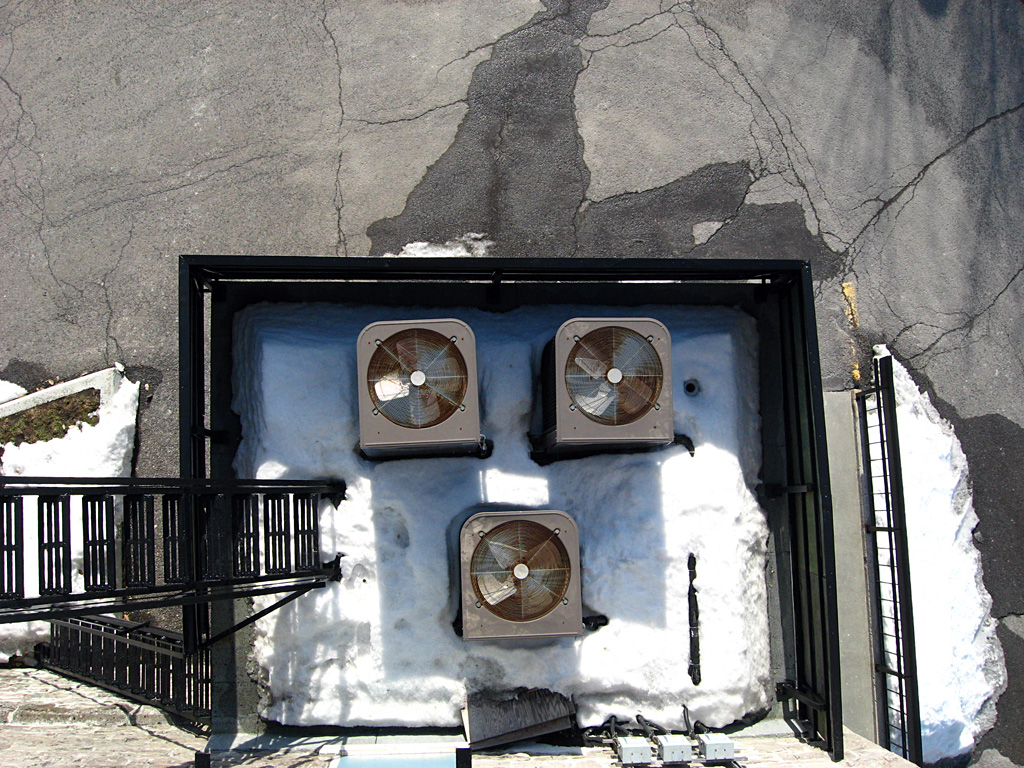
Air conditioners from above

This background note on carbon trading from the Sightline Institute does a good job of explaining the relevance of different modes of permit allocation to consumers. That sounds terribly dull, I’m sure, but it’s simple and important. The basic idea of carbon trading is that you set some level of allowable emissions for a facility, firm, sector, or economy. Say you want to reduce total national emissions by 2% over the next year. You multiply current national emissions by 0.98 and create permits for that quantity of emissions. What you do next is very important. You can either auction these credits to the highest bidder, requiring firms that produce greenhouse gasses to purchase them, or you give some or all of them away for free to such firms.

The critical point here is that these credits are money. Auctioning them does two things: it requires polluters to pay for their emissions and it raises funds. These can be invested in research, used to subsidize low-carbon technologies, or just used to fund general tax cuts. When these credits are given away for free, they give firms the option of either continuing to pollute for free or selling the right to pollute to someone else.

The point made in this document is that consumers end up bearing the cost from either approach. This is because unless firms are tightly regulated or in competition with other firms that don’t face emissions restrictions, they will both profit from any permits they are allocated for free and pass along the cost of permits to consumers. The analogy used in this document is a good one:

Try buying World Series tickets from a scalper. Would he charge you any less if he found the tickets on the ground? Of course he wouldn’t. Like energy, the street price of World Series tickets is based on supply and demand. The supply and demand for tickets is the same no matter how much the scalper paid for them, and so the price he charges you will also be the same no matter how he got them.

Of course, the scalper would much rather get his tickets for free – and that’s precisely the point. Polluters are financially much better off if permits are given away instead of auctioned, but the cost of cutting emissions and the resulting effect on energy prices will be the same no matter how the permits are delivered.

As such, the superiority of an auction system is further reinforced. Not only does it implement the Polluter Pays principle, but it also provides a mechanism through which governments can compensate consumers for the manipulative behaviour of firms.

Of frogs and fungus

Ottawa stadium

Batrachochytrium dendrobatidis is devastating communities of amphibians worldwide. Strangely enough, this may partially be because of pregnancy testing. Between the 1930s and 1950s, a curious property of the African clawed frog (Xenopus laevis) was exploited: human chorionic gonadotropin (HCG), which is present in the urine of pregnant women, stimulates egg production in these animals. As a result, commercial trading spread them – and the fungi that afflicted them – around the world.

Which the clawed frogs are affected by the fungus and act as carriers, it doesn’t kill them. Other species are not so fortunate. Now, more than 100 species of amphibian have been infected by the fungus, which colonizes the skin. The spread of the disease varies according to altitude and temperature. In the right conditions, it can kill 85% of the amphibians in an area.

In the case of some species that have been especially badly affected, conservationists have taken the desperate step of removing the last living creatures from the wild:

Rather than letting the animals become extinct, a number of conservationists have started gathering up frogs believed to be doomed — in some areas collecting every last individual of a species — in an effort to enable some to persist in captivity. Some believe it would be worth causing the extinction of a species in the wild if it prevents the species from disappearing altogether.

Some captive breeding programs have been more successful than others, but all are symbols of the unpredictable and destructive impacts of human activities on the natural world, as well as our imperfect ability to counteract them.

Even if the frogs are successfully kept alive in captivity, it is dubious whether they can ever be returned to the wild. In addition to ongoing climatic changes, the simple fact of their removal will fundamentally change the ecosystem in which they lived. Their absence might disrupt the food web, or some other creature might change its location or behaviour to fill the gap. In any event, it is unlikely that many of these frogs will ever be part of a natural breeding population in the wild again.

Carbon capture in Saskatchewan

A $1.4 billion carbon capture (CCS) equipped coal plant is on the drawing board in Saskatchewan. The projected output is 100 megawatts (MW). That works out to a price of $14,000 a kilowatt, compared with about $2000 and $4600 per kilowatt for wind turbines (according to Agriculture and Rural Development Alberta). Of course, unlike the coal plant, the wind turbines wouldn’t require fuel after being installed.

Unless the cost of CCS falls dramatically, it is never going to be able to ride in, horse at a gallop and sword drawn, to rescue the coal sector. The cancelled FutureGen project in the United States was one demonstration of this. Until there is at least one unsubsidized commercial facility out there that is producing electricity from coal and sequestering emmisions – all for less than the price of ‘expensive’ renewable technologies like wind and solar – a fair bit of skepticism about the technology is justified.

Earth Hour, and why it is a bad idea

Bank Canal Bridge

The news today is full of talk about Earth Hour. Frankly, I think the idea is stupid. Telling people to turn out the lights for one hour one day has a trivial impact. Furthermore, it has nothing to do with approaches that actually would. Shutting down the lights in a brief symbolic gesture does nothing to change the energy basis of our society. Replacing one ordinary light bulb with a compact fluorescent one would have a bigger impact in the long term, and would at least suggest an understanding that brief voluntary abstinence from energy use is no solution whatsoever. Earth Hour is akin to choosing to fast for one hour and hoping that it will send a strong message to the factory farming industry.

Earth Hour reinforces many of the fallacies people believe about climate change, such as:

  • It will mostly be solved through consumer choices
  • Voluntary efforts are enough
  • It’s the visible changes that really matter

As discussed at length here in the past, it is very likely that none of these things are true. Climate change will only be dealt with when the energy basis of society has changed enough that the most greedy and selfish people are nonetheless leading low-carbon lives. That requires massive infrastructure change over the course of decades – the progressive replacement of high carbon options with low carbon and finally zero carbon ones. Earth Hour is, at best, a distraction from this process.

[Update: 25 March 2009] Judging by the Google searches, another ‘Earth Hour’ is coming up. I still think the exercise is a pointless one. Moving to a sustainable society isn’t about reducing energy use for one hour, it’s about reforming the energy basis of society. Tokenistic environmental gestures do no good, and help to convince people that the real changes we need are trivially easy.

[Update: 24 March 2011] Looking back over it, what I have written about Earth Hour before is a bit harsh. Yes, I think the basic idea of turning out the lights for an hour is a weak one. At the same time, environmental groups presumable use Earth Hour as an opportunity to communicate with the public. It might have less value as a symbolic action, and more as a simple advertising opportunity, in terms of direct communication with the public and media exposure.