climate change activist and science communicator; photographer; mapmaker — advocate for a stable global climate, reduced nuclear weapon risks, and safe human-AI interaction

Atmosphere, biosphere, lithosphere, hydrosphere, etc – everything about life and the state of this planet
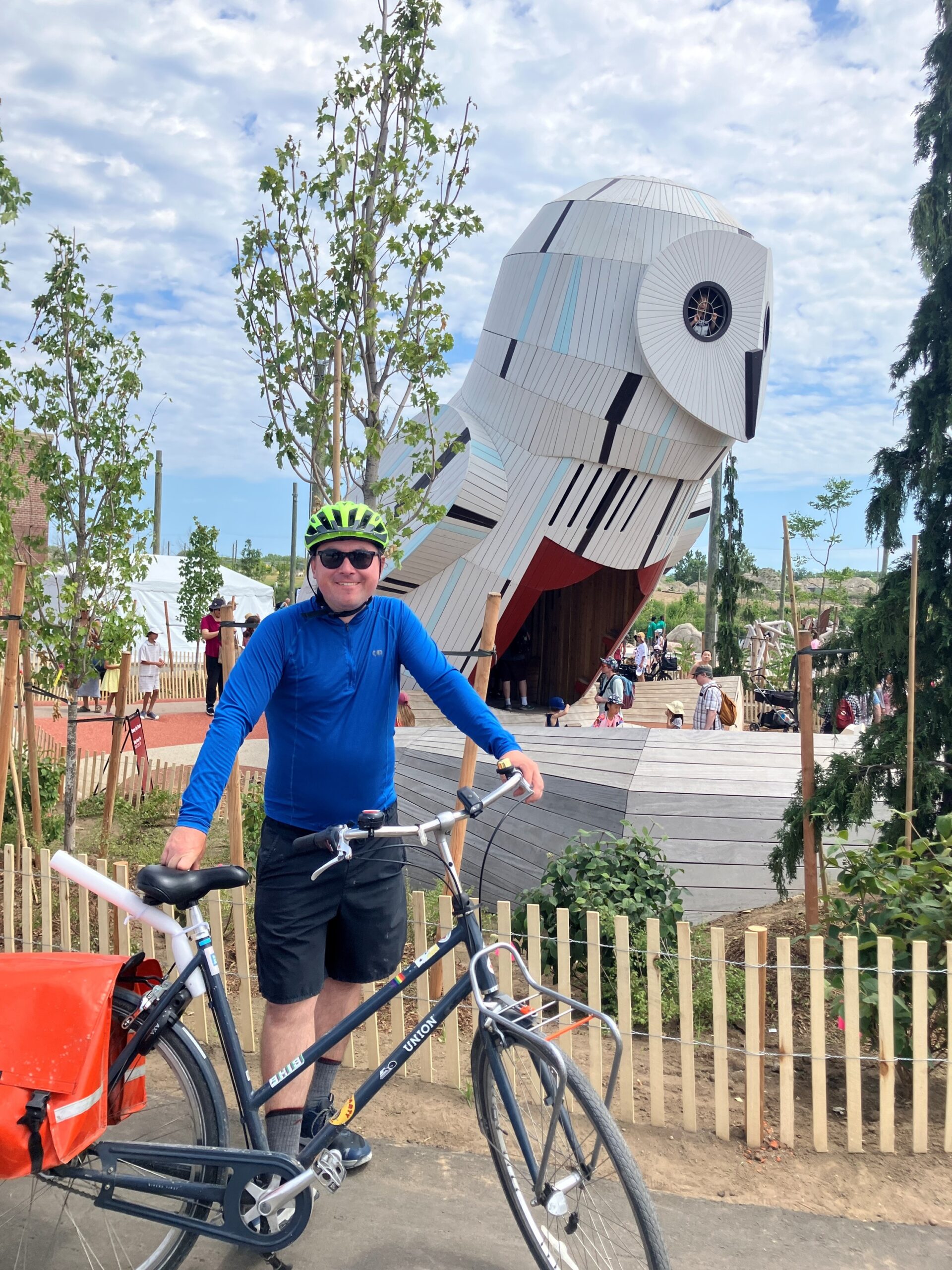
Photo by Jess
I had a great Saturday. It was cool enough not to be oppressive, and I was able to ride down the Don past the Brickworks to the new Biidaasige (bee-daw-sih-geh) Park. The park is very impressive. They have turned the engineered, industrial, concrete landscape around the mouth of the Don River into a real human space again, and an alluring one. There is a large outdoor adventure playground with ziplines, charmingly rendered animal play sculptures, and two-story high treehouses shaped like a raccoon and an owl, the latter of which has a tiny amphitheater in front. Within a large landscape of springy concrete, kids can use human-powered pumps to move water into a simulated watershed with controllable floodgates and sand areas to play in. There are curving paths along the new rivercourse, which is lined thickly with native plants. There are also boat launches and fishing spots.
The park grand opening was happening just a short ride from the Neon Riders BBQ, so I was able to see some friends there and bring one back for another ride through Biidaasige Park. After that, another friend from the Riders had a charmingly creative and playful music gig in Bickford Park, which was further enriched for me by a pair of very friendly dogs who were part of the small audience.
A river mouth should be a geographical anchor and natural point of interest. As someone who has walked extensively all over Toronto, the way the Don came to an end failed to satisfy those expectations. With Corktown Common, Biidaasige Park, and the other park areas still in progress, the city is doing a great job at making the river mouth part of the human landscape again. I have thought for years that Toronto’s greatest planning blunder was cutting off the city from the lake with the Gardiner Expressway. Personally, I would be fine with getting rid of the whole thing through the mechanism of less driving downtown, but while we are waiting it’s great that at least the river is being reclaimed.
The ziplines all had long lines of small children on Saturday, so I will need to return when things are less crowded. I expect Biidaasige Park to become a popular break spot for Neon Rides.
P.S. At an arts and crafts station, I was taught to make ‘seed bombs’ out of dirt, pottery clay, and heirloom open-pollinated seeds of Common Evening Primrose (Oenothera lamarckiana) from the Ecoseedbank in Montreal. The flowers are native to the region and good for pollinators, and the initiative reminds me of charming videos of dogs who help re-seed the forest after fires in Chile.
I’m excited about Toronto’s launch of Biidaasige Park tomorrow. How often does a city get a big new area of green space, and in as geographically and ecologically important a place as a river mouth?
Along with the existential risk to humanity posed by unmitigated climate change, I have been seriously learning about and working on the threat from nuclear weapons for over 20 years.
I have written an introduction to nuclear weapon risks for ordinary people, meant to help democratize and de-mystify the key information.
The topic is incredibly timely and pertinent. A global nuclear arms race is ongoing, and the US and Canada are contemplating a massively increased commitment to the destabilizing technology of ballistic missile defence. If citizens and states could just comprehend that nuclear weapons endanger them instead of making them safe, perhaps we could deflect onto a different course. Total and immediate nuclear weapon abolition is implausible, but much could be done to make the situation safer and avoid the needless expenditure of trillions on weapons that will (in the best case) never be used.
Nuclear powers could recognize that history shows it only really takes a handful of bombs (minimal credible deterrence) to avert opportunistic attempts from enemies at decapitating attacks. States could limit themselves to the most survivable weapons, particularly avoiding those which are widely deployed where they could be stolen. They could keep warheads separate from delivery devices, to reduce the risk of accidental or unauthorized use. They could collectively renounce missile defences as useless against nuclear weapons. They could even share technologies and practices to make nuclear weapons safer, including designs less likely to detonate in fires and explosions, and which credibly cannot be used by anyone who steals them. Citizens could develop an understanding that nuclear weapons are shameful to possess, not impressive.
Even in academia and the media, everything associated with nuclear weapons tends to be treated as a priesthood where only the initiated, employed by the security state, are empowered to comment. One simple thing the briefing gets across is that all this information is sitting in library books. In a world so acutely threatened by nuclear weapons, people need the basic knowledge that allows them to think critically.
P.S. Since getting people to read the risk briefing has been so hard, my Rivals simulation is meant to repackage the key information about proliferation into a more accessible and interactive form.
During my childhood, I remember a book circulating around the house called 50 Simple Things Kids Can Do to Save the Earth.
It included activities like putting a milk carton underneath a dripping tap to measure the rate at which it was dripping, and leaving elastic bands stretched and exposed outside to supposedly measure air pollution.
Much later, I realized how fucked up the implications of the book and its genre are.
The buried premise is that the Earth needs “saving” — which is horrifying and terrifying. The book takes it for granted that the one life-sustaining planet known in the universe is imperiled by human activity. If something needs saving and doesn’t get it, that means it dies or gets destroyed. The book comes right out and takes for granted that all known life is at risk unless humanity changes its conduct and attitudes and that this won’t happen through the existing political, economic, and legal systems.
The next implication is that the appropriate resolution to this, at least in part, depends on kids. It’s up to kids to save the Earth. Furthermore, they need to do it through some sort of resistance to or reform of the political and economic systems which embody and sustain the ecological crisis.
So not only does the book imply that it is the responsibility of kids to save all the life in the universe, but it goes on to give them a series of trivialities as action items: find a way to avoid wasting a carton of water, check the pH of a local stream… It sets up a colossal threat, then gives some arts-and-crafts activities and low-impact personal lifestyle changes as the solutions available.
Of course, my bitterness about this arises from the decades of utter betrayal toward young people which have characterized my life. Given the choice between perks today and not wrecking the Earth, all our leaders choose the former with lip service to the latter. Young people have grown up in a world where they expect catastrophe, and understand that their leaders prefer that outcome to changing the self-serving status quo.
I was part of that youth movement at least from my experiences with LIFE in the mid-1990s until the fossil fuel divestment movement at universities after 2012, and saw how it was systematically patronized, treated in bad faith, and ignored by those who set policy. Adults told kids that it was up to them to save the world, then knowingly and purposefully undermined those efforts in order to protect their own interests, all while portraying themselves as sage decision-makers moderating the unreasonable requests of radical activists. This process is ongoing.
This dynamic has produced a great deal of apathy and political disengagement, but I think there is also an underlying rage arising from young people understanding that they have been put in lifelong peril by a society which systematically disregards their interests — to say nothing about how the prospects for their potential children have been ravaged. It is hard to guess how that rage will manifest, but it seems very implausible that it will be through the sort of long-sighted planetwide cooperation which provides the only path to curtailing the climate crisis.
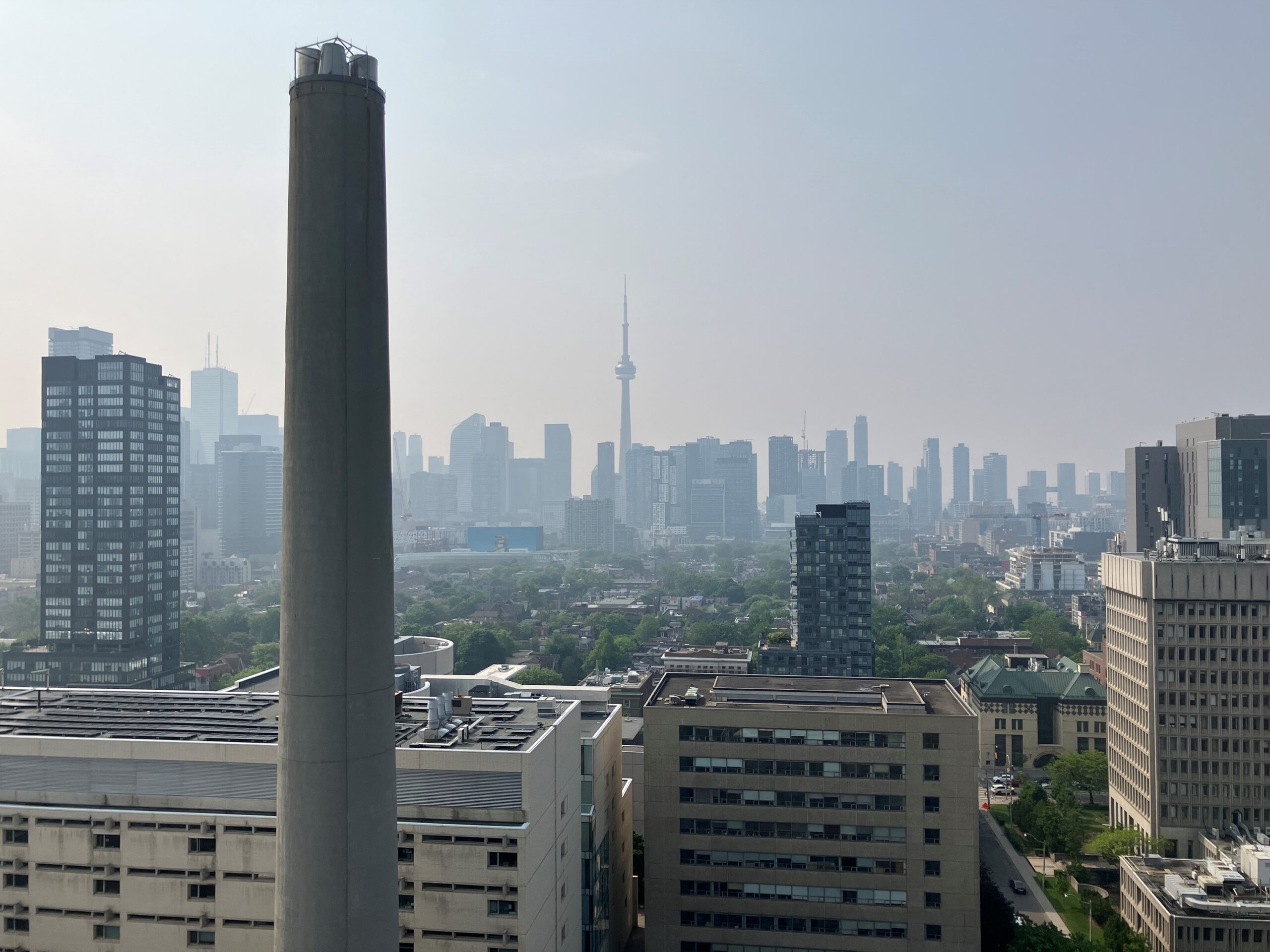
blogTO reports: “By Friday morning at 9 a.m., Toronto ranked third-worst on IQAir’s Air Quality Index for major cities, behind Tashkent, Uzbekistan and Montreal — the latter affected by the same wildfires filling Ontario skies with soot particles.”
I don’t like the practice of answering people’s questions with the response I guess they most want to hear. Lately, with people who I know to a certain degree, if they ask, I have just been saying that I am not doing well, and if they follow up provide a brief explanation of how multilateralism and evidence-based policy are collapsing while the world commits itself to climate chaos.
I tend to get two fallacious responses.
The first is the inductive fallacy: bad things have happened before (Black Death, WWI, etc) and people and civilization have endured, therefore we will endure whatever climate change brings as well. In terms of logic, this is an obviously weak argument. If a man is playing Russian Roulette and manages to pull the trigger once without getting shot, that doesn’t prove that trigger-pulling is nothing to worry about. Furthermore, there are excellent reasons to think the world is more dangerous now than at the times of the Black Death or WWI. It wouldn’t take too many nuclear strikes against cities to produce a nuclear winter which would essentially kill us all.
The other is motivated reasoning: you need to have hope. This approach basically rejects the value of knowledge and thinking, or at least the idea that hypotheses should be tested against logic and evidence. Deciding how you want to feel in advance, and then seeking out beliefs that reinforce the feeling, is a recipe for ending up totally deluded about the world. Someone who decides what they think based on how they want to feel loses the connection which a skeptical mind maintains with the empirical world. Instead, they become like transcendentalist gurus who only care about how the world seems inside their own mind. They are no longer able to help anybody, except perhaps to become as disconnected and useless as they are.
I know people who ask how you are doing seldom want an honest answer. It’s a social cue to come back with a light and social answer. At the same time, I am utterly terrified about how the population normalizes and ignores the dismal signs of just how much trouble humanity is in. The mechanisms that let people cope and maintain a tolerable emotional bubble around themselves seem thoroughly interconnected with the mechanisms which are letting us destroy the future because we don’t want to think about scary things, or give any consideration to the interests of others when we choose what to do for ourselves.
I have been trying to make sense of why I feel so intensely unhappy now, especially when in numerous ways life was a lot worse while I was in the PhD program. The closest thing to answer is that before I felt like there were worthwhile things to try to achieve in the world, but I was just being blocked from taking part effectively in them by nearby obstacles and barriers. Now I feel like I have no idea whatsoever of what to do to try to dodge the planetary calamity ahead. With the climate change activist movement distracted and disempowered, I also feel uniquely alone.
In all the time while I have been concerned, and later terrified, about climate change and the future of life on Earth, I still had the narrative convention of fiction influencing my expectations: the emergence of a big problem will imperil and inspire a group of people to find solutions and eventually the people threatened by the problem will accept if not embrace the solutions. A tolerable norm is disrupted and then restored because people have the ability to perceive and reason, and the willingness and virtue to act appropriately when they see what’s wrong.
Now, I feel acutely confronted by what a bad model for human reactions this is. It seems to me now that we almost never want to understand problems or their real causes; we almost always prefer an easy answer and somebody to blame. The narrative arc of ‘problem emerges, people understand problem, people solve problem’ has a real-world equivalent more like ‘problems emerge but people usually miss or misunderstand them, and where they do perceive problems to exist they interpret them using stories where the most important purpose is to justify and protect the powerful’.
If the history happening around us were a movie, it might be one that I’d want to walk out of, between the unsatisfying plot and the unsympathetic actors. Somehow the future has come to feel more like a sentence than a promise: something which will need to be endured, watching everything good that humankind has achieved getting eroded and destroyed, and in which having the ability to understand and name what is happening just leads to those around you punishing and rejecting you by reflex.
Psychologically and emotionally, I have really been doing badly lately.
I have spent all of my adult life studying environmental politics and trying to fight climate change, and now we are at a juncture where the world’s leaders have effectively given up. They won’t acknowledge fossil fuels as the root of the crisis, and they are far too controlled by the fossil fuel industry to accept phasing them out as a solution. They see every new potential oil, gas, and coal project as a vehicle for wealth and self-advancement. Meanwhile, environmentalists are distracted by social issues as the long-term crisis keeps deepening, and people generally are too frightened to even perceive the truth of their situation. Perhaps scariest of all, young people don’t have a coherent and politically-activated sense of what is happening. They can’t see that their leaders are destroying their futures, and they are being drawn into the same sorts of non-solutions which are driving the rise of charlatans and authoritarians to power.
The path forward is totally unclear, and I don’t know how — psychologically or morally — to cope with a world where we have identified that the processes of collapse are accelerating but where we don’t have the honesty or the courage to work through what that means or work toward any remedy.
These are dark, dark days.
By some measures, based on science, the scale of the energy revolution required is staggering.
If we had started in 2000, we could have hit the 1.5°C objective by halving emissions every thirty years. Now, we must halve emissions every ten years. If we wait another four years, the challenge will be to halve emissions every year. If we wait another eight years, our 1.5°C carbon budget will be exhausted.
The entrepreneur and engineer Saul Griffith argues that the carbon-emitting properties of our committed physical capital mean that we are locked in to use up the residual carbon budget, even if no one buys another car with an internal combustion engine, installs a new gas-fired hot-water heater or, at a larger scale, constructs a new coal power plant. That’s because, just as we expect a new car to run for a decade or more, we expect our machines to be used until they are fully depreciated. If the committed emissions of all the machines over their useful lives will largely exhaust the 1.5°C carbon budget, going forward we will need almost all new machines, like cars, to be zero carbon. Currently, electric car sales, despite being one of the hottest segments of the market, are as a percentage in single digits. This implies that, if we are to meet society’s objective, there will be scrappage and stranded assets.
…
To meet the 1.5°C target, more than 80 per cent of current fossil fuel reserves (including three-quarters of coal, half of gas, one-third of oil) would need to stay in the ground, stranding these assets. The equivalent for less than 2°C is about 60 per cent of fossil fuel assets staying in the ground (where they would no longer be assets).
When I mentioned the prospect of stranded assets in a speech in 2015, it was met with howls of outrage from the industry. That was in part because many had refused to perform the basic reconcilliation between the objectives society had agreed in Paris (keeping temperature increases below 2°C), the carbon budgets science estimated were necessary to achieve them and the consequences this had for fossil fuel extraction. They couldn’t, or wouldn’t, undertake the basic calculations that a teenager, Greta Thunberg, would easily master and powerfully project. Now recognition is growing, even in the oil and gas industry, that some fossil fuel assets will be stranded — although, as we shall see later in the chapter, pricing in financial markets remains wholly inconsistent with the transition.
Carney, Mark. Value(s): Building a Better World for All. Penguin Random House Canada, 2021. p. 273–4, 278