An op-ed I wrote about pipelines, Brad Wall’s comments, and the “Canadian Energy Strategy” for Rabble.ca.
Category: The environment
Atmosphere, biosphere, lithosphere, hydrosphere, etc – everything about life and the state of this planet
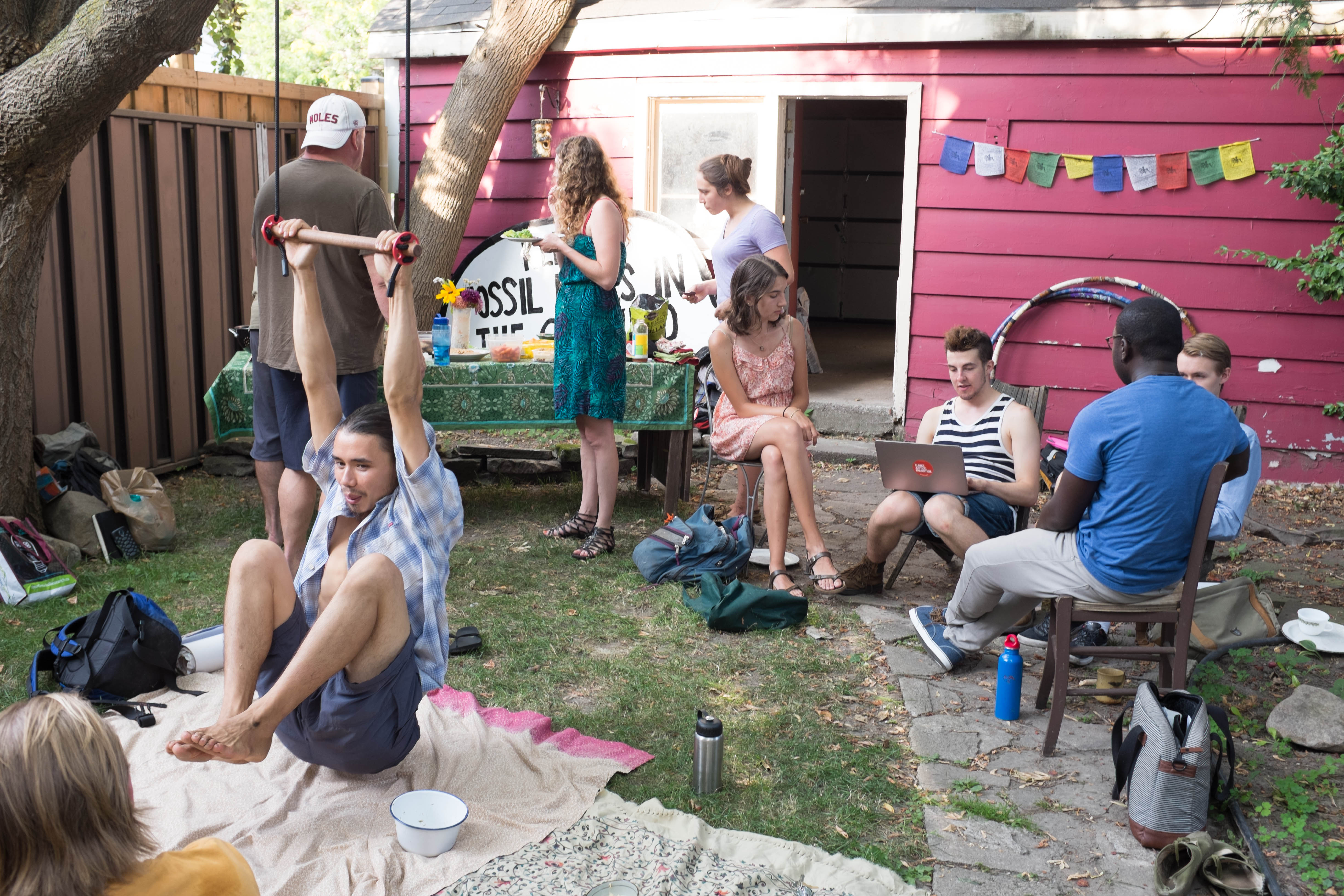
Toronto350 meeting
March for Jobs, Justice, and the Climate
Today, 10,000 people took part in a march through downtown Toronto calling on Canada’s governments to take more aggressive action on climate change.
Many groups were involved, alongside great speakers and musical performers.
Joe Oliver sit-in
Today there was a student sit-in at the constituency office of MP and Minister of Finance Joe Oliver. The students were calling for an end to Canada’s ineffective and harmful climate change and energy policies.
Six other sit-ins took place, attempting to meet with other MPs across Canada.
On Sunday, the major March for Jobs, Justice, and the Climate will be happening in Toronto: moving from Queen’s Park to Allan Gardens.
Volunteers needed: July 5th March for Jobs, Justice, and the Climate
If you will be in Toronto on July 5th, it would be great if you could participate in Toronto350.org’s March for Jobs, Justice, and the Climate: http://jobsjusticeclimate.ca/
Even better, you can volunteer as a marshal to help guide everyone: http://jobsjusticeclimate.ca/volunteer/
If we’re going to deal with climate change, the world needs to change course dramatically and fast. This is a chance to help send that message to our political leaders.
Collier on plunder and romanticism
Plunder and romanticism are so rife precisely because ordinary citizens are insufficiently informed about the opportunities and threats that nature poses to have forced governments into effective regulation. In the task of building an informed citizenry the starting point is an ethics of nature that people in societies with widely different value systems can understand and accept. Neither the romantic variant of environmentalism that sees nature as an end in itself, nor the austere universalism of economic Utilitarianism, can provide such a foundation. The most difficult wars to win are those that must be fought on two fronts. It is more straightforward, psychologically more satisfying and dramatic to have only a single enemy. The romantics among environmentalists and the Utilitarian Platonic Guardians among economists see nature as a single-front war. The romantics regard economic growth as the enemy; the Platonic Guardians regard the values of ordinary citizens as the enemy. But most struggles in development are not like that: sanity lies in the middle rather than at the extremes. Aid provides an example. It is neither a panacea nor a menace.
Collier, Paul. The Plundered Planet: Why We Must – and How We Can – Manage Nature for Global Prosperity. 2010. p. 12 (paperback)
The G7 on getting beyond fossil fuels
Regardless of whether you think the commitment is credible, a position on climate change adopted by the G7 bears consideration:
For one thing, it’s questionable when politicians set goals so far off in the future. For another, we need to phase out fossil fuels much more rapidly if we’re to avoid catastrophic climate change. Nonetheless, there’s one important message here: fossil fuels have no long-term future, and that is increasingly being recognized by the world’s most powerful governments.
Hopefully, this will help people come to grips with the implications of the carbon bubble, and make people think more critically about the appropriateness of building long-lived new fossil fuel infrastructure like pipelines.
March for Jobs, Justice, and the Climate media launch
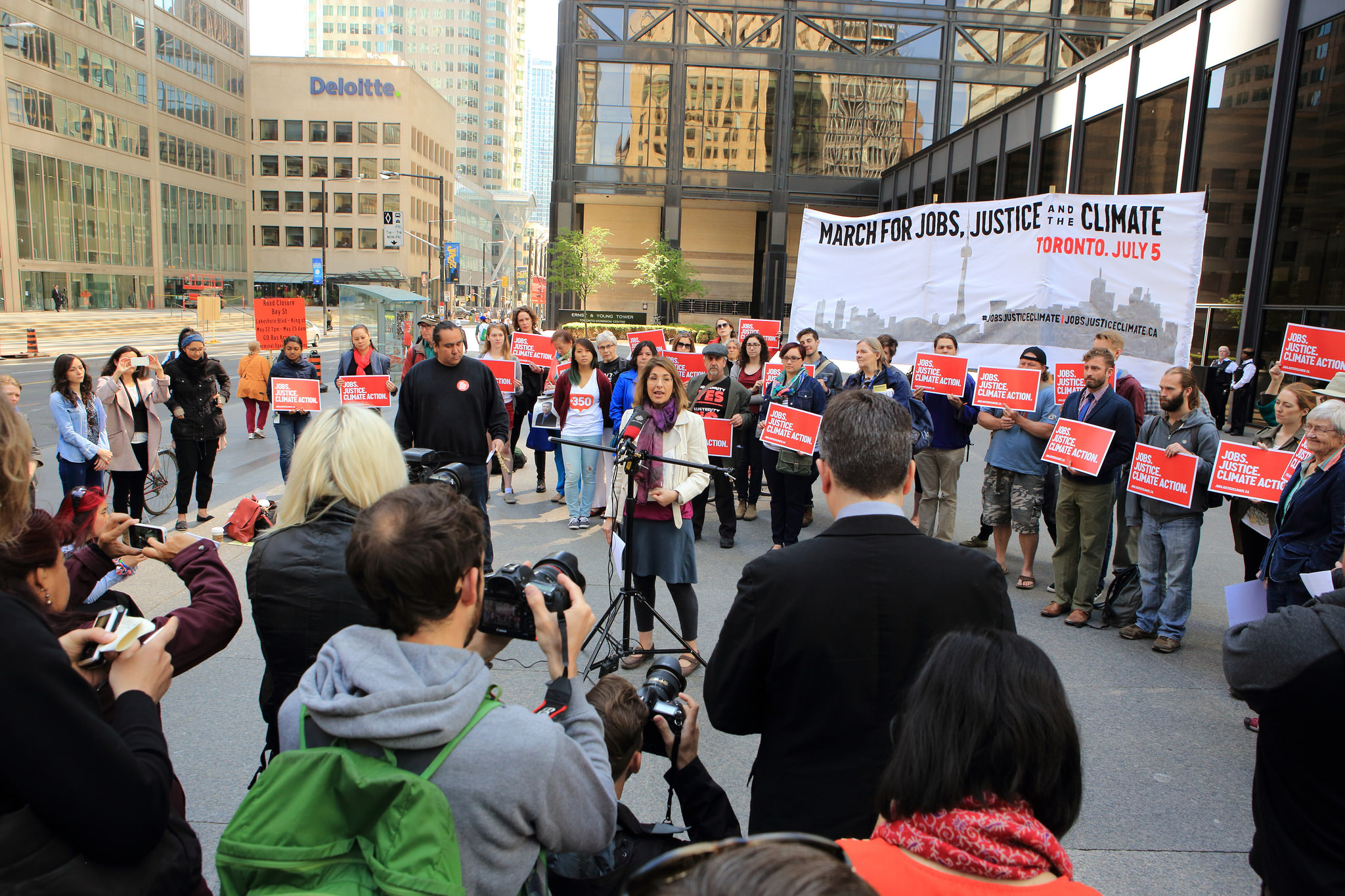
A great set of speakers announced the July 5th March for Jobs, Justice, and the Climate to the media at Bay and King this morning, across the street from the Toronto Stock Exchange.
What’s finite and what’s flexible
We know that we are trapped within an economic system that has it backward; it behaves as if there is no end to what is actually finite (clean water, fossil fuels, and the atmospheric space to absorb their emissions) while insisting that there are strict and immovable limits to what is actually quite flexible: the financial resources that human institutions manufacture, and that, if imagined differently, could build the kind of caring society we need.
Klein, Naomi. This Changes Everything: Capitalism vs. The Climate. p. 347 (hardcover)
Naomi Klein at the March for Jobs, Justice, and the Climate media launch