Two James Hansen updates

James Hansen getting arrested at an August 2011 protest against the Keystone XL pipeline outside the White House
James Hansen after getting released from Anacostia jail, 2011-08-29

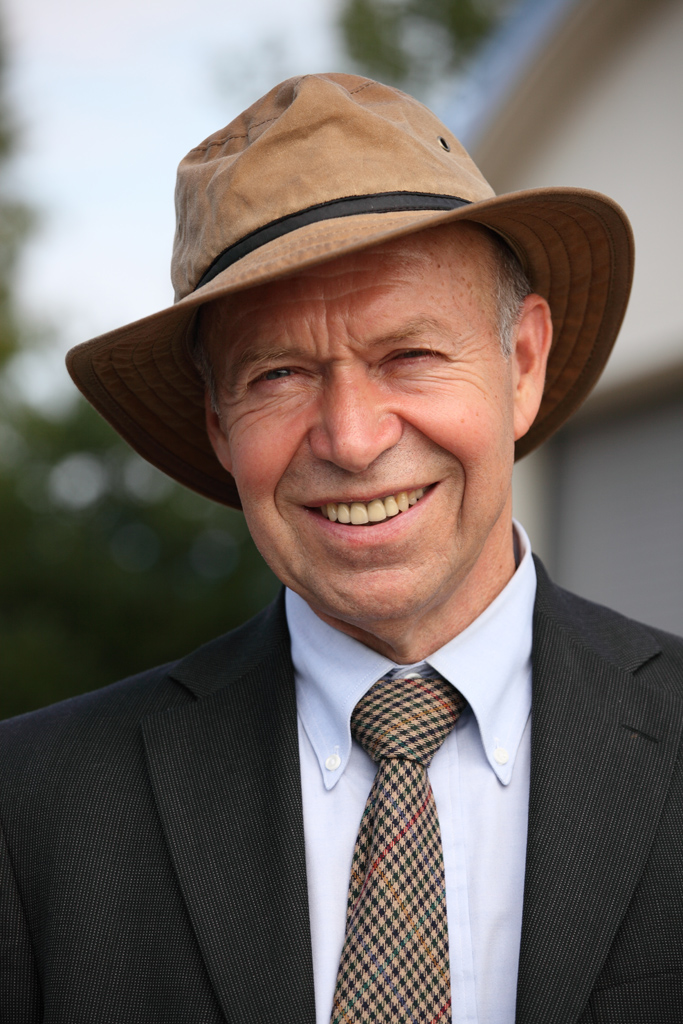
NASA climatologist James Hansen

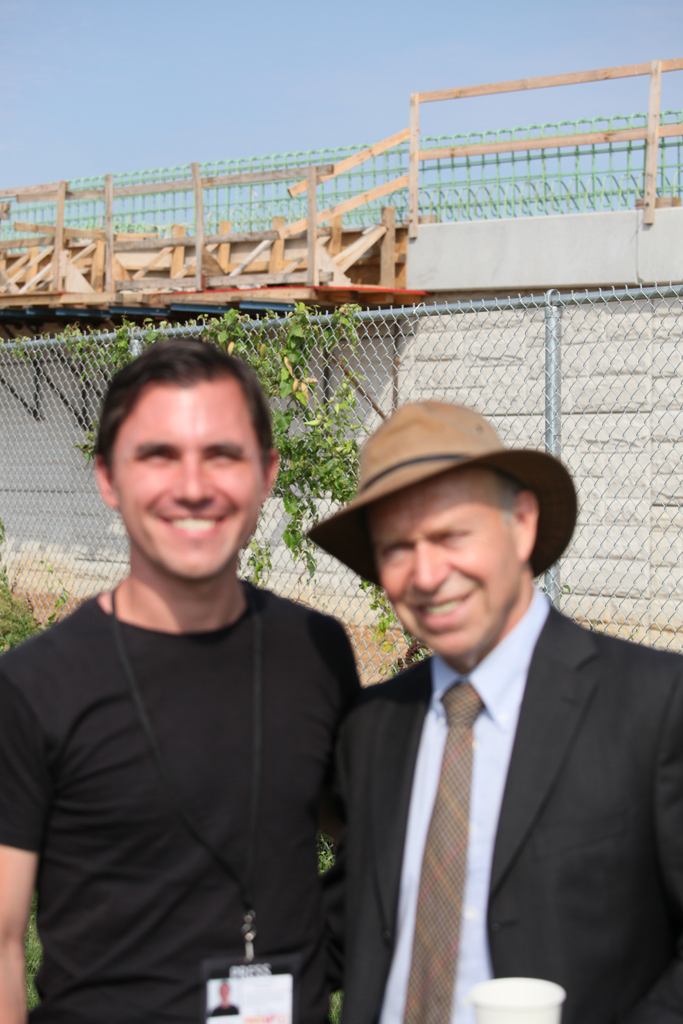
Bonus: a demonstration of why I can’t just hand my camera to passers-by to take a picture

After 32 years as the head of NASA’s Goddard Institute for Space Studies, climatologist James Hansen is retiring (New York Times, Nature). He now intends to devote more of his time and energy to pushing for action on climate change.

One recent publication of Hansen’s: “Prevented Mortality and Greenhouse Gas Emissions from Historical and Projected Nuclear Power” in Environmental Science and Technology. From the abstract:

Using historical production data, we calculate that global nuclear power has prevented an average of 1.84 million air pollution-related deaths and 64 gigatonnes of CO2-equivalent (GtCO2-eq) greenhouse gas (GHG) emissions that would have resulted from fossil fuel burning. On the basis of global projection data that take into account the effects of the Fukushima accident, we find that nuclear power could additionally prevent an average of 420 000–7.04 million deaths and 80–240 GtCO2-eq emissions due to fossil fuels by midcentury, depending on which fuel it replaces.

Related:

Toronto350.org bibliography party

One element of developing Toronto350.org has been learning how to do complex cooperative work using a devoted group of volunteers.

This afternoon, we are having a ‘bibliography party’ for our University of Toronto divestment brief.

We will be taking all the sources people have collected and putting them into biblatex format. It will then be easy to incorporate them into our LaTeX document and produce nicely formatted footnotes and a good bibliography.

Then it will just be a matter of finishing each section of the brief and sending it out to experts for comment. It will need to be run by some people who can comment on the science, others who can comment on the law, and others who are familiar with the U of T administration.

In the end, we should have an authoritative and meticulously cited document explaining why divestment makes ethical and financial sense, and why it is in keeping with the university’s existing divestment policy.

Line 9 and the National Energy Board

If you want to get approval for a huge project with many risks and serious associated problems, one strategy is to get decision-makers to split up the question into tiny pieces. Forbid the people on one team from considering the issues another team is looking at. That way, you can prevent the consideration of interactions between effects and cumulative impacts.

This seems to be what Canada’s National Energy Board (NEB) does for pipelines. For instance, they have hearings upcoming in Toronto related to the Enbridge Line 9 pipeline. Currently, it carries conventional crude oil from east to west. The company wants to reverse the flow so it can carry diluted bitumen from the oil sands from west to east.

In these hearings, the NEB is only allowed to consider the direct effects and risks from the pipeline right here in Toronto. They are explicitly not going to consider the effects ‘upstream’ from oil sands extraction and processing. Likewise, the climate change damage ‘downstream’ cannot be considered.

The fact is, we need to be phasing out fossil fuels – not building infrastructure to facilitate their use into future decades. We’re past the point where building additional fossil fuel infrastructure makes sense, but the NEB isn’t allowed to consider the reasons for that.

Panel discussion on Tuesday

On Tuesday night at 7pm, I am participating in a panel discussion organized by University of Toronto Environmental Action and featuring MPP Peter Tabuns, environmental activist Angela Bischoff, and School of the Environment and Munk Centre Professor Erich Vogt.

Among other topics, we are meant to discuss: “How can young people get their voices heard in our democracy?”

I have some ideas of my own, but would be curious how readers would approach the question.

The event will be in the Music Room at Hart House, and should run until 9pm.

Mark Jaccard on the Harper government’s climate legacy

Mark Jaccard in The Walrus:

“The Harper government supports accelerating the extraction of fossil fuels from our soil, which will send more carbon pollution into the atmosphere. Meanwhile, that same government brazenly assures Canadians that it will keep its 2020 and 2050 emission reduction promises. But I know these assurances are worthless, for the very reason that Chrétien’s Kyoto promise was worthless. The 2020 target is only seven years away. Emissions have fallen slightly because of the global recession. However, the combination of economic growth and oil sands expansion will increase emissions. In a chapter of the Auditor General’s spring 2012 report, “Meeting Canada’s 2020 Climate Change Commitments,” his commissioner on environment and sustainability, Scott Vaughan, noted, “It is unlikely that enough time is left to develop and establish greenhouse gas regulations… to meet the 2020 target.” Instead, Canada is on a path to be “7.4 percent above its 2005 level instead of 17 percent below.””

Strongs word from the author of Sustainable Fossil Fuels.

“Star Wars civilization”

Humanity today is like a waking dreamer, caught between the fantasies of sleep and the chaos of the real world. The mind seeks but cannot find the precise place and hour. We have created a Star Wars civilization, with Stone Age emotions, medieval institutions, and god-like technology. We thrash about. We are terribly confused by the mere fact of our existence, and a danger to ourselves and the rest of life.

Wilson, Edward O. The Social Conquest of Earth. (New York: W.W. Norton, 2012) p.7 (hardcover)

Divestment campaign successes

From an excellent Rolling Stone article by Bill McKibben:

We even had some early victories. Three colleges – Unity in Maine, Hampshire in Massachusetts and Sterling College in Vermont – purged their portfolios of fossil fuel stocks. Three days before Christmas, Seattle mayor Mike McGinn announced city funds would no longer be invested in fossil fuel companies, and asked the heads of the city’s pension fund to follow his lead. Citing the rising sea levels that threatened city’s neighborhoods, he said, “I believe that Seattle ought to discourage these companies from extracting that fossil fuel, and divesting the pension fund from these companies is one way we can do that.”

Toronto350.org is looking for volunteers to help run our divestment campaign.