Even without growth, climate change is a problem

Over at Forbes, Tim Worstall has written something rather silly about climate change:

“This might look like very bad news, that economic growth has pretty much come to an end as an important phenomenon. On the other hand we could regard it as pretty good news as well: for it means that we no longer have to worry about climate change.”

When we talk about economic growth, we are talking about gross domestic product: the sum of all the transactions that happen in an economy in a year.

Climate change isn’t caused by GDP directly, but rather through the burning of fossil fuels. What matters is how much fossil fuel gets burned, not what the size of the economy is. Even with a shrinking economy, climate change is a huge problem if we continue to get the bulk of our energy from oil, gas, and coal. Conversely, a strongly-growing economy built on nuclear or renewable sources of energy could see rising GDP with falling greenhouse gas pollution.

In The Bridge At the Edge of the World James Gustave Speth summarizes our predicament:

“How serious is the threat to the environment? Here is one measure of the problem: all we have to do to destroy the planet’s climate and biota and leave a ruined world for our children and grandchildren is to keep doing exactly what we are doing today, with no growth in the human population or the world economy.”

Our challenge is to find a way to leave most of the Earth’s remaining fossil fuels underground. Reducing our emphasis on economic growth may help with that, but it is not sufficient. It may not even be necessary, if we are successful at building prosperous economies based on zero-carbon sources of energy.

Air conditioning, energy, and climate change

Here’s a statement liable to make a person think about ethics, international relations, climate change, and energy:

As Stan Cox points out in his book, “Losing Our Cool: Uncomfortable Truths About Our Air-Conditioned World“, America uses more energy for air conditioning than Africa uses for everything.

While it certainly illustrates some of the injustice that now exists between countries, it also touches upon the ways in which our present choices can be an injustice toward future generations, as well as how climate change can beget more climate change. As people get richer and the world gets hotter, more energy is likely to be used for air conditioning. Since much of that energy will come from fossil fuels, that will in turn cause more climate change.

Recruiting for 350

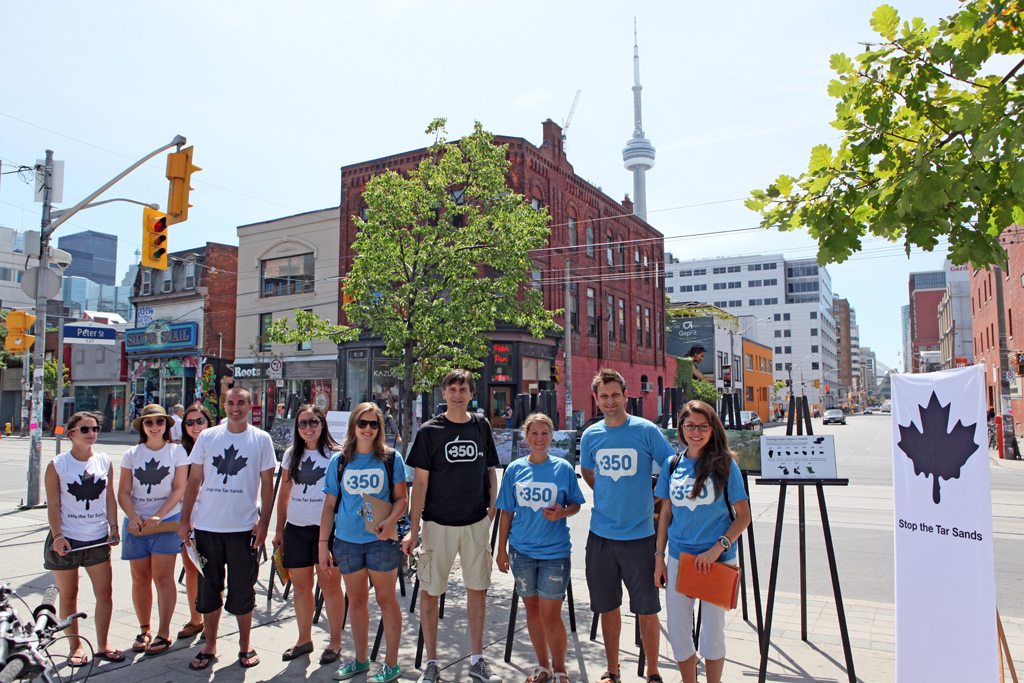
Yesterday evening, I was out trying to collect email addresses for Toronto 350’s events email list.

I wasn’t being pushy – mostly just wandering around with a clipboard and a 350 t-shirt saying ‘good evening’ to people and then trying to engage the ones who responded in a discussion about climate change and the group. Over the course of two hours, I got 10 email addresses – one of them totally illegible. Many of the people who I spoke to yesterday declined to give me their email because they were already inundated with similar messages from other environmental groups. A few others explained that they didn’t see climate change as the environmental issue on which we should be concentrating our attention.

It’s a slow business: trying to build up a group run by a handful of volunteers, without any resources or connections to influential people in the city. My hope is that once I start at the University of Toronto it will become a lot easier to recruit members who will be willing to organize and participate in events. Then perhaps we can begin to engage effectively with the question of how to motivate interested members of the general public to take useful action on climate change.

That challenge of motivating people may be the central problem of climate change. There is a small group that has a huge interest in maintaining the fossil fuel status quo, and they are doing an effective job of pushing that agenda. The majority of people probably do support the transition to a post-fossil-fuel economy in a general sense, but they aren’t willing to push for it or to accept the sacrifices that it is likely to involve.

Organizing and analysis

During the last couple of months, I have been involved with establishing a local chapter of the climate change organization 350.org. Since the organization has no money, it relies upon the work of volunteers during their spare time. This is good in many ways, since it means the group consists of people who have a personal conviction that it is necessary to take action on climate change and that they are willing to devote their talents to the project.

All told, the process of organizing differs substantially from the kind of analysis that happens in government and academia. Indeed, I wonder how much the skills required for good organizing and good analysis overlap. The key requirement for organizing seems to be an ability to motivate people to take action. For that action to be effective, it is obviously necessary to have a big-picture understanding about the science and politics of climate change. At the same time, an active awareness of the scale of the problem may hamper effective organizing. It is impossible to honestly claim that any single action or campaign will make a major difference in the trajectory of Canada’s emissions, much less those of the world as a whole. Motivation requires the hope that one person’s actions will make a difference; analysis often suggests that the actions will have no perceptible effect.

Climate change is a problem without precedent. That means we cannot know in advance which strategies could succeed in curbing it. Given how threatening and urgent it is, I think we need to try everything simultaneously: technological development, political lobbying, grassroots organizing, and all the rest. If nothing else, organizing 350.org is a way of getting in touch with people who are serious about the problem. Together, we can do a better job of evaluating our efforts, spotting opportunities, and correcting mistakes.

P.S. If you are in Toronto and interested in helping to prevent dangerous climate change, I would appreciate if you would join the 350 Toronto mailing list. If you really want to make a difference, please get in touch with me about joining our organizing team.

Working on climate change

I was out all day today with volunteers devoting their time to sharing the message about climate change and encouraging others to take action.

If the science is right, this is a critical time. These are the years in which humanity will either choose to abandon fossil fuels or choose to commit itself to catastrophic climate change. As such, there may be no more important topic to be working on.

That’s even more likely given how few people are actually doing it. Compare the amount of effort devoted to addressing humanity’s most important problem with the amount of effort devoted to putting up advertising, fancy hairdos, driving dirt bikes, or watching television. The fight for the future of the planet is being waged between a handful of activists and a set of massively profitable fossil fuel companies, while a largely apathetic mass of people mostly ignores it.

Dark times

Bill McKibben on the state of the climate change mitigation movement:

“Since I wrote one of the first books for a general audience about global warming way back in 1989, and since I’ve spent the intervening decades working ineffectively to slow that warming, I can say with some confidence that we’re losing the fight, badly and quickly – losing it because, most of all, we remain in denial about the peril that human civilization is in.”

It’s pretty worrisome that some of the most articulate and convincing voices calling for action on climate change are now despairing about humanity’s ability to get things under control.

McKibben’s article talks about how risky warming the planet by even 2°C would be, going on to point out that we are on track to push temperatures up by more like 6°C by 2100. If we want to stay below 2°C, we can only burn about 1/5 of the world’s proven reserves of oil, gas, and coal. Those reserves are worth about $27 trillion, which explains why fossil fuel companies are so desperate to prevent effective action on climate change.

The fossil fuel companies and the politicians that support them are winning the fight over what kind of world will exist in the future, and humanity did more in 2011 to make the problem worse than in any previous year.

Thermus aquaticus and Taq DNA polymerase

Interesting fact: the hotsprings of Yellowstone Park yielded an enzyme that is critical for the DNA-copying polymerase chain reaction (PCR):

“In the hot springs of Yellowstone National Park, [American microbiologist Thomas] Brock (then 40, now 85) had discovered a microbe which he christened Thermus aquaticus, a creature that could survive at temperatures as high as 80°C. At once, our sense of the life-sustaining zone on Earth expanded. “It was Brock who set the ball rolling,” says Michael Danson. “What has happened since is that the temperature has been set higher and higher. The highest temperature record at which growth has been observed is 121°C.”

Thermus aquaticus was also, serendipitously, the organism that established the enormous potential practical importance of these newly discovered life forms. The point about a thermophilic bacterium is that it needs some very tough enzymes, the catalysts of living processes. Our own enzymes break down very quickly at high temperatures, which is another reason that life outside what we consider a normal temperature range was thought impossible. An enzyme in Thermus aquaticus is now known as Taq DNA polymerase and it has become one of the most important enzymes in microbiology. It made possible the polymerase chain-reaction (PCR) technique for amplifying DNA samples. This led to the uses of DNA in forensic science and, in fact, to much of what we now know about DNA. PCR is a molecular photocopier, making it possible to take very small samples of DNA and repeatedly reproduce them. So now murderers have to be obsessively clean if they are to escape the attentions of the forensic scientist.

On a high school field trip, I once got to replicate my own DNA using PCR, at a lab in the University of British Columbia.

Dire Predictions: Understanding Global Warming

While the 4th Assessment Report (4AR) of the Intergovernmental Panel on Climate Change (IPCC) represents the most comprehensive scientific assessment of the causes and consequences of climate change, the report itself is not written in language that is accessible to the average person. Written by climate scientists Michael Mann and Lee Kump, Dire Predictions is an accessible illustrated guide to the conclusions of the IPCC. It also includes some discussion of the practical, political, and ethical implications of the IPCC’s findings.

The 200 page book is a quick and easy read, even for those who are not well acquainted with scientific principles and terminology. It responds directly to many issues raised in the media (such as common climate change denier talking points) and it includes a great many illuminating charts and illustrations. It covers key concepts like what climate models are, and the reasons why we expect the planet to respond to a certain amount of additional carbon dioxide with a certain amount of warming.

The book is broken into five parts, covering climate change basics, projections, impacts, vulnerability and adaptation, and solutions. It very clearly describes which areas are well-understood scientifically and which areas contain substantial remaining uncertainties. Mann and Kump convincingly explain the core mutually-reinforcing lines of evidence that support the ‘big picture’ view of a world that is being dangerously warmed by human emissions, and in which greenhouse gas pollution must be reduced if major damage to humanity and the natural world is to be avoided.

The section on impacts is detailed and wide-ranging, covering everything from different projections of future sea level rise to expected impacts on global agriculture. It covers the trade-offs associated with different mitigation and adaptation strategies, and provides a brief overview of international efforts to address the problem. The section on solutions breaks down where humanity’s greenhouse gas footprint comes from, what options exist for reducing it, and what some of the economics of the situation are. Mann and Kump also do a good job of sketching some of the ethical issues associated with climate change, including the disjoint between the people producing emissions and the people likely to suffer most and the question of what represents a fair effort on the part of countries with different histories and present circumstances.

The book will be elementary to those who already have a through grounding in climate science and policy, though it may be a good way to get a quick and balanced overview of the whole subject. For those who are new to the topic or who feel confused about what the state of the scientific consensus is, this book would be an excellent place to begin.

Climate change and conflict between generations

From what we can tell, the people alive today are putting their own welfare ahead of the integrity of the planet, worsening the prospects of those who will follow. Can anything be done about that?

The problem

The decisions of governments have always affected future generations. When a new bridge is built, it will likely remain in use for a number of decades. Today’s health research (or lack thereof) affects the fates of disease sufferers in the future. The debts accumulated by governments today affect what sort of financial environment the people of the future will live in. The legitimacy of democratic governments is grounded on the claim that they represent the interests of the people who they govern. More precisely, they are meant to implement the current wishes of those people, as identified and put in action through institutions like elections. Ideally, such a system prevents the emergence of parasitic or predatory governments that serve their own interests at the expense of those of the population at large.

Climate change complicates the situation, most importantly by creating a deep conflict between the current generation and all future generations. The choices we are making today – about how much energy we use and where we get that energy from – profoundly affect what kind of world members of future generations will live in and, by extension, what their life prospects will be. The choices we can make that seem most likely to improve their life prospects are generally deeply unpopular, given that they usually involve sacrifices. For instance, we can reduce our impact on the climate by traveling less, enduring colder homes in winter and warmer homes in summer, tolerating the presence of dangerous nuclear power stations, eating less meat, and reducing our consumption of luxury products. By contrast, many of the things which we enjoy doing cause harm to future generations.

Today’s governments necessarily respond to the preferences of the current generation. There is some extent to which those preferences include concern for the future. We generally resist proposals to clearcut national parks, for example. But the revealed pattern of our overall behaviour strongly suggests that we care a lot more about our own immediate physical comfort and convenience than we care about the prospects of the people that follow us. We might delude ourselves into thinking that buying recycled toilet paper and avoiding plastic bags represent sufficient action to protect the planet for future generations, but it seems naïve to think that anybody aside from the most ill-informed members of society seriously believe that.

Today’s governments therefore represent a generation that has chosen to be parasitic and predatory when it comes to the interests of the generations that are to come. We are choosing to impoverish their world, in order to continue to enjoy our present comforts and recreations. Even though we have been amply informed that we are emptying the seas of fish, stripping the planet of biodiversity, and flooding the atmosphere with climate-changing gas, we prefer to carry on as we have in the past. The only threats that seem to motivate large-scale action are immediate threats to the financial system (witness the eagerness with which banks are rescued) and threats to our physical security (the over-reaction to September 11th, huge ongoing investment in weapons, paranoia and mass incarceration in response to crime, etc).

Possible solutions

How are we to escape from this situation? One set of possibilities centres around ways in which the current generation could be brought to sacrifice some of its own welfare for the sake of future generations. One possibility is that the current generation will progressively become willing to accept sacrifices for the sake of the people who will follow – foregoing cheap flights and giant air conditioners for poorly insulated homes. Another possibility is that people will become sufficiently concerned about climate change affecting themselves personally that they will become willing to accept present sacrifices in exchange for a reduction in future risks. Governments could also deviate from the course of implementing the current wishes of voters by enacting policies that reduce the welfare of those alive now for the sake of those yet to come.

There are some alternative possibilities highlighted by those who see such sacrifices as either undesirable or unattainable. It is possible that technological advancement and the operation of markets will somehow make our current preferences compatible with a good world in the future, thus eliminating the conflict between generations. It is also possible that we will undergo a profound shift in what we value, moving away from a preference for resource- and energy-intensive goods and services toward a preference for things that have less of an impact on the planet.

Obviously, there are reasons to be skeptical about all of these possibilities. There are probably other possibilities not listed here. Still, it seems we are in a situation where a clear problem exists and where no clear route forward toward solving it is obvious. Indeed, several of the possible approaches to solution are in conflict with one another. Should we be covering huge areas of desert with solar panels and building hundreds of new nuclear plants to feed the energy ‘needs’ of future generations without altering the atmosphere, or should we be trying to provoke people into re-assessing their needs and living less energy-intensive lifestyles? Perhaps we should be encouraging a rapid reduction in the global population, so that the aggregate impact from a smaller number of richer people will remain within the boundaries of what the planet can tolerate. Perhaps we should be giving up on the project of reducing greenhouse gas pollution, which has been failing now for decades, and accept that our best chance of preventing catastrophic climate change is developing technologies to intentionally cool the planet. Of course, there is no guarantee these technologies will work, and it is virtually certain that they will have serious side-effects.

There are so many overlapping uncertainties that it is challenging to adjudicate between these and other options. We don’t know what the future of fossil fuel production will look like, particularly given that we don’t know what sort of investment decisions will be made. We don’t know how the technology and economics of other forms of energy will evolve during the next couple of decades, in fields as diverse as batteries, nuclear power, and solar panels. We don’t know how quickly and severely the impacts of climate change will be felt, or where in the world they will first occur. We don’t know the political future of important countries like China, or important supra-national entities like the European Union.

One possible response to uncertainty is to identify the things about which we can be most confident and focus our action on them. We now know that burning fossil fuels causes the climate to change dangerously. In response, we could devote our energies to doing whatever we can to avoid the production and use of fossil fuels. We also know that there are many opportunities around the world for improving energy efficiency while simultaneously saving money. That suggests that strategies focused on deploying more efficient technologies and approaches could be promising. We also know that people do care to some extent about the kind of world they are creating for their children and grandchildren, suggesting that further efforts to share what we are learning about the consequences of our current actions and the alternatives that exist for us may prove fruitful.

All of these responses have problems. Restricting fossil fuel use mainly involves choices that are deeply unpopular. People in rich places are accustomed to incredibly energy-intensive lifestyles which only fossil fuels can plausibly sustain in the near-term. Efficiency improvements can be hard to achieve, and tend to be negated when people invest the savings in doing more energy-intensive things, rather than achieving an overall efficiency improvement. Finally, while people do care about the prospects of their children, it is hard to convince them that a stable climate is a key part of that. Even if they can be convinced of that, people are loathe to take action when others around the world are not doing so. Also, our energy choices affect hundreds of future generations. People may care intensely about the prospects of their children and grandchildren, but they tend to behave as though they are indifferent to the prospects of people living in 500 or 1000 years, who by most accounts have an equal claim to our moral consideration.

All told, this is a murky time for the environmental movement. Progress has been blocked on most fronts. International negotiations on climate change have failed to produce meaningful action. The United States, which is arguably the most important country in the world when it comes to developing a global consensus to proceed, is immobilized by domestic politics. Nuclear power stations – one of our larger-scale low-carbon options – are explosively unpopular. Meanwhile, continued growth in rapidly-developing countries and the development of unconventional oil and gas resources keep the world on a trajectory of ever-increasing greenhouse gas pollution. It’s hard not to despair about the future.

Related:

Earth as inheritance

People sometimes refer to the Earth as an inheritance that passes from each generation to the next. There is some truth in this, but it misses something important. A child who inherits nothing nonetheless stands a decent chance of surviving, but no human generation can survive without an intact biosphere. That makes the Earth much more important than any inheritance and therefore makes it substantially more unethical to squander for short-term enjoyment.