Category: The environment
Atmosphere, biosphere, lithosphere, hydrosphere, etc – everything about life and the state of this planet
Pedaler’s Wager photos
Thanks to the generosity of a fellow photographer, I had access to a MacBook Pro for a few hours tonight and I was able to process and upload my photos from the Clay and Paper Theatre Company’s 2011 summer show: The Pedaler’s Wager.
The show was very colourfully and professionally put on, and I enjoyed it thoroughly. At the same time, I think it may have glossed over some of the hardships of pre-industrial life and some of the benefits of the current global economy. While there are certainly many critical problems with it, and much that needs to be done to make it sustainable, I do think it serves important human needs and that those who are most critical of it are often those who benefit from constant access to its nicest features. That includes things like modern medicine, communication technology, and transport. It seems a misrepresentation to say that the Industrial Revolution and its aftermath have transported the average person from a blissful pastoral state into a situation of agonizing bondage.
Of course, the purpose of art is not to carefully express both sides of every argument. By provoking us to think in new ways, art can give us a better overall sense of context and an appreciation for important facts that were previously concealed.
Tar Sands Action: Come Join Us!
Professional organizers
The ongoing Washington protest has given me my first real exposure to an interesting group of people – professional organizers of protests. These are people who provide direct action training, run websites, work with the press, etc. The organizers are progressive people – to be sure – and I am sure they are selective about the causes they support.
The organizers are distinct from activists in that activists are usually firm believers in a specific cause. The activists in this particular protest are the people who are willing to get arrested to express their strong opposition to the Keystone XL pipeline.
Those people are obviously necessary, but it has been interesting to learn a bit about the general logistical side of things – watching people work in dark cubicles on a Sunday, updating websites and watching the news coverage roll in.
Reasoning behind going to Washington
Over on BuryCoal, I have posted an explanation of why I am going to the Keystone XL protest in Washington D.C.
I hope it is comprehensible, despite having been tapped out during an unusually exhausting Greyhound journey and posted using snatches of WiFi from passing coffee shops and motels.
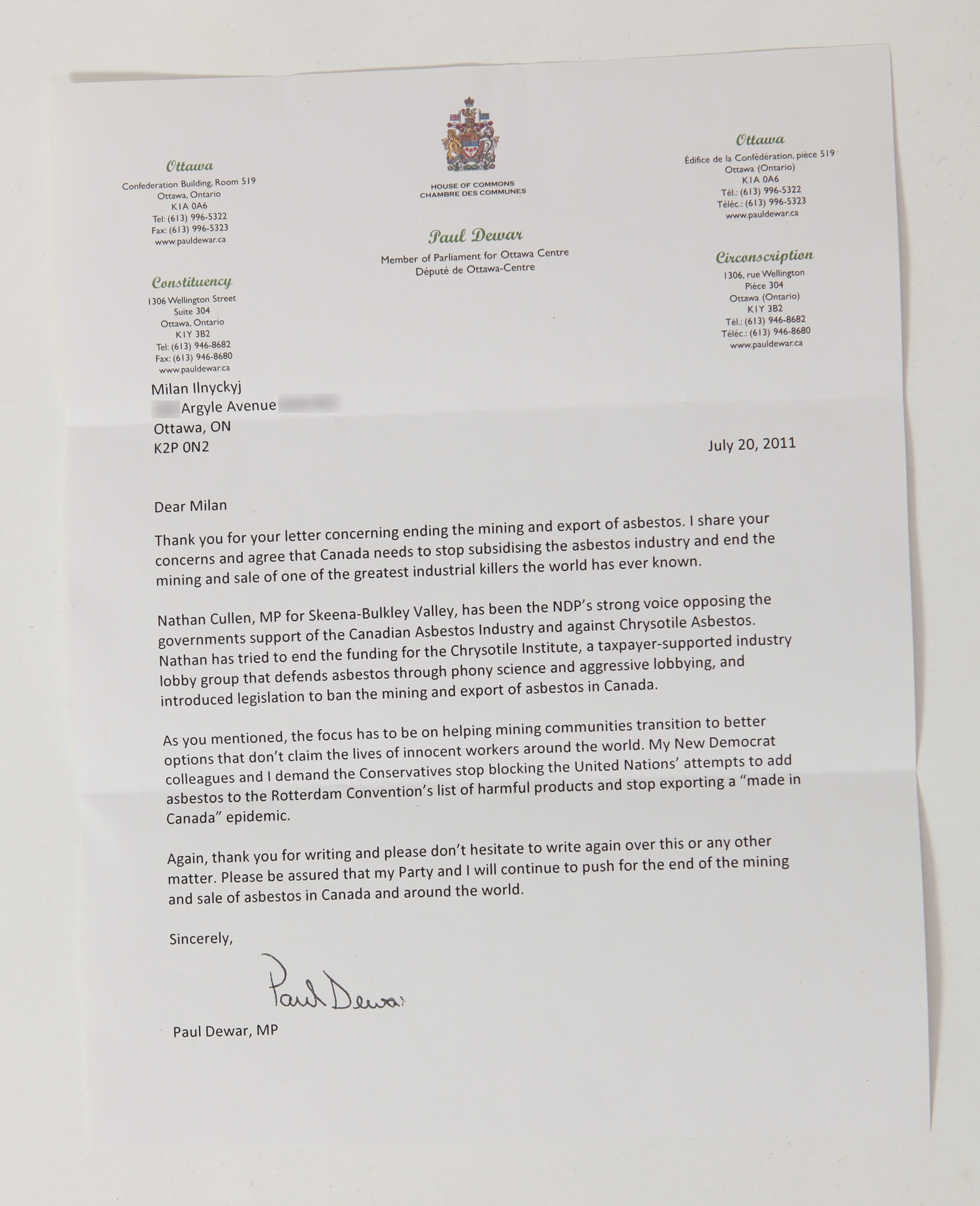
Dewar letter regarding asbestos
Around Canada Day, I wrote a letter to Paul Dewar, my Member of Parliament, about Canada’s export of crysotile asbestos. It seemed classier than holding up a giant “Shame on Canada, Asbestos = Cancer” sign during the Royal Visit.
Today, I got a response setting out his position on the issue:
Any pro-asbestos residents of Ottawa Centre should start bombarding him with strongly worded letters immediately. I am curious what sort of response they would get; hopefully, the same statement of policy with an explanation of why Dewar disagrees with those who favour Canada’s current policy of asbestos support.
It’s good that he has staked his colours to the mast on the issue. Constituents who are concerned about the issue of asbestos should make sure he has voted along these lines the next time the issue arises in the House of Commons. By then, I expect, I will have a new MP (due to me moving).
Asbestos export is an issue I first raised here some time ago.
Key Climate Questions
I have started a new series of blog posts on BuryCoal.com. Entitled “Key Climate Questions”, it will provide information on some of the most important outstanding questions about climate change. The first one is on how long the effects will last. Later posts will address things like whether geoengineering will work, what the regional impacts of climate change may be, the significance of methane from melting permafrost, etc.
Obviously, the aim of the series is not to answer these questions. Rather, it is to flag some of the areas where important scientific work is being done and provide links to information about that research.
Feel free to suggest topics.
Harperland: The Politics of Control
Lawrence Martin’s 275-page account of the political life of Canadian Prime Minister Stephen Harper is useful reading for those who want to more fully understand how Canadian politics reached the arrangement it is now in, as well as those who wish to speculate more effectively about what the years ahead will involve. While Martin’s account is fairly hostile to Harper, the claims included within it are generally quite focused and backed by evidence. It is definitely written in the style of a journalist: opinionated, but with an awareness that everything will be fact checked. The book is packed with illuminating little details, from the way former Liberal Party leader Stephane Dion first arrived to work in Ottawa by bus to how the election-prompting decision to cut per-vote funding to political parties arrived was conveyed by unexpected BlackBerry message.
At times, Martin is sharply critical of Harper and the decisions of the Harper government. For instance, he objects strongly to the treatment of underage terrorist suspect Omar Khadr, the suppression of information on the torture of detainees in Afghanistan, as well as the fiscal record of the Conservative government. Martin argues that on many different policy files, the Harper government is driven by ideology and actively hostile to evidence. These include minimum sentences, drug policy, the long-form census, and others. The Harper government is also portrayed as obsessed with power for its own sake, rather than for the advancement of a well-articulated philosophy, as well as irrationally hostile to their political adversaries and those who disagree on policy grounds. In addition, the Harper government is portrayed as ignoring Canada’s constitutional conventions on matters like the supremacy of parliament, weakening government overall while strengthening the executive.
At many points, the book touches upon climate change and environmental topics. It probably won’t be too illuminating for people who have been following the file, but the details included strengthen the argument that the Harper government has largely seen climate change as a public relations problem to be managed, rather than a real-world issue of any importance to Canadians.
Written by someone who obviously has a great deal of personal experience with the various recent eras of Canadian politics, Harperland may be an especially worthwhile read for younger citizens who dimly remember the Chretien era that took place when they were children and who do not have any personal basis for comparing the recent Conservative governments to those earlier in Canadian history. The book also provides some personal details and character insights on Harper himself and those closely associated with him. It is interesting to read about how despair often precedes the re-emergence of resolution for him after a setback, or to have some examples of his documented vindictive streak provided. Matin quotes Charlie Angus in describing Harper’s “fundamental flaw” as “a mean streak, a level of viciousness that comes out”.
The book contains many references to the interactions between the political and bureaucratic sides of government, particularly on issues like access to information. There are also detailed accounts of the fates of various ministers and high-level advisors.
At times, Martin’s account is rather passionate – particularly concerning the near-emergence of a Liberal-NDP coalition. Particularly when describing this time period, the author seems to be shouting after-the-fact advice to journalists and the opposition. I haven’t been keeping track of his journalistic contributions elsewhere, so it is possible that he is simply re-asserting claims of his own that he feels have been vindicated by future events.
One thing that annoyed me a bit about the book is Martin’s habit of using ‘the West’ as a synonym for ‘Alberta’. It may look that way to someone who sees Ontario and Quebec as the centre of the political universe, but it looks awfully different from British Columbia.
Harperland does praise some successes of the Conservative government. In the ‘achievement log’ he places “the granting of nation status to the Quebecois, the apology to the Native peoples on residential schools, corporate tax reductions, the softwood lumber accord, and the Haitian earthquake rescue effort”. In the end, however, Martin’s verdict is fairly strongly negative:
As a strongman prime minister, [Harper] was beyond compare. He made previous alleged dictators like Jean Chretien look like welterweights. It was no small wonder that Canadians feared what he might do with a majority government. With that kind of power he could establish a hegemony the likes of which Canadians could not imagine.
Martin will have to provide an update in four years or so.

Blowout 2100
The overall aim of governments and political parties in North America an Europe at the moment seems to be serving the interests of people who are about 50 and at least fairly well off. Keep stock prices and house prices up, prop up failing banks and car companies, keep pumping fossil fuels, don’t worry about climate change or what future generations will use for energy. After all, the core supporters of the politicians (especially when it comes to all-important campaign cash) will probably be dead by the time the most serious effects of climate change are felt. The same goes for the people in high-level decision-making positions in government and industry today.
It seems that future generations will have good cause to hate us. We have had climate change endlessly explained to us, with multiple convincing lines of evidence to back up the theory. We have been told what we need to do to stop it, but we have chosen to do nothing because we care about our short-term economic welfare more than anything else.
If that is the implicit attitude of the politics of today, it would be helpful if it was made explicit. “Vote for Party X for 30 or 40 more years of relative prosperity. After that, no promises.”
Climate wave crested?
At least for the next few years, it seems likely that the level of public concern about climate change has peaked, and attention will be focused elsewhere. That isn’t justified by the facts, but it seems to be the case, and it is the reality that people pressing for more action need to deal with now.
We have to be intelligent and determined enough to drive the emergence of acceptable climate change policies – ones that protect the planet which we all fundamentally depend upon from casual destruction, because people prefer to have cheaper electricity and transport right now. We need to do that despite how people are worried about other things, how the science is complex and challenging to understand, and how the ideal path forward can only be approximated through risk analysis. We need to try approaches until we find ones that work.