LORAN being shut down

The ground-based LORAN network has been aiding navigation since WWII. Now, it is being shut down to save money, based on the thinking that the GPS system has made it obsolete. I had direct experience with the Pacific LORAN array and its coordinate system during the LIFEboat Flotillas. Most of the LORAN stations will go offline on February 8th, with the rest shutting down in the fall.

It is probably fair enough to say that LORAN is antiquated and redundant, though GPS is not without problems. It may eventually get a backup, if the EU finishes building their Galileo navigation satellite system by 2013, as planned.

Both LORAN and GPS function on the same basic principle: that if you know where certain radio transmitters are, and how far you are from each, you can sort out where you are located. GPS has the virtue of being global and increasingly ubiquitous, as more and more devices become capable of locating themselves using the system.

Observation

Even with my cheap 8 x 25 binoculars, the moon is impressive on a cold, clear night. You can get quite a sense of its differing terrain and three-dimensional character. It may be an illusion, but it even seems barely possible to make out that Venus is a crescent rather than a point.

It would be really interesting to try out a pair of image stabilized 15 x 80 binoculars. With those, you could see a lot more detail – especially if you could get away from city lights.

Wind farms and NIMBY syndrome

Over at Boing Boing, there is an interesting article about wind power and the Not In My Backyard (NIMBY) syndrome. The article suggests that the general understanding of the NIMBY syndrome is wrong, and the problem is not that people locally oppose what they support in a general sense. Rather, people who oppose wind farm on principle become energetic opponents when the prospect of it being installed locally arises. I am not sure how convincing I find the analysis, but the issue is an important one and not only for wind. Whatever our post-fossil fuel energy mix is going to consist of, it is going to require facilities being built near where people live, whether those facilities are concentrating solar plants, dams, wind farms, carbon capture and storage facilities, nuclear reactors, or something else.

The same issue was discussed in the film The Age of Stupid. There, it seemed pretty clear that the primary objection people had was local wind farms depressing property values. The Boing Boing article does discuss one partial solution there: offering the locals a share of the revenues from the project might change their thinking.

Environmentalism and ‘breathing underwater’

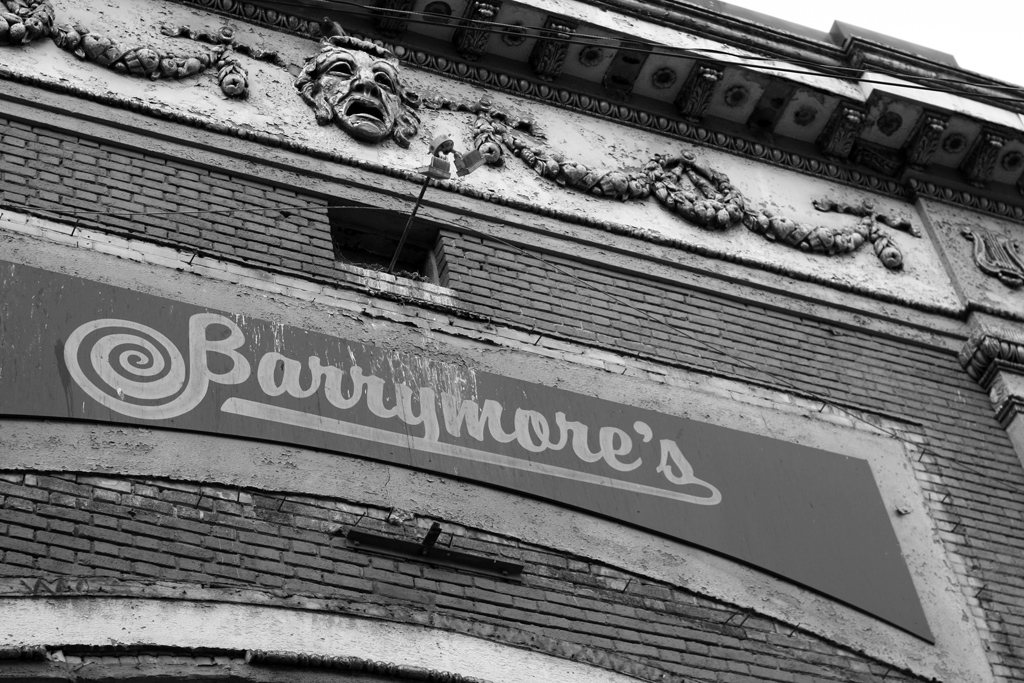
Barrymore's on Bank Street, Ottawa

The Walrus recently published an article entitled: “The Age of Breathing Underwater.” Written by Chris Turner, it relates to a number of previous discussions here, such as the recent one about being unimpressed with humanity, when it comes to behaving sensibly about climate change.

It begins with a lengthy discussion about some of the life in coral reefs: one of the ecosystems most profoundly and immediately threatened by climate change. Indeed, even with some pretty aggressive mitigation, most will probably perish during the lifetimes of those reading this, as the result of both rising temperatures and increasing ocean acidity. The article quotes scientist J. E. N. Veron saying that by 2050 “the only corals left alive will be those in refuges on deep outer slopes of reefs. The rest will be unrecognisable — a bacterial slime, devoid of life.”

The article also discusses environmental activism, science fiction, the prospect of geoengineering, the concept of ‘resilience’ in a threatened world, and what it means to be alive in the Anthropocene – the era in human history characterized by the impacts of human beings on physical and biological systems. It makes the strong point that we can somewhat reduce the eventual impact of climate change by working to diminish other stresses; reefs threatened by warm and acidic water don’t need dynamite fishing and oil drilling to help drive them to extinction. The same is surely true of terrestrial ecosystems. Resilience is also something that can be built into human systems – the ability to stretch and change without breaking. From my perspective, that is one huge limitation of the ‘survivalist’ approach to surviving climate change. Your little armed colony might be able to sustain itself under present conditions, but it isn’t necessarily very flexible, when it comes to adapting to whatever the future will bring.

The ‘underwater’ metaphor is an interesting one. The author points out that the human capacity to remain underwater for extended periods depends fundamentally on the whole enterprise of modern industry. The author points out that we’re not really trying to save reefs anymore: we’re trying to save the ability of human beings to do things like SCUBA dive. That ability can only be maintained if we maintain an industrial society, while transforming its energy basis. The article’s conclusion addresses this, but is somewhat underwhelming. While renewable forms of energy are surely a huge part of the solution, putting solar panels on top of buildings won’t be anywhere near adequate. We need comprehensive plans of the sort David MacKay has cooked up. Making the transition from surviving underwater using a set amount of compressed air (akin to fossil fuels) in a tank to living in a self-sustaining colony (akin to renewables) requires appreciation of scale and logistics. A few houseplants are not going to do it.

In any event, the whole article is worth reading and responding to. My thanks to my friend Ann, for pointing it out to me.

More cycle-friendly Burrard Street Bridge

The Burrard Street Bridge – one of Vancouver’s prettiest – has been modified so as to be more friendly to cyclists. One of the two sidewalks has become a dedicated corridor for cyclists heading north into downtown. Meanwhile, one traffic lane has been converted for use by cyclists heading south toward Kitsilano. Pedestrians will be restricted to the other sidewalk.

The move is a very welcome one. The bridge offers nice views of the mountains, False Creek, and downtown. Making it cycle-friendly also contributes to a beautiful cycling arc extending from the University of British Columbia, along the beaches to the Granville Island area, then across the Burrard Street Bridge and along the waterfront path to Stanley Park.

Cyclists in Vancouver should definitely give this ride a try, while the six month bridge trial is ongoing.

Pine beetles spreading into the US

Coiled firehose

According to the BBC, the climate-linked mountain pine beetle epidemic in British Columbia is threatening to spread south and west, into the United States. Forests with a mixture of species and small regular fires would be more resilient, overall.

In addition to mentioning the importance of warm winters in aiding the spread of the insects, the article describes how past fire suppression policies have produced huge areas of mature lodgepole pine, which are especially susceptible to the beetles.

The continuing spread represents not only an economic and environmental cost linked to climate change, but also a potentially serious positive feedback effect. It is estimated that Canada’s boreal forests alone contain about 186 billion tonnes of carbon dioxide equivalent: an amount equivalent to about 25 years of global emissions at the present level.

Grouse Mountain’s 1.5MW wind turbine

Fence and brick wall

According to the Megawatt blog and The Vancouver Sun, the Grouse Mountain ski resort is going to put a highly visible 1.5MW wind turbine near the mountain’s highest point.

While the move is more symbolic than substantive, the turbine is expected to provide about 20% of the power requirements of the resort. It will also be a tourist attraction in and of itself, with a viewing platform 58m up. The turbine is meant to go up in August or September, and produce power in early 2010, in time for the Vancouver Olympics.

The most important impact may be making people gradually more tolerant of visible renewable energy facilities. If we are going to escape our harmful dependence on fossil fuels, we are going to need a lot of them.

Bixi bikes in Ottawa

Purple flower

The Ottawa area now has four bicycle rental kiosks – two in Gatineau, and two on the Ottawa side. The company that provides them is called Bixi and they are priced to encourage brief usage: free for 30 minutes, $1.50 for the next thirty, $3.00 for the next thirty, and then $6.00 for each half hour after that. To take one out, you swipe your credit card. It charges the appropriate amount when returned to another station. Montreal has a system with the same bikes: 3,000 of them at 300 locations. The Montreal system apparently cost $15 million, and is expected to pay itself off with user fees.

The stations are outside the Portage Complex and near the Civilization Museum in Gatineau, as well as beside the ByWard Market on Sussex near York and on the other side of the Canal at Elgin and Queen.

I want to try doing a rally between all four, making each trip in less than half an hour, so as to make it all free. Going from Portage to the Civilization Museum would be a breeze. From there to the ByWard stop would also be pretty easy, across the Alexandra Bridge. The trip between the Ottawa stations would be short, but going from the Elgin station back to Portage would be the trickiest part to achieve in half an hour, though still very possible.

The system should be very useful for both visitors and residents. I hope people treat it with respect.

Slowing the demise of Germany’s last glacier

Apparently, the last glacier in Germany is going to be covered up during the summertime to reduce melting. Located in Bavaria, at an altitude of 2,962m, the Zugspitze glacier will have an area the size of a soccer field covered with 30 metre long tarps, in order to protect its 40 remaining metres of thickness.

Apparently, protecting glacier coverings are also being used in Switzerland and Austria.

The value of private cars in cities

Squirrel near Mud Lake, Ottawa

In the midst of the discussion about the ethics of traveling to Vancouver, the issue of how cars have benefited and harmed people living in urban areas came up. It is undeniable that they have been a major transformative force, when it comes to the shape and character of cities.

To me, it seems that private cars in cities do more harm than good, for a slew of reasons:

  1. They kill a lot of people: both drivers and pedestrians.
  2. They take up a lot of space and alter urban design in negative ways, contributing to sprawl and vast areas of just residential or just commercial zoning.
  3. Sprawl reduces natural and agricultural space. It also leads to people commuting, which is a major waste of their time.
  4. They pollute and emit greenhouse gasses.
  5. They are loud.
  6. They cause neighbours to know one another less than they otherwise would.
  7. They help make many states dependent on oil exports, and frequently involve them militarily in Middle Eastern conflicts.
  8. They have made roads into hostile spaces for everything but automobiles, whereas previously they were more versatile public spaces.
  9. The roads they require are built with public money, though they do not provide value to everyone, and contribute to serious negative externalities.
  10. They use energy quite inefficiently, since they move faster than is sensible, and the mass of the vehicle itself far exceeds that of passengers and cargo.

If it were possible to re-design cities, I think it would be better if they excluded cars entirely within their cores and had a lot of dedicated transit and bicycle routes. Stores could be permitted to have delivery vehicles for large items, and taxis could continue to exist, but the use of private cars within city limits would ideally be eliminated.

What points would people offer to defend private cars in cities? Also, are there and indictments against them I missed?