Hybrid-ed

Milan’s Ottawa hybrid

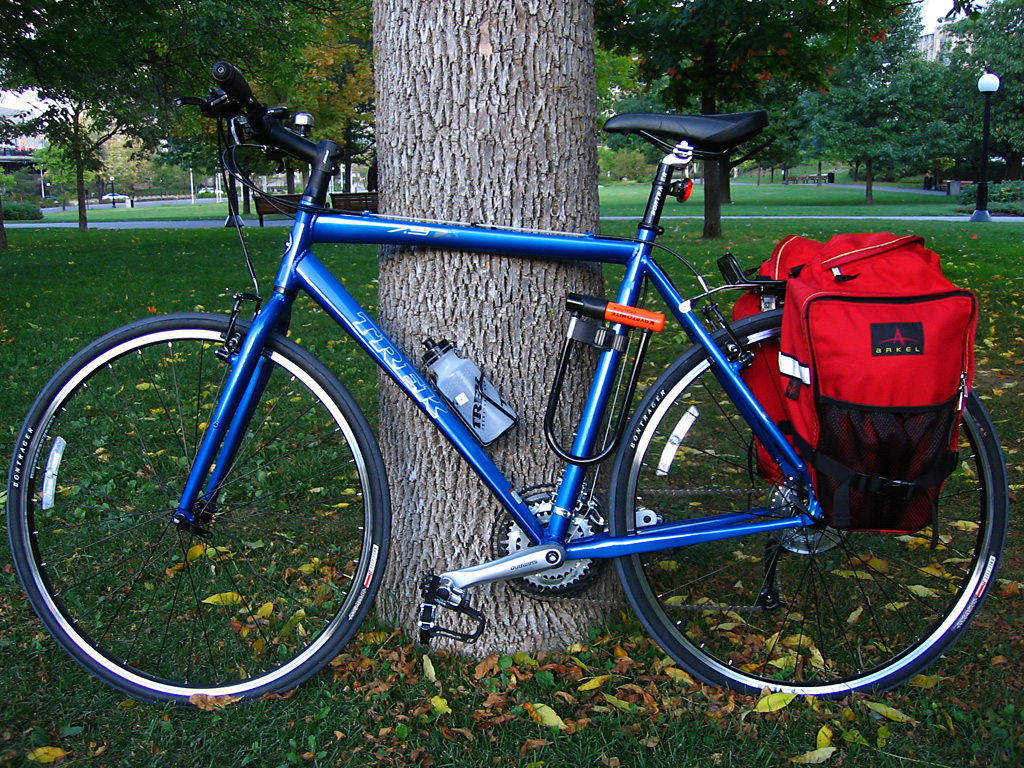
I got my new bike today, and it is a thing of beauty. It seems to weigh about half as much as my Oxford hybrid and the components are dramatically sharper and more precise in their operation. I had them swap the grips for some with more traction, as well as replace the pedals with solid metal ones with cages. I have never ridden a bike with the latter before and have mixed feelings about them. With my feet in the cages, it is a bit awkward to stop at intersections. With the cages hanging loose under, they can scrape the ground on the inside of a turn.

In addition to the bike, lock, and helmet, I got a pair of 14L Arkel panniers. They aren’t the most attractive looking things, but the fabric they are made from seems extremely durable and the staff of the shop were very keen on the brand. At present, the left one has an awkward habit of sometimes brushing the back of my foot when my toes are inside the cage. I will need to adjust it somehow to avoid that.

I celebrated the acquisition of the bike and panniers through the purchase of about 35kg of dense foodstuffs: from yams to big tins of beans to salsa. Tomorrow, I am looking forward to Critical Mass. This weekend, I am looking for cycling further afield.

PS. I also want to express the degree to which I appreciated G.M Bertrand Cycles. Their staff was dramatically more helpful than those at any other place I visited. They gave me a good deal, fit the bike to me (with my pedaling on this odd stationary platform), promised a year’s maintenance, installed all the accessories I bought, did the grip and pedal switch for a pittance, and were otherwise exemplary.

Refraction and arctic solar canines

Both for work and my own interest, I am reading Richard Alley’s The Two Mile Time Machine, as recommended back in Oxford by Henry Shue. A relatively informal history of ice core science, it also includes some interesting facts and observations about the polar regions. For instance, I learned about the phenomenon of sun dogs or parhelions.

In the Arctic, ice crystals in cirrus and cirrostratus clouds sometimes produce a refractive effect, framing the sun with a pair of luminous partners. It gladdens me somewhat to know that the Arctic summer has at least one visual effect to compensate for the drowning out of the Northern Lights by constant sunlight. I once had the good fortune Aurora Borealis myself – from Neal’s balcony in the Gage Towers during a period of exceptional ionic activity in the upper atmosphere. Perhaps I will be lucky enough to see a sun dog before the Arctic changes beyond all recognition.

Candidate bicycle located

Ottawa tower block

I found a possible bike this evening: a Trek 7.3 FX hybrid. Originally $619.99, it is on sale for $439.99. I would probably have bought it tonight if there had been time to test it out before the shop closed. As it is, I will have some time to research it before I go give it a test ride on Thursday (mandatory orientations are happening for me tomorrow and Wednesday, on the opposite side of town).

The bike has Shimano Deore components, which the salesman tells me are the 6th of eight levels of quality sold on hybrids. It is quite light and seems well constructed. The place promises free repairs and tune-ups for a year, as well as an unspecified discount on a helmet, lock, and pump.

This is the last one available with a 20″ frame, which I am told would suit me better than the 22″. Hopefully, nobody will snap it up before me.

A storm by any other name

A couple of interesting facts relating to meteorological nomenclature:

First, a ‘cyclone’ is any “system of winds rotating around a centre of minimum barometric pressure,” according to the OED. Once those winds reach hurricane speeds (64 knots), the storm is called a ‘hurricane’ in North America; a ‘typhoon’ in the Northwest Pacific, west of the International Date Line; a ‘severe tropical cyclone’ in the Southwest Pacific, west of 160°E or the Southeast Indian Ocean east of 90°E; a ‘severe cyclonic storm’ in the North Indian Ocean; and a ‘tropical cyclone’ in the Southwest Indian Ocean.

Secondly, the American National Oceanic and Atmospheric Administration (NOAA) names cyclones in a number of different regions several years in advance. If the list of names assigned for a season runs out (there are 21 assigned names per year) subsequent storms are named after the successive letters of the Greek alphabet. Short, distinctive names are used because doing so was found to produce fewer errors than designating storms on the basis of latitude and longitude. Sometimes, a storm is “so deadly or costly” that the NOAA retires the name, for reasons of emotional sensitivity.

Geography and the web

While it certainly doesn’t have the best name, the concept behind heywhatsthat.com is a neat one. Using data from Google maps, it generates panoramas as seen from mountaintops and other high places. You can then identify the mountains that you see around you.

The interface definitely needs some work, but the site does suggest ways in which openly accessible storehouses of data – such as the position and altitude information available from Google – can be combined into novel tools.

exploreourpla.net is a similarly badly named but interesting site. It combines geographic data and images related to climate change. You can, for instance, view a satellite map of Western Europe overlaid with luminous dots showing the most significant greenhouse gas emitters.

Ravenous pine beetles

According to an interview with the CBC given by Allan Carroll at Natural Resources Canada, there is not much hope of British Columbia containing the mountain pine beetles (Dendroctonus ponderosae) that have already killed 9.2 million acres of forest. He said that “Our estimates are that by about 2013 to 2015, the beetle will have killed about as much as 80% of the mature pine in the province and I don’t think we can really affect that now.” As the supply of Lodgepole Pine becomes eliminated, the beetles sometimes move on to Spruce and other species. If the beetles begin to target the Jack Pine of the boreal forest, Carroll says that it “could wipe out billions of trees all the way to the East Coast.”

These insects were mentioned here before, in the context of the effect of changing minimum temperatures on species ranges. Apparently, once they have reached their maximum cold tolerance, these beetles can endure temperatures of -40°C. It is significant cold events in the early and late winter – before their chemical defences have fully come on stream – that can lead to “very large amounts of mortality in the [beetle] population.” A few very crisp fall days would do a lot for western Canada’s forests.

Out of season

If you want to save some money and make yourself feel like you are really on the ball, have a look at the winter clothing prices at Mountain Equipment Co-op (MEC). Presumably because they have new stock coming in this fall, a lot of old stuff is quite heavily discounted. If you sense a long-term need for Gore-Tex trousers or a down parka, now may be the time to invest.

Personally, I am placing my hope in a long summer. Unless some new hassle arises, my next paycheque should finally mean the acquisition of a used bike.

Sustainable transport required

Now that I have a flat leased and am starting to collect furniture, the next target for a search is a bicycle. I am open to either a new or a used bike of a reasonable price. A hybrid is probably the correct formfactor, since I am unlikely to always use it on the road, but will generally be doing so. Picking up a pannier or two is also probably a good idea, especially given that I plan to commute to and from work by bike – at least until the snows begin.

Local intel is always valuable in these situations. Anyone who can speak to one of the following is encouraged to let me know: the relative merits of local bike shops selling used bikes, the same information on places that sell used ones, any specific opportunities to buy a good bike from a private individual. Having sold my Oxford bike in desperation, shortly before my departure, I know that relocating individuals with a moderate lack of foresight can be an excellent source of such vehicles.

Ottawa River hydro

Bridge to Gatineau

Right near the complex where I work, there is an unusual hydroelectric system on the Ottawa river. On either side of the main channel are large concrete canals with blocks of turbines. From those, high voltage power lines extend. In the middle of the river, there is a long arc of gates. These are to manage the degree to which water flows through the side channels, and the degree to which it flows over the uneven stone surfaces that were once natural cascades.

Since the water level in the river is high, there is pretty much always some degree of overflow venting through the gates. The little building you can see above them actually moves along the arc, raising and lowering gates. I am not sure if there are people inside or whether it is robotic, but everyone with an office on the south side of my building has a constant view of the whole installation. Those on the north side must content themselves with the fountain at a Gatineau casino.