
From The War of the Ring

I have long found Tolkien to be an effective antidote to leaden academic prose. His sentences demonstrate such craft, and his epic language – evocative of Beowulf and Norse legend – contrasts pleasingly with the sesquipedalianism of the academy.

Reading The War of the Ring yesterday, I found a passage that is ironic in hindsight. Gandalf is explaining why vanquishing Sauron is a sufficient task, even though it may leave other perils to be faced by those in the future:

Other evils there are that may come; for Sauron is himself but a servant or emissary. Yet it is not our part to master all the tides of the world, but to do what is in us for the succour of those years wherein we are set, uprooting the evil in the fields that we know, so that those who live after may have clean earth to till. What weather they shall have is not ours to rule.

This is strange to read, in light of climate change realities. The weather future generations shall have is now largely ours to rule, and we must decide how much suffering we are willing to impose on them for our convenience and for the pleasure of extravagant energy use.

I have heard it argued that there is no point in dealing with climate change, because some other problem will inevitably arise to confront those in the future. Alternatively, some argue that climate change should be ignored until other ills which they consider more pressing have been addressed. To me this seems a cowardly bit of rationalization. We have the knowledge know to foresee the consequences of our energy choices, and we have several varied courses of action open to us. In choosing how to rule the weather of the future, we ought to acknowledge that and confront the implications.
Strunk&White on style

Young writers often suppose that style is a garnish for the meat of prose, a sauce by which a dull dish is made palatable. Style has no such separate entity; it is nondetachable, unfilterable. The beginner should approach style warily, realizing that it is an expression of self, and should turn resolutely away from all devices which are popularly believed to indicate style — all mannerisms, tricks, adornments. The approach to style is by way of plainness, simplicity, orderliness, sincerity.

p. 69

What Toronto350.org is up to

We are quite busy this summer. We are working on finalizing our brief to the University of Toronto, making the case for why they should divest from fossil fuels. We could definitely use some expert assistance for some of the legal and financial sections, so if you know any lawyers or financial professionals who would be willing to have a look for us and make some suggestions, it would be much appreciated.

We are also taking part in the National Energy Board process on the reversal of the Enbridge Line 9 pipeline to carry diluted bitumen east. We have been accepted as a commenter, and will be providing written evidence in early August.

With the sponsorship of Toronto’s Pure+ Simple spas, we are also holding a massive screening of the film Do the Math on October 9th. It will be at the Bloor Cinema, which seats 700, and there will be two shows at 6:30pm and 8:30pm respectively. We are working to line up some exciting speakers, as well as food and beverage sponsors.

Finally, we are gearing up for a big recruitment drive at the beginning of the school year in September. We will be working to get the 300 endorsements we need for the completed brief, as well as swelling our ranks of supporters and volunteers.

Divest McGill arguments rejected

A committee formed by the administration of McGill University has rejected the argument from Divest McGill that the school should sell its stock in “corporations involved with the production, refining, transport and sale of fossil fuels” and “financial institutions which have not adopted a policy of making no further loans to corporations that produce, refine, transport of sell fossil fuels”.

Rather startlingly, the committee concluded that: “Since the Committee is not satisfied that ‘social injury’ has occurred, no action was considered or is recommended.”

Given that climate change is the ‘greatest market failure the world has ever seen’ the case that fossil fuel companies are doing social harm is very strong. While the committee’s decision is disappointing, it is useful for Toronto350.org insofar as it shows what sort of things the committee that will eventually be formed here is likely to focus on. For instance, no discussion of science and a strong emphasis on law. Knowledge that we derive from this response will help us make our own brief stronger.

We are also calling for a different set of actions from the University of Toronto, which I think will make it easier to establish our case. Specifically:

  • Make an immediate statement of principle, expressing its intention to divest its holdings in fossil fuel companies within five years,
  • Immediately stop making new investments in the industry,
  • Instruct its investment managers to wind down the university’s existing holdings in the fossil fuel industry over five years, and
  • Divest from Royal Dutch Shell by the end of 2013.

This seems easier than asking a Canadian university to divest from all financial institutions which invest in fossil fuel companies, which probably includes all those in Canada.

The McGill committee never got to questions of practicality or financial impact on the university, since they rejected the basic claim that fossil fuel companies are doing social harm. If we are able to establish the second point to the satisfaction of the University of Toronto, we will still need to address concerns in the first two areas.

Our brief still requires a lot of work, so if you know anyone in Toronto who would be willing to help, please encourage them to get in touch with us. We could especially benefit from anyone with expertise in law or finance.

The Looking Glass War

I picked up a library copy of John le Carré’s The Looking Glass War because all my own books were in moving boxes, and to begin re-habituating myself to intensive reading in the lead-up to my comprehensive exam in August.

The novel is what you would expect from le Carré: not sensationalized, conveying a sense of awareness about realistic tradecraft. The characters aren’t much differentiated, but the writing is very good and the book seems like a nice counterweight to the sensationalism of the general espionage genre. For instance, there are a number of detailed passages about the inconveniences of operating a WWII-era radio using Morse code. The bureaucratic turf war that forms the primary motivation for the action in the novel seems depressingly realistic.

To sum up: it’s a reasonably interesting quick read which provides the sense of a brush with realism that distinguishes le Carré from other writers in the genre.

William James on war

“History is a bath of blood,” wrote William James, whose 1906 antiwar essay is arguably the best ever written on the subject. “Modern war is so expensive,” he continued, “that we feel trade to be a better avenue to plunder; but modern man inherits all the innate pugnacity and all the love of glory of his ancestors. Showing war’s irrationality and horror is of no effect on him. The horrors make the fascination. War is the strong life; it is life in extremis; war taxes are the only ones men never hesitate to pay, as the budgets of all nations show us.” (emphasis in original)

Wilson, E.O. The Social Conquest of Earth. (New York, Norton, 2012) (p.62 hardcover)

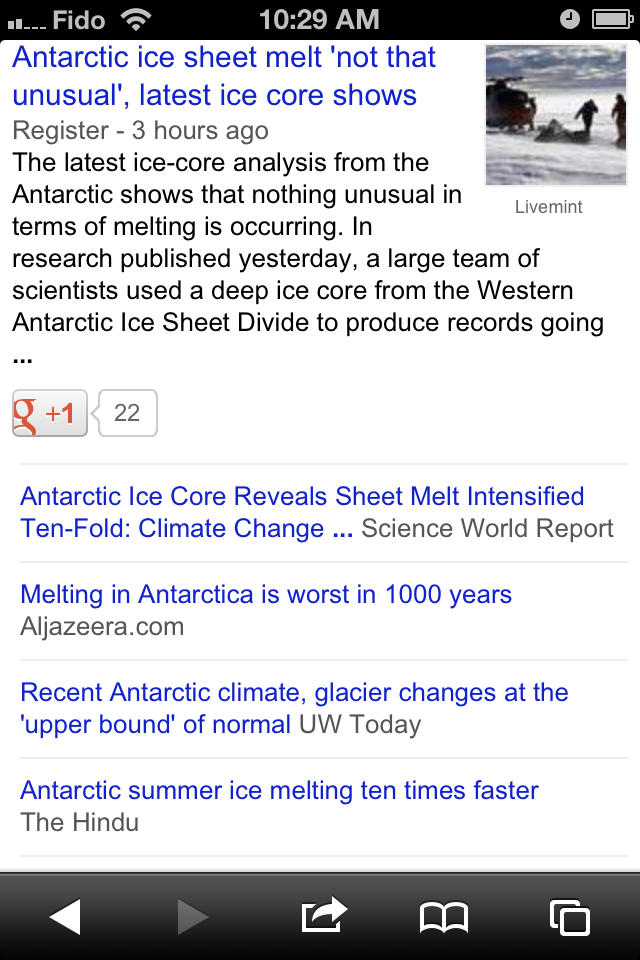
Different journalistic interpretations of the same scientific study

Google News stories about antarctic melting 2013-04-15

Here’s the actual abstract from “Acceleration of snow melt in an Antarctic Peninsula ice core during the twentieth century“, published in Nature Geoscience:

“Over the past 50 years, warming of the Antarctic Peninsula has been accompanied by accelerating glacier mass loss and the retreat and collapse of ice shelves. A key driver of ice loss is summer melting; however, it is not usually possible to specifically reconstruct the summer conditions that are critical for determining ice melt in Antarctic. Here we reconstruct changes in ice-melt intensity and mean temperature on the northern Antarctic Peninsula since AD 1000 based on the identification of visible melt layers in the James Ross Island ice core and local mean annual temperature estimates from the deuterium content of the ice. During the past millennium, the coolest conditions and lowest melt occurred from about AD 1410 to 1460, when mean temperature was 1.6 °C lower than that of 1981–2000. Since the late 1400s, there has been a nearly tenfold increase in melt intensity from 0.5 to 4.9%. The warming has occurred in progressive phases since about AD 1460, but intensification of melt is nonlinear, and has largely occurred since the mid-twentieth century. Summer melting is now at a level that is unprecedented over the past 1,000 years. We conclude that ice on the Antarctic Peninsula is now particularly susceptible to rapid increases in melting and loss in response to relatively small increases in mean temperature.”

From the full text: “The nonlinearity of melt observed in the JRI ice-core record also highlights the particular vulnerability of areas in the polar regions where daily maximum temperatures in summer are close to 0˚C and/or where summer isotherms are widely spaced, such as along the east and west coasts of the Antarctic Peninsula. In these places even modest future increases in mean atmospheric temperature could translate into rapid increases in the intensity of summer melt and in the poleward extension of areas where glaciers and ice shelves are undergoing decay caused by atmospheric-driven melting.”