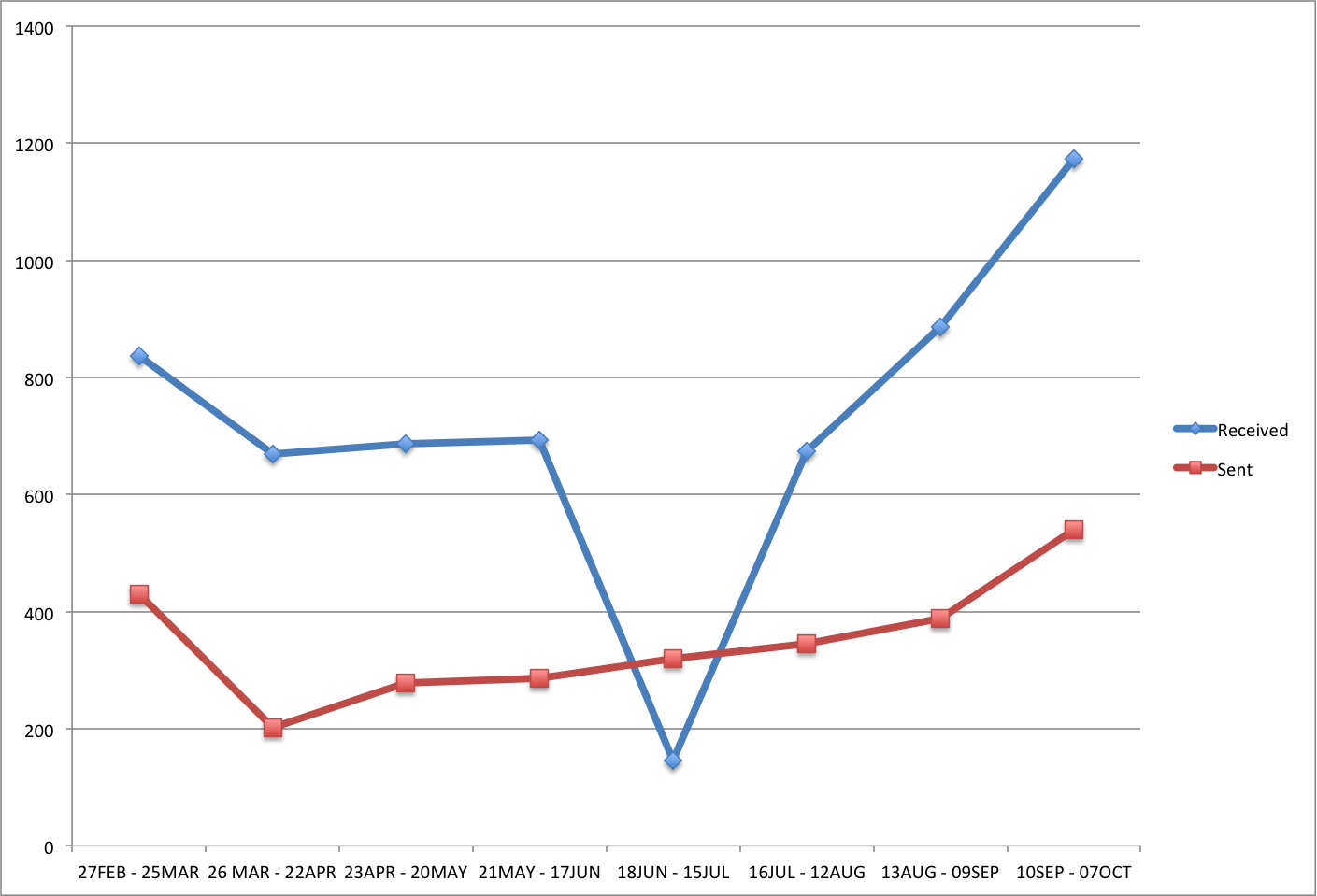
Emails sent and received – 27 February 2012 to 07 October 2012
Two obvious features of note: school involves a lot of email, and everyone goes on vacation in July.
climate change activist and science communicator; photographer; mapmaker — advocate for a stable global climate, reduced nuclear weapon risks, and safe human-AI interaction

Anything on the process or results of writing as an activity and a passion
Emails sent and received – 27 February 2012 to 07 October 2012
Two obvious features of note: school involves a lot of email, and everyone goes on vacation in July.
As an antidote to my more intolerable academic reading, I have started working through Joseph Anton – Salman Rushdie’s memoir about the aftermath of the death edict issued against him through Ayatollah Ruhollah Khomeini’s fatwa. He calls it: “his unfunny Valentine from those bearded men, those shrouded women, and the lethal old man dying in his room, making his last bid for some sort of dark, murderous glory”. Rushdie goes on to suggest that the purpose behind the decree was to distract domestic opinion from the disaster of the Iran-Iraq war: “The real imam had taken his country into a useless war with its neighbor, and a generation of young people had died, hundreds of thousands of the country’s young, before the old man called a halt. He said that accepting peace with Iraq was like eating poison, but he had eaten it. After that the dead cried out against the imam and his revolution became unpopular. He needed a way to rally the faithful and found it in the form of a book and its author. The book was the devil’s work and the author was the devil that gave him the enemy he needed. This author in this basement flat in Islington huddling with the wife from whom he was half estranged. This was the necessary devil of the dying man” (p.11 hardcover).
As would be expected from the author of Midnight’s Children and The Satanic Verses, it is a rich, dense text with nested sub-biographies of friends and family members. It is a book that demands time and attention but, unlike the academic prose, it is clear and not redundant. You need to pay attention because there is something important in each line.
So far, the book stands out as an affirmation of the importance of free speech and of questioning religious dogma. Rushdie explains that his family name was the invention of his grandfather and an homage to Abul Walid Muhammad ibn Ahmad ibn Rushd: an atheist scholar of religious belief from the 12th century. Rushdie describes “the flag of Ibn Rushd” “which stood for intellect, argument, analysis and progress, for the freedom of philosophy and learning from the shackles of theology, for human reason against blind faith, submission, acceptance and stagnation” (p.23 hardcover).
I read George Grant’s 1965 book Lament for a Nation for my Canadian politics core seminar. In it, Grant describes what he sees as the inevitable process of the disappearance of a sovereign Canada, driven by economic interdependence with the United States and a form of liberalism focused on technological development and consumerist individualism. In particular, he laments the downfall of the Diefenbaker government: an event he interprets as a noble conservative standing on the principle of sovereignty and then being beaten down by North American elites unwilling to tolerate an independent Canadian defence policy.
Perhaps I am too young, but I find it hard to understand what Grant is talking about. Perhaps that is because the political assumptions he challenges have been dominant for the entire span of my life. His view that Canadian independence is desirable in and of itself hasn’t gone away – witness how many Canadians feel driven to define the country as distinct from the United States – but the kind of Anglophile community-focused conservatism he describes isn’t something that I feel a personal connection to. Nor do I think it is something that is given much importance by Canada’s contemporary conservative politicians.
Grant is convincing in writing about how science and capitalism can erode the particularities of different geographic regions of the world, and about how a rapidly changing world is unlikely to include many stable institutions. Grant argues: “The practical men who call themselves conservatives must commit to a science that leads to the conquest of nature. This science produces such a dynamic society that it is impossible to conserve anything for long” (p.65 paperback). Grant is particularly critical of capitalists, civil servants, and the Liberal Party for abandoning what he sees as distinctive and valuable about Canada in exchange for increased continental trade and integration. Speaking of policies that favour continental integration, Grant writes: “The society produced by such policies may reap enormous benefits, but it will not be a nation. Its culture will become the empire’s to which it belongs. Branch-plant economies have branch-plant cultures” (p.41 paperback). His is an oddly socialistic form of conservatism, in which individuals are expected to restrain their desires and work toward a common good.
My response to Grant’s concern about the homogenization of culture and political institutions between countries would be to say that the country-scale is the wrong scale for each of Grant’s two concerns. I don’t see any special reason why the particularities of culture should be defined by national borders. Indeed, defining culture in that way can become frightening when the national government then uses it to legitimate policies that treat outsiders as morally unworthy. Rather than ascribe high political and moral importance to the national level, I would argue that we should see all human beings as our moral equals and thus as equally deserving of good treatment. As for culture, I think it may function best as a phenomenon that emerges naturally from interacting groups of humans, not something to try to imbue with a specific national character or link to particular national symbols or institutions.
While his book is mostly a celebration of the particular, toward the end Grant does acknowledge an argument that seems very convincing to me – namely that the lesson of the two world wars was largely the moral bankruptcy of nationalism. Insofar as pride in one’s country makes non-countrymen less human, I see nationalism as a frightening and destructive force. By trying to get the state to do everything, I think Grant is ascribing too much power and importance to an institution that the 20th century has shown to be profoundly flawed and dangerous. For that reason, I find it difficult to share his concern about the passing of Canadian nationalism. Grant is mostly concerned about destruction of a different kind, in which tradition and a spirit of community give way to excessive individualism and hedonism. The excessive focus on the individual which he highlights may be worrisome, but I don’t see the kind of old-fashioned respect-for-institutions based conservatism he values as a plausible counter for it at this stage in history (neither does he, hence his focus on the inevitable character of the changes that concern him).
If we are to curb the dangerously self-interested focus of those in today’s society, I don’t think it will be through appeal to tradition or through religion, which is another important element in Grant’s political philosophy. Rather, it seems likely that it will emerge in response to a realistic fear about the universal consequences of ignoring the big picture. If we come to accept some limits on hedonistic individualism, it seems likely to happen because of an individualistic concern about the consequences of such behaviour. Whether such concern can win out over the promise of immediate satisfaction remains to be seen.
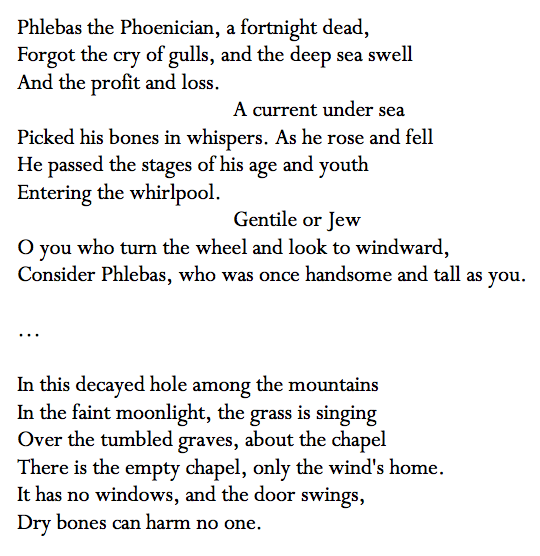
Eliot, T.S. The Waste Land. 1922.
‘Let me think!’ said Aragorn. ‘And now may I make a right choice, and change the evil fate of this unhappy day!’ He stood silent for a moment. ‘I will follow the Orcs,’ he said at last. ‘I would have guided Frodo to Mordor and gone with him to the end; but if I seek him now in the wilderness, I must abandon the captives to torment and death. My heart speaks clearly at last: the fate of the Bearer is in my hands no longer. The Company has played its part. Yet we that remain cannot forsake our companions while we have strength left. Come! We will go now. Leave all that can be spared behind! We will press on by day and dark!’
…
‘With him lies the true Quest. Ours is but a small matter in the great deeds of this time. A vain pursuit from its beginning, maybe, which no choice of mine can mar or mend. Well, I have chosen. So let us use the time as best we may!’
Tolkien, J.R.R.. The Lord of the Rings: Book III: The Treason of Isengard.
Psychologically active drugs may be the least rationally regulated part of our society, with one dangerous and addictive drug advertised and available everywhere (alcohol) and only nudges to disocurage the use of another that kills five million people a year globally (tobacco). Meanwhile, police forces and court systems around the world tie themselves up with investigating, processing, and incarcerating people who own or sell small quantities of much less dangerous substances.
David Nutt was appointed as chairman of the British Advisory Council on the Misuse of Drugs in 2008: an expert panel intended to provide non-partisan advice on drugs to the government. He was fired in 2009 after pointing out that the chances of getting hurt from an hour of horseback riding are about 30 times greater than the odds of dying from taking a pill of MDMA (ecstasy). His book Drugs Without the Hot Air: Minimising the Harms of Legal and Illegal Drugs covers some extremely interesting ground in a convincing and well-argued way.
Nutt describes how policy-making in the area of drugs is often driven by a combination of media-enhanced hysteria and an effort on the part of politicians to seem ‘tough’ on the issue. He categorizes many of the harms that result from this, ranging from criminal records acquired by youth (which harm their lives much more than drugs) to harsh restrictions on the availability of painkillers around the world, leaving many with terminal illnesses to die in a great deal of pain.
Nutt also provides a nuanced and interesting description of the nature of addiction, distinguishing between people who rely on steady access to a drug to control and underlying condition (as diabetics use insulin) and those whose use of a drug has been sufficient to give them harsh withdrawal symptoms when they stop using it, which in turn drives them into a cycle of continuous use. Nutt argues that treating addicts as criminals causes a great deal of harm to the addicts themselves and to society at large, through mechanisms including the suppression of scientific research, the discrediting of the law through its obviously unjust application, the enrichment of criminal gangs, increasing the spread of infectious disease, diverting attention from controlling alcohol and tobacco, and the indirect encouragement of more harmful drug-taking practices because safer alternatives are not available.
My copy of the book is sprinkled with a few typographic errors which I am told have already been corrected in the newest printing. It’s also a bit challenging to square a few of the claims about the relative dangerousness of drugs. Early in the book, Nutt describes a complex exercise in which multi-criteria decision analysis was used to evaluate the relative harmfulness of a variety of legal and illegal drugs across sixteen dimensions, encompassing both harm to the individual and harm to society. The ranking found alcohol to be the most destructive drug overall, followed by heroin and crack cocaine. Methamphetamine, powder cocaine, and tobacco follow. Lower in the list are amphetamine, cannabis, GHB, and benzodiazepines. At the bottom of the scale are ecstasy, LSD, and psilocybin mushrooms. Between ecstasy and benzodiazepines – about 1/3 of the way up the harmfulness scale – Nutt lists ‘butane’ – an inhalant. Later in the book, however, he characterizes butane as extremely dangerous and capable of killing people on the first use if misused. Perhaps the scale is based on the proper administration of the drug. Still, it seems like a drug that carries a significant risk of accidental fatal overdose should probably be rated as more harmful than drugs like cannabis which carry no such risk.
Regardless of the exact ranking of harmfulness that is most appropriate, the book contains a great deal of interesting information, as well as an informative chapter on what parents should tell their children about drugs. Nutt argues convincingly that treating drug addicts as people with a serious medical problem makes more sense than treating them as criminals, and lays out a good case for why the supposed ‘War on Drugs’ has failed. He also provides some interesting information on the functioning of the brain and makes some suggestions about how drugs of all sorts could be regulated to reduce harm. He does a good job of pointing out the hypocrisy in our treatment of tobacco and alcohol and makes some sensible suggestions for how states could effectively discourage the use of the latter.
All told, Nutt’s book provides a scientist’s take on the various substances people consume with the desire to change their thinking, as well as the consequences of the production and use of those substances for individuals and society. By repeatedly pointing out the many areas where policies are poorly informed by reality and counterproductive, he makes a strong case for the need for drug law reform. Both for individuals who wish to educate themselves about drugs and for policy-makers who aspire to regulate them more appropriately, this book could be a very useful reference.
Nutt is now associated with the Independent Scientific Committee on Drugs which has a great deal of useful information about drugs and harm reduction on their website.
From Walden:
“But,” says one, “you do not mean that the students should go work with their hands instead of their heads?” I do not mean that exactly, but I mean something which he might think a good deal like that; I mean that they should not play life, or study it merely, while the community supports them at this expensive game, but earnestly live it from beginning to end. How could youths better learn to live than by at once trying the experiment of living? Methinks this would exercise their minds as much as mathematics. If I wished a boy to know something about the arts and sciences, for instance, I would not pursue the common course, which is merely to send him into the neighbourhood of some professor, where any thing is processed and practiced but the art of life; – to survey the world through a telescope or a microscope, and never with his natural eye; to study chemistry, and not learn how his bread is made, or mechanics, and not learn how it is earned; to discover new satellites to Neptune, and not detect the motes in his eyes, or to what vagabond he is a satellite himself; or to be devoured by the monsters that swarm all around him, while contemplating the monsters in a drop of vinegar. Which would have advanced the most at the end of a month, – the boy who had made his own jackknife from the ore which he had dug and smelted, reading as much as would be necessary for this, – or the boy who had attended the lectures on metallurgy at the Institute in the mean while, and had received a Rogers’ penknife from his father?
In Canada, there is a large apparatus that exists to handle correspondence sent to federal ministers. This is because they receive a large volume of correspondence, much of it consisting of large numbers of form letters sent by supporters of various non-governmental organizations.
When a letter to a minister is received, it is usually sent to a low-level civil servant who works on files vaguely related to the subject matter of the letter. If at all possible, the response drafted will say that the matter is outside the minister’s area of responsibility (since this keeps things simple). Letters may also be forwarded to other ministers deemed better suited to answering it. For instance, letters to the prime minister are often sent to the minister responsible for the files described in the letter. These ministers may in turn pass along the letter to yet other people.
When a response to a ministerial letter is drafted by a civil servant, the standard practice is to ignore whatever the letter writer is urging the minister to do. Say you write a letter objecting to the construction of a new power station. The response you get is unlikely to mention the power station or any of your concerns. It is also extremely unlikely to promise any new action. What it is overwhelmingly likely to do is to list a number of popular actions already taken by the government in your general area of concern, and then to list a few more actions in the area that have been promised.
Once a maximally bland letter has been written by a civil servant, it will get passed to the political staff in the minister’s office who will add a bit of their own content.
At no point is the minister likely to see your letter and, if they actually sign it themselves, they are merely likely to glance over the text prepared by their officials. By writing to a minister, the main action that you produce in response is to re-direct a low-level civil servant away from their usual work to write a suitably inoffensive and low-content response to your query.
If you want to write a letter that will actually get read by someone influential, you can consider writing to the deputy ministers of federal departments. They generally don’t have an elaborate system in which other people write their correspondence for them, and they are probably more likely to actually read your letter. While in theory deputy ministers do not set policy, their roles as administrators and as expert advisors mean they are influential people and that it could be quite meaningful to change their minds on a subject. You can find out who the deputy minister of a department is from the organizations website, which will also include their mailing address.
Alternatively, you can always try writing ‘private’ on the envelope of your letter to a minister. Caution on the part of officials may lead to the minister actually opening the mail personally.
Finally, it is worth knowing that all references made in the media to ministers and to government departments are meticulously observed and recorded by civil servants. Even mentioning a minister in a tweet is likely to get you added to a column in some civil servant’s spreadsheet. As such, it can be a more effective use of time to write a letter to the editor that mentions a minister than to write to the minister directly.
Over my last few commutes, I read Phillip Pullman‘s short and unusual book The Good Man Jesus and the Scoundrel Christ. It’s part of the Canongate Myth Series, in which “ancient myths from myriad cultures are reimagined and rewritten by contemporary authors”. The book isn’t easily categorized, but includes a few thought-provoking passages, particularly about how institutions imbued with authority tend toward corruption and abuse.
For instance:
“As soon as men who believe they’re doing God’s will get hold of power, whether it’s in a household or a village or in Jerusalem or in Rome itself, the devil enters into them. It isn’t long before they start drawing up lists of punishments for all kinds of innocent activities, sentencing people to be flogged or stoned in the name of God for wearing this or eating that or believing the other. And the privileged ones will build great palaces and temples to strut around in, and levy taxes on the poor to pay for their luxuries; and they’ll start keeping the very scriptures secret, saying there are some truths too holy to be revealed to the ordinary people, so that only the priests’ interpretation will be allowed, and they’ll torture and kill anyone who wants to make the word of God clear and plain to all; and with every day that passes they’ll become more and more fearful, because the more power they have the less they’ll trust anyone, so they’ll have spies and betrayals and denunciations and secret tribunals, and put the poor harmless heretics they flush out to horrible public deaths, to terrify the rest into obedience.”
And:
“Lord, if I thought you were listening, I’d pray for this above all: that any church set up in your name should remain poor, and powerless, and modest. That it should wield no authority except that of love. That it should never cast anyone out. That it should own no property and make no laws. That it should not condemn, but only forgive. That it should be not like a palace with marble walls and polished floors, and guards standing at the door, but like a tree with its roots deep in the soil, that shelters every kind of bird and beast and gives blossom in the spring and shade in the hot sun and fruit in the season, and in time gives up its good sound wood for the carpenter; but that sheds many thousands of seeds so that new trees can grow in its place.”
Perhaps this book is to the New Testament what Pullman’s “His Dark Materials” trilogy was to Milton’s Paradise Lost – a fictional re-appraisal with an emphasis on a re-interpretation of certain moral elements.
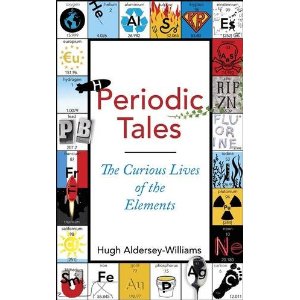
Hugh Aldersey-Williams‘ book Periodic Tales: The Curious Lives of the Elements shows off the author’s wide range of knowledge, willingness to investigate, and ability to tell a compelling story. Starting with gold and finishing with a pilgrimage in search of rare earth metals, Aldersey-Williams covers a fair fraction of the periodic tale – identifying the importance of elements not only in chemistry, but in diverse fields including art, literature, and theology. There are also many nice little nuggets of information, such as how Inuit steel tools were made from the nickel-containing natural stainless steel in some meteorites.
In addition to tracking down physical specimens of elements, the author tries to extract some on his own using natural materials said to be abundant sources (urine for phosphorus, kelp for iodine, even testing whether rotting herring luminesces). This admirable curiosity and willingness to undertake experiments adds much to the book.
Despite being about 400 pages, the book is a very quick read. It is well worth a look for anybody who is curious about the building blocks of the world or, alternatively, who is interested in seeing how the process of scientific discovery interacts with other human undertakings.