
Ologies on invisibility
Alie Ward’s marvellous science communication podcast has a new episode on invisibility: Invisible Photology (INVISIBILITY CLOAKS) with Dr. Greg Gbur.
I was just about bowled over during my exercise walk on the Beltline trail, when Alie and Dr. Gbur discussed my Hyperface Halloween costume, designed to confound facial recognition systems.
Tomorrow I will read Dr. Gbur’s latest book: Invisibility: The History and Science of How Not To Be Seen.
Doug Macdonald on Canada’s political character
Yesterday I attended a scholarly memorial conference for Professor Douglas Macdonald, from U of T’s School of the Environment.
I worked for him as a TA in 2015–16, in the environmental decision-making course (ENV1001) at the core of the collaborative specialization in environmental studies. I also knew him from various on-campus climate science / policy / activism events.
Between sessions in which people shared kind personal tributes, I picked up Macdonald’s earlier books (having used his final book Carbon Province, Hydro Province in my PhD research). They provide an intriguing opportunity to compare the environmental movement of the 1990s and before with what is happening now.
In The Politics of Pollution (1991), Professor Macdonald makes some observations about Canadian political culture with respect to the environment:
Canada’s global location has two major implications for environmental politics. First, as a northern nation, no matter how much we may insulate ourselves by living in cities, huddled close to the southern border, we Canadians think of ourselves as living in a northern land — looking instinctively to the north, just as Americans look to the west — which means, by definition, living in what is often a hostile and cold environment. Thus, the simple fact of geography has contributed to the “garrison mentality” described by Northrop Frye and others, in which the human and natural worlds are viewed, at least by the non-aboriginal population, with fear and suspicion from behind the stockade walls. The harsh rigour of a northern environment historically reinforced the Canadian perception, brought over from Europe, of this northern environment being something to be feared and, therefore, to be dominated and exploited.
But a northern environment does not lead only to alienation from the land. It also offers the purity of ice and snow and the stillness and quiet beauty of rock and trees encircling a northern lake. Above all, our North American environment offers a sense of being new, fresh, and unsullied. Like the Americans, although to a lesser degree because we did not sever our ties to Europe by means of revolution, we have traditionally seen ourselves as a people who by crossing the ocean left the decadence of the old world and came to live in a new one. For Americans this fostered a conviction of moral superiority; in Canada it produced something very different — a perception of innocence. Canadians see themselves as venturing forth from their new land to do nothing but good in the world, perhaps naive but certainly well-meaning and unburdened by the guilt and corruption of world power. (p. 47–8)
In the end, nearly everything which I said about Carbon Province, Hydro Province in my dissertation ended up being in sections that were cut for length. After I get through Robarts Library’s only physical copies of his two prior books, perhaps I will move those thoughts into a blog post or two.
Coronation sceptre
Bird on a plate

Back with Bagehot
Because it is a frequent and respected source of information about things and places I likely would not hear about from free news sources — and because it routinely goes into usefully greater depth on complex topics — I renewed my print and digital subscription to The Economist.
I certainly don’t always agree with them, but I always find their position worth reading. Furthermore, however one might want to characterize my unusual educational and career path, the magazine has been an important part of the process.
Economist subscription expired
I have been subscribing to The Economist since their coverage of the Bush-Gore election in 2000, renewing it in three year batches and taking advantage of a student rate when possible.
My subscription expired yesterday and I will not be renewing if for now, just because life is too strained. That feels a bit like giving up on myself — since the value of staying informed lies in being better able to think and make decisions in the future — but it also feels like a suitable part of a post-PhD rethink. I am working through making sense of the implications of my time in government, academia, and activism and contemplating what I ought to do in the future.
What that future may be is very hard to say. For their varied reasons, governments and environmental NGOs don’t actually want to solve climate change, or at least it is much less of a priority than other contradictory things their leaders want to do. Perhaps the best hope is to get into the non-fossil energy / grid interlinkage / energy storage space in the private sector. At least they are building solutions.
First night in the woods with the Savage Industries bedroll (v2)
My friend Natalia made a suggestion that gave me a 24 hour respite from the misery of finding a room in Toronto, and we went back to the Hemlock forest near Catchacoma for an overnight camp.
One great thing about short visits to a place that has a brief and easy walk between where we parked and where we camped is that it allows for pretty quick and low-risk evaluation of gear for backpacking and camping. It’s feasible to bring two of something and try both, and not that bad if you only bring one version of something and it doesn’t work.
I have been so happy with my Savage Industries EDC ONE bag that even though I can’t say I ever had “buy a bedroll” on my to-do list, when I saw that they had made one I was curious about it. I have been very pleased with their stuff in the past and I know it sells out fast, so when they issued a second release I ordered one in time to have it to show off at this week’s bluegrass / hike planning evening.
Before leaving, it seemed like a bit of a questionable camping item when a lot of people live some version of the ultralight philosophy. Just the bedroll weighs 4 pounds, and it rolls up into a package bigger than my tent or sleeping bag.
The design justified itself in the field for sure. It has waterproof sailcloth on the outside and a good warranty, so I felt fine about putting it down on little sticks and stones that I would move away from the area under my thin-floored tent. The wool platform was great to rest on after the hike in, and to watch the clouds from. At night, it was a great venue for stargazing, and I expect it will be good for tent-free “cowboy camping” later in the season.
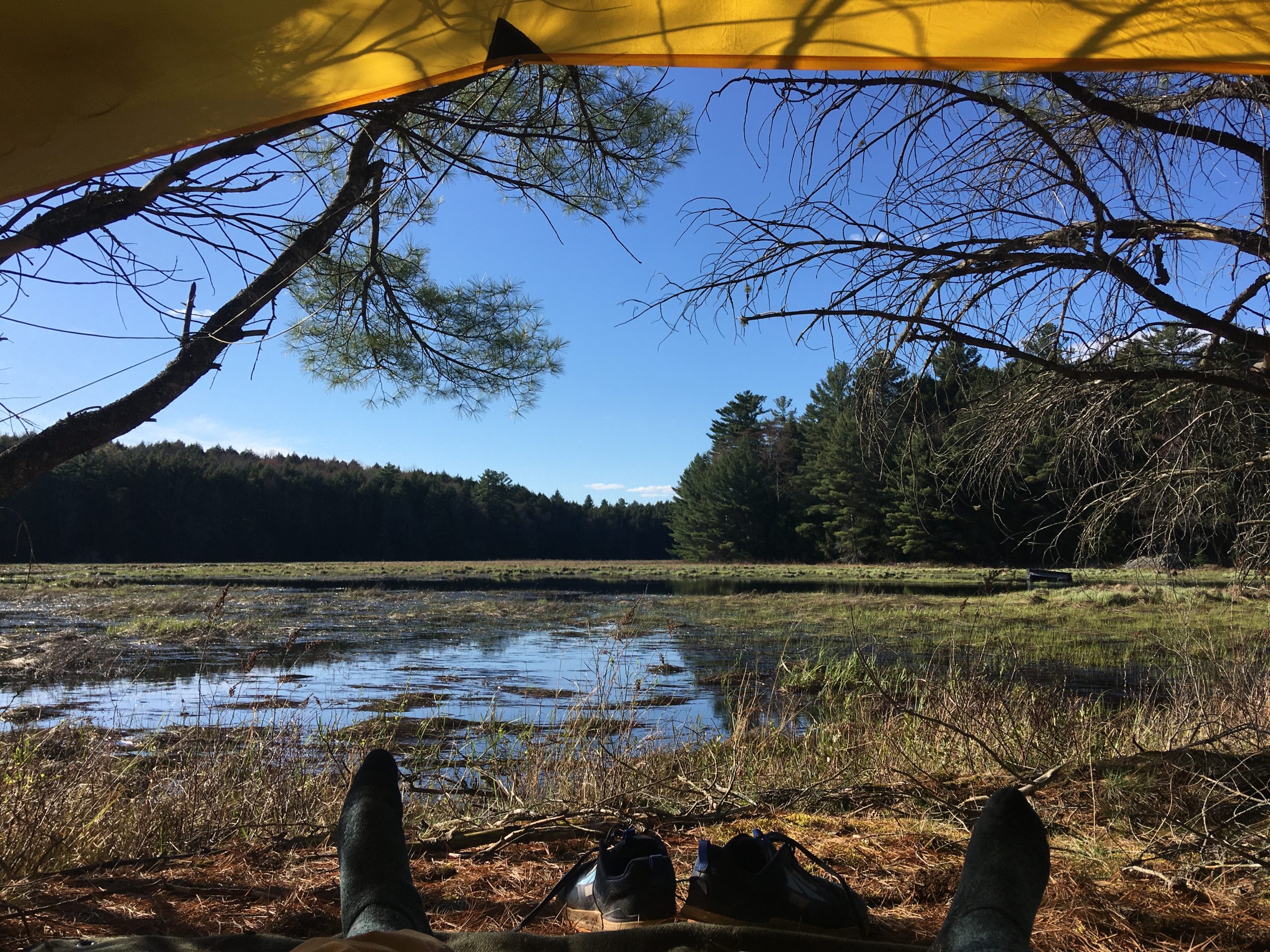
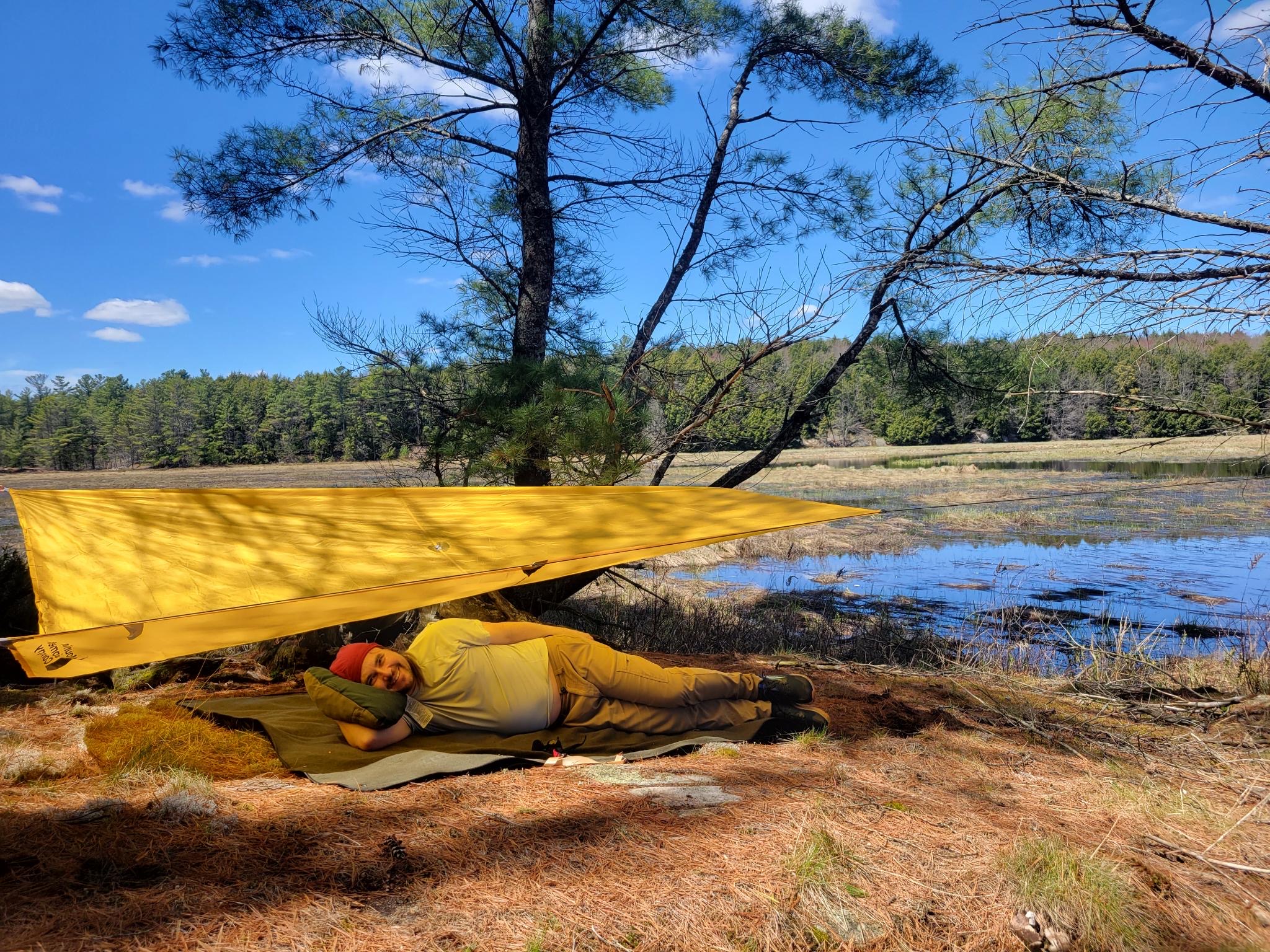
Back in my tent — where on the last trip I spent all night curled at the bottom of my sleeping bag and shivering for warmth — I followed Natalia’s advice to put the bedroll above and below my light sleeping bag. In that configuration, I was warm with my sleeping bag unzipped until after dawn, and then warm with the bag zipped and light clothes on after. Note, however, that we had -11 ˚C and -9 ˚C nights last time, compared with +5 this time. (Though last time, I also used a fleece sleeping bag liner which I never had to pack this time, and slept in all my clothes rather than light PJs.)
One more nice unanticipated feature emerged when we were breaking camp: the bedroll is large enough to use as a soft, dry, and debris-free place to roll up my tent. Being able to pack up a tent clean saves times and annoyance, reduces the odds of needing to unpack it later in the day to dry or clean it, and probably extends the life of the tent.
For the hike out, I even discovered that the integrated straps on the bedroll can be passed through two loops that were already there at the bottom of my pack. The bedroll still needs to be tied so that the middle doesn’t slide out of the roll, but the bedroll is nevertheless quite feasible to carry attached to the outside and bottom of a pack.
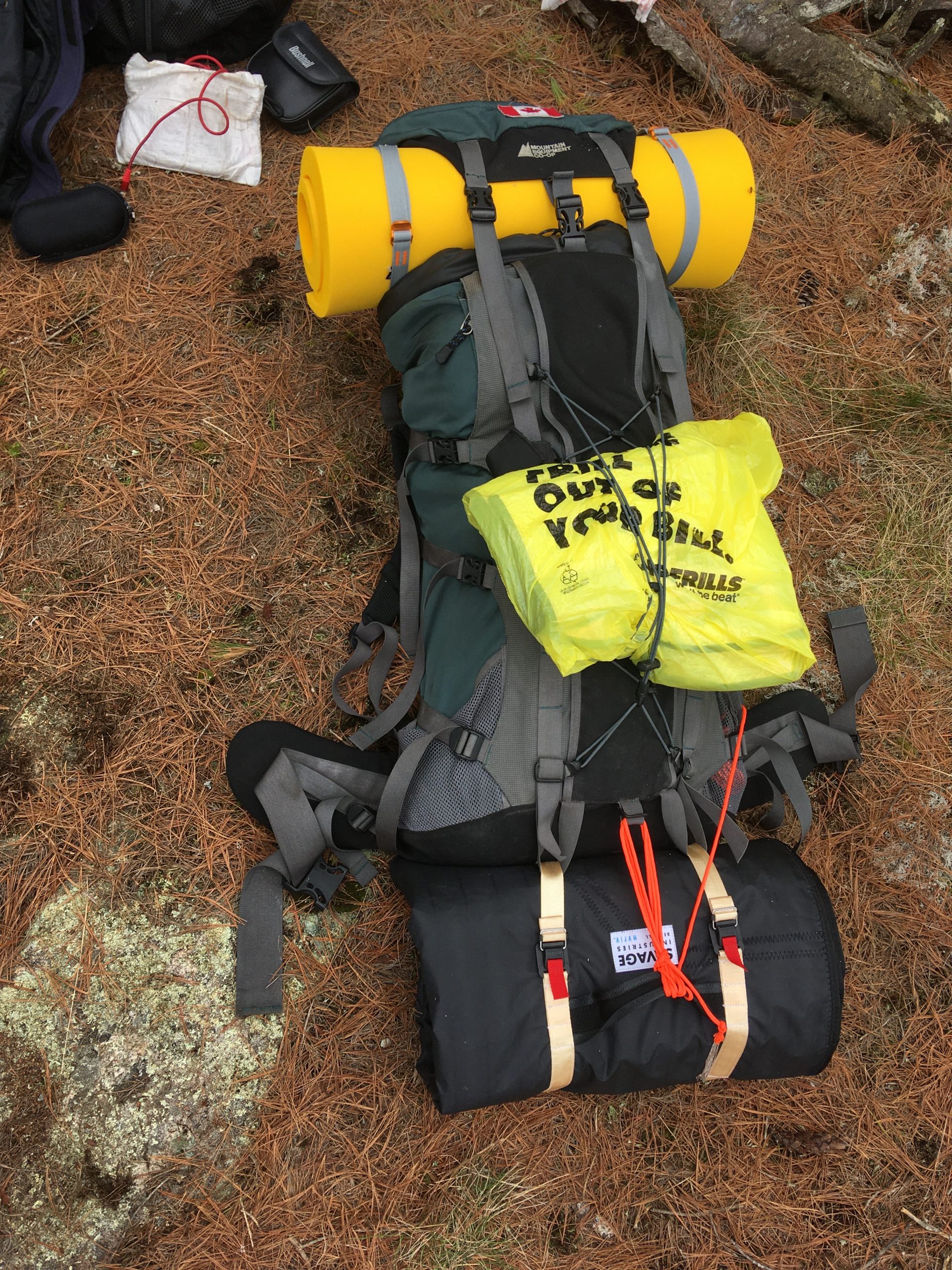
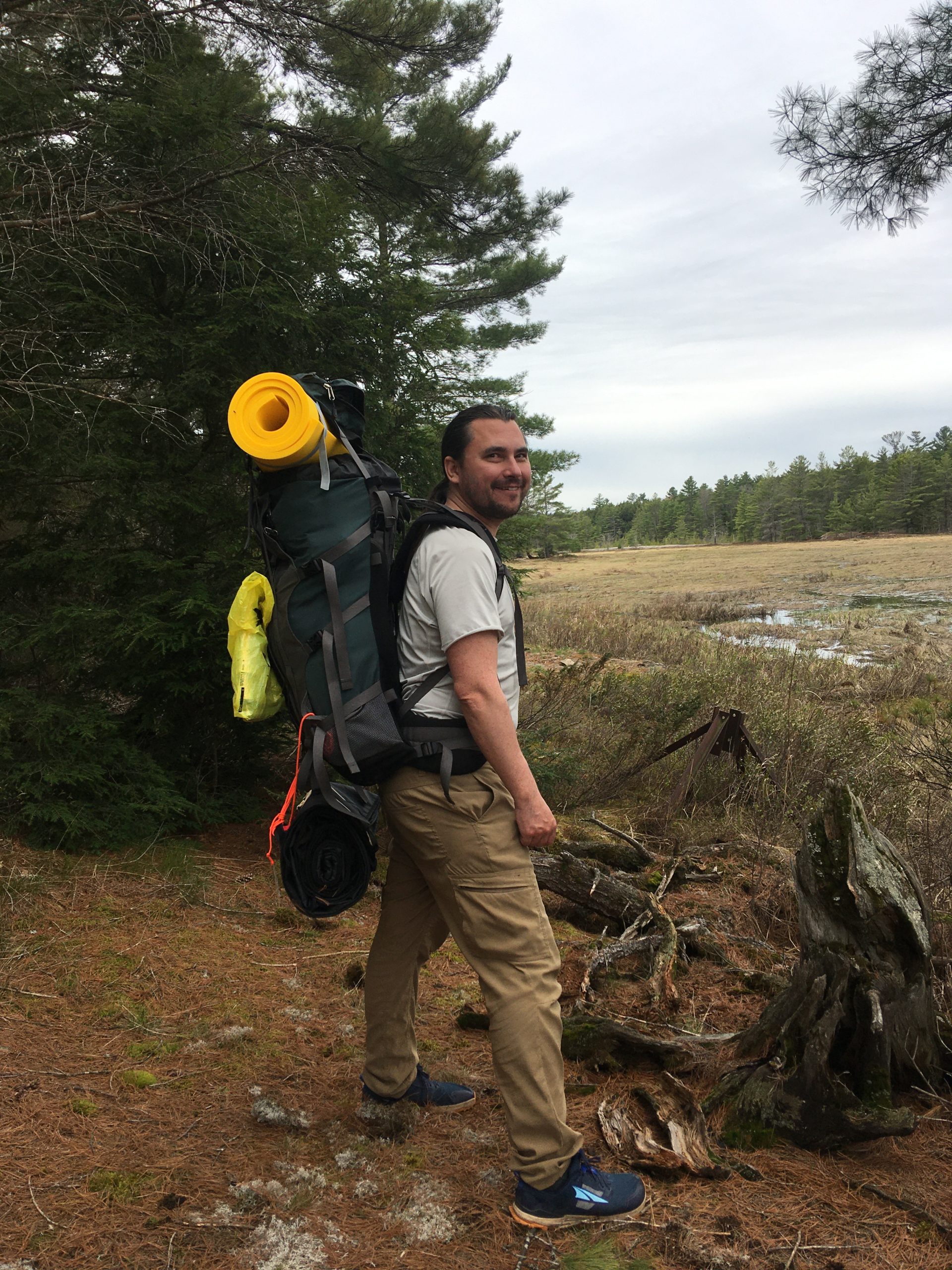
I probably would not carry it on a thru hike of thousands of kilometres, but it seems great for trips like this one plus picnics and Hive games in the park.
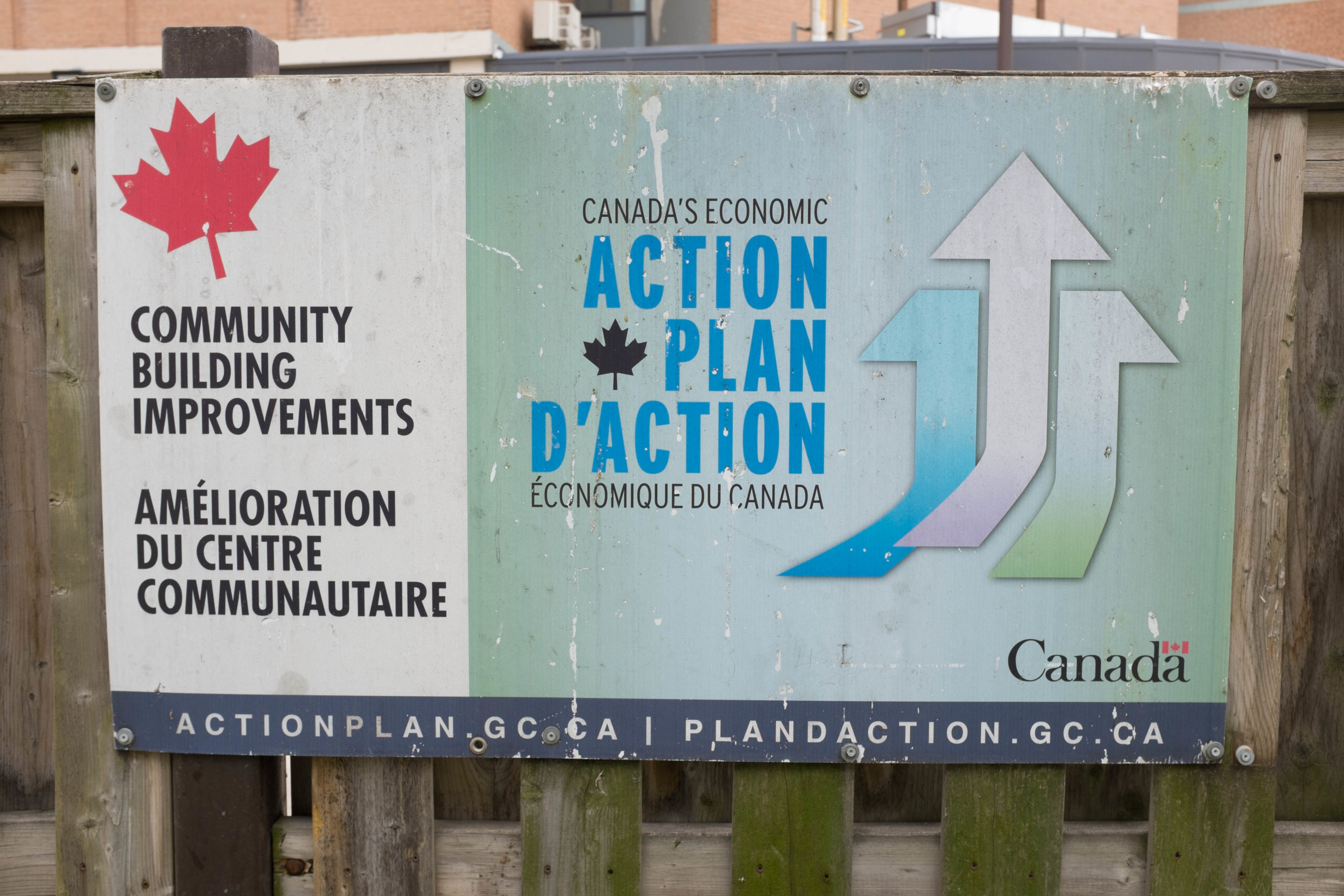
Circa 2008, Harper-era Economic Action Plan sign at Regent Park
Erosion of knowledge and integrity in governments
A recent Economist article on the British civil service features some observations that are true of government bureaucracies more broadly:
In part, churn reflects career incentives. Mid-ranking policy officials talk of being encouraged to move every 18 months to gather experience, pay and promotion. But it also reflects a deeper malaise, argues Jonathan Slater, a former permanent secretary (the most senior department official) at the Department for Education: a culture which prizes the ability to “handle” ministers and “fix” political problems. John Kingman, a former Treasury bigwig, has claimed there is a “disdain” for deep knowledge. A pyramidal structure of older managers at the top and younger generalists at the bottom does not provide a home for well-paid, experienced experts.
…
What does it matter if some officials are unhappy? Because, say experienced Whitehall-watchers, the delicate compact at the heart of Britain’s system of government is being degraded. Telling a secretary of state what they don’t wish to hear is never easy. Candid advice becomes that much rarer in a civil service that is inexperienced, criticised, poorly led and short on evidence of what works. In the staff survey in 2021, just 54% of civil servants agreed that it is “safe to challenge the way things are done”. For good ministers, that lack of candour can be frustrating. For bad ones, it is a recipe for blunders—which degrades their trust in civil servants even more. Rival sources of advice, such as think-tanks and party gurus, fill the void and the civil service’s authority is eroded yet further.
It is very, very hard — perhaps impossible — to create organizations that serve the broad long-term interests of society, rather than the narrower and shorter-term interests of the people inside those institutions and the people who those institutions serve. That gets even worse for issues like climate change, where the benefits of ignoring it and making the problem worse arrive in hard cash in the here-and-now, while the costs get spread out across time and space and made invisible by the apparent lack of cause and effect.