Foreign Policy on the end of oil

Foreign Policy has put out a special report on oil, entitled “The Long Goodbye.”

Topics covered include the ‘resource curse,’ geopolitical and pipeline issues in Europe, as well as nuclear and renewable forms of energy. It is nice to see major publications starting to devote serious consideration to the inevitable end of the hydrocarbon era.

Compensation for climate change

In Ethiopia, ministers from ten African countries are meeting to work out negotiating positions for the upcoming climate change talks in Copenhagen. One likely position will be a demand for financial compensation in response to the harm caused by climate change.

In principle, some compensation is probably justified between those who have knowingly engaged in actions that cause climate change and those that have suffered as a consequence. In practical terms, however, things are rather more complex. For one thing, it is dubious whether all of the governments with populations affected by climate change would effectively and equitably distribute any payments.

The world’s priority needs to be on getting effective mitigation action started. Without that, adaptation costs will eventually exceed what even rich states are able to spend on their own citizens. Effective negotiating tactics to drive a global mitigation agenda are really what especially vulnerable states should be concentrating on now. Some of these – such as paying for avoided deforestation – may have a similar character to a compensation scheme.

The 350 movement

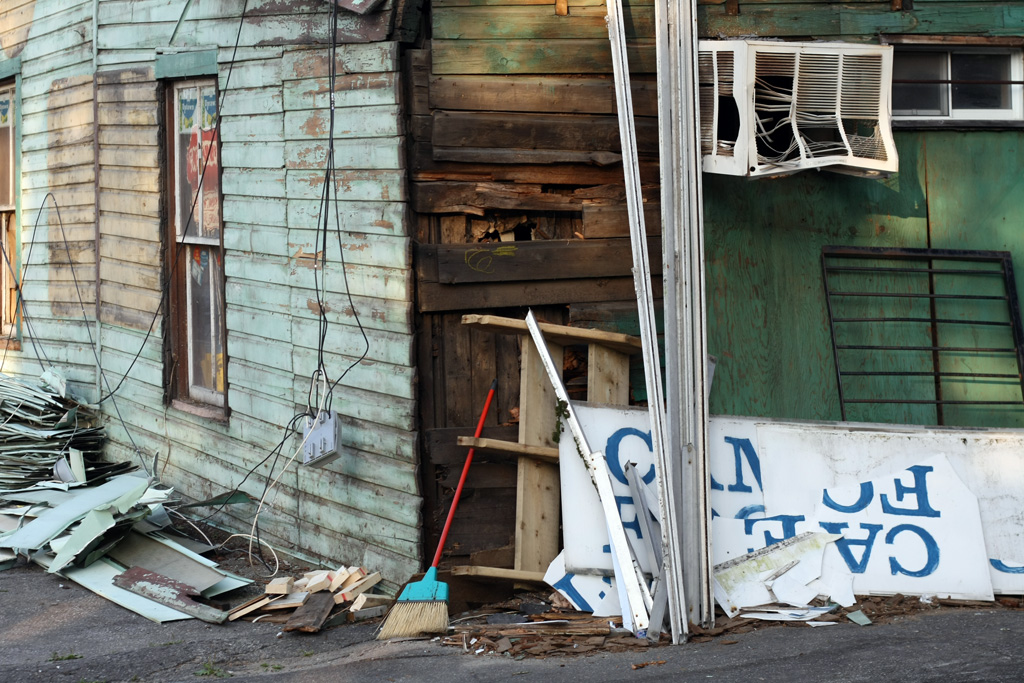
Derelict store, Ottawa

Right now, the atmospheric concentration of carbon dioxide (CO2) is around 385 parts per million (ppm), up from about 280 ppm before the Industrial Revolution. Scientists, economists, and others disagree about what figure to accept as a ‘safe’ maximum concentration, with uncertainty enduring both about what temperature increase any particular concentration level will mean and what the social, political, physical, and biological consequences would follow.

Probably the most cautious group of all, with regards to what concentration is safe, is Bill McKibben’s 350.org, with their target of a reduction to 350 ppm. One major supporter is top NASA climatologist James Hansen:

If humanity wishes to preserve a planet similar to that on which civilization developed and to which life on Earth is adapted, paleoclimate evidence and ongoing climate change suggest that CO2 will need to be reduced from its current 385 ppm to at most 350 ppm.”

By contrast, many environmental organizations have expressed support for targets between 450 ppm and 550 ppm, usually while hoping that such an increase would not generate more than 2°C of additional warming. Whether it would do so or not depends primarily on the relative strength of feedbacks within the climate system.

With extremely aggressive cuts in human greenhouse gas emissions, it could be possible to stabilize concentrations below their current levels. One major reason for this is the oceans. When CO2 is added to the atmosphere, it is akin to adding more CO2 to the area of air at the top of a soda bottle. Left alone, some of that extra CO2 will end up dissolved in the soda. In precisely the same way, if human beings were to stop emitting CO2 today, the levels would gradually begin to decline, until the amount of CO2 dissolving into the ocean became equal to the amount bubbling out of the oceans: a stable equilibrium with constant macroscopic properties. As such, the oceanic acidification that arises from climate change does, to some extent, reduce the amount of warming that would result from any set quantity of CO2 emissions.

Recentlly, Bill McKibben appeared on The Colbert Report, where he did quite a good job of getting his message across despite Colbert’s unique style of interview. (Link for those in Canada)

Marx and Engels

Reading a book review, I was surprised to learn that the lifestyle of Karl Marx and his entire family was bankrolled by Friedrich Engels running his family’s Manchester textile mills, which he had previously condemned as terribly inhumane to their workers:

Engels left Manchester to work with Marx on the “Communist Manifesto” and the two of them spent the late 1840s criss-crossing Europe to chase the continental revolutions of the time, ending up in England. Marx had started work on “Das Kapital”, but there was a problem. He had by then acquired an aristocratic German wife, a clutch of small children and aspirations for a comfortable bourgeois lifestyle, but no means of support.

Engels (whose name resembles the word for “angel” in German) offered an astoundingly big-hearted solution: he would go back to Manchester to resume life in the detested family cotton business and provide Marx with the money he needed to write his world-changing treatise. For the next 20 years Engels worked grumpily away, handing over half his generous income to an ever more demanding Marx. He also collaborated intensively on the great work, contributing many ideas, practical examples from business and much-needed editorial attention. When at last volume I of “Das Kapital” was finished, he extricated himself from the business and moved to London to be near the Marx family, enjoying life as an Economist-reading rentier and intellectual.

He also raised an illegitimate son of Marx. It is surely ironic that the most famous critic of capitalism lived by virtue of his friend practicing it in one of its most notoriously cruel forms.

Building a camera system

Woman with flowers in her hair

I often get asked about what sort of photographic gear serious amateurs should buy. Normally, I direct them towards this excellent primer on building a digital SLR system, written by Philip Greenspun. It is, however, a bit on the long side. Here is a briefer encapsulation.

Brand

I would go with Canon or Nikon. This is mainly due to compatibility, both across a wide range of accessories (lenses, flashes, etc) and across long spans of time. Both companies make excellent gear that will be usable for decades. I happened to go with Canon and have always been happy with them.

There are other brands that have advantages (both in terms of price and features), but the market for Canon and Nikon related gear is broad and deep.

Sequence

This really depends on what sort of photography interests you most. Someone seriously into nature photography would skew their purchases towards telephoto gear, while someone looking to take informal shots in casual settings might go for fast primes. The basic sequence, however, looks something like this:

  1. Get a crop-sensor dSLR. These cost about $600-700 and are very capable cameras. One thing to remember, though, is that they will multiply the effective focal length of all your lenses by 1.6. As such, a 50mm lens on a crop sensor is akin to an 80mm lens on a film body or full-frame dSLR.
  2. Get a memory card, but don’t worry about filters and things unless you are going to be working in very wet or dusty places.
  3. Get a couple of batteries. You don’t want to find yourself in the middle of an excellent and unexpected photo session, but unable to snap any more shots.
  4. Buy the kit lens. It won’t be of great quality, but they are usually very cheap when bought with the camera body. They are also often the only way to get cheap wide angle capability for a dSLR.
  5. Buy a 50mm f/1.8 lens. These have great optical quality, can allow fast shutter speeds in dark circumstances, and can often be purchased for about $100. A 28mm or 35mm lens would more closely approximate a 50mm ‘normal’ lens on a film camera, but these tend to cost a lot more.
  6. Get a tripod. It’s not necessary for absolutely every kind of photography, but it is useful for most. It is also a good way to keep your camera stored in an accessible and highly visible place (which prompts me, at least, to go out shooting more often).
  7. Get a camera bag that works for you. This is a tricky process that usually takes some experimentation. You want something big enough to carry what you need, but not so big you can never take it anywhere. You also need to decide whether you prefer a shoulder bag (much more accessible), a backpack (more comfortable), or something else. When carrying around just one camera and lens, don’t bother with a camera bag. Just bring a plastic bag in case of rain. Having your camera stuffed a way in a bag when walking around will make you miss photos. Bags are for carrying extra gear, and providing protection in transit.

Beyond this, the sequence really depends on what you plan to shoot. Some people might start with flash(es), some people might save their pennies for professional grade zoom lenses. Others might improve on their kit lens with consumer grade zooms (such as the reasonably high quality lenses that zoom from around 30mm to around 100mm and are available for under $500). Some people might assemble a collection of primes. Some people might save up to go straight to a full-frame body.

As someone who has tried a fair sampling of different kinds of photography, I would suggest that the following is a reasonable sequence:

  1. Consumer grade zoom (about 30mm to 100mm)
  2. Portable reflector (for portraits in sun)
  3. External flash and method for triggering it off-camera (either a cable or radio triggers)
  4. Light stand for flash and umbrella
  5. Second flash with triggering system
  6. Light stand for flash and umbrella
  7. Professional grade telephoto zoom (i.e 70-200mm)
  8. Professional grade wide angle zoom (i.e. 24-70mm)
  9. Wide angle prime lens (28mm or 35mm)
  10. Macro lens (85mm or 100mm)
  11. Full-frame dSLR body

You may want to sell the consumer zoom once you have professional grade ones, though it can be useful in situations where you need a wide range of focal lengths but can only bring one lens. If you never plan to get a full-frame dSLR, a professional grade wide angle zoom specific to crop sensor bodies might be a good idea.

Other options beyond this:

  • More flashes
  • Flash accessories (grids, snoots, softboxes, beauty dishes, gobos, etc)
  • Crazy nature lenses (i.e. 100-400mm)
  • Teleconverters (make any lens act like a longer one)
  • Fisheye lenses
  • A second body, so you can use two lenses without having to swap.

If you’ve worked your way through all of that, probably know a lot more about photography than I do. If you are in need of more distant horizons, there are two words to consider: medium format.

Ethics and autonomous robots in war

The increasing use of autonomous robots in warfare raises questions about how they can be used ethically and in concordance with international law on armed conflict. While unarmed robots like those used by bomb squads are ethically unproblematic, those with both weapons and an independent capability to make decisions about their use are quite different. This is especially true if they will be used in environments where civilians could be injured or killed.

The BBC has an article about some of the concerns that have been raised and issues that have been considered. In some ways, the trade-offs are similar to those with existing technologies. For instance, there is often a trade-off between how much risk an army exposes its own personnel to, and how effectively it can avoid causing civilian casualties.

Win a print for commenting

As regular readers will already know, next month I have a photography exhibition at Raw Sugar Cafe (692 Somerset, Ottawa). Some kind of an event corresponding to the opening of the show will be arranged, with details to be published here when known.

As a means of encouraging discussion, the following will be in effect for the time between now and the start of the show: anyone who posts a comment on any of my posts will be entered into a draw for a mounted photographic print of mine which I will select. Each comment will have an equal chance of winning, so people who post more will have better odds.

I will have the print delivered for free (though not necessarily immediately) to anyone in Ottawa, Toronto, or Montreal. Those farther afield would be required to reimburse me for the shipping.

Incidentally, if anyone wants a print of any of my photos, they are welcome to contact me. I am sure we could work something out.

Continue reading “Win a print for commenting”

Why climate change could be catastrophic

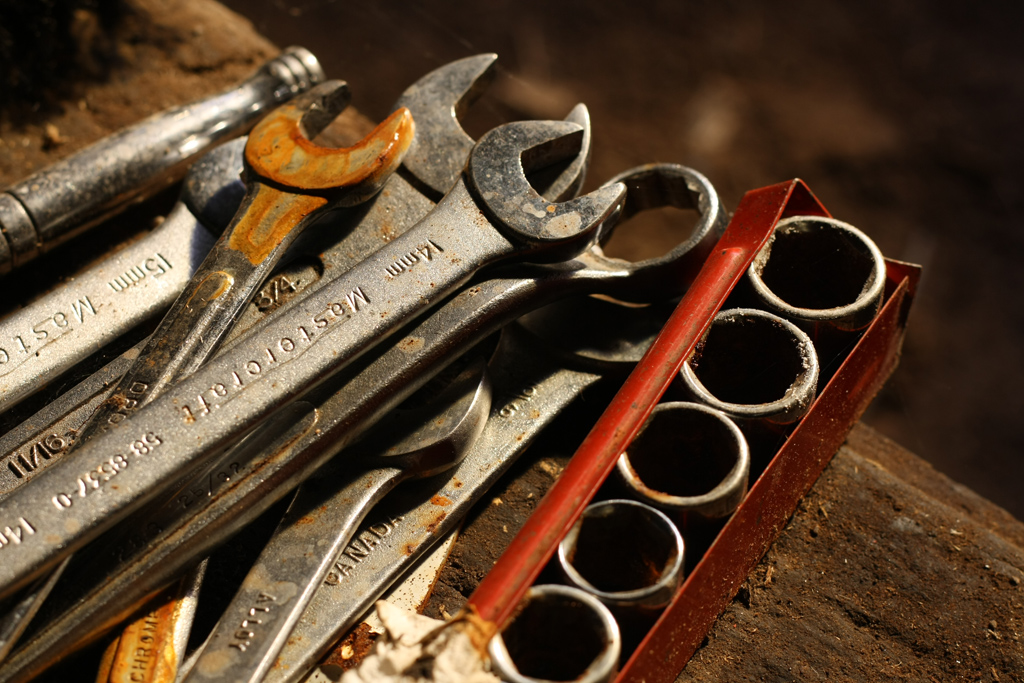
Wrenches and sockets

The basic equation of climate change is simple enough: add greenhouse gases to the atmosphere and you warm the planet. Of course, there are endless complications in areas like changes in precipitation, sea level, etc.

There are, however, a relatively small set of reasons for which climate change could potentially enormously problematic, or even a civilizational threat. That is to say, one that has the capacity to eliminate or virtually eliminate civilizations with the major characteristics of being industrial, such as level of technological advancement and share of the population whose primary vocation is farming.

The probability of all of these is unknown, and may be very low. Still, they bear consideration when we are deciding how precautionary an approach we should take when it comes to reducing emissions. Also, more than one of these could happen simultaneously.

1) It could happen very quickly

While the normal order of business for climatic changes seems to be gradual change, there is some evidence that it is possible to cross some threshold and experience massive sudden changes. An example would be the mass melting of icecaps in Greenland and Antarctica, producing several metres of sea level rise in a matter of decades. Rapid sea level rise (albeit perhaps not to that degree) has happened before, as the result of other ‘forcings’ that affect the climate system.

More rapid change would be harder to adapt to than slower change. Rather than having to make gradual changes to how we grow food, use water, etc, we would be confronted with the immediate necessity of making big, expensive, and politically difficult changes.

2) It could take place to an extreme extent

The ultimate extreme – seeing our oceans boil away and the planet turn into a burning hell like Venus – is probably impossible. That being said, a much less dramatic change could still strain the ability of human beings to cope. There is a general consensus that warming of more than 2°C would be ‘dangerous’ and that each additional degree would heighten problems such as agricultural failure and lack of access to fresh water.

A business-as-usual course of greenhouse gas emissions that takes atmospheric concentrations to over 1000 ppm by 2100. If climate sensitivity is high (say, 8°C) then the warming that results could average 25°C above pre-industrial levels, worldwide (with more warming in high latitudes). That would surely cause massive agricultural problems and leave many areas uninhabitable. Even with sensitivity at the high end of the IPCCs probable range (4.5°C), 1000 ppm conditions could generate warming of over 15°C.

3) It could become self-sustaining

The climate system contains a number of positive feedback effects, where warming causes a change that produces more warming. Examples include sea ice melting to reveal more heat-absorbing ocean, melting permafrost releasing methane, and tropical forests drying out and burning.

If the natural world began to regularly emit more greenhouse gasses than it was removing from the atmosphere, even cutting human emissions to zero would not prevent further climate change. Our only options would be various forms of geoengineering: air capture to remove greenhouse gasses directly from the atmosphere, or techniques to alter how the planet absorbs and reflects solar radiation.

If there is a threshold beyond which runaway climate change begins, humanity might find itself trapped between facing an unknown level of warming (to stop only when the system finds a new equilibrium) or taking the desperate step of trying to actively engineer the climate.

4) It could foster conflict

Even without any of the scenarios above, it is plausible that climate change could kick off major conflicts. Bangladesh and Florida could be permanently submerged. Major river systems could see massively decreased flows. Major famines could result, etc.

If the climate changes experienced were abrupt, the danger of conflict would be further heightened, as states made desperate attempts to cope and populations relocated.

In the end, our best chance for dealing with climate change is for states to begin cooperating when they still have a good amount of time and lots of resources to direct at the issue. Also, when their will to cooperate isn’t being reduced by Hobbesian tensions. By investing reasonable amounts now in transforming our energy system and protecting carbon sinks – as well as by creating increasingly powerful incentives to reduce greenhouse gas emissions – states can not only prevent the scenarios above from occurring, they can also switch the energy basis of their society from dirty and unsustainable fossil fuels towards renewable forms of energy that can be relied upon indefinitely.

[Update: 4 February 2009] Here is a post on the danger of self-amplifying, runaway climate change: Is runaway climate change possible? Hansen’s take.