
After a long holiday break, The Daily Show and Colbert Report have returned. You can watch the highlights of each episode for free from the websites, though they are now interspersed with advertising. Hello comedic news… goodbye productivity.
the fussy, blond, larcenous heroine of an English children’s story
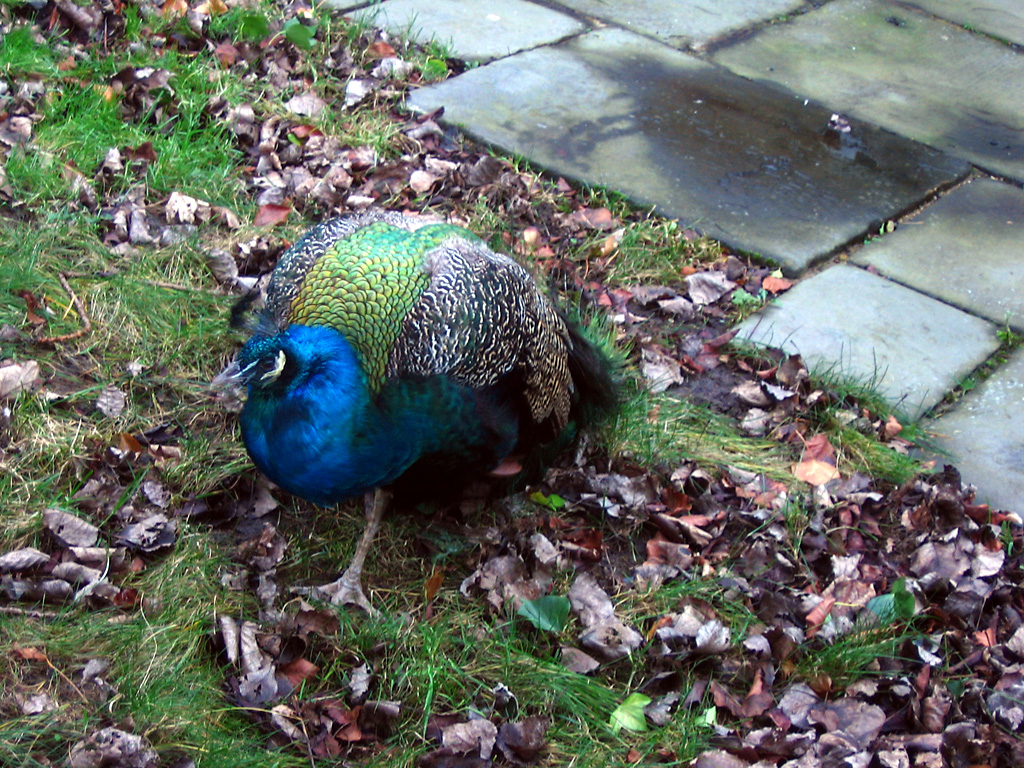
For the vast majority of the four billion year history of the Earth, it would have been a very inhospitable place for human beings indeed. An atmosphere with oxygen in it, the existence of essential ecosystems (most of them composed of microorganisms), the presence of an ultraviolet-blocking ozone layer: all of these are essential to human life, and all are temporary and largely the product of random events. So too, a huge number of other considerations, from the ambient temperature to the level of volcanic activity. Of course, if the situation were different, beings would have evolved in a different way. There are, no doubt, other forms of metabolism; likewise, it is possible to endure all kinds of environments and ecological surroundings. This is where the anthropic principle and the Goldilocks fallacy collide.
The Goldilocks fallacy is to observe that if the conditions of the Earth were different, human beings as they are could not live here. The faulty conclusion drawn is that these ‘perfect’ conditions could not, or have not, arisen by accident. This is akin to seeing a large number of black moths sitting on black trees in England during the 19th century and stressing how perfectly matched they were. Of course they were, because soot from factories had blackened the trees, allowing black moths to hide from predators more effectively than their lighter brethren, who duly saw their numbers reduced. The situation establishes which beings will do well, and ensures that those who do not will disappear. This was Darwin’s great insight.
A broader version of the Goldilocks fallacy stresses how unlikely the development of life in the first place was, then uses that as evidence for divine creation. The first response to that is to wonder how unlikely life really is. Life, at the lowest level, is something that can take what is in the environment, then make copies of itself using those materials. Prions (the replicating molecules that cause mad cow disease) are a bit like crystals: they reproduce themselves on the basis of coming into contact with the right materials. Given millions of billions of galaxies, hundreds of billions of stars per galaxy, and an unknown but massive number of planets, there is certainly a lot of chemistry going on. Given what chemists have cooked up using a few basic organic molecules and lightening in a closed environment, I would be personally astonished if at least single-celled life forms did not exist elsewhere in our galaxy, much less in the observable universe.
The last step in the logical chain is to consider the very real possibility that our universe is only one of an infinite number that could exist. It is also entirely possible that others do exist. Some universes will have life forms in them who can putter about and strangle each other and write blog entries. Others will not, but there is nobody reporting on them. As such, the puttering, strangling, blogging beings who marvel at their own existence may be rather missing the point.
Logic and ethics
Without warning, my failed states paper has grown to include Venn diagrams and predicate logic. This is what happens when you realize that one sentence could be expressed more comprehensibly through the use of a few symbols, then allow yourself to run with it. The paper (previously mentioned here and here) now includes branched formulations such as:
(h) Any state within the international system has the:
- obligation
- option
to intervene in a failed state, so as to:
- help it return to a non-failed status
- protect the human rights of those within it
- cause the cessation of large scale violations of human rights, ie. genocide
Of course, the whole point is to prove that you cannot reduce normative considerations in international relations to such crude formulas. Logic is not a substitute for judgment, in the consideration of how to act in response to weak or criminal states. Also, any consideration of how to act morally in the international arena will involve the examination of multiple justifications and counter-justifications, weighing the importance of certain moral claims against alternatives. Logic doesn’t really help us with that.
It does, however, help with the writing of a paper that is at least likely to stand out from the rest of those submitted on the topic. I knew that symbolic logic course I took at UBC would be useful for more than just the Law School Admission Test.
Anfal charges dropped for Saddam Hussein
Compounding the error of hanging him, the Iraqi High Tribunal has chosen to drop all charges against Saddam Hussein in the ongoing trial about the Anfal campaign. He was convicted earlier for the killing of 148 civilians in Dujail, but the campaign against the Kurds in Anfal between 1986 and 1989 killed more than 100,000 people and involved the use of chemical weapons including Sarin.
The brutality and illegality of this campaign has been used by many to bolster the assertion that Saddam Hussein was a tyrant and a criminal, and that the American-led invasion and occupation have been justified. It has also been used by those critical of the United States, particularly because some of the weapons used were almost certainly provided to Iraq by the United States and other western or NATO powers, either during or before the Iran-Iraq War (1980-88). In March of 1986, the President of the United Nations Security Council issued the following statement:
[P]rofoundly concerned by the unanimous conclusion of the specialists that chemical weapons on many occasions have been used by Iraqi forces against Iranian troops… the members of the Council strongly condemn this continued use of chemical weapons in clear violation of the Geneva Protocol of 1925 which prohibits the use in war of chemical weapons.
(S/17911 and Add. 1, 21 March 1986)
The United States voted against the issuance of the statements, while the UK, Australia, France and Denmark abstained.
Those who hoped that there would at least be a proper investigation and documentation of the crimes committed under his regime will be disappointed. Likewise, those who hoped that further precedents about the use of chemical weapons by heads of state might be established in international law. The progression in Iraq seems less and less like one towards a democratic state governed by the rule of law.
Thesis literature review

The first substantive chapter of my thesis is meant to be a review of the relevant literature. Actually, it would be more correct to say ‘relevant literatures’ since so many different ones touch upon the subject matter. While climate science, ecology, and biochemistry are all relevant to Kyoto and Stockholm, they are not directly relevant to the thesis. The point is to examine the roles played by expertise in policy formulation, not engage directly with the scientific issues at hand. As such, the primary sources of interest are not studies of global warming of POPs, in their own right, but the discussions that took place within the scientific and policy community about what is going on (to be analyzed in Chapter 3: Information and consensus issues) and then about what should be done about it ( Chapter 4: Normative and distributional issues).
Having a look at the conversations that took place within the scientific community about taking a political stake against nuclear testing might be one way of gaining insight into how scientists deliberate about political matters, and how the legitimate role of scientists and the scientific community is seen. Likewise, the whole debate that arose about Bjorn Lomborg’s controversial book. While the public perspective on these debates is largely outside the scope of the thesis, it might be worth touching upon the relationships between public, expert, and political opinion in the chapter on consensus and information issues.
The relevant secondary literatures are various. They obviously include political and international relations theory, especially as they concern questions about prudent decisionmaking, the welfare of future generations, and other normative concerns. (On the normative side, Henry Shue’s work is both highly topical and likely to be considered essential reading by his colleagues here). In general, I am a lot more interested in the core issues of political theory (legitimacy, justice, etc) than in those of international relations theory, though some discussion of the nature of cooperation between states and the formation of international regimes is required. To some extent, international law is relevant, insofar as it helps to define how science relates to the policy process and the practice of states. Elizabeth Fisher’s work on public administration has made me think that the Rationalist-Interventionist and Deliberative-Constitutive frameworks she describes can be applied to international environmental negotiations. It is also fairly clear that some understanding and discussion of the philosophy of science is necessary to prevent the thesis from being overly naive in that regard.
Histories and analyses of the meetings and agreements leading up to the Stockholm Convention and Kyoto Protocol are likewise important secondary sources. Rather than repeat lengthy summaries of what happened in the limited space that I have, I can further summarize it and refer the interested back to more comprehensive accounts. Similarly, other secondary discussions about the nature, causes, and implications of the two agreements should be mentioned.
The last section I mean to include in the literature review is a listing of recent theses, primarily at Oxford, that have addressed similar issues. While it is probably better to engage with more widely known scholars than debate the arguments of these theses directly, there will probably be a bit of the latter in the final version as well. In particular, it might be a good way of making reference to other potentially relevant case studies. Also, since these works have often led me to useful sources, it seems only courteous to give a nod to their authors. Also, they may appreciate knowing that at least one person has dug up the document they spent so much time and energy completing.
If people can think of any other literatures I need to address – or can think of any really stellar sources within the disciplines enumerated above – please leave a comment.
Syriana
I saw Syriana with Claire this evening and, quite frankly, did not think much of it. The central messages – that the oil business, espionage, and Middle Eastern politics are murky – are exceptionally obvious. Furthermore, the story was told in such a way that no concern was ever really developed for any of the characters. The plot was complex, but lacking in suspense, and one torture scene was graphic and unpleasant enough to have us both looking away from the screen. While the point of the film may have been the sheer cynicism of these processes, and those engaged in them, it is not a message that seems original, or even well conveyed.
With neither subtlety, human appeal, or much of an ability to conjure a response, Syriana is a film better skipped.
Dislocated dining
Because Wadham College is a Grade I listed building, it is not permitted to make any changes to it that alter the appearance. As such, the roofs of the main quad are being replaced in a slow and expensive fashion, the most annoying consequence thereof being that the dining hall will be closed next term. (Note that none of these are good photos; taking handheld photos inside buildings at night rarely has the most aesthetically pleasing consequences. Perhaps I can get a better crop in Hilary Term, through the use of my mini tripod.)

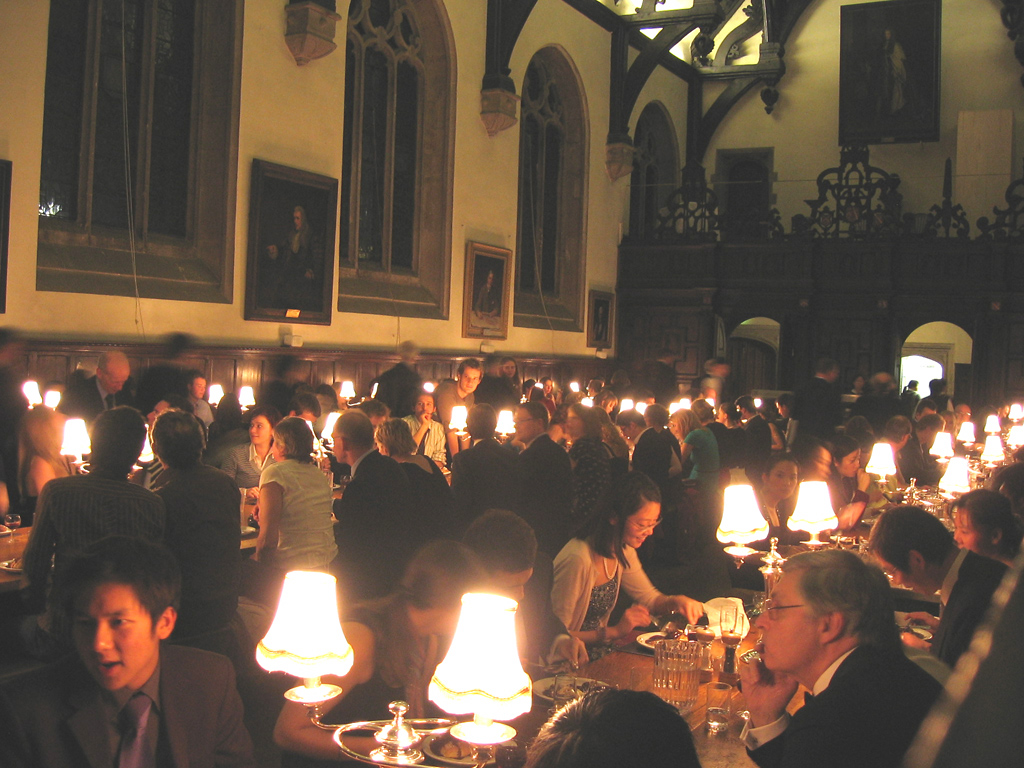
Given that the eight dinners at high table that accompany my scholarship are the major reason for which I spend any time in the college (the other two being checking my mail and printing papers), this is irksome. That said, I would be quite happy to have the dinners shifted to the Old Library, where people tend to shuffle afterwards anyhow. It would be slightly more annoying for the serving staff, on account of being a bit farther from the kitchen, but it is enormously more aesthetically pleasing than either the Old or New Refectory.

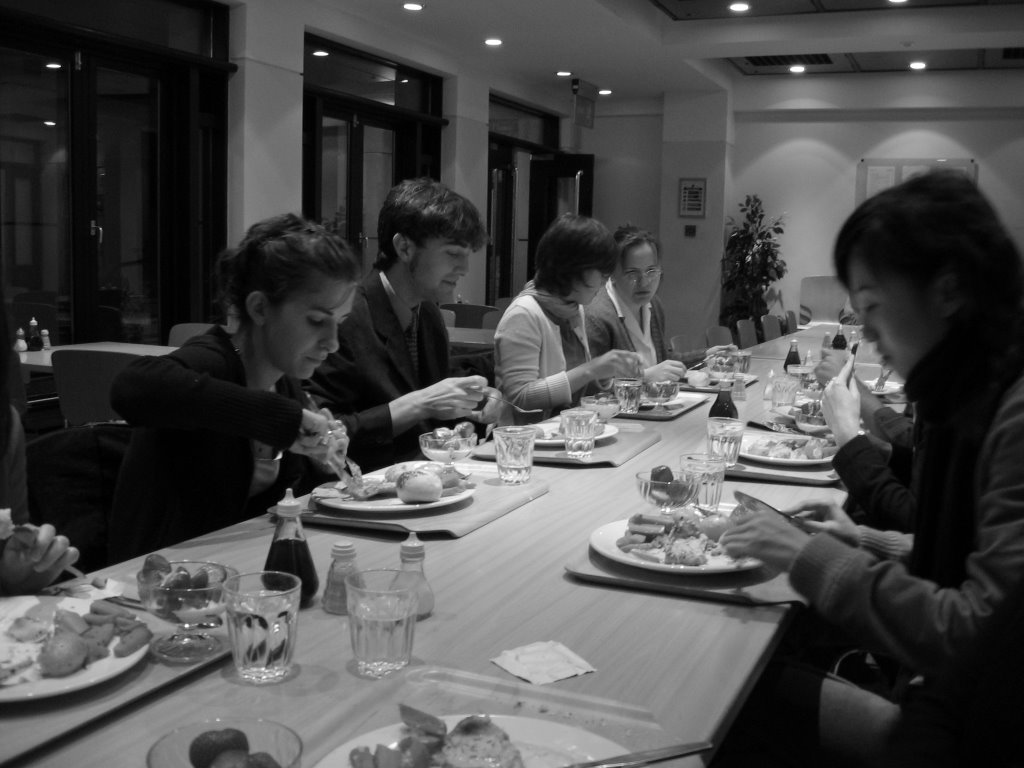
That said, I am happy with free dinners, wherever held.
Science and external social needs
One major analytical component of the thesis is the consideration of why scientists are a special group, within the larger set of expert practitioners (a category that includes snipers, surgeons, and sinologists). Usually, the explanation given relates to the scientific method: the norms according to which scientists engage with information. I was interested to see that Kuhn offers a different perspective:
In the sciences (though not in fields like medicine, technology, and law, of which the principal raison d’etre is an external social need), the formation of specialized journals, and the foundation of specialists’ societies, and the claim for a special place in the curriculum have usually been associated with a group’s first reception of a single paradigm. (SoSR 19, italics in original)
Two bits of this are interesting. The first is the idea of emergence in the unbracketed text. When Robert Keohane explained how new disciplines peeled away from philosophy as their practitioners became good enough to specialize in them, he was describing something similar. The ways in which new sub-disciplines within science emerge is clearly of interest. There are those that emerge primarily from the emergence and application of new paradigms (say, quantum chemistry). There are those that emerge because aspects of other sub-disciplines can be usefully combined (say, biochemistry). There may be others that emerge or endure on the basis of other characteristics.
To me, the assertion in the bracketed text is the more interesting part of this quotation. Glancing through the Science and Technology section of this week’s Economist, I see an article on the bacteria in the human digestive tract, and the relationship between obesity and the ratio of Bacteroidetes and Firmicutes found therein. Another describes a study on hypoxia (low oxygen in the blood) being carried out by shipping volunteers to different altitudes on Mount Everest. Another is on the use of linear temporal logic to address privacy concerns in computing. The last is about how wonderful bats are, when it comes to eating bugs that eat crops and helping to pollinate Agave plants critical to the manufacture of tequila. All four articles relate quite directly to “external social need[s].”
This is not to say that Kuhn is wrong; rather, the situation sheds light on the relationship between science and society. There may be reasons for studying bacteria or subatomic physics that are concerned purely with the development of further understanding of these things. These are now, however, the reasons that are generally presented to or accepted by budget committees. While it is obviously true that ‘useful’ science is easier to motivate people to fund, there is also the issue of verifying the superiority of new truth claims. When you can say that understanding nuclear physics allows us to generate thousands of megawatts of power and incinerate our wicked enemies, you can provide qualitative evidence for the superiority of information based on a modern nuclear conception of physics over a previous view that treated atoms as indivisible, or a still previous view that rested on the idea that everything in the universe is composed of a combination of water, fire, earth, and air.
Perhaps this linkage between scientific progress and social need can be set aside just by saying that the scientific ideal is unconcerned with “external social need,” while real world science operates under other constraints. What this doesn’t take into account is the possibility that science is part of a broader project: the kind of Enlightenment dream so shamelessly categorized on The Economist’s contents page as: “a severe contest between intelligence, which presses forward, and an unworthy, timid ignorance obstructing our progress.” Is science separable from the myriad assertions in that phrasing (most importantly, that there is the possibility of progress, and that it can be evaluated by contrasting ‘intelligence’ with ‘ignorance’) or is the bubble of exclusion from external social needs that exists in the ideal case durable enough to isolate science from the historical context in which it arose, and the kinds of tasks that scientists are generally called upon (and often personally driven) to engage in? If not, we are returned to the question of what distinguishes science.
L’emploi et moi

Much of today has been spent digging around for jobs. The four final exams for the M.Phil will occur between the 11th and 16th of June (8th week of Trinity Term). Having written the qualifying exam last year, I am much less worried about the finals than about the thesis. Being able to write something cogent – on the basis of what I can recall about a subject and a limited amount of time – is enormously less challenging than reading a high proportion of everything academics have written about a subject, then contributing to that discussion somehow. After all, I do the former every single day and have never before done the latter. After the exam period ends, I am obligated to remain in Oxford for two weeks, in case they need to give me a viva exam (oral examination). Those are only given to people who end up on the cusp of pass/distinction or pass/fail.
As of the 30th of June, I will thus no longer be a student. It’s a thought to make a person shiver, and begin scanning through dozens of web pages looking for employment opportunities. I have already sent queries of one sort or another to the following organizations:
- The Economist and The Economist Intelligence Unit
- Environment Canada
- Google and Google Scholar
- The UBC Institute for Resources, Environment & Sustainability
- McKinsey (see post)
Most have not been formal applications for specific jobs. Mostly, I have been trying to assess what kinds of jobs are out there for someone with my credentials and experience. I can write well, do research, teach and lecture (though not with a huge amount of experience), take a decent photo, debate, do some semi-complex web stuff, and converse for at least fifteen minutes on most any subject that is not terrifically obscure. My CV is available online, in PDF or Word format. I am most interested in jobs that focus on international relations or the environment. I can certainly work anywhere in Canada, and can very probably get a work visa for the United Kingdom or the United States.
The dozens of lectures and pamphlets I have been given in the last decade or so about finding jobs, generally stress how most people find jobs through the people who they know, rather than though the kind of listings I have been trawling. So far, my efforts to identify such opportunities through people who I know have met with only moderate success. This is probably the product of mostly knowing people who are (a) career academics or (b) students who probably work for minimum wage a few days a week. That said, anyone who has any leads that they think would be appropriate for me is very much encouraged to let me know (milan.ilnyckyj@politics.ox.ac.uk).
PS. I have written previously about the job search, about why I am not going straight into a PhD program.
Outward flowing data
Every time I run iTunes, gigabyte after gigabyte starts flowing out from my computer. In the last two hours, I have send 4.11GB worth of data, and I don’t use any kind of file sharing service. The hard drive gets hot. It clicks, when I am not even using the computer. The only plausible explanation is that people are using software, such as OurTunes, to download my music library. Normally, I would be flattered that they want my music. Unfortunately, two factors complicate things. Firstly, if all the drive activity makes my HD go kaput, I am left with no working computer at a time when having one is critical. Secondly, as a non-St. Antony’s student, I am on their network on a fairly provisional basis.
As such, you now need a password to access my shared music. If you’ve gone to the trouble to find this message and read it, send me an email.