Conservatism and the environment

In the northern lower reading room of the Bodeleian, I read a really interesting chapter on ecology and conservatism by Roger Scruton, from the University of Buckingham.1 He makes a surprisingly solid argument that a greening of conservatism would be more of a return to its roots than a departure into uncertain territory. He evokes the position of Burke that all living people are involved in a trusteeship involving both the living and the dead. The moral onus is to maintain, resist damage, and pass along that which has been inherited.

The problems with this position are twofold, and both problems arise from the parochialism of conservative environmentalism. I have always admired the sensible conservative caution about grand projects and the building of utopias. That said, encouraging enclaves to behave in environmentally responsible ways does nothing to protect those within from their neighbours (or those across the world) who do not behave similarly. When the greatest environmental threat in the world (climate change) arises from collective economic activity, a love of one’s home and country, and the fervent desire to protect both, will come to nothing without international cooperation and the changing of behaviour, using some combination of consent and coercion.

The second problem is that of material equality. Protection of what you have inherited for those who are to follow may be a noble individual pursuit (think of the shame attached to those who squander fortunes and wreck empires), but it is not a path towards greater global justice. Now, greater global justice may be exactly the kind of Utopian project that conservatives are smart to be wary about. That said, there can be moral impulses strong enough to make us embark upon difficult and uncertain projects, simply because it would be profoundly unethical to behave otherwise. When it comes to extreme poverty and the deprivation and danger under which so much of the world’s population lives, I think those impulses are justification enough.

Strategically, it seems essential to foster an emergence of green conservatism in the political mainstream. We cannot oscillate between relatively responsible governments and those that act as wreckers. Moreover, once both sides of the mainstream have accepted how vital the environment is, and the sacrifices that must be made to protect it, there is a better chance that the debate and policy can move forward. If one group is forging ahead with more far-thinking ideas, they risk excessive electoral punishment. If, however, the thinking of both politicians and the population as a whole evolves towards a more serious way of thinking about environmental management, there is a much greater chance that the push will be sustained and effective.

[1] Scruton, Roger. “Conservatism.” in Dobson, Andrew and Robyn Eckersley. “Political Theory and the Ecological Challenge.” Cambridge: Cambridge University Press. 2006.

Sleep pattern adjustment

As suggested by Jessica, this seems like a good idea: How to Become an Early Riser (Part II).

I don’t care about getting up early, per se. I care about being able to fall asleep when I need to and being up and aware at a consistent time. Given the value of evenings for social events and speaking to friends back home, I think I will aim for rising at 9am, with the hope that I will end up normally going to be around 2am.

Perhaps I will finally be able to knock this off my 43Things list.

Unrelated, but scary: There will be virtually nothing left to fish from the seas by the middle of the century if current trends continue, according to a major scientific study.

See: Worm, Boris et al. “Impacts of Biodiversity Loss on Ocean Ecosystem Services.” Science. 3 November 2006: Vol. 314. no. 5800, pp. 787 – 790. (Oxford Full Text)

On Wadham high table dinners

Old Senior Common Room, Wadham College, Oxford

After four successive weeks of high table dinners in Wadham College, I have become attuned to their patterns. Those who arrive early or have guests tend to congregate in the Senior Common Room (SCR), just below the MCR, in the main quad. From there, they head over to the hall, to meet those who proceeded there directly.

Dinner itself is bread, an appetizer (usually soup), a main, and dessert. Wine is served to accompany. Unlike the Red Room in New College, where there is Sherry beforehand and both a white and a red wine with dinner, at Wadham it is simply two glasses of the same sort of wine. In both cases, I generally find myself to be the only vegetarian at the table. For the past couple of weeks, I have been even more unusual, insofar as I have been declining the wine, in hopes of speeding my recuperation from this tenacious illness.

After dinner, if there is a senior member of the college who takes it upon themselves to organize it, people retire to either the Old Library – if there are many people coming along – or the Old Senior Common Room, if there are fewer. Tonight, five of us went to the latter, marking the first time I had even been inside. The reasonably small, green-paneled and candle-lit room definitely feels more intimate than the Old Library, which is probably half as large as the dining hall. I should like to return their once the cold has set in a bit further, and the fire is going. In either place, people converse and eat fruit and chocolates, while drinking sweet after-dinner drinks, like port and claret.

After that, people often head to the SCR for coffee from the famously expensive espresso machine. The conversation is usually about people’s areas of research, with interested individuals trying to learn more about fields in which they are non-expert. One of the fellows today actually worked as part of the team at NASA that operates the Hubble Space Telescope. When talk of research areas fail, people discuss the peculiarities of Oxford.

In attendance are usually between three and five graduates: either those being brought as guests by their college advisers or those who have privileges attached to offices or scholarships. In my case, the dinners are part of my Senior Scholarship. In addition to the graduates, there are usually about a dozen fellows of the college and their guests. Since there are usually three rotations of who you are sitting beside and across from, you actually get to meet a good number of people. This is reinforced through seeing some every couple of weeks.

The New College dinners – which I attend as a member of the Strategic Studies Group executive – tend to be more lavish, but the Wadham ones definitely feel more exclusive. This is particularly the case when people retire for port and fruit in one of the old rooms afterwards. Aside from a greater diversity of people present, the whole arrangement is probably not enormously different from when Christopher Wren and Isaac Newton apparently ate, drank, and conversed in these same places.

PS. I realize the photo is garbage, but the light was bad, I had nothing to brace against, and I was pressed for time. I will try for a better one next time.

Seeking thesis HQ

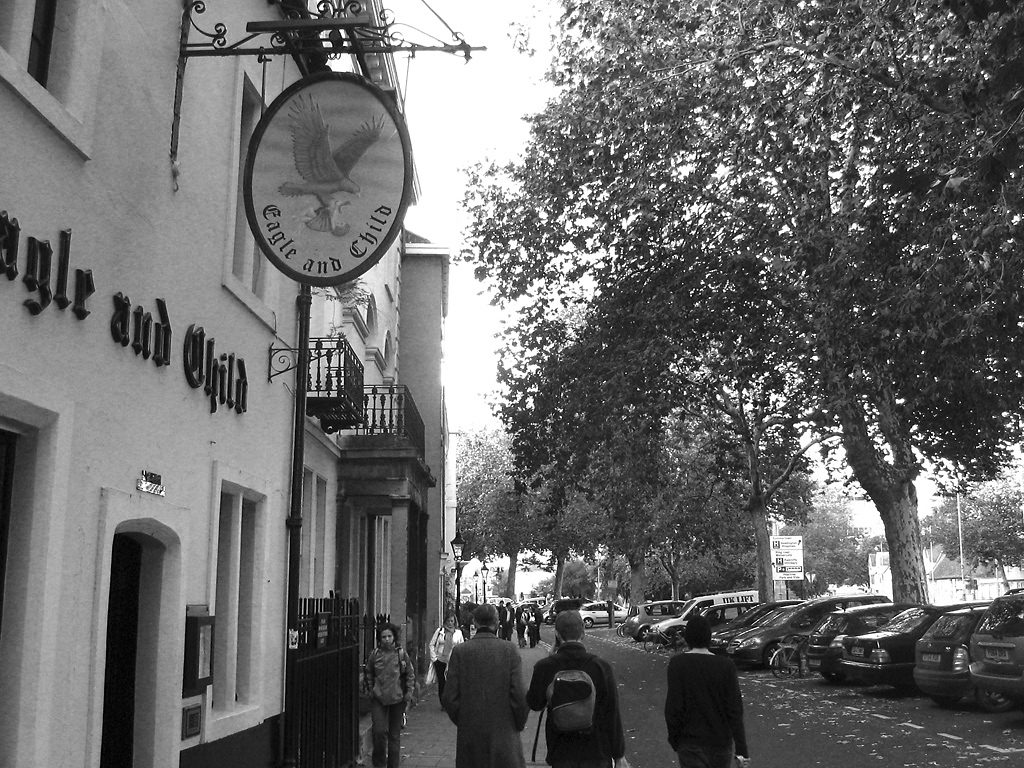
The Eagle and Child

My recent thinking suggests that I need a thesis base of operations. My room is no good, because there are lots of things here enormously more interesting than a thesis to be written. The library is likewise no good, since there is not enough energy there to keep a brain firing at any decent level. Libraries make me fall asleep.

As such, I am considering using Green’s Cafe, beside the Eagle and Child, during the mornings and afternoons. They close around 5:30pm, which is obviously no good. Not even Starbucks stays open after 7:00pm. Perhaps G&D’s would work during the later period, but they have no internet access available whatsoever.

All this bother for a document that about ten people will read, plus or minus 4 nineteen times out of twenty.

[Update: 3:00am] After a week that has felt scatterbrained and unproductive, as well as marked by illness, I am unveiling a programme meant to help set things aright:

  1. A strong attempt at asserting my target sleep schedule (in bed to sleep at 1:00am, out of bed preparing to work by 9:00am)
  2. Multiple alarm clocks deployed to this end
  3. Complete prohibition on caffeine, with an exception for tea meant to assist with aforementioned illness
  4. No alcohol whatsoever – including a continued policy of declining wine at OUSSG and Wadham high table dinners
  5. Vitamins and omega-3’s as usual
  6. Continued course of ColdFX (ginseng extract CVT-E002), as kindly provided by my mother
  7. At least four hours a week of solid physical exercise, ie. cycling in the countryside
  8. Continued efforts to resist insatiable craving for olives – cause mysterious, sodium levels involved considerable
  9. Continued efforts to get in touch with sympathetic friends elsewhere in the world – esp. write letters
  10. Requirement to finish all Developing World seminar reading by the Monday before they are due
  11. Requirement to either read one thesis related item per day, or write 500 thesis usable words

Having to lay such a thing out makes me feel like Bridget Jones, but perhaps it will make it easier to abide by.

Hiccups and new hardware

As the number of support requests I am getting from friends with brand-new MacBooks demonstrates, buying hardware that has just been released – even from a good company like Apple – is likely to land you with all the teething troubles inherent.

Apple laptop lines (formerly, the iBooks and Powerbooks; now, the MacBooks and MacBook Pros) tend to get quietly upgraded as they age: they highlight the bigger hard drives and faster processors, but the more important changes are usually fixes for issues that have cropped up among the early adopters.

The general maxim: if you want to avoid tech support and headaches, let others walk ahead of you. My iBook may take fifteen times longer to boot than the new MacBooks, but at least it does so consistently.

PS. Those having trouble with MacBooks not restarting, shutting down randomly, and doing other problematic things with regards to power should try the following:

  1. Make sure you have downloaded and installed all the patches for Mac OS X itself. You should have your system to check for these daily, and you should install them as soon as they come out.
  2. Try reseting your PRAM – this may sound like nonsense, but everyone with experience in trying to fix Apple hardware will be nodding knowingly to that suggestion.
  3. Try resetting your System Management Controller (much like the Power Management Unit in the iBooks and PowerBooks).

My general tips on protecting your computer are useful for at least minimizing the harm if a serious hardware issue arises.

Final reminder: OxBlogger gathering tonight

Time: 8:00pm
Date: Today – Wednesday, November 1st
Place: Far From the Madding Crowd (map)

What to expect: Meeting other residents of Oxford who maintain blogs.
Note: You need not have met us before to attend; indeed, this is how we met in the first place.

Seth and Ben have also announced this. For more information, see previous announcements and records of past gatherings.

Hubble’s new lease on life

Abstract colour and shape

Good news for anyone interested in the nature and content of our universe: NASA has reversed course and decided to repair the Hubble Space telescope. For many with an interest in astronomy, the idea that this fine instrument would be allowed to fall out of orbit seemed quite mad.

The refit, which should take place in 2008, should extend the life of the telescope until at least 2013. The primary objective will be to replace failing batteries and gyroscopes, though new instruments will also be installed.

The Hubble instrument has already generated some of the most important data in the history of astronomy and cosmology, including totally new information on very distant objects generated through the use of gravitational lenses: where the light-bending properties of galaxies are used on a massive scale to resolve extremely distant objects. Since the light being observed has been traveling for so long, such views are also a glimpse into a much earlier time in the development of the universe.

In contrast to manned space flight – which is inspirational but not always very scientifically useful – it is this kind of experimentation that we should be focusing our research dollars and efforts upon.

Let my packets go!

Oxford Social Sciences Library

Why is wireless networking so dodgy right now? I am not talking about typing 400 character messages into your phone with your thumbs, but about accessing something really useful with a device not physically connected to a computer network.

Not to sound like Margaret Thatcher, but a big part of the answer is government regulation. Back in the day when analog cellular phones were a dream, there was a belief that radio frequencies had to be allocated, for eternity, to a particular group for a specific use. The advent of cool networking technologies like CDMA has demonstrated that this is not only wrong, but incredibly inefficient.

If we abandoned a broadcast television station or two, or national militaries gave up some of the radio frequency spectrum allocated to them, some really good wireless internet access could emerge. Until then, we must all wait until technological advancement removes the shackles imposed by governments concerned about the technological issues of decades past.

Fish presentation tonight

My fisheries presentation in Wadham is in a few hours. For those who are not going, but who are interested in EU fisheries policy in West Africa, you can have a look at the following:

My PowerPoint slides (1.8mb)
My speaking notes (79kb)
The page on my wiki relating to this (includes PDF versions of the above).

Wish me luck.

[Update: 10:00pm] The talk went well, but was quite poorly attended. The ratio of hours I spent preparing to aggregate hours the audience spent listening (number of listeners * length of talk) was no better than 1:1. Perhaps, if I had called it: “A Second Spanish Armada: Neo-Colonialist Pillage in West Africa,” more people would have attended.

That said, having two people I knew in the audience – my friend Bilyana and my college advisor Robert Shilliam – made it seem more worthwhile. Also, it is always good to have a change to practice public speaking. I am getting better, but I still find that I get entirely lost within the act of speaking and lose a good sense of how I look from the outside.

All academic issues aside, the warden has some nice cheese.