
There are some who assert that the global warming that has been observed on all continents is caused by changes in the output of the sun. This hypothesis does not stand up to scrutiny in either the short or the long-term, as made clear in James Hansen’s Storms of My Grandchildren as well as published papers of his, including “Target Atmospheric CO2: Where Should Humanity Aim?.” It is important to remember that what follows does not come from climate models, but rather from data on the paleoclimatic history of the planet, collected from ice and ocean cores and other sources.
The 12-year solar cycle
The sun dims and brightens across a twelve year cycle. While each square metre of the planet absorbs about 240 watts of sunlight averaged over day and night, the recorded magnitude of these cycles is about 0.2 watts. Not all forcings have the same effect on the climate. Taking the forcing caused by carbon dioxide (CO2) as the baseline, it can be calculated that the solar cycle forcing has an effective strength of between 0.2 and 0.4 watts. The climate forcing due to the 1750-2000 CO2 increase is about 1.5 watts. Other human-caused changes, such as adding methane, nitrous oxide, CFCs, and ozone to the atmosphere, make the total greenhouse gas forcing about 3 watts.
Each year, we are increasing the concentration of carbon dioxide in the atmosphere by about 2 parts per million (ppm). That equates to an effective forcing of 0.03 watts. As such, seven years of carbon dioxide emissions at the current level would offset the cooling effect of the sun being at the lowest ebb of its cycle. As a consequence, human-made climate change now overwhelms this natural cycle.
Long-term trends
Longer-term data also shows how greenhouse gases are more important to the climate than changes in solar output. The geological era spanning the last 65 million years is called the Cenozoic. Over that time, the sun’s output has increased by 0.4%. This corresponds to an increase of about 1 watt since the dinosaurs died out. Over this time period, the planet has actually cooled considerably: with mean global temperature more than 8°C higher at the end of the time of the dinosaurs. This, despite the increased solar output.
Over this timespan, the atmospheric concentration of CO2 has ranged from between 1,000 and 2,000 ppm during those hot years of the early Cenozoic and as little as 170ppm during recent ice ages. This range corresponds to a climate forcing of about 12 watts: at least ten times more than the forcings from the sun and from changes in the configuration of continents. As Hansen says: “It follows that changing carbon dioxide is the immediate cause of the large climate swings over the last 65 million years.”
The following diagram deserves consideration:
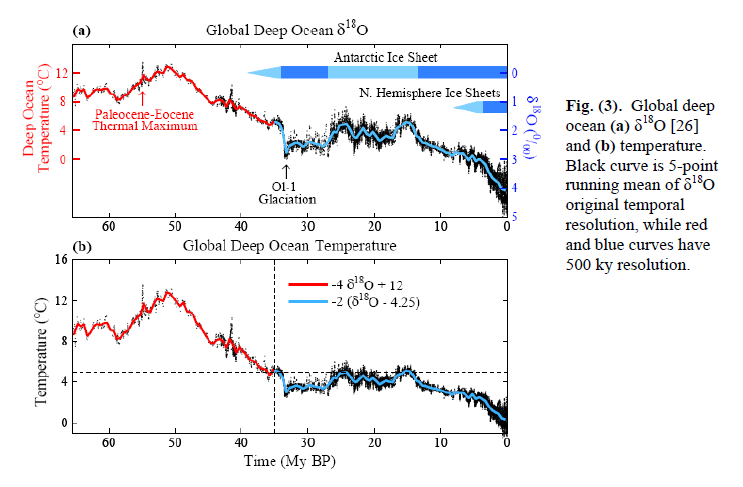
It shows temperatures from the Cenozoic: data that was obtained by examining the shells of microscopic animals called foraminifera. It shows the slow decline in mean global temperature over the whole span, as well as evidence that abrupt changes in temperature are possible.
What we’re doing now
One thing to consider is that if we keep increasing our greenhouse gas emissions, we will push carbon dioxide concentrations way above pre-industrial levels and into the range that existed at the beginning of the Cenozoic. While the cooling trend that we are living at the end of happened over tens of millions of years, temperature increases of well over 4°C could occur by the end of the century, with further warming beyond. While life has had ages to adapt to climate change as it was occurring before humanity, we are presiding over a spike in temperatures and greenhouse gas concentrations.
This graph shows CO2 concentrations from the last 400,000 years, as measured in ice core samples:
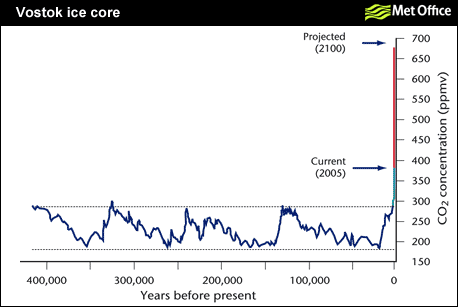
Keeping all that in mind, it seems very sensible to be working hard to keep the tip of that spike from getting too high. We should be worrying about our emissions, not blaming the warming we have observed on the sun and moving on.

More on sun-climate relations
Four new papers discuss the relatiosnhip between solar activity and climate: one by Judith Lean (2010) in WIREs Climate Change, a GRL paper by Calogovic et al. (2010), Kulmala et al. (2010), and an on-line preprint by Feulner and Rahmstorf (2010). They all look at different aspects of how changes in solar activity may influence our climate.
The paper by Judith Lean (2010) has the character of a review article, summarizing past studies on the relationship between solar forcing and climate. The main message from her article is that the solar forcing probably plays a modest role for the global warming over the last 100 years (10% or less). It’s a nice overview, but I miss treatment of uncertainties.
Her analysis is based on the HadCRUT3 data, and I wonder if she would get similar results if she chose the GISTEMP or NCDC instead. The choice may in particular be relevant for the discussion of the temperatures after 1998.
Personally, I regard the data on solar activity before 1900 as quite uncertain too. The reason is that there are strange things happening to the solar cycle length in the shift from the 19th to the 20th century. Hence, any analysis based on the past centuries is uncertain because of suspect data quality in the early part of the record. Lean mentions that proxy-based records are uncertain, however.
Another source of uncertainty stems from the analysis itself – a regression analysis with chaotic data can easily yield misleading results. Gavin and I showed in a recent paper that multiple regression can produce strange results when applied to the global mean temperature and a number of forcings.
In other words, I think the reader may get the wrong impression from Lean (2010) that the link between solar activity and climate is better established than the data and methods suggest. Especially when she discusses forecasts for the near future (eg. for year 2014) – I fear that such a discussion can be misinterpreted and misused. However, that’s my view, and it does not necessarily mean that her paper is incorrect – quite the opposite, I think her main conclusions are sound (Her estimate of the solar contribution to the global warming over past century – 10% or less – is in good agreement with the figure Gavin and I got in our analysis).
The positive side is that the paper is probably clearer and more accessible without all these caveats. I also think she makes an interesting point when she discusses ‘fundamental puzzles’ associated with claims of strong solar role in terms of the past warming. She puts this into the context of climate sensitivity, arguing that it would imply that Earth’s climate be insensitive to well-measured increases in GHG concentrations and simultaneously excessively sensitive to poorly known solar brightness changes. Furthermore, Lean argues that it would also require that the Sun’s brightness increased more in the past century than at any time in the past millennium – a situation not readily supported by observations.
…
So what can we learn from these articles? What we see is how science often works – increases in knowledge by increments and independent studies re-affirming previous findings, namely that changes in the sun play a minor role in climate change on decadal to centennial scales. After all, 2009 was the second-warmest year on record, and by far the warmest in the southern hemisphere, despite the record solar minimum. The solar signal for the past 25 years is not just small but negative (i.e. cooling), but this has not noticeably slowed down global warming. But there are also many unknowns remaining, and the largest uncertainties concern clouds, cloud physics, and their impact on climate. In this sense, I find it ironic that some people still rely on the cosmic rays argument as their strongest argument against AGW – it does involve poorly known clouds physics!
“There was an even bigger problem with the Marshall [Institute’s 1989 report] analysis that climate modeler Steven Schneider pointed out. If Jastrow and company were right that the climate was extremely sensitive to small changes in solar output, then it meant the climate would also be extremely sensitive to small changes in greenhouse gases. Schneider argued,
Sensitivity cuts both ways. And as physicists, [Marshall Institute employees] Jastroy, Seitz, and Nierenberg would of course have known this.”
Oreskes, Naomi and Erik Conway. Merchants of Doubt: How a Handful of Scientists Obscured the Truth on Issues from Tobacco Smoke to Global Warming. p.189 (hardcover)
That’s a nice little rebuttal. It can be applied to the sunspot people, like Dan Pangburn, as well.
Solar surprise for climate issue
By Richard Black Environment correspondent, BBC News
The Sun’s influence on modern-day global warming may have been overestimated, a study suggests.
Scientists found unexpected patterns in solar output in the years 2004-2007, which challenge existing models.
However, they caution that three years of data are not enough to draw firm conclusions about long-term trends.
Writing in the journal Nature, they say it may become necessary to revise the way that solar influences are dealt with in computer models of the climate.
But, they add, the research does not challenge the role of humanity’s production of greenhouse gases as the dominant long-term driver of modern-day climate change.
“What we can’t really do at this stage is to extrapolate from this three-year period to any longer period – we can’t even say that [what we’ve seen] has happened on previous solar cycles,” said principal researcher Joanna Haigh from Imperial College London.
Solar physics
Sun down
Several lines of evidence suggest that the sun is about to go quiet
DURING the four centuries that it has been studied in detail, the sun has usually behaved in a regular manner. The number of spots on its surface has waxed and waned in cycles that last, on average, 11 years. Such cycles begin with spots appearing in mid-solar latitudes and end with them near the equator. And the more spots there are, the more solar storms there are around.
Sometimes, though, the sun sulks and this solar cycle stops. That has happened twice since records began: during the so-called Maunder minimum of 1645 to 1715 and the Dalton minimum of 1790 to 1830. These coincided with periods when global temperatures were lower than average, though why is a matter of debate.
An absence of sunspots also means an absence of solar flares and their more violent siblings, coronal mass ejections. Such outbursts disrupt radio and satellite communications, electricity grids and a variety of electronic equipment, so the pattern of solar activity is of more than academic interest. A new solar minimum, then, would test theories about how the climate works and also make communications more reliable. And many solar physicists think such a new minimum is on the cards. A group of them, who all work for America’s National Solar Observatory (NSO), have just had a meeting in New Mexico, under the aegis of the American Astronomical Society, to announce their latest results.
…
That is good news for operators of communications satellites. And it is interesting news for those who worry about global warming. If the Maunder and Dalton minima actually did affect the climate, then a new one might counteract the effects of the extra greenhouse gases people are now pumping into the atmosphere—at least, until the solar cycle returns. Whether the breathing space thus granted would be used wisely or squandered is another matter. Do not expect that debate to be as placid as the spotless sun.
Song, X., D. Lubin, and G. Zhang. 2010. Increased greenhouse gases enhance regional climate response to a Maunder Minimum. GRL, Vol. 37, Lo1703, doi:10,1029/2009GL041290, 2010.
A future Maunder-Minimum type drop in solar irradiance is not expected to offset CO 2 -induced warming and may even amplify the warming in certain regions.
During the 11 year solar cycle, total solar irradiance (TSI) fluctuates by about 0.1%. This small but important variation has a detectable influence on the Earth’s climate through changes in atmospheric pressure (AO/NAO) and surface air temperatures, which can be amplified through a sea ice-solar radiation feedback. Imposed on this short term cycle are longer term variations in solar irradiance. A sustained long term drop in solar activity occurred during the Maunder Minimum (1645-1715), when TSI was thought to have been reduced by about 0.2% causing severe winters in the western Baltic regions. This study investigates how a future climate system would respond if the TSI were to decrease in the future, as it did during the Maunder Minimum. Given that future climates will be warmer as a result of elevated greenhouse gases, a question of interest is whether a similar decrease in the TSI sometime later this century would result in similar cooling. The authors examined the climate system responses to a sustained multi-decadal decrease in TSI of 0.2% in a pre-industrial era climate and under a global warming scenario (IPCC B1 scenario) using the NCAR CAM3 model coupled with a mixed-layer slab ocean model. They found that the global average cooling effect induced by the TSI decrease is reduced by about 27% in the B1 scenario relative to that in the pre-industrial era. This difference was due to both the suppression of the sea ice-solar radiation feedback and a stronger greenhouse effect associated with the increase in greenhouse gases. Regionally, however, a more negative AO/NAO affected wind circulation and sea air temperatures which strongly amplified warming in certain regions in the B1 scenario, namely in western Greenland, Central Asia and East Asia. The results showed that a future solar grand minimum is not expected to offset the CO2-induced warming under even a relatively low warming scenario (B1) and may in fact amplify the warming in certain regions.
Summary courtesy of Environment Canada
Benestad, R.E. and G.A. Schmidt, 2009, Solar trends and global warming. Journal of Geophysical Research, Vol, 114, D14101, doi: 10.1029/2008JD011639.
A new methodological paper is critical of previous estimates of a large contribution of solar forcing to recent global warming based on linear analytical methods. This work concludes that solar forcing most likely accounts for 7 ± 1% of 20th century warming.
Benestad and Schmidt (2000) explore methodologies used to detect and attribute the contribution of solar forcing to global warming over the 20th century. To accomplish this, they test the ability of different statistical techniques to correctly quantify solar forcing in GCM (GISS ModelE GCM) simulations of 20th century climate that have been generated with known forcing contributions. Similar analyses are applied to the observed temperature record. Their results demonstrate that, in the presence of internal climate variability and multiple colinear forcings, linear analytical methods (such as regression) yield non-robust results. The authors are also critical of previous studies by scientists Scafetta and West that have yielded high estimates of the solar contribution to global warming (50-69% since 1900) based on such methods. As such, the authors repeat their analyses and evaluate their robustness using modeled and observed data. The authors conclude that the linear approach of Scafetta and West is subject to the problems noted above and suggest that the solar contribution to global warming is unlikely to have been larger than 7 ± 1% (0.1-0.2°C) over the 20th century and is negligible for warming since 1980.
Summary courtesy of Environment Canada
By comparing rates of seed formation during the different phases of the experiments, the researchers have been able to put a figure on cosmic rays’ contribution to the process. The results, reported in this week’s Nature, suggest naturally occurring rays enhance seed-formation rates by a factor of ten. That implies the rays’ varying intensity could indeed affect the climate.
Dr Kirkby and his colleagues remain cautious about the result, however, because of a second finding. To their surprise, they discovered that the seed-formation rates for sulphuric acid and ammonia are between a tenth and a thousandth of those needed to account for the cloud seeding actually seen in the atmosphere. That suggests other compounds are important, too—and this, in turn, implies that current climate models, which assume most seeds are made of ammonia or sulphuric acid, may require revision.
Is the Sun causing global warming?
No. The Sun can influence the Earth’s climate, but it isn’t responsible for the warming trend we’ve seen over the past few decades. The Sun is a giver of life; it helps keep the planet warm enough for us to survive. We know subtle changes in the Earth’s orbit around the Sun are responsible for the comings and goings of the ice ages. But the warming we’ve seen over the last few decades is too rapid to be linked to changes in Earth’s orbit, and too large to be caused by solar activity.
One of the “smoking guns” that tells us the Sun is not causing global warming comes from looking at the amount of the Sun’s energy that hits the top of the atmosphere. Since 1978, scientists have been tracking this using sensors on satellites and what they tell us is that there has been no upward trend in the amount of the Sun’s energy reaching Earth.
A second smoking gun is that if the Sun were responsible for global warming, we would expect to see warming throughout all layers of the atmosphere, from the surface all the way up to the upper atmosphere (stratosphere). But what we actually see is warming at the surface and cooling in the stratosphere. This is consistent with the warming being caused by a build-up of heat-trapping gases near the surface of the Earth, and not by the Sun getting “hotter.”