
Here are some photos I snapped of the x-rays taken at the Ottawa General Hospital, at various points after my cycling accident:
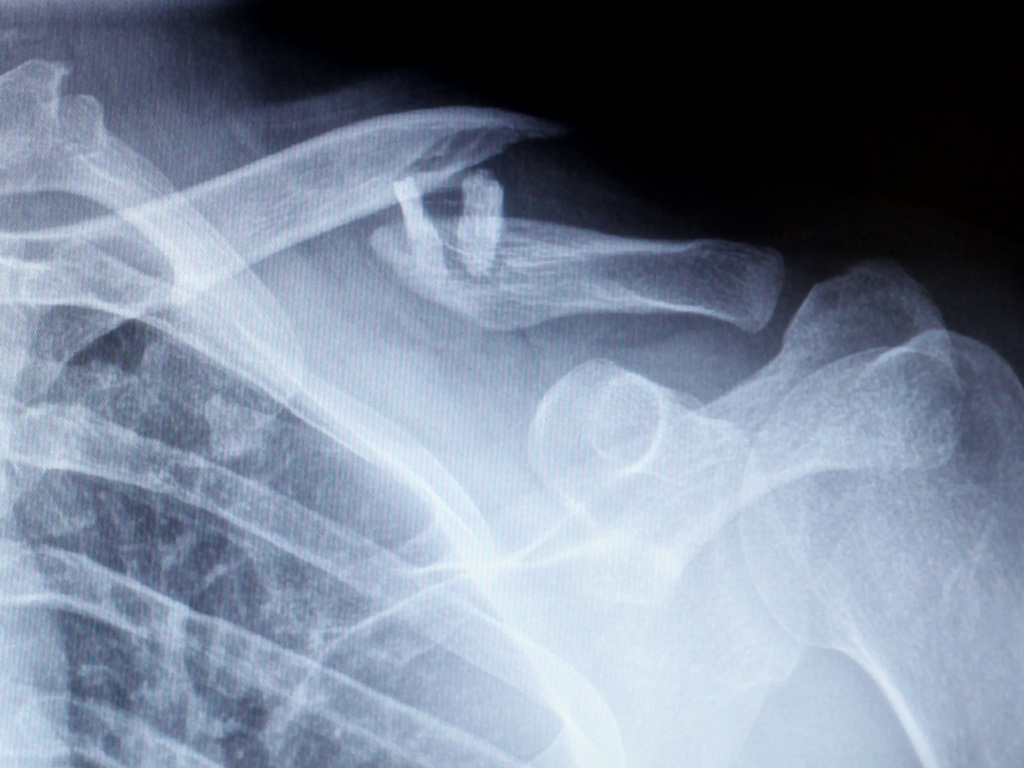
May 30th – a couple of hours after the accident
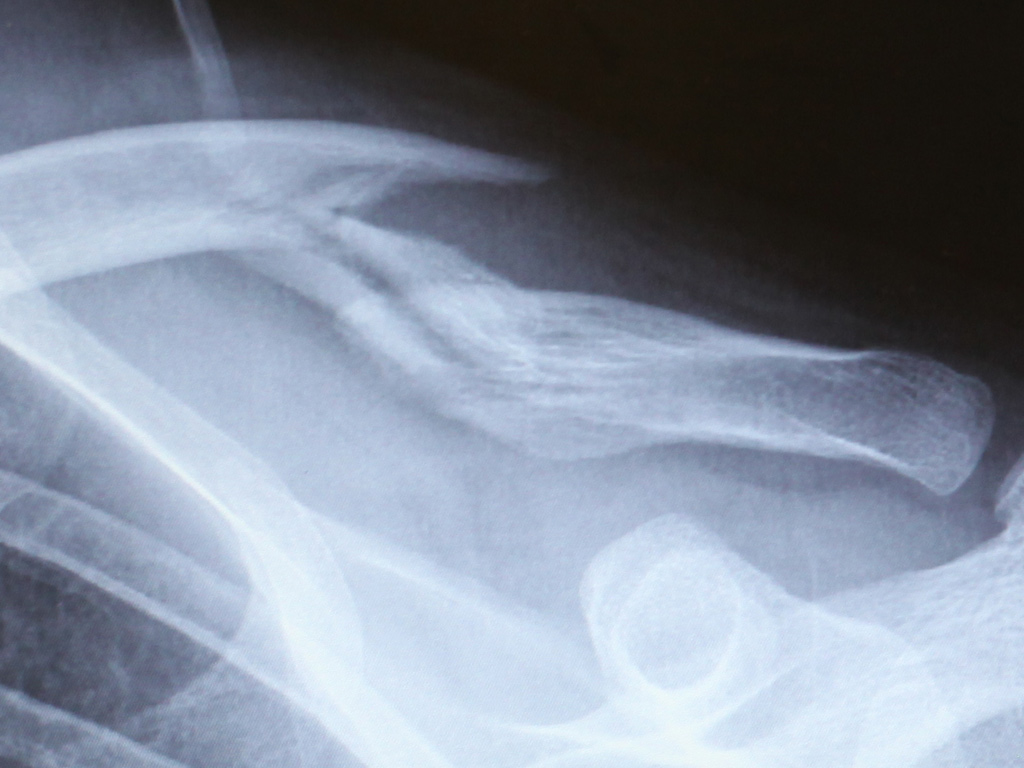
T+4 days
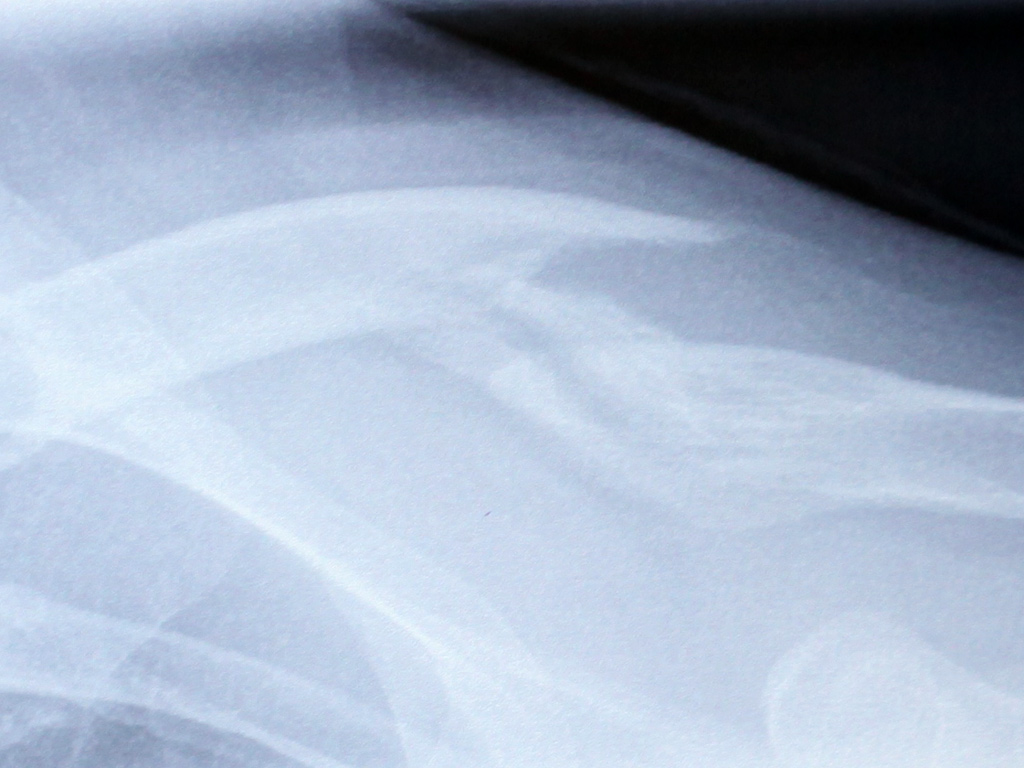
T+19 days
In three weeks, I will get another x-ray. I have been warned that I will need to avoid any intense physical activity for a further three months after that, meaning I will miss most of the summer cycling season.
[Update: 9 July 2010] Here is an x-ray from today, showing a bit more of the affected area. The biggest difference from the T+19 shot is the round area of bone forming underneath the fracture area. The doctor told me another should form later underneath that sharp protrusion:

T+40 days
[Update: 13 August 2010] Today, the doctor said they might eventually need to operate, to remove that sharp spike of bone. I am supposed to go back in three months for another x-ray.
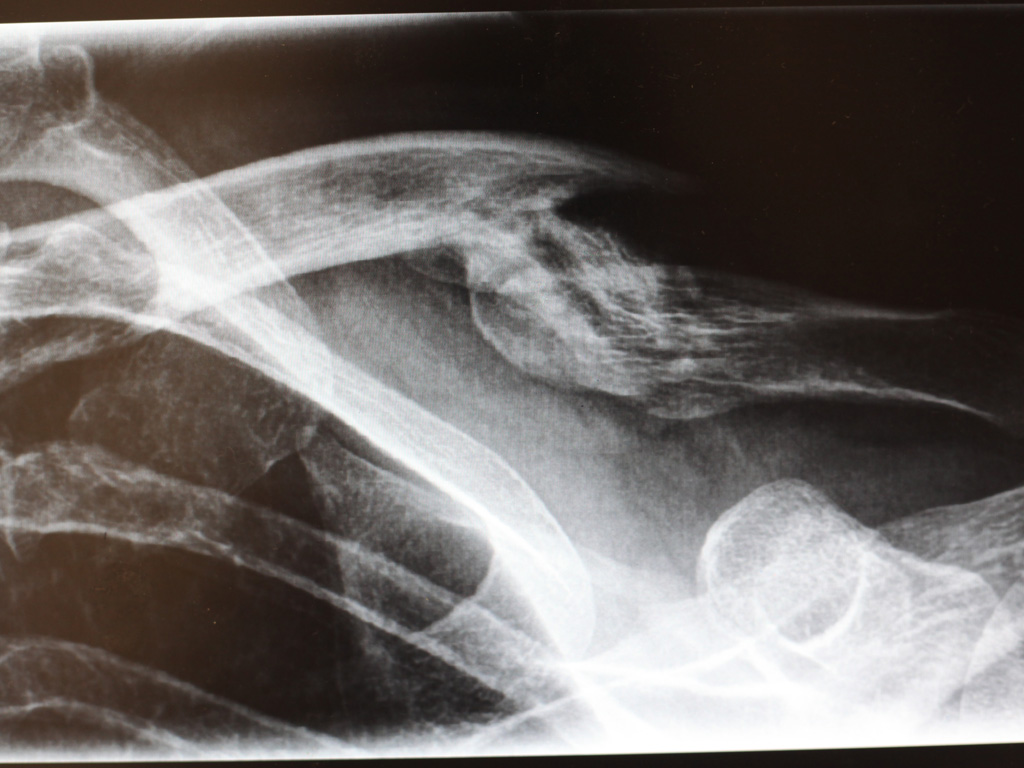
T+75 days
[Update: 24 November 2010] I told the doctor about how my shoulder has been aching a fair bit, since it started getting cold. He set me up with an appointment for some physiotherapy.

T+178 days
[Update: 2 March 2011] This will be the final x-ray in this series, as the doctor is now satisfied that things are healing properly. He told me the bone will still be remodelling itself for at least a year.
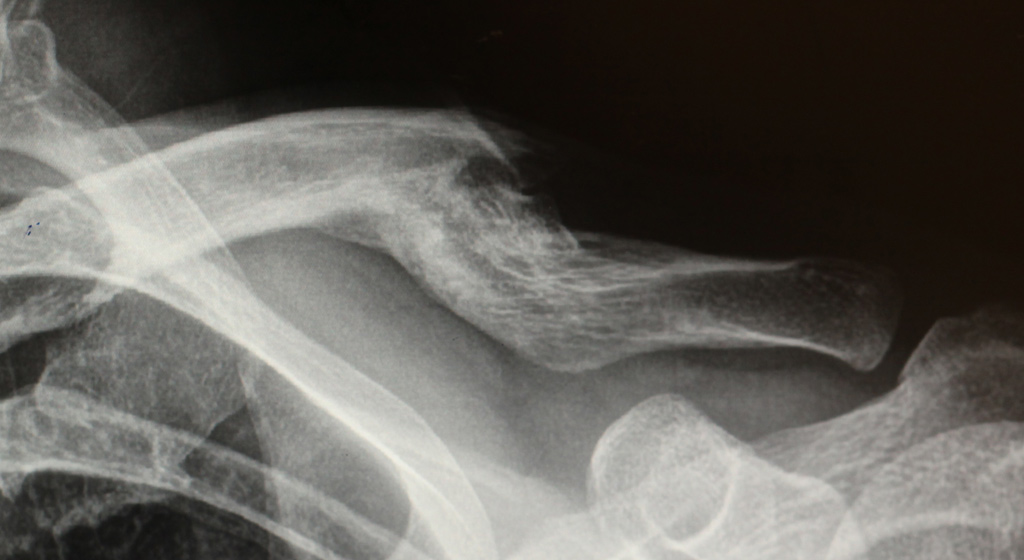
T+275 days

What’s it supposed to look like? It doesn’t exactly seem to look… connected.
Clavicle
From Wikipedia, the free encyclopedia
Oddly, I think seeing the x-rays today made my shoulder hurt a lot more than it did before.
It’s like my brain is saying: “Wow! That’s a real injury. I ought to be careful about how I move.”
Did the doctor mention if it’s healing as it’s supposed to be? When it’s healed, will it look more or less as it did before you broke it?
The emergency room doctors told me that I would be ‘permanently deformed.’ Thankfully, that just means a bit of a bump and some asymmetry.
Supposedly, the bone will actually be stronger after it heals than it was before.
It is apparently healing essentially as it should be. I hope that spike-shaped protrusion on the upper bone fragment goes away eventually.
I’m pretty sure I was biking within 3 months of breaking my collarbone. In fact, I think I was biking within 6 weeks, although carefully, not in traffic, & I was very aware that it wasn’t properly healed because it hurt when I put much weight on the arm. In my experience some doctors are much more cautious than others and there is a range of ‘we don’t advise this’ that goes from ‘really, really, really don’t do this – doom will follow!’ all the way to ‘well, I don’t recommend it, but if you do then I doubt anything bad will happen’. All in all, my guess is that it’s hard to know when you’ll be biking again without seeing how the collarbone does, how you feel about the potential risks, & how much your doctors advise against it.
Ouch!
That sharp part looks like it could be a future health risk. If you get hit in a certain way, it could be driven forward into your shoulder. Or it could break off and become a pointy disconnected fragment.
Have you considered an x-ray pinup calendar?
It’s amazing how much it’s changed in such a short time! I hope you continue to recover steadily.
-L.
I wonder if drew’s point from his break has gone away yet. It stayed relatively pointy for quite some time.
If you find out, please let me now.
Also, how long ago was it broken?
Hey I broke mine about a year ago playing football and its actually very similar to yours. Took me 5 months till I could even workout again. I broke it again my 1st game back this season. I have no clue why Ottawa doctors dont recommend any surgery… Im back in a sling just like i was before
Perhaps it is because of the cold, but my shoulder has been aching a lot lately.
I have more x-rays on Wednesday.
Plastic surgery
A newly developed material should make it easier to mend broken bones
MUCH of modern medicine is high-tech wizardry. Broken bones, however, are still dealt with in a clumsy, old-fashioned way that frequently involves screws, nails and pins. Even the simplest operation can result in infections and incomplete healing if those devices are not placed as they should be. In dramatic circumstances—for instance on a battlefield, where surgeons cannot use X-ray machines and there is no proper operating theatre—the need for so many bits and bobs can make effective surgery impossible. Thousands of soldiers fighting in Iraq and Afghanistan, for example, have had limbs amputated after injuries that could have been treated at any hospital.
It was with them in mind that DARPA, the research-funding agency of America’s Department of Defence, approached a group of scientists at the University of Texas, Houston, two years ago. DARPA wanted something that army doctors could carry in their bags and use to mend injured limbs on the spot, before amputation became inevitable. The researchers, led by Mauro Ferrari and Ennio Tasciotti (who have since moved to the Methodist Hospital Research Institute in the same city) came up with an idea that could change orthopaedic surgery once and for all: a material that surgeons can implant or even inject; which fixes a fractured bone quickly; and which then leads to its full regeneration, with no need for nails and pins.
The material in question, the product of a collaboration between biologists, nanoengineers and mathematicians, is based on a chemical called polypropylene fumarate. It is activated at 37°C, the temperature of the human body. When applied to a broken bone it solidifies and works like a glue, bringing the two parts of the fracture together. That is necessary, as any orthopaedic surgeon knows, because if a gap of more than a few millimetres is left between fragments the bone will never heal.
The key to success, says Dr Tasciotti, is timing. Stem cells must reach the site of the fracture, proliferate and turn into osteoblasts at the right moment. If they start to specialise too early, there will not be enough bone cells to heal the fracture. This is where the mathematicians of the group came in. Using computer simulations, they found the ideal thickness for the silicon spheres and the ideal size for their pores, so that the spheres degrade and release their content at the right rate. While this happens, the polypropylene fumarate becomes integrated with the body thanks to protein fragments called peptides placed on its surface. These make it look like human tissue and thus prevent its rejection by the patient’s own cells.
One lesson from cycling: pavement is dangerously hard.
i recently just broke my clavicle, its been six weeks i go to the doctors tuesday, but did it still hurt at six weeks? and the deformation of the bone on mine… i can still feel the bone thats broken. idk but it still feels broke
Thank you so much, these X-rays give me hope. I recently have broken mine, and it is not even touching. I don’t like the sound of surgery, so thank you thank you
i have a broken clavicle and i cant belive how much it is healing up
Hey, just wondering, at T+19, were your bones joined back together already? My fracture is similar to yours but I still see a little black area between the floater and the top piece.
I don’t exactly know. The x-rays are not three-dimensional, which makes it hard to be certain of when the bones fused. They did fuse at some point, clearly, but I couldn’t tell you when.
Are you experiencing pain from this collarbone injury?
I should say still experiencing pain two years later?
Hi my name is Carisa ayungua I am 13 I was drawn to this because I think it might of happened to me I was in 6th grade and a boy pushed me out of my char and I landed on my side right on my shoulder and I poped and it was hurting really bad I could not left my arm and I did not go to the hospital and I still haven’t and I also have a bump and it wasn’t there before so ya I thought you would like to know and if u know any way to stop the dull pain in it plz and thank you
Hey thanks mate, really helpful seeing this series of shots, seems like a bit of a mystery as have had 2 X-rays now and no great difference between them day one and 4 weeks hopefully 10 weeks will hold a positive change. (Road cycling accident, sprint finish went a bit wrong, fractured femur as well)
Hi,
I recently broke my clavicle, Aug 1 and hope you’ll please answer some questions for me. How well have you recovered from your broken clavicle? How does your current post-break range of motion and strength compare to your pre-break functioning. I understand you did not have any surgical intervention? If you didn’t have surgery, do you wish you would have had surgery? In the first x-ray it appears that there is at least a +2cm overlap of the broken ends of your clavicle: what is the measurement of the overlap of the broken end?
Hi there
Came across this blog when I was looking for comparisons to my own broken clavicle, so I could get an idea of how mine might be looking at different stages of healing.
I was just wondering if you wore a sling and for how long? I broke my collarbone 8 weeks ago and am still wearing a sling on doctor’s advice as a full union has not yet been formed. What advice were you given in terms of permissible activities and how to aid the healing process?
Doug,
How well have you recovered from your broken clavicle?
I don’t have a personal basis for comparison. I do have some chronic pain and find it uncomfortable to carry a lot of weight with that arm, or wear a heavy backpack strap on that shoulder.
How does your current post-break range of motion and strength compare to your pre-break functioning.
I think the strength is definitely somewhat less. The range of motion is the same, I think, but some positions are uncomfortable to place or hold my arm in.
If you didn’t have surgery, do you wish you would have had surgery?
I did not have surgery. From what I have read and heard, it’s not clear that there is a benefit from doing so that justifies the risks.
In the first x-ray it appears that there is at least a +2cm overlap of the broken ends of your clavicle: what is the measurement of the overlap of the broken end?
They never provided me with this data, and there is no scale on the x-rays to use for calibration. Just estimating myself, it seems like 2 cm of overlap is probably about right.
Andrew Cullen,
I was just wondering if you wore a sling and for how long?
I wore a basic cloth sling for eight weeks. Later, I did physiotherapy sessions with weight machines.
I was also given a large stretchy rubber band and told to do two exercises daily with it indefinitely.
Did you end up having the spike of bone shaved down? I have a pretty similar break to yours and a spike sticking forward. So annoying. It’s like it’s getting worse as the callous forms, it’s very sensitive. As of today, how is your spike, does it ever cause problems? Has it remodeled into a smoother surface? Thanks:)
The only treatment I ever got was wearing a sling for a few weeks after the accident, followed by more weeks of physiotherapy.
I don’t know if it’s because of the spike of bone or not, but I do experience chronic pain in my shoulder. It hurts a bit literally all the time, and easily becomes quite painful from carrying something heavy (like groceries) or wearing a backpack strap on top of that shoulder.
Hi there!
I’m wondering how age affects healing. I’m 48 and broke my clavicle similar to yours 2 months ago. Healing is slow! Do you mind sharing your age at the time of the accident? Thx!
26 years 6 months 2 days
Hi,
Do you still have pain now