WTO debate tomorrow

Tomorrow’s developing world class consists of a debate about the WTO. We were asked last week whether we believed, at an intuitive level, that the WTO was good on balance for developing countries or not. I put up my hand along with those who thought that the organization is imperfect, but slightly beneficial on balance. As such, I was assigned to argue the opposite position tomorrow.

The odd thing is that a week of reading all the reasons for which the WTO is a raw deal for the developing world has made me much more skeptical about my original position. I am not sure if that’s just the much-innoculated ability to make a good argument, or whether my personal position has actually changed. This may represent a reasoned change of opinion through learning, and it might just be a cognitive realignment based on an assigned social role. Either way, I will put up a link to my portion of the presentation, as well as the notes from the seminar, after class tomorrow.

Another school-related note: today’s thesis seminar presentation went better than expected. People seemed very keen on the idea in general, with the only real criticism being the need to focus things reasonably tightly. Hopefully, I will meet Dr. Hurrell about it soon.

[Update: 16 November 2006] Notes on our side of the debate are now on the wiki. So too are notes from the seminar itself. One more project down.

Paul Martin on economic governance

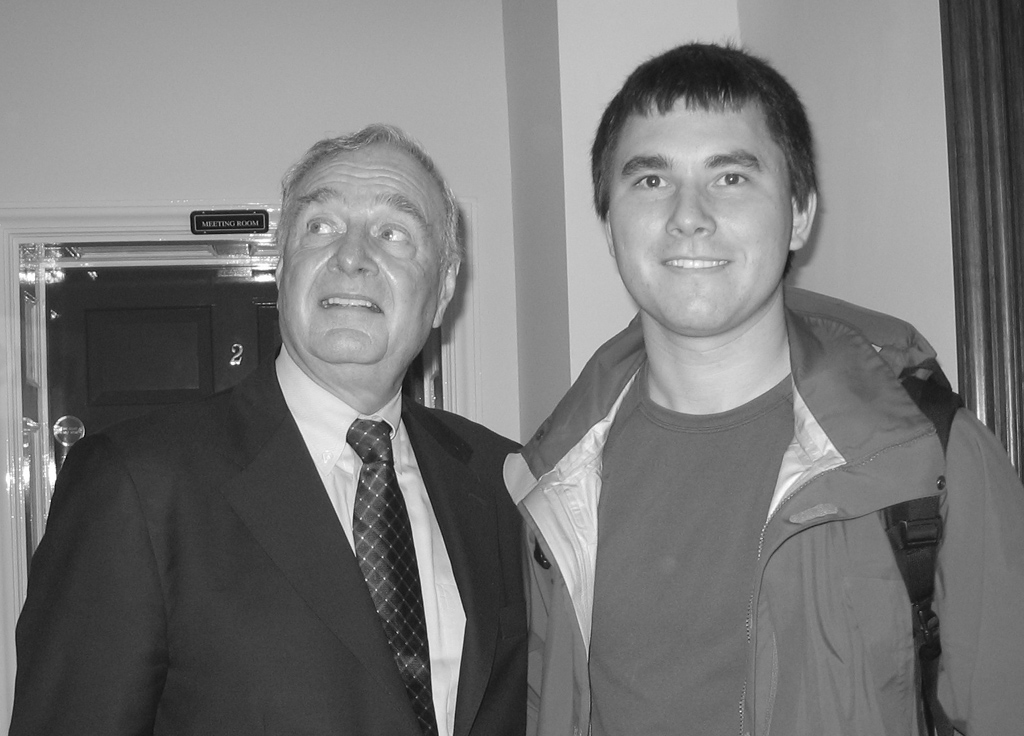
Paul Martin and Milan Ilnyckyj

Former Canadian Prime Minister Paul Martin’s talk was candid, informative and engaging. At a Global Economic Governance Program seminar, he covered a very diverse collection of issues: from China’s hunger for natural resources to the regulation of multinational corporations. I have never seen the room so packed, and the questions were excellent. He managed to get some good laughs, as well. In response to my question about climate change, he said, in part:

“Climate change has long since been recognized as caused by human activity principally.

The net effect is going to be devastating.

Prince Edward Island will disappear; Toronto won’t. That’s a disaster on both sides

That would make a great headline back home, wouldn’t it?”

Generally, he was very open, but there were certainly a few notable questions ducked. He declined to endorse a candidate for the Liberal leadership race when asked, for instance. People should feel free to have a look at my transcript, in which I have tried to quote directly wherever I could type fast enough.

PS. As today’s photo demonstrates, there is a downside to having a camera that takes 2-3 seconds to charge and fire its flash.

Far from entertaining

Orange flowers

I was going to write something tonight about international law, but the present craziness of things has extinguished my desire to do so. An ongoing dispute with my college is especially sapping, as far as energy goes, and I need to conserve and enhance what fraction remains for the presentation and reading tomorrow. The porters, butler, and I have progressed into a weird realm of overlapping denials. I maintain that mine are entirely truthful, but we have reached the point where nobody can withdraw a claim without losing face. Hopefully, the whole thing will sink below the waves in a short while.

In exchange for not providing something interesting to read, perhaps I can provide something useful. As I explained earlier, as part of an extensive thesis-related analogy, the best way to photograph cats or human babies is to set up all your equipment, make all necessary adjustments, and then snap your fingers above the lens, a moment before you hit the shutter. Creatures of the sorts described will look at the source of the sound, intuitively. If only the attention of the rampaging beast that is my thesis topic could be focused so easily…

Thesis presentation tomorrow

I have come up with a draft handout for my thesis presentation tomorrow. I still don’t feel entirely confident about the the content. I know the general neighbourhood in which the thesis lives, but I am not yet sure of exactly how I am going to organize it and deal with it all. I’ve never had to write something longer than 6,000 words before, with the exception of a few long but decidedly non-academic letters.

Partly, I just don’t feel like I have read enough of what’s out there. It can be quite hard to do, when there is everything from a job search to seminar readings to papers that must be written pressing more urgently at my waking hours.

I have an evolving thesis timeline online, as well as an increasingly outdated thesis outline. The latter will get a facelift on the basis of the comments I receive in seminar tomorrow.

Thesis flowchart: data to action

One thing the thesis should definitely include is flowcharts. They make it easier to disentangle what is going on in complex relationships, both by clearly showing what phenomena are connected, and by suggesting the direction(s) in which causality runs. Here is one that I came up with, regarding the relationship between personal consensus (the position a person reaches after having thought a question through and reached an answer that satisfies them internally) and group consensus:
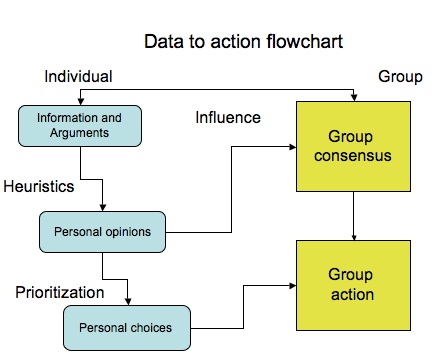
Data to action flowchart

The starting point is the data presented to the individual. This consists both of empirically observed phenomena and of representations of truth made by others. There is an internal dynamic here. For instance, a person who has been reading a lot about global warming might be prejudiced towards interpreting an unusually hot summer in their part of the world as evidence for that trend. This is partly captured in the two-way arrow with group consensus, but it is also a matter of internal cognition.

Both empirical data and arguments (both logical and those based on other kinds of rationality) are transformed into personal opinions through the applications of heuristics. Examples of heuristic reasoning devices include:

  1. Conceptions about which individuals and groups provide trustworthy information
  2. Conceptions about what kind of evidence is strong or weak (for instance, opinions on the use of statistics or anecdotes)
  3. Particular facts that are so thoroughly believed that they become a touchstone against which other possibilities are rejected

This is not a comprehensive listing, but it gives an idea of the kind of mechanisms within a single person that are at work when forming opinions.

The link from personal opinions to personal choices is not a simple linear one. A second category of heuristics exist that do not determine what is considered true. Instead, they determine which opinions are important; specifically, they determine which opinions are important enough to deserve action.

Two major types of personal choices are represented in this model. Those in the box ‘personal choices’ could be called direct actions. This would include something like buying a hybrid car or boycotting a company. Within the arrow between personal opinions and group consensus lies the other kind of action: namely advocacy actions, in which an individual tries to convince other individuals or groups to adopt the same position the original individual has already reached. That feeds into the “information and arguments” boxes for other people, as well as contributing to the group phenomenon of consensus.

Group action is thus both the sum of personal choices, and the product of public deliberation leading to institutional or societal choices. Here again, a process of prioritization takes place.

An adapted version of this diagram could be constructed for scientists and for non-scientists. The biggest difference would be that scientists can engage in a broader project of empirical examination, thus contributing in a different way to the information and arguments being presented to others. They may well also employ different kinds of heuristics, when forming personal choices.

Carbon offsets

Bug on a flower

Cycling home with a £5 quarter-kilo of Fair Trade coffee, I found myself thinking about carbon offsets. These are financial instruments in which an individual or group pays someone else to reduce the carbon emissions they would otherwise have produced, so as to offset the buying individuals own carbon emissions. Al Gore used them to make the production of An Inconvenient Truth carbon neutral. They were also used by The Economist to make their Survey on Climate Change (Subscription required) carbon neutral. At the end of the opening article, they explain:

This survey, which generated about 118 tonnes of carbon dioxide from flights, car journeys, paper production, printing and distribution, has been carbon-neutralised through the Carbon Neutral Company. The cost was £590; the money was spent on capturing methane from an American mine.

According to the calculator at climatecrisis.org (the site set up by Al Gore to accompany his book and film), my annual carbon emissions are about 1.6 tons, including two trans-Atlantic flights a year. Not having a car and living in a shared dwelling makes a big difference, even if all our power is coming from the huge coal plant at Didcot.

At the rate The Economist paid, I could offset that for £8. It might be a worthwhile thing to include in my thesis. My only problem with it all is that it is hard to tell which of the many websites that sell offsets actually provide what they claim. There has been a kerfuffle recently about dodgy wind power cards. Does anyone know of a reputable place where I can offset those 1600 kilos of carbon? This site looks like a possibility.

Obviously, paying for the offsetting of your own carbon isn’t an adequate response to the issue of climate change (any more than buying Fair Trade coffee is an adequate response to global poverty), but it couldn’t hurt. It is also a potentially useful demonstration of how seriously you take the problem

[Update: 5:00pm] According to the company The Economist used, one round-trip flight from London to Vancouver generates 1.7 tonnes of CO2. As such, it would seem appropriate to offset at least four or five tonnes a year, to cover electricity, heating (however St. Antony’s does it), and travel.

Wadham Queer Bop

The infamous Wadham College Queer Bop is coming up this Saturday. Tickets go on sale today, and cost £8. My experiences last time were mixed: it is certainly not the progressive and politically aware event that is has sometimes been misrepresented as. Rather, it is mostly a large group of drunk undergraduates, out in the cold (or in a big tent) while wearing unusual costumes. The weather forecast predicts a low of four degrees for Saturday: a possibility that people may want to take into account when selecting their attire.

My two entries about it from last year are here: early, late. Some of my photos from last year are on Facebook.

All that said, it is basically the event for which Wadham College is most famous. It doesn’t cost anything to me, and it offers some unique photographic opportunities. I will drop in for at least a little while.

[Update: 20 November 2006] My entries about the 2006 Queer bop are here: short Queer Bop 2006 entry / long Queer Bop 2006 entry.

Photo modification, and tasks ongoing

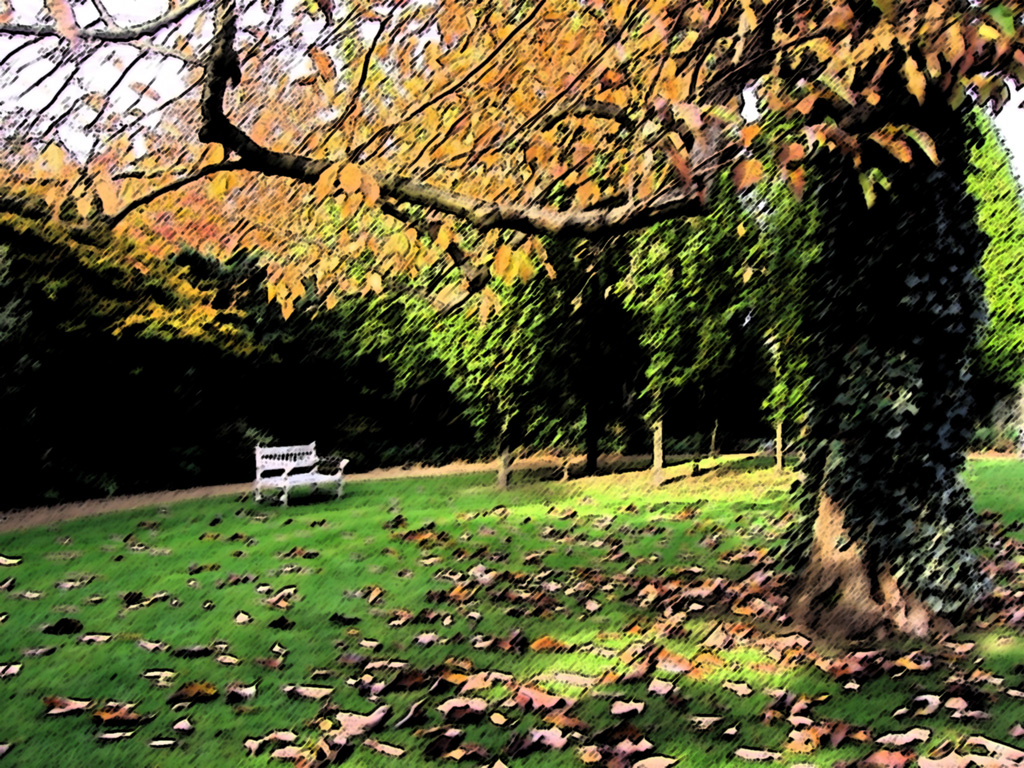
Wadham College garden, with sumi-e applied

Modified photos of the day

What do people think of the modified photos I have been posting recently? (One, two, three, four, five.) In basically all cases, they have a single Photoshop filter applied, along with some contrast, levels, hue, and sharpness adjustments. I like them because they look good, and they provide a bit of variety. Unlike a film camera, where you can change the look of your photos enormously by using different stock, you are stuck with the characteristics of the digital sensor you have. Even as those become familiar, they begin to feel like constraints.

One thing that seems to be true about photos is that they often contain too much information; just as black and white can be a good way to force attention towards texture and composition, it seems like a lot of shots can be more interesting when elements of their geometry and colouration are highlighted.

That said, if people don’t like such modifications, I can certainly go back to showing straight versions all the time. Unmodified versions of all of these shots can be found on Facebook, as I do not take the time to adjust anything that goes online there.

Ongoing tasks

There is a great deal to be done at the moment:

  1. I need to write two essays for the Developing World seminar, presumably before I go to Turkey with my father.
  2. to prepare for that trip: finding out at least a tiny bit about the country and what to see in it.
  3. to prepare a group debate for this coming Thursday, as well as do the normal readings for that class.
  4. to push a batch of student loan paperwork through the bureaucratic edifices of the college.
  5. read two thesis-related books, three long thesis-related articles, and a thesis related thesis: soon
  6. pay a hefty chunk of backdated rent from this summer
  7. prepare a fifteen minute thesis presentation for this Wednesday
  8. come up with something to do for my birthday on or around the 28th of November (probably around, as there is OUSSG that night)
  9. continue seeking a job for next year
  10. write a first chapter for the thesis?

The collection is a daunting one; hence, the importance of developing and maintaining motivation. This is something that my flatmate Alex seems to have no trouble with – one of the reasons for which he often seems such a likable but incomprehensible creature.

Thesis case studies, justification for

The Stockholm Convention on Persistent Organic Pollutants and the Kyoto Protocol are both attempts at a multilateral solution to a previously unknown transboundary environmental problem. The reasons for which these case studies are useful for accessing fundamental questions about the science-policy relationship are several:

  1. Each agreement addresses an environmental problem that only recently became known.
  2. Each deals with a problem that is essentially transboundary, and requires concerted effort to resolve.
  3. Each involves scientific uncertainty, both about the material effects of the problem in the world and about the different characteristics of possible approaches for dealing with it.
  4. Each involves normative and distributional issues, with regards to groups that benefit or are harmed by the application of the agreement.

As such, each represents the outcome of a dialogue between stakeholders and experts. The former group is concerned with securing their interests, or those of their principles, such as they are understood at the time of interaction. The basis upon which this group operates is that of legitimacy: either implicitly held among those representing themselves, or transferred through a process, agreement, or institution to a representative whose legitimacy is premised upon advocacy.

The latter group is concerned with the generation and evaluation of data. Understood broadly here, ‘data’ are claims about the ontological nature of the world. This includes claims that are rigorously verifiable (such as those about the medical effects of certain pollutants) as well as those involving considerable interpretation (such as the meaning of international law).

The groups are not mutually exclusive, and many individuals and organizations played an overlapping role in the development of the agreements. Through the examination of these two case studies, as well as related matters, this thesis will engage with the interconnections between expertise and legitimacy in global environmental policy making, with a focus on agreements in areas with extensive normative ramifications.

Development, equity, and the WTO

My opinion of the World Trade Organization has probably shifted more than that for any other international institution, during the course of university study. The conception of the WTO as some sort of monolithic and powerful body, forcing countries to do things against their will does not seem like an accurate one. Where such pressures do exist, they are more parallel to the WTO (caused and driven by the preferences of member states) than self-arising from within. The inability of the WTO to enforce its rulings on trade – save through the highly problematic vehicle of allowing the country sinned against to raise its own tariffs – seems to underscore how weak the organization really is.

Naturally, all of the above assumes that free trade is generally a good thing. While there are undeniably problems – some of which can be well expressed using an economic framework of analysis – there are myriad advantages to global economic integration. Globalization needs to be modified so as to operate better as a process that aids in poverty reduction; likewise, it needs to become more environmentally balanced. With the Doha Round utterly stalled it isn’t clear how the WTO could contribute to either aim, a reasonable case can be made that it is at least not worsening either. A rules-based system like the WTO seems to hold out at least the possibility of a more just relationship between rich and powerful states and those that are poor. While the system is highly imperfect in practice, it does seem to have a small net positive effect.

All that said, since I need to argue that the WTO is a bad thing for developing countries this Thursday, I should start looking at the most eloquent and well defended expressions of the the position.

People interested in economic issues should have a look at Trade Diversion: a blog run by Jonathan Dingel, an M.Phil student in economics.