Foregoing WEP and WPA

Bruce Schneier, the security guru and internet sensation, has been suggesting that people unlock their wireless networks. Given the constant and well-justified anxiety that exists about computer security, it is unconventional advice. That said, he argues effectively that the risks are fairly limited and that it is a neighbourly thing to do. Who hasn’t benefitted once or twice from the availability of an open wireless network? They were invaluable during my early weeks in Ottawa: allowing me to access Craiglist, Google Maps, and other vital apartment-hunting data while I was out there searching.

I am going to try leaving my wireless network open for a couple of weeks. If it doesn’t seem likely to burst my 200GB monthly bandwidth cap, I will leave it that way indefinitely. Hopefully, it will transpire that others have done the same when I start hunting around for a quieter flat in a more interesting neighbourhood this spring.

Carbon constrained travel

Jennifer Ellan and a yellow wall

Pondering the era of post-air travel tourism, I have been thinking about places to visit by train. There are actually quite a lot of appealing prospects:

  • Halifax: see the Maritimes for the first time, and perhaps Caity Sackeroff as well
  • Boston: visit Iason, Sheena, Loretta, and perhaps Claire
  • New York: re-visit the city five years after my first foray
  • Bennington, Vermont: visit family

Have any readers undertaken the exploration of North America’s east coast using ground-based means? Are trains generally much more expensive than buses? How do they compare, in terms of speed?

The moral unacceptability of air travel has also left me thinking more seriously about the kind of grand backpacking tours that were more common when long-haul flights were ruinously expensive. The most ambitious possibility – flitting around at the edges of imagination – is to travel by ground all the way from London to Hong Kong, seeing as much as possible between the two. Emitting a couple of tonnes of carbon, in the form of flights across the Atlantic, would be a lot more ethically acceptable than undertaking multiple hops. Of course, a truly conscientous traveler would emulate a friend of a friend of mine and book passage across on a container ship.

More Diebold problems

The myriad problems of electronic voting machines have been mentioned here before. Given that 80% of electoral districts in New Hampshire use electronic voting machines – and ones made by the infamous Diebold, at that – it’s not surprising that talk of fraud is circulating in relation to the latest primary. Some commenters are arguing that: “In machine counted precincts, Clinton beat Obama by almost 5%. In hand counted precincts, Obama beat Clinton by over 4%, which closely matches the scientific polls that were conducted leading up to the election” and alleging that this proves either unintentional bugs in the voting system or fraud.

The issue is less the outcome of that particular contest and more the way in which electronic voting machines diminish the perceived validity of elections. Given how they have been proven insecure again and again, and given how straightforward and manageable counting paper ballots is, there really isn’t much reason for anyone to use these machines. Hopefully, the world will finally figure this out soon.

Related prior posts:

Fiction, non-fiction, and memory

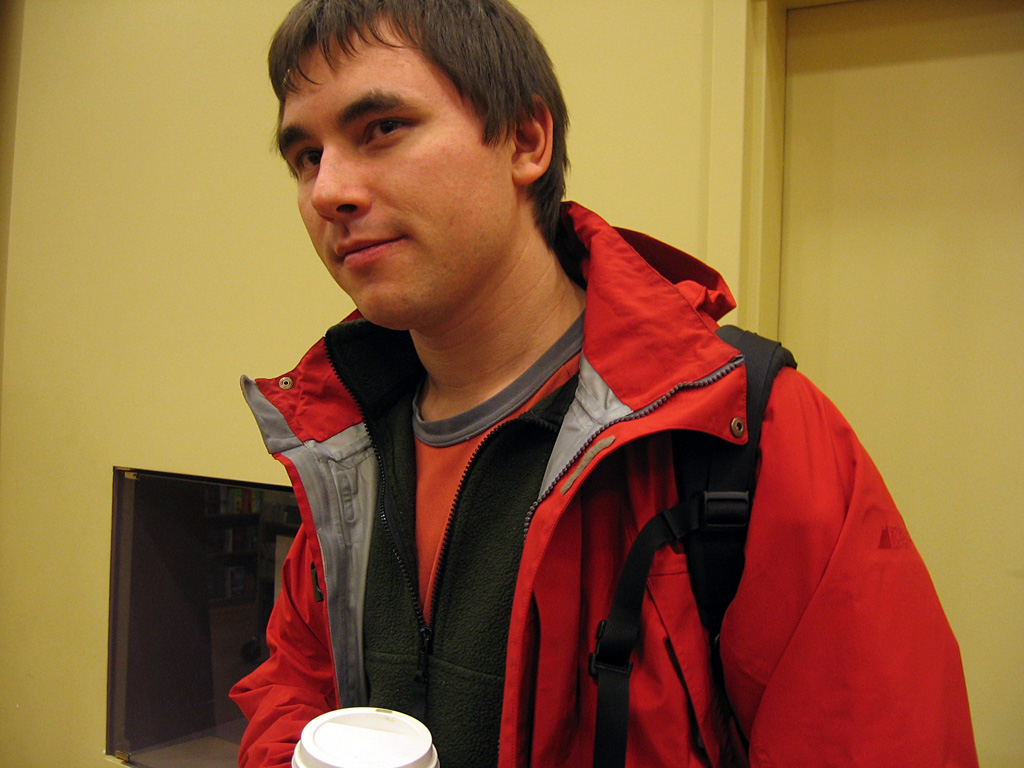
Milan Ilnyckyj in a red coat

I have a new theory about why I do so much better with non-fiction than with fiction. It has to do with the way I read and the relationship between reading and kinds of memory. There has probably been no point in the last decade in which I was reading only one book at a time. At present, I am reading thirteen. It is routine for me to leave a partially completed book for weeks or months, while engaging with something more immediately interesting or urgent.

With non-fiction, every sentence and chapter you read gets integrated into your general schema of knowledge on the topic in question. You can read one chapter on cryptography or ice core sampling or the life of Voltaire and it will henceforth be stored along with related thoughts and memories in a general databank of knowledge. Admittedly, the databank is full of rats that chew their way through ideas long left uncontemplated. The point is that there is a single and relatively well ordered web of knowledge in one’s general library.

Fiction, by contrast, demands the recollection of a lot of specific facts in an organized way. You need to remember the world of that book or story: a world potentially very distinct from the ‘general world’ about which non-fiction knowledge is collected. Remembering characters, world characteristics, relationships, and plot points all calls upon us to treat a fictional universe with a similar kind of importance to the real universe. While this is simple enough when reading a single book at a time, it does not fit very well into a reading pattern based on reading many books in parallel, sometimes abandoning any particular one of them for months at a time.

1024 by 768 does not a pretty 4 x 6 make

Partly because of concerns about archiving digital files in the long term, I am hoping to make prints from some of my digital files. Unfortunately, there is an issue of aspect ratios. My digital photos all have an aspect ratio of 4:3 – different from those used for 4 x 6″, 5 x 7″, and 8 x 10″ photographic prints. I don’t especially want black bands on two sides of each image, and I definitely don’t want them arbitrarily cropped.

Is there anywhere online where I can order digital prints on photographic paper in native digital resolution? Albums capable of holding prints with that aspect ratio would also be required. The alternative – manually cropping hundreds of photos to minimize the unwanted aesthetic effects of switching to the 4 x 6″ format – is something I only want to do as a last resort.

Regression to the mean

Emily Horn at Canada Place

All manner of diets, supplements, and vitamins compete for customers and adherents. Given that we are creatures of biochemistry, it is plausible that such chemicals will have effects on human health. Unfortunately, they do not act alone, but rather within a complex web of interactions: genes, environmental effects, physiological changes, etc, etc, etc. This makes it exceedingly difficult to isolate and prove the effect of any particular substance, especially given that the effect in different people, or the same person at different times, may differ.

The phenomenon of regression to the mean is especially confounding when it comes to individuals. We do not generally change our regimen of diet or supplements unless we perceive something to be wrong. We take vitamins when we feel ill, and analgesics when we have a headache. Given that both illness and headaches tend to rise to a peak and then taper off naturally, virtually any action we take in response will precede an improvement. It doesn’t matter if you spend a pile of money on remedies, spend your time praying, or simply sit still and wait for improvement. Regression to the mean is the product of basic statistical mathematics and isn’t caused by anything chemical or biological. It is tautological to say that things are normally like the mean and that, most of the time, situations far away from the mean will be replaced by those closer to it. While it is true that we can do things likely to shorten or lengthen the period of illness or discomfort, it is virtually impossible for an individual to know whether such an effect has occurred. Did taking those vitamins shorten or lengthen the cold? Did it have no effect? What about those glasses of red wine?

The only sensible course of action is to essentially disregard our own experiences, except in such cases where there is both a reasonably large body of evidence (ideally in the form of a large number of double-blind and controlled trials) and there is a plausible explanation for the method of action. Failure to employ such checks against hasty false reasoning leave us vulnerable to the pernicious human tendency to see causal relationships everywhere, without the scepticism that is critical in separating conjecture from an investigated hypothesis.

A query for any lurking physicists

I was having a conversation this afternoon about the Tunguska event: a huge explosion that occurred in Russia in 1908. I had always heard that it was caused by a meteor impact, though apparently some other explanations have also been considered. One that I just heard about is the possibility that it was caused by a collision between the earth and some antimatter.

Wikipedia suggests that this explanation isn’t credible, but it does leave me wondering: in the event of a collision between a particle of matter and a particle of antimatter, where the two particles are traveling at different velocities in opposite directions, how does the net momentum of the two translate in their annihilation? If antimatter did hit the earth, it would start to strike particles of matter in the upper atmosphere, the particle pairs would annihilate one another, and energy would be released. Would all that happen before the antimatter hit the ground? Presumably, it would strike its mass in antimatter before then. If so, what would the effect on the surface of the planet be?

Conservation of energy dictates that the kinetic energy in the faster particle would need to go somewhere. Presumably, it would manifest in the production of more energy during the annihilation event. As such, I suspect the antimatter clump would get blasted apart in the upper atmosphere and produce some kind of horrible shower of radiation, though nothing in the way of direct physical debris.

Love and Hydrogen

Bubble blowing graffiti, Vancouver

The twenty-two stories in Jim Shepard’s Love and Hydrogen cover a lot of ground: from gay love aboard the Hindenburg to Dutch soccer to a first-person narrative written by the Creature from the Black Lagoon. While a common style and repeated themes connect the collection, a great deal of effort is demonstrated in creating a rich scenario for each. I appreciated the degree to which each story felt like an initiation into a new area of knowledge, while also feeling united by a kind of unfathomable emotional edge – intentionally vague and melancholic.

Shepard clearly likes disasters, dysfunctional families, aviation, and monster-style early science fiction. The prevalence of the latter theme makes the book feel older than it is: as though it was written in the age of drive-in movies rather than as a response to it, about five decades later. The whole collection has strong overtones of post-war America, though with violence as a near-constant theme.

The sports stories elicited much the same reaction in me as the sports themselves: soccer interesting, football brutal, and baseball hokey with an American twang. Among the aviation stories, the one describing the experience of German trainee pilots with the infamous Messerschmitt Me 163 “Komet” was perhaps the most compelling. I can see why the vehicle appealed to Shepard; as the first rocket-powered manned fighter, with corrosive fuel and no landing gear, it was an incredibly perilous thing to fly. That particular story resonated nicely with the recently completed Why the Allies Won, both touching upon the theme of Germany pushing technology forward, but often doing so in ways that were not tactically or strategically useful.

Shepard has a talent for simple yet powerful statements. In a story about the first bathysphere, the narrator notes calmly that he “passed the point below which only dead men had sunk.” In a story written from the perspective of John Entwistle, the bass player in The Who, the narrator remarks that: “Rage in the service of self-pity was what we’d always been about. It was what rock had always been about.” Similar elegant tidbits are sprinkled through the volume – counterpointing descriptive passages that sometimes come off as an evocative but elusive tangle of words. I found myself getting particularly lost in some of the dysfunctional family narratives – most of my mind warning that “this isn’t something we want to wander into.”

Having the daring to write the supposed thoughts of contemporary figures is an impressive if somewhat off-putting characteristic. “John Ashcroft: More Important Things than Me” is probably the most elusive story in the collection. It is written as a collection of aphorisms, focusing on Ashcroft’s personal convictions and life experiences. I don’t know to what extent it faithfully reproduces the life or views of the controversial figure, but – as a story – it remains quite opaque in its motivations. In a sense, it is a humanizing text, seemingly contributing to a more balanced understanding of the public figure. At the same time, it leaves the reader suspicious: both the supposed author (Ashcroft himself) and the actual author are presumably trying to forward a political agenda or perpetuate some sort of satire or criticism. As it stands, it remains unclear what either message is meant to be.

Overall, the collection is the kind of literary work where you are constantly thinking “I will understand this better the second time around.” Given the quality of the stories, it is plausible that this will be one of the few books that actually earns a second reading.


Advertising over-fishing

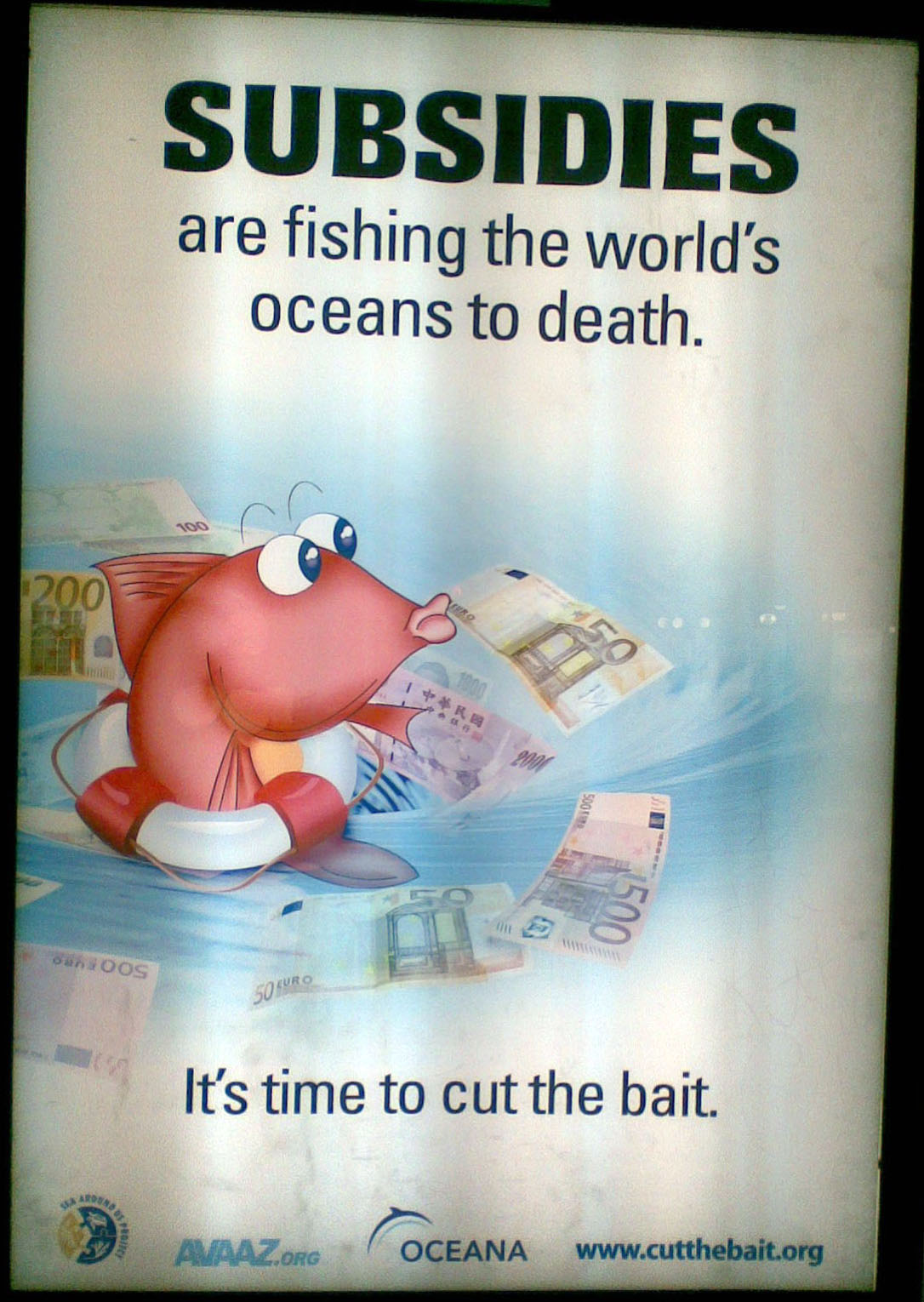
This evening, I was surprised to happen across a billboard advertisement condemning fisheries subsidies. It declared that: “Subsidies are fishing the world’s oceans to death” and “It’s time to cut the bait.” The sentiment is an accurate one, particularly when it comes to the operation of the subsidized fleets of the developed world in the waters of developing states. Still, it was interesting to see a public display about a subject that is of considerable interest to me, but seemingly ignored by most of the population. You do see a bit of lobbying through advertising in Ottawa; for instance, there are piles of backlit signs personally thanking Prime Minister Harper for supporting ethanol and biodiesel. It was good to see something advocating the protection of a common resource, rather than seeking rents for private enterprises.

I was curious who would be behind such an advertising campaign, but then I noticed the logo of the Sea Around Us Project at the bottom. They have been mentioned here fairly frequently before and do good work. Shifting Baselines – a favourite blog of mine – is run by a doctoral student associated with the project.

[Update: 13 January 2007] I finally got around to uploading the low quality photo of the ad I took on my phone.