Patchwork rules and industry strategy

In many states, a disjoint can be seen between action being taken on climate change at the state or provincial level and inaction at the federal level. Some people argue that such approaches are fundamentally inefficient because they increase uncertainty and the cost of compliance. While this is true in a static sense, it ignores an important element of game theory. Generally, the moment at which it becomes possible to effectively regulate an environmental problem is the moment when industry decides that some form of regulation is inevitable. It then switches its attention from lobbying for total inaction to lobbying for the kind of regulatory regime that suits business best: something as large-scale as possible, with long enough time horizons to guide investment decisions.

This is certainly the pattern that was observed with ozone depletion. Industry went from saying: “There’s no problem” to saying: “There’ a bit of a problem, but it would bankrupt us to fix” to realizing that regulation was inevitable, lobbying for a kind that suited them, and developing superior alternatives to CFCs within a year.

As such, it is entirely possible that grumbling about a “patchwork of regional approaches” signals the approach of an inflection point, beyond which effective regulation and large-scale industry and consumer adaptation occurs.

Killing animals to save them

Nick’s dog Molly

The Inuit Tapiriit of Canada are protesting attempts in the United States to have polar bears designated as an endangered species. They argue that the bears are being killed in sustainable numbers, that a listing in the United States would cut off the supply of hunters, and that such hunting provides vital economic stimulus within their communities. Apparently, the total population of polar bears is estimated at 25,000. Between the summers of 2006 and 2007, 498 bears were killed – 120 of those by commercial hunters who paid about $30,000 for the right to do so. They also hired guides and purchased goods and services within native communities.

The situation raises a number of moral questions. The most obvious is whether it is ethical or prudent to fund conservation efforts through hunting. Unsurprisingly, The Economist says yes, at least for African game. It does make sense to say that ensuring conservation of nature depends on making such conservation in the interests of those who live in the region. After all, they are the only ones with a sustainable capacity for enforcement.

The polar bear may also be a special case. It is estimated that melting sea ice could slash their numbers by two thirds or more by 2050. In response to that, it is possible to argue that saving as many as possible from hunting is justified; it could also be argued that we may as well hunt them, since they are doomed anyhow.

The particular case of polar bears is probably not especially important. Barring dramatic and sudden shifts in the climate policy of most states, it seems unlikely that more than a handful will survive the coming Arctic melt. It is entirely conceivable that all Arctic summer ice will be gone in a few decades and that the bears will only survive in zoos, and possibly by shifting to a new habitat and food supply. The effect those changes will have upon the Inuit are difficult to over-state.

A more general moral question raised by all of this is: “To whom do species belong?” Legally, they belong to the states in which they are found. At the same time, it is part of international law that states are not permitted to take actions that impose ecological costs on other states. Clearly, Brazil or Indonesia burning or cutting down their rainforests has such an effect. The situation is less clear when it is a locally important ecosystem or a single species being considered. Do people in India or France have a right to the existence of polar bears? Is it part of the collective of nature, within which we are all trustees?

It does seem as though there is a certain force to that argument, and a parallel obligation on the part of states not to destroy elements of their natural legacy. Of course, a strong case can be made that allowing hunting to pay for conservation serves rather than violates this principle. Such are the kinds of questions that need to be hashed out within international law and politics as the clash between a notion of state sovereignty predicated on non-interference clashes with the nature of a world as interconnected and full of humans as ours is.

Democracy as constraint

One common view of the nature of democracy is a system wherein a populace seeks to advance the common interest, either through direct participation in decision-making that affects everyone or through the election of representatives to do so. This view posits the existence of a universal interest that is beyond the sum of individual interests; the aim of government is to help to pull the reality of life closer to the kind of life that would be established through the realization of that universal good.

One major problem with this view is the possibility that, with a few exceptions, no such universal interest exists. We have a universal interest in not being exterminated, but it’s not clear that there is any such thing in the realm of social policy. An alternative view of the nature of democracy highlights its procedural characteristics, two of which I consider to be the most important: the division of power and oversight.

Democracy, viewed in this way, is a system of rules designed to limit the collection and arbitrary usage of power by individuals and groups. It recognizes the fundamental difficulty of this struggle, derived from the way in which most people given the opportunity to rule will try to use that power to perpetuate their influence. It likewise recognizes that authority in the absence of oversight leads inevitably to abuse, whether by corrupt politicians, unaccountable police, or an unconstrained army. The most important institutions within a democracy, then, are things like the rule of law, courts, regulatory bodies, a free press, and elections. The last of these serve less to select a group of representatives who have the right ideas about the universal good and more to rotate people often enough that they cannot escape the shackles that democracy is meant to impose upon them. When rulers do wriggle out of those bonds, the results are corruption, incompetence, and tyranny.

A procedural view of democracy does not assume the existence of a universal good – it just acknowledges that people have life projects of their own and, unconstrained, most are happy to trample all over the plans of others. The basic idea derives from the expression: “My right to swing my fist ends where your nose begins.” Unfortunately, plenty of people are happy to swing regardless. Only by constraining individuals in some ways – especially those in positions of power – can we have any hope of living our lives unmolested.

What, then, of social programs and all the efforts government makes to cajole and convince the populace of things? It is certainly possible that such cajoling can serve worthwhile ends, such as making people aware of previously unknown dangers. It can also serve far less universal ends: the promotion of the interests of one group through a devious appeal to a universal good. Arguably, much of politics is jostling between groups with narrow interests, seeking both to gain access to power and represent their personal interests as universal. This is exactly the kind of conduct a procedural democracy is meant to check: marrying empowerment within the sphere of individual agency with constraint in realms of inappropriate interference.

I am not willing to wholly disregard the possibility that democracies can develop projects based on the universal good, and perhaps even carry them out more effectively than other systems of government. What I am arguing is that such endeavours are a potentially valuable benefit of democracy, rather than its foundational justification. The aim is less to achieve the ‘best’ – a mode of thinking perhaps best suited to fascist states – but to moderate and avoid the worst. As such, when we abandon the principles of oversight and divided power, whether out of ambition or fear, we sacrifice a critical aspect of what it means to live in a democratic society.


E. Coli and the acid rumen

Fork and spoon on salad

This blog has previously considered the relationship between antibiotic resistant bacteria and factory farming. Recently, I learned about another way in which industrial meat production is breeding microbes that kill humans all the more efficiently. This one has to do with the acidity of our stomachs, one of the ways in which our bodies protect themselves from microorganisms living in the food we eat.

A cow living on a diet of grass has a rumen with a neutral pH. The rumen is the ‘first stomach’ of grass eating animals. Inside, bacteria help to ferment undigestible grass into material the cow’s body can process. Along with these digestive bacteria, many other kinds are present. One sort – Escherichia coli – kills humans by releasing toxins that destroy the kidneys. ‘Normal’ E. Coli, of the sort found in cows since the 1980s, cannot tolerate an acidic environment. As such, our stomachs are pretty good at killing it and thus keeping it from killing us.

A cow in a factory farm does not eat grass. The corn it eats creates an acidic environment in the rumen. This makes the cows ill, while also helping to breed E. Coli that can survive passage through acidic human stomachs. Now, about 40% of feedlot cows have E. Coli in their rumens. Feeding them grass or hay for a few days before slaughtering reduces the number of E. Coli in the animal’s digestive tract by about 80%, but factory farms do not do this. Instead, they try to prevent E. Coli outbreaks through irradiation.

Just another way in which industrial meat farming perverts nature and threatens human health.

[Update: 22 January 2010] Apparently, new research has called this hypothesis about diet and e. coli into question: “different set of findings emerged to indicate that this particular strain did not, in fact, behave like other strains of E. coli found in cattle guts. Most importantly (in terms of consumer safety), scientists showed in a half-dozen studies that grass-fed cows do become colonized with E. coli O157:H7 at rates nearly the same as grain-fed cattle. An Australian study actually found a higher prevalence of O157:H7 in the feces of grass-fed rather than grain-fed cows. The effect postulated (and widely publicized) in the 1998 Science report—that grain-fed, acidic intestines induced the colonization of acid-resistant E. coli—did not apply to the very strain of bacteria that was triggering all the recalls.”

Fissure in the Beaufort ice pack

During the past month, a massive piece of ice has broken off west of Banks Island, in the Canadian Arctic. This picture shows the area in question, while this animation from the US National Oceanic and Atmospheric Administration. The split left open water in the Bering Strait for 45 days. At the same time as the fissure, there was an unusual 45 day period of open water in the Bering Strait.

For a sense of scale, here is a map showing Banks Island in relation to the rest of Canada. While one event of this kind cannot be understood without comparison to what is happening in other areas and what has happened at other times, it is a reminder of the dynamic character of the polar icecap, even in the middle of winter. According to NOAA’s 2007 Arctic Report Card, anomolously high temperatures are yielding “relatively younger, thinner ice cover” which is “intrinsically more susceptible to the effects of atmospheric and oceanic forcing.”

It will be fascinating to see what happens the the icecap next summer: specifically, how the level of ice cover will compare to the shocking minimum in the summer of 2007.

[Correction: 15 January 2008] The open water in the Bering Sea is unrelated to this fissure, though both took place at the same time. Both pieces of information are listed in this report from the Canadian Ice Service.

Oil sands report card

Drew Sexsmith with a mandolin

The Pembina Institute and the World Wildlife Fund of Canada have a new report out on the oil sands. It is available as a four page summary or a 72 page PDF. The report is based on surveys sent to 10 different oil sands operations and focuses on the degree to which they have adopted policies to mitigate their environmental impact.

The report highlights both the greenhouse gas emissions associated with oil sands extraction and processing and the impacts upon fresh water. It also points out how the idea that land is ‘reclaimed’ after extraction is seriously faulty. Apparently, “[d]espite over 40 years of oil sands development, not a single hectare of land has been certified as reclaimed under Government of Alberta guidelines.” The permanent conversion of boreal forests ultimately belonging to the people of Alberta into fields of toxic mud is certainly cause for concern.

The report stresses possibilities for improvement, explaining how running all facilities using the best standards in other existing facilities would cut greenhouse gas emissions by 66%, and reduce volatile organic compound emissions by 47%. Nitrous oxide emissions could be cut by 80%, while sulphur dioxide emissions could be reduced by 47%. Adopting a proposed water efficiency standard would reduce annual water consumption by 60%. These figures are all based on facilities running at maximum capacity, as can probably be assumed with oil around $100 a barrel.

Depressingly, the report highlights that a currently proposed project has even worse standards than existing facilities. In order to mitigate the trend, three recommendations are made to government along with two to industry. The governmental suggestions are:

  1. Government needs to enforce acceptable standards of environmental performance and continuously improve regulations to reflect continuous improvement in companies’ abilities to reduce environmental impacts.
  2. Government needs to report on environmental impacts to public lands.
  3. Government must request segregated information to enable comparison of environmental performance.

The industry recommendations are:

  1. Companies need to implement best available practices and focus on developing and implementing new technologies and processes that lead to step-wise reductions in environmental impacts.
  2. Companies should make project specific oil sands environmental performance information more widely available and in a consistent format.

Overall, this approach may be a productive one. Rather than highlighting the ecological costs of oil sands extraction and demanding that the industry be scaled back, demands for all firms to meet the highest existing standards might be able to mitigate some of the harmful effects without creating as much antagonism. It’s not a comprehensive solution, but it may be a clever form of harm reduction.

Anyone interested in the state of Canada’s environment is encouraged to read at least the short summary.

Best books of 2007

The five best books I read in 2007:

I unreservedly recommend them all. The links go to my reviews.

Canada’s nuclear waste

Hilary McNaughton at Darma’s Kitchen

After being removed from a reactor, nuclear fuel is both too radioactive and too physically hot to be reprocessed or placed in dry storage. As such, it is kept in cooling pools for a period of five to six years. Given the absence of long-term geologic storage facilities, all of Canada’s high level waste is currently in cooling pools or on-site dry cask storage. On a per-capita basis, Canada produces more high level nuclear waste than any other state – a total of 1,300 tonnes in 2001.

Canada currently has eleven nuclear waste storage facilities. Among these, one is in the process of decommissioning and six contain high level waste. Four sites have waste in dry storage casks: Darlington, Bruce, Pickering, Gentilly, and Point Lepreau. Other facilities include spent fuel pools. According to the Canadian Nuclear Safety Commission (CNSC), all Canadian wastes are currently in ‘storage’ defined as: “a short-term management technique that requires human intervention for maintenance and security and allows for recovery of the waste.”

In 2002, a major review of waste disposal options was undertaken by the Nuclear Waste Management Organization (NWMO). Their final report – released in November 2005 – endorsed a system of “Adaptive Phased Management” employing both interim shallow storage and deep geological storage, with the possibility of future recovery of materials. Such recovery would be motivated either by concerns about leakage potential or a desire to process the fuel into something useful. The NWMO is currently engaged in a process of site selection, intended to lead eventually to a National Nuclear Waste Repository.

The nuclear waste problem

From both an environmental and public support standpoint, the generation of nuclear waste is one of the largest drawbacks of nuclear fission as a power source. Just as the emission of greenhouse gasses threatens future generations with harmful ecological outcomes, the production of nuclear wastes at all stages in the fuel cycle presents risks to those alive in the present and to those who will be alive in the future, across a span of time not generally considered by human beings.

Wastes like Plutonium-239 remain highly dangerous for tens of millennia: a span roughly equivalent to the total historical record of human civilizations. Furthermore, while most states using nuclear power have declared an intention of creating geological repositories for wastes, no state has such a facility in operation. The decades-long story of the planned Yucca Mountain repository in the United States demonstrates some of the practical, political, and legal challenges to establishing such facilities in democratic societies.

Dry cask storage is not an acceptable long-term option, as suggested by its CNSC categorization as “a short-term management technique.” When dealing with wastes dangerous for millennia, it cannot be assumed that regular maintenance and inspection will continue. Storage systems must be ‘passively safe:’ able to contain the wastes they store for the full duration of their dangerous lives, without the need for active intervention from human beings. To date, no such facilities exist.

The sex life of corn

Corn, the key species in modern industrial agriculture, is completely incapable of reproducing itself in nature. The cobs that concentrate the seeds so nicely for us are not conducive to reproduction because, if planted, the corn grows so densely it dies. As such, the continued existence of Zea mays depends upon people continuing to divide the cobs and plant a portion of the seeds.

Corn is apparently a descendant of an earless grass called Teosinte. It is hard to overstate the consequences of a heavily mutated strain of Teosinte finding a species capable of closing a reproductive loop that would otherwise be open, leading to swift extinction.

The actual mechanics of corn reproduction are similarly odd. Male gametes are produced at the top of the plant, inside the flower-like tassel. At a certain time of year, these release the pollen that fertilizes the female gametes located in the cobs. It reaches them through single strands of silk (called styles) that run through the husk. When a grain of pollen comes into contact with one of these threads it divides into two identical cells. One of them tunnels through the strand into the kernel, a six to eight inch distance crossed in several hours. The other fuses with an egg to form an embryo, while the digger grows into the endosperm.

Another curious aspect of corn reproduction is that, because of seed hybridization (not genetic modification), every stalk of corn in a field is a clone of every other stalk. This is because the seeds came from inbred lines: each made to self-pollinate for several generations, eventually yielding batches of genetically identical seeds that farmers buy every year. They do this because the yield from the identical seeds is higher than that from the mixed generation that would follow it by a degree sufficient to justify the cost of buying seeds.

Such hybrid corn pushed yields from twenty bushels an acre – the amount managed by both Native Americans and farmers in the 1920s – to about two hundred bushels an acre. Given the degree to which we are all constructed more from corn than from any other source of materials (most of the meat, milk, and cheese we eat is ultimately made from corn, as are tons of processed foods), these remarkable processes of reproduction and agriculture deserve further study. For my part, I am reading Michael Pollan’s The Omnivore’s Dilemma. I am only 10% into it, but it has been quite fascinating so far.

Per capita emissions and fairness

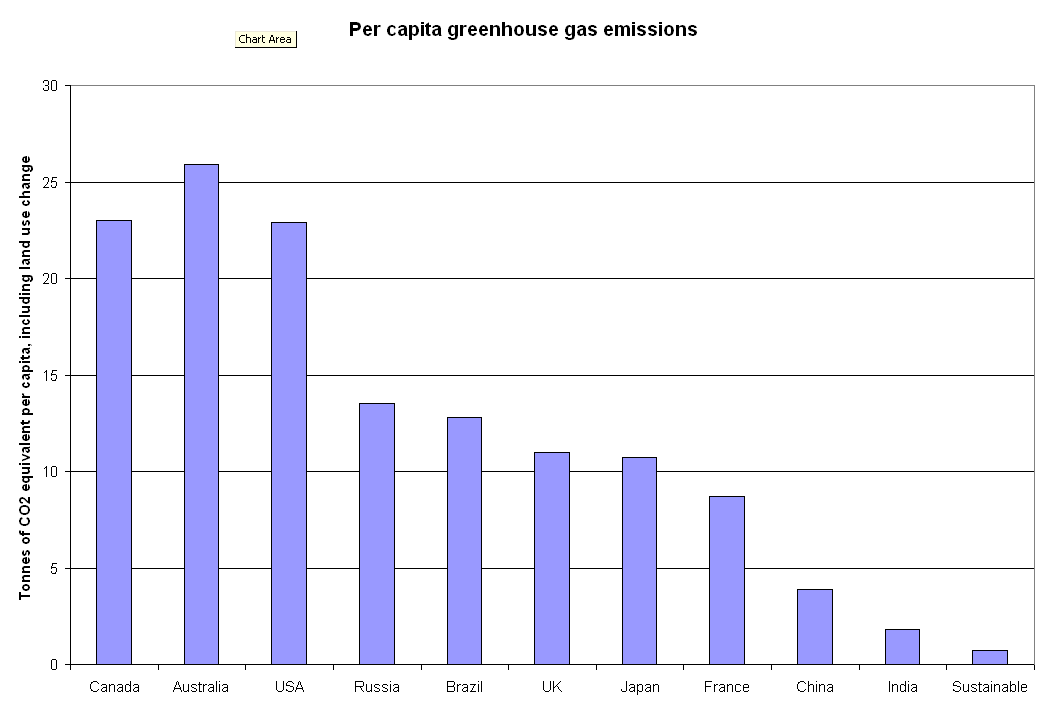
Per capita emissions by state, compared with sustainable emissions

As mentioned before, the Stern Review cites a figure of five gigatonnes of carbon dioxide equivalent as the quantity that can be sustainably absorbed by the planet each year. Given the present population of 6.6 billion people, that means our fair share is about 750kg of emissions each, per year. Right now, Canadian emissions are about 23 tonnes per person per year. They are highest in Alberta – 71 tonnes – and lowest in Quebec – 12 tonnes. Even in hydro-blessed Quebec, emissions are fifteen times too high.

Everybody knows that emissions in the developed world are too high. The average Australian emits 25.9 tonnes. For Americans it is 22.9; the nuclear-powered French emit 8.7 tonnes each. The European average is 10.6 tonnes per person, while North America weighs in at 23.1. One round-trip flight from New York to London produces the amount of greenhouse gas that one person can sustainably emit in three and a half years. These are not the kind of numbers that can be brought down with a few more wind turbines and hybrid cars; the energy basis of all states needs to be fundamentally altered, replacing a system where energy production and use are associated with greenhouse gas emissions with one where that is no longer the case.

What is less often acknowledged is that emissions in the developing world are already too high. Chinese per capita emissions are 3.9 tonnes, while those in India are 1.8. The list of countries by per-capita greenhouse gas emissions on Wikipedia shows three states where per-capita emissions are below 750kg: Comoros, Kiribati, and Uruguay. Even the average level of emissions for sub-Saharan Africa is almost six times above the sustainable level for our current world population.

And our world population is growing.

All this raises serious questions of fairness. Obviously, people in North America and Europe have been overshooting our sustainable level of emissions for a long time. Do developing countries have a similar right to overshoot? How are their rights affected by what we now know about climate change? If they do have a right to emit more than 750kg per person, does that mean people in developed states have a corresponding duty to emit less than that? Even if we emitted nothing at all, we couldn’t provide enough space within the sustainable carbon budget for them to emit as much as we are now.

The only option is for everyone to decarbonize. The developed world needs to lead the way, in order to show that it can be done. The developing world needs to acknowledge that the right to develop does not trump other forms of legal and ethical obligation: both to those alive now and to future generations. People in both developed and developing states may also want to reconsider their assumptions about the desirability of population growth. Spending a few centuries with people voluntarily restricting their fertility below the natural rate of replacement could do a lot to limit the magnitude of the ecological challenges we will face as a species.