Carbon junkies and nicotine addicts

The comic in the July 12th issue of The Economist is quite a good one. It shows an American eagle, mouth crammed with cigarettes and a cigarette package labelled ‘Greenhouse’ in its talon, telling a tiger labelled ‘India’ and a dragon labelled ‘China’ that it is: “Time to cut back.” Both the tiger and the dragon also have mouths and fists crammed with smokes.

The tiger says to the dragon: “He wants us to follow his lead.” To which the dragon replies: “That’s what we have been doing.”

It does a good job of encapsulating the whole “you developed in a dirty way so we have the same right” argument, as well as the poisonous “there is no point in acting ourselves if other big emitters won’t do so” argument. The best answer to all this is:

  1. The developed world does owe some assistance to the developing world, largely on the basis of the effects the latter will suffer because of the past emissions of the former.
  2. Developing countries have an excellent opportunity to carry out the process of development in a more sustainable way than has been employed elsewhere.
  3. Cutting back on fossil fuel use and greenhouse gas emissions is a temporary sacrifice, but a long-term boon. In the end, it will be the societies that do the best job of transitioning to a low-carbon future that will be the most successful in decades and centuries ahead.

Hopefully, the basic truth of those positions will be able to carry through into the ongoing global negotiations and we will have something big and meaningful to show for it at COP-15 in Copenhagen next year.

Cacophony

This morning, Emily, my mother, and I all woke to what sounded like somebody upstairs using a jackhammer on a hardwood floor. The whole house was vibrating, saturated with squealing and rattling noises.

A few minutes of pyjama-clad inquiries led me to the neighbour involved with the noise: “Oh, we’re just cutting some beams in the basement.”

Brain-thoughts, at that moment: “First thing in the morning? On a Saturday? With what sounds like an misfiring chainsaw?”

Promises of ‘just a few more minutes’ secured, back-to-bed trundling.

Brain-thoughts, just before returning to sleep: “Those aren’t the beams holding up this building, are they?”

Oh, it is too hot here…

The only question on renewables is when

Goliath beetle

One of the most active debates within the environmental community is how much of our energy we should be getting from renewable sources in the near to medium-term. There are those who assert that it is too scarce or intermittent to provide more than a small share, thus making things like nuclear fission and carbon capture and storage necessary. Then, there are those who assert that with more efficiency and a better grid, we can move to a renewable-dominated grid within the next few decades.

Ultimately, it seems important to remember that the only real questions on renewables are ‘which ones’ and ‘when.’ By definition, we cannot keep using any other kind of power indefinitely. Furthermore, there is good reason to believe that renewables will soon be a more desirable option overall, even when fuel scarcity and climate change are not taken into account. Both questions have their technical sides: the relative appeal of different options depends on technology, funding issues, and physical circumstances. Both questions also raise issues of preferences and fairness.

Yes, there is a danger of moving too quickly and suffering from early adoption problems and the later emergence of superior technology. There is also, of course, a danger of falling behind and suffering from dependence upon energy sources in decline. Striking the right balance requires good engineering, good policy-making, and the vision to build a better world.

Is it ethical to fly?

Continuing our long debate, here is another entry.

It seems to me that there are four possible long-term outcomes of the conflict between preventing climate change and travelling long distances quickly:

  1. We come up with a way to keep flying without doing too much climatic harm. This could be sequestration of carbon from biomass, it could be carbon neutral fuels, it could be something unanticipated.
  2. We come up with another transport technology that is carbon neutral and just as good or almost as good as flying, such as very high speed trains.
  3. We cannot reconcile long-distance high-speed travel with the need to mitigate, so we essentially stop doing it. A few people are still able to get from New York to London in a day, but it becomes out of almost everyone’s reach.
  4. We cannot reconcile long-distance high-speed travel with the need to mitigate, so we choose not to mitigate and wreck the planet.

How does the choice to fly look, in relation to each possibility?

  1. It’s not your fault you lived in the era before green flying was possible. That said, it may have been immoral to choose a mode of transport you knew to be (a) unsustainable and (b) harmful to others. It may be laudable or morally necessary to minimize flying and/or compensate for your impact by purchasing offsets.
  2. It’s not your fault you lived in the era before non-flight green travel was possible. That said, it may have been immoral to choose a mode of transport you knew to be (a) unsustainable and (b) harmful to others. It may be laudable or morally necessary to minimize flying and/or compensate for your impact by purchasing offsets.
  3. Again, you are on the hook for choosing an unsustainable option – specifically, one that had to be harshly curtailed in the future. Of course, if you are (a) selfish and (b) desirous of seeing the world, the danger that flying will be either restricted or far more expensive in the future creates an incentive to do a lot of it now.
  4. Flying was hardly a laudable thing to do, but it probably didn’t affect the outcome. Once we get into a runway climate change situation, it doesn’t matter much whether emissions in year X were Y megatonnes or 1.5Y megatonnes.

The larger question of whether future outcomes affects the morality of present decisions must also be contemplated. It does seem a bit odd to say that an action in 2007 was right or wrong as a consequence of technologies developed later. This post really cannot provide any answers to these questions – though my position remains that virtually all flying taking place at present is immoral – but perhaps it will provide a new way to consider things.

Power plant economics

Bicycle parking spot, Montreal

This useful post on Gristmill details the economics of power plants. It explains how costs are divided into four categories (fuel costs, non-fuel operating costs, capital recovery, and profits) and how some of these vary with commodity prices and output, while others are fixed. It makes an excellent point about the marginal effects of price changes. Basically, there is an incentive to run your plant whenever the hourly revenues exceed the hourly costs. Since the hourly costs are lower than the real costs associated with an hour of production (because of capital costs, etc), this creates a disincentive to build more capacity. The existing plants that have the option of selling for less than their true cost but more than their true costs will undeprice you. Nuclear plants are a special case of this:

The U.S. power grid has long relied on this bucket (central-station coal and nuclear, specifically) to provide baseload power. You’d be a fool to build these plants if you didn’t first secure guaranteed equity returns, but that’s what our regulatory model is really good at. Note that these plants actually have very high costs, but since they are so cheap to operate on the margin, they tend to depress prices for power on the grid once they are built. The interesting point of comparison here is with renewables — specifically wind and solar — which also have comparatively high capital costs, but very low variable costs. We frequently talk about wind needing over $100/MWh to pencil, but this is a cost discussion, not a price discussion. You may need over $100/MWh to justify the investment in a wind turbine, but a grid dominated by such units will put downward pressure on the prices for power due to it’s low variable costs — just as nuclear and coal have done for decades.

Clearly, these are the kind of second-order economic impacts that regulators need to take into consideration, if they are to help encourage the emergence of an efficient and low-carbon energy system.

In addition to considering the impacts of fixed versus variable costs, it probably makes sense for regulators to encourage profits from energy conservation. If all the benefit goes to the consumer and the producer suffers from reduced revenue, the incentives for improvement are curtailed.

See also:

Knickbein

Star cactus, Montreal botanical gardens

During the Second World War, the German air force used a system called Knickbein to guide bombers to targets in Britain. Essentially, it consisted of a two radio beams which the planes could fly, allowing them to drop bombs on blacked out cities, deal with bad weather, and otherwise manoeuvre accurately. The beam to one side broadcasts ‘dot’ signals, while the other sends ‘dash’ signals. Hearing a continuous tone means you are in the middle. Hearing one or the other tells you to divert your course somewhat. Intersecting beams over targets told pilots where to drop their ordinance:

Estimates of the accuracy of the Knickebein suggested that it was capable of putting a 300 m x 300 m box around an intended target, which when saturated with bombs from a mere 40 aircraft would put the bombs down on average 17 metres apart.

The beams were 400-500 metres wide and were in operation (at a frequency of 31.5 Hz) as of 1940.

The British came up with progressively more sophisticated means of blocking the technology. Operation ‘Headache’ sought to jam the beams using radio chatter, itself produced using “modified hospital electro-diathermy units used for cauterising wounds.” Later, more sophisticated approaches were employed. According to David Khan, the British were eventually able to ‘bend’ the guidance beams using transmitters of their own, causing bombers to “unload most of their high explosive… into empty fields and the Channel.” A jamming system used against the more advanced Y-Geraet system in 1941 apparently prevented 80% of bombers employing it from dropping their bombs at all, as they were prevented from getting accurate ranging signals.

No doubt, dramatically more advanced systems and countermeasures exist today, in spite of the existence of cheap and accurate satellite-based positioning technology.

Pay back the Joules

Pondering the question of international and intergenerational equity, one idea that occurred to me was some sort of ‘pay back the joules’ process. Basically, it would be an acknowledgement that the economic strength of some states has largely been based on the exploitation of non-renewable resources, to the detriment of those in other places. The basic idea of the scheme would be to be to ‘repay’ the same amount of energy, in the form of renewable generating capacity. The transfers would run from states that have used fossil fuels to those that have done so less, in proportion to the difference between the two. A state that had used X Joules of non-renewable fuels would pay half as much as a state that had used 2X Joules, up to the point where the gap between heavy and light users is eliminated

As described before, one barrel of oil contains about 1,700 kilowatt-hours (kWh) of energy. With similar figures for coal and gas, as well as data on total historical consumption, one could work out a total energy figure. It would then simply be a matter of multiplying the mean output of any renewable facility by its usable life. A 500 megawatt (MW) wind farm that lasts for 30 years will produce 131.4 gigawatt-hours (GWh): equivalent to 773,000 barrels of oil. One kilowatt-hour is 3.6 million Joules.

The plan would be one way to defuse the criticism that “the West got rich through dirty fuels, so we have the right to do the same.” It would also help to ensure that the developing world builds the right kind of infrastructure the first time, rather than having to replace most of it (and overcome all the special interests who will want to perpetuate it).

Fishing and restraint

Colourful leaves, botanical garden

Research being done off Lundy Island, in the United Kingdom, shows how quickly some marine ecosystems can begin to recover when fishing is discontinued. A five year old marine protected zone has resulted in the lobster population increasing sevenfold, as well as benefits to other species. This is consistent with the kind of larger scale recoveries that took place during the world wars, when the need for merchant ships and the dangers of war prevented most fishing fleets from operating.

It makes a person wonder what would be involved in producing a genuinely sustainable national fishery (trying to do the same in the open ocean is probably impossible for the foreseeable future, given the sheer number of unapologetically rapacious national fleets). One idea that comes to mind is this:

  1. Ban all imports. This will ensure that all fish being sold were caught under the sustainable approach.
  2. Restrict all fishing equipment (except safety equipment) to that which was available at the height of the age of sail. That means no diesel engines, no fish aggregating buoys, no satellite navigation, etc.
  3. Set catch quotas at a level where marine ecosystems as a whole remains vibrant and robust.

This would make fish dramatically more expensive, probably reducing consumption considerably. Arguably, it would actually increase employment in the industry. It would also make the industry rather more interesting to those both within and without it. Fishing from wooden tall ships has a lot more aesthetic appeal and romance than smashing the ocean floor and stripping the sea with freezer trawlers.

Of course, the above is supremely unlikely to ever happen. The question, then, is whether we will ever be able to come up with a mechanism that provides society with fish in an ethical and sustainable way, or whether we will keep plundering the resource, earning poorer and poorer catches, until we must be satisfied with whatever worms and jellyfish remain.

Hierarchy of climate change uncertainty

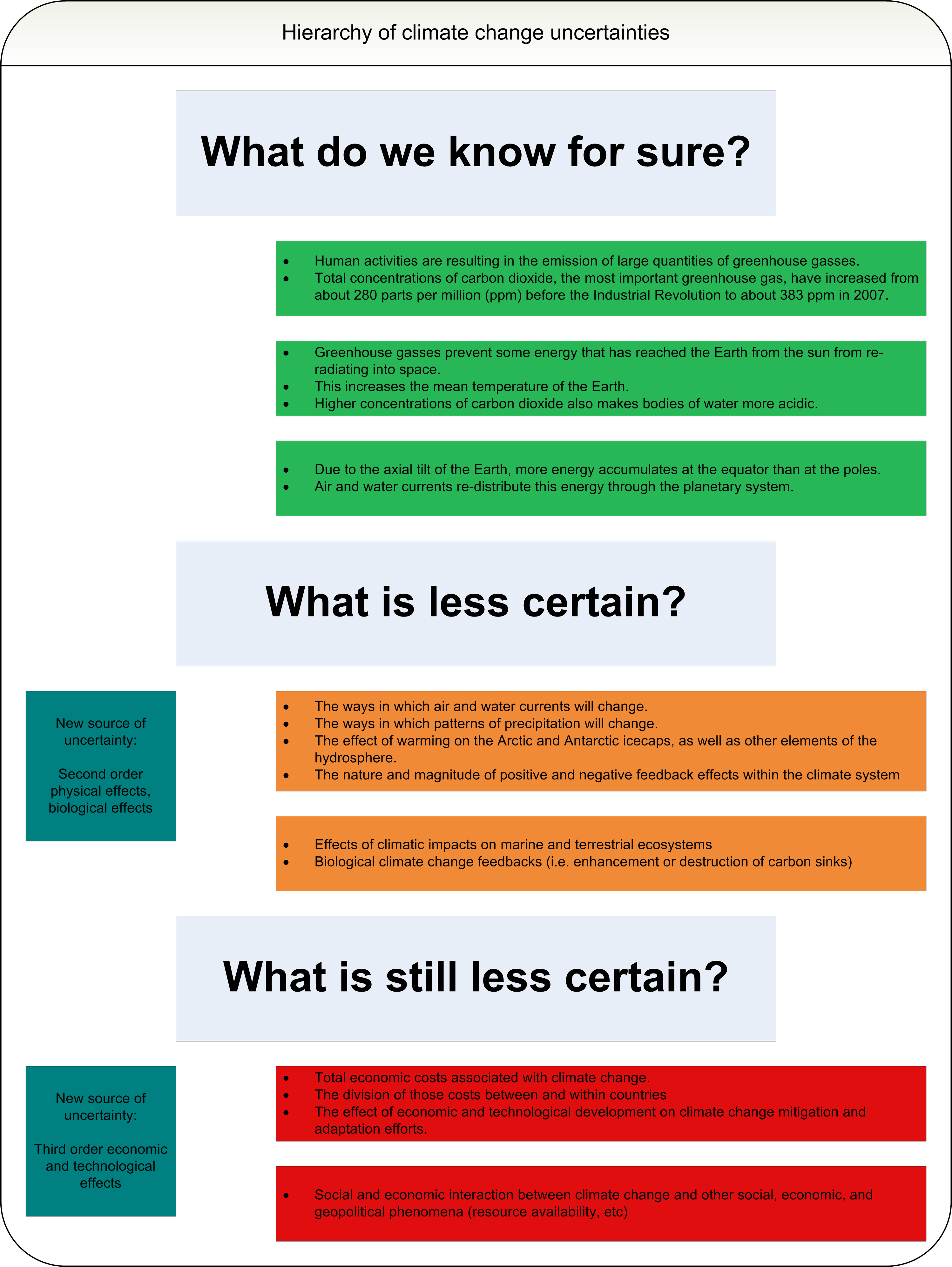
When people say that ‘the science of climate change is settled’ they are often being problematically imprecise. Elements of the science are certainly settled beyond a doubt – for instance, the simple fact that adding carbon dioxide to the atmosphere raises global temperatures. Other elements are certain but less precise: overall warming of the planet will alter air and water currents, though we do not know exactly how. Still higher order questions have answers at lower levels of both precision and certainty.

This graphic sketches out a bit of what I mean:

Climate change uncertainties

Responding to climate change is perhaps the ultimate case of needing to make decisions under conditions of uncertainty. Simplistic conceptions of what it means for something to be ‘certain’ must give way to a more nuanced appreciation of the nature of knowledge and evidence.