Once more on the importance of backups

As mentioned before, the best defence against data loss from viruses or hardware damage is to make comprehensive, frequent backups. As such, I propose the following rule of thumb:

If a piece of data is worth more than the drive space it occupies, a second copy should exist somewhere else.

Nowadays, you can easily pick up hard drives for less than $1 per gigabyte. At those prices, it probably isn’t just personal photos and messages that are worth saving, but any bulk data (movies, songs, etc) that would take more than $1 per gigabyte in effort to find and download again.

Mac users should consider downloading Carbon Copy Cloner. It produced bootable byte-for-byte copies of entire drives. That means that even if the hard drive in your computer dies completely and irreplaceably, you can actually run your system off an external hard drive, with all the data and functionality it possessed when you made the most recent copy.

One nice perk about having one or more such copies is how they can let you undo mistakes. If you accidentally erased or corrupted an important file, you can go back and grab it. Likewise, if you installed a software update that proved problematic, you can shift you entire system back to an earlier state.

[Update: 22 January 2010] Since I wrote this article, Apple released new versions of OS X with their excellent Time Machine backup software built-in. I strongly encourage all Mac users to take advantage of it.

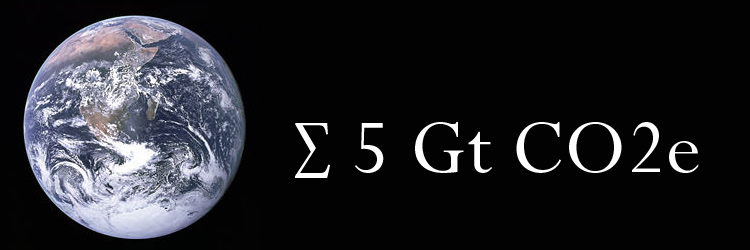
Five gigatonne globe

∑ 5 Gt CO2e

[Update: 22 January 2009] Some of the information in the post below is inaccurate. Namely, it implies that some level of continuous emissions is compatible with climate stabilization. In fact, stabilizing climate required humanity to have zero net emissions in the long term. For more about this, see this post.

As discussed before, credible estimates of the carbon absorbing capacity of the biosphere are around five billion tonnes (five trillion kilograms) per year of carbon dioxide equivalent.

The graphic above is probably far too nerdy to have popular appeal – and it is possible the numerical figure will need revision – but it does strike me as a concise expression of what needs to be tackled.

Busy weekend

Tristan Laing in a playground

Tristan, Meaghan, and I went for an excellent bike ride around Ottawa this afternoon, following a large egg and vegetable breakfast I made for us. Yesterday, we visited Chez Lucien: possibly Ottawa’s best pub, notable for a good selection of beer, nice ambiance, and very friendly staff. Tonight, it will be Somerset Street Pho.

Tomorrow, the Museum of Civilizations is being considered, as well as a veggie lunch at The Table to replace the dinner intended for tonight, but which proved impossible due to the length of our bicycular explorations.

Our standard coverage of climate change, science, and general geekery will resume next week.

A suggestion to Google

One cool feature of Google is that it performs unit conversions. It makes it easy to learn that 1000 rods is the same as 2750 fathoms. One useful addition would be the calculation of carbon dioxide equivalents: you could plunk in “250 tonnes of methane in CO2 equivalent” and have it generate the appropriate output, based on the methodology of the IPCC. The gasses for which the calculator should work would also include nitrous oxide, SF6, HCFCs, HFCs, CFCs, and PFCs.

Sure, this feature would only be useful for less than one person in a million, but Google has often shown itself willing to cater to the needs of techie minorities.

Knowledge brokers get the Nobel

Meaghan Beattie and Milan Ilnyckyj

The hot news today is that the Intergovernmental Panel on Climate Change and Al Gore (though not Sheila Watt-Cloutier) have been awarded the Nobel Peace Prize. While some have questioned the appropriateness of awarding the prize on the basis of achievements not directly related to armed conflict, it does seem that the conflict potential connected with migration, water scarcity, and so forth makes this less of a stretch than some previous awards.

What is most notable about all this, for me, is that neither Gore nor the IPCC have actually contributed to climatic science. The IPCC exists to review the published academic literature on climatic science and agree upon a consensus position; Gore has acted as an effective advocate and representative, though his overall contribution has been far more in the area of information transmission than the area of information generation.

What this shows is how vitally important the layer between scientists and policy-makers or the general public is. Scientists are looking (with great skill and detail) at the individual elements that make up the climatic system. Translating that into a comprehensive understanding of relationships and risks – of the sort that can guide policy development – is critical and challenging. As such, these Nobel prizes are well earned.

Previous related entries:

The World Without Us

Around the globe, every natural system is being affected by human behaviour: from the composition of deep oceanic sediments to mountaintop glaciers. As such, the concept behind Alan Weisman’s extraordinary book The World Without Us is both ambitious and illuminating. Using a combination of research, expert consultation, and imagination, he projects what would happen to the Earth if all 6.7 billion human inhabitants suddenly vanished. Within weeks and months, all the nuclear power plants will melt down; the massive petroleum refinery and chemical production complexes will burn, corrode, and explode; and nature will begin the slow process of reclaiming everything. Over the course of decades and centuries, the composition of all ecosystems will change as farmland is retaken and once-isolated patches of wildlife become reconnected. Cities will fall apart as bridges stretch and compress with the seasons and foundations fail on account of flooding. In the end, only bronze sculpture and ceramics are likely to endure until our red giant sun singes or engulfs the planet in about five billion years. More broadly, there is reason to hope that radio waves and some interstellar space probes will endure for billions of years.

Weisman uses his central idea as a platform from which to explore everything from material science to palaeontology and ecology. The book is packed with fascinating tidbits of information – a number of which have been shamelessly plagiarized in recent entries on this blog. A few examples of especially interesting topics discussed are the former megafauna of North America, human evolution and migration, coral reef ecology, lots of organic chemistry, and the history of the Panama Canal.

In the end, Weisman concludes that the human impact upon the world is intimately linked with population size and ultimately determines our ability to endure as a species. As such, he concludes with the concise suggestion that limiting human reproduction to one child per woman would cut human numbers from to 3.43 billion by 2050 and 1.6 billion by 2100. That might give us a chance to actually understand how the world works – and how human activity affects it – before we risk being overwhelmed by the half-glimpsed or entirely surprising consequences of our energetic cleverness.

Whether you accept Weisman’s prescription or not, this book seems certain to deepen your thinking about the nature of our world and our place within it. So rarely these days do I have time to re-read things. Nevertheless, I am confident that I will pick up this volume again at some point. Readers of this blog would be well rewarded for doing likewise.

[4 November 2007] I remain impressed by what Weisman wrote about the durability of bronze. If I ever have a gravestone or other monument, I want the written portion to be cast in bronze. Such a thing would far, far outlast marble or even steel.

Hot Air

Meaghan Beattie and Tristan Laing

Hot Air: Meeting Canada’s Climate Change Challenge is a concise and virtually up-to-the-minute examination of Canadian climate change policy: past, present, and future. Jeffrey Simpson, Mark Jaccard, and Nic Rivers do a good job of laying out the technical and political issues involved and, while one cannot help taking issue with some aspects of their analysis, this book is definitely a good place to start, when seeking to evaluate Canada’s climate options.

Emission pathways

Hot Air presents two possible emissions pathways: an aggressive scenario that cuts Canadian emissions from 750 Mt of CO2 equivalent in 2005 to about 400 Mt in 2050, and a less aggressive scenario that cuts them to about 600 Mt. For the sake of contrast, Canada’s Kyoto commitment (about which the authors are highly critical) is to cut Canadian emissions to 6% below 1990 levels by 2012, which would mean emissions of 563 Mt five years from now. The present government has promised to cut emissions to 20% below 2006 levels by 2020 (600 Mt) and by 60 to 70% by 2050 (225 to 300 Mt). George Monbiot’s extremely ambitious plan calls for a 90% reduction in greenhouse gas emissions by 2030 (75 Mt for Canada, though he is primarily writing about Britain).

While Monbiot’s plan aims to reach stabilization by 2030, a much more conventional target date is around 2100. It is as though the book presents a five-decade plan to slow the rate at which water is leaking into the boat (greenhouse gasses accumulating in the atmosphere), but doesn’t actually specify how to plug the hole before it the boat sinks (greenhouse gas concentrations overwhelm the ability of human and natural systems to adapt). While having the hole half-plugged at a set date is a big improvement, a plan that focuses only on that phase seems to lack an ultimate purpose. While Hot Air does not continue its projections that far into the future, it is plausible that the extension of the policies therein for a further 50 years would achieve that outcome, though at an unknown stabilization concentration. (See this prior discussion)

Policy prescriptions

Simpson, Jaccard, and Rivers envision the largest reductions being achieved through fuel switching (for instance, from coal to natural gas) and carbon capture and storage. Together, these account for well over 80% of the anticipated reductions in both scenarios, with energy efficiency improvements, agricultural changes, waste treatment changes, and other efforts making up the difference. As policy mechanisms, the authors support carbon pricing (through either a cap-and-trade scheme or the establishment of a carbon tax) as well as command-and-control measures including tightened mandatory efficiency standards for vehicles, renewable portfolio standards (requiring a larger proportion of energy to be renewable), carbon management standards (requiring a larger proportion of CO2 to be sequestered), and tougher building standards. They stress that information and subsidy programs are inadequate to create significant reductions in emissions. Instead, they explain that an eventual carbon price of $100 to $150 a tonne will make “zero-emissions technologies… frequently the most economic option for business and consumers.” This price would be reached by means of a gradual rise ($20 in 2015 and $60 in 2020), encouraging medium and long-term investment in low carbon technologies and capital.

Just 250 pages long, with very few references, Hot Air takes a decidedly journalistic approach. It is very optimistic about the viability and affordability of carbon capture and storage, as well as about the transition to zero emission automobiles. Air travel is completely ignored, while the potential of improved urban planning and public transportation is rather harshly derided. The plan described doesn’t extend beyond 2050 and doesn’t reach a level of Canadian emissions consistent with global stabilization of greenhouse gas concentrations (though it would put Canada on a good footing to achieve that by 2100). While the book’s overall level of detail may not satisfy the requirements of those who want extensive technical and scientific analysis, it is likely to serve admirably as an introduction for those bewildered by the whole ecosystem of past and present plans and concerned with understanding the future course of policy.

Geologic time

Autumn leaves

While the Earth is about 4.54 billion years old, all of human civilization has been compressed into a single geological epoch: the Holocene. This has been ongoing for about 11,500 years, predating the first Mesopotamian civilizations for which we have any evidence. Prior to the Holocene was the Pleistocene, which ended with the Younger Dryas cold spell. Actually, the Holocene exists more as a demarcation for the period of geologic time that has included human civilization than as an epoch with an independent definition.

Our best ice core samples extend back 650,000 years: about a third of the way into the Pleistocene, but just a tiny foray into geologic time. Pollen from Lake Tanganyika might take us through the Pliocene (Greek for ‘more new’) and into the Miocene (‘less new’). Perhaps some yet-unanticipated data source will be able to take us further still.

It is amazing what scientists are able to determine from inference and the meticulous collection of data: from the age of the universe to the evolutionary history of the planet.

Heat, bacteria, and evolution

Rusty metal

For those who are unfamiliar, capsaicin is one of the most interesting molecules out there. This is the chemical that makes chili peppers spicy; it is also the active ingredient in pepper spray. Pure capsaicin is rated at about 15 million Scoville heat units: a scale where Tabasco sauce is scored at about 2,500.

Capsaicin is quite an amazing adaptation, actually. Plants developed it to deter animals from eating them. Eventually, animals realized that capsaicin was painful to them, but not actually harmful. By contrast, it is very harmful to some of the species of bacteria that spoil food. As such, spicy foods emerged in hot climates as a defence against nasty prokaryotes. A direct descendent of that realization are the veggie vindaloos I enjoy so much.

Spices have been mentioned here before.

Polymers in the Pacific

In addition to nuclear waste, there are other very long lived forms of human detritus accumulating in the world. Most pervasive among those may be plastics. Virtually non-existent before the Second World War, they are now produced in staggering quantities. So far, none of those artificial polymers have broken down chemically; instead, they just break into smaller and smaller pieces, float down rivers to the sea, and end up in places like the North Pacific Gyre. It is also discussed on MetaFilter.

As with vulcanized rubber, these materials will endure in the world until microorganisms evolve the ability to metabolize them. Apparently, when plants first evolved lignin and cellulose, bacteria were unable to digest them. Until that changed, wood would have been as enduring as the plastic wrap currently swirling and collecting persistent organic pollutants in the world’s oceanic gyres, quite probably for millions of years.