Who watch him lest himself should rob / The prison of its prey

In case anyone doubts that the War on Terror creates situations straight out of Kafka, reading this article from The Guardian is in order. Sabbir Ahmed, a British citizen, was held in a detention centre for nearly two months because officials thought he was Pakistani and wanted to deport him there. He couldn’t prove that he was British because his passport was in his London flat and they offered him no other means by which to prove that he was, in fact, born in Blackburn as the son of two other British citizens.

He ought to be receiving some pretty heavy compensation, and high level apologies and/or sackings, for this kind of massive incompetence. Of course, this also speaks of institutional racism. Frances Pilling, chairwoman of the charity Bail for Immigration Detainees, said: “They chose not to pursue any avenue of investigation at all.” If he had been white and named John Brown, they might have accepted that he was from Blackburn after calling the Passport Office, or even some people there who would vouch for him.

It goes to show, yet again, that we have more to fear from government than from terrorists.

A disappointing presentation

If it had been an intellectual argument, Professor Timothy Luke‘s presentation on climate change tonight might have been subject to some strong criticism. As it was, it was essentially a smug collection of sniping ad hominem arguments directed at Al Gore, Nicholas Stern, and the concept of liberal environmentalism generally. He made clear that he holds these people in contempt – using a mocking tone of voice while quoting their work – but never really explained why, beyond some vague suggestions that ‘ecopopulism’ would be superior, and how the powerful and the plutocratic are aligned to remain in control. The idea that grassroots organizations will somehow directly access environmental science, then manifest their new preferences through the popular alteration of the political dialog seems rather unlikely. While you can certainly engage in argument with knowledge brokers like Nicholas Stern and Al Gore (starting that argument is much of the point of their work), simply attacking them for being part of existing governmental and economic systems carries little water.

One can hardly expect leaders of politics and industry to abandon their power and the standard economic system. That is especially true when you don’t seem to have any well-formed idea about what the alternative might be. By nor following up his scorn with substance, Professor Luke left us with little value for our time.

A new library, precious sources

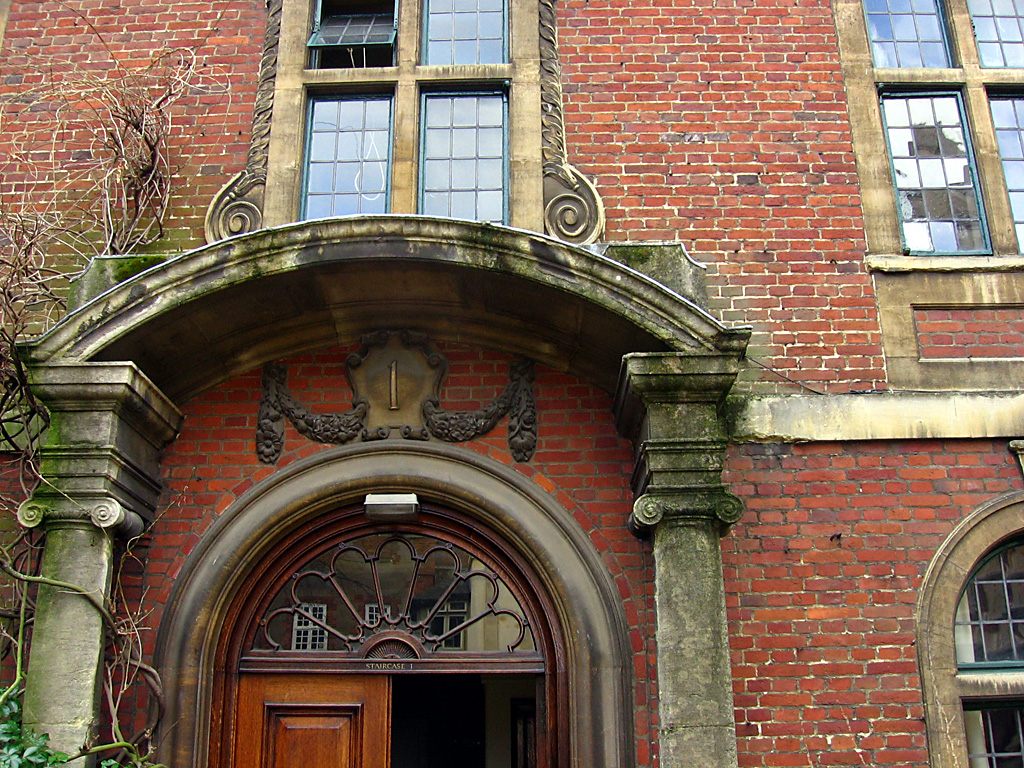
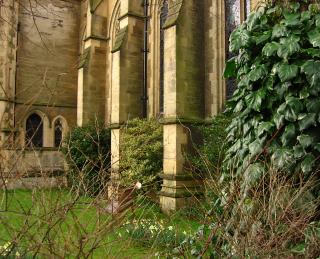
St Peter’s College, Oxford

While I am a certifiable idiot for not realizing it earlier, it transpires that the Geography and the Environment Library on Mansfield Road has a treasure trove of thesis related books. In five minutes flat, I registered to use the library and take out their books. I now have an elegant stack of books on the history of climate change: just the sort I have been looking for, while despairing about the gap in my bibliography. Once I have finished Spencer Weart’s The Discovery of Global Warming, read John Hardy’s Climate Change: Causes, Effects, and Solutions, tracked down a few of their sources, re-read Northern Lights Against POPs, and done the same for that, I will be ready to re-draft my second chapter in a far superior form.

The library itself is also quite a welcoming place. I will link a photo of it here, once I have the chance to put one online. The main room, has a very attractive asymmetrically gabled roof. It is quiet, smells faintly of wood, and has high resolution monitors and blazing fast internet access. The maps on the wall, skylights, and windows overlooking the Balliol Sports Grounds are also reasons for which I am considering making this another thesis base of operations, in addition to Church Walk and the High Street Starbucks.

Chapter two, second version

I have been thinking about how to incorporate the general ideas from this post into the revised and clarified version of my second chapter, upon which I am now working. It seems that there are three axes across which environmental problems can be assessed: predictability, intentionality, and desirability. Of these, the third is most likely to have different values for different actors.

The mine tailings example is certainly intentional, for it is an inescapable and obvious product of mining activity. The predictability score depends on the status of knowledge about the health and ecological consequences of particular tailings at the time when they were released into the environment. Here, there is also a discussion to be had about the extent to which an actor engaged in something that could well have ecological or health consequences is morally obligated to investigate what those may be. There are also questions about whether private actors are merely obliged to follow the law, or whether they need to act upon moral considerations with which the law has not explicitly saddled them.

On the matter of desirability, the range includes possibilities of utility gain, indifference, and loss. The mining company probably has an indifferent or unfavourable view of tailings: if they could be avoided for moderate cost, they would be. This is certainly true now that the consequences of certain tailings are known and legal and moral obligations on the part of such companies are fairly well entrenched. A more interesting possibility is environmental change that increases the utility of some, while diminishing that of others. This could happen both with intentional acts (say, building a dam) or unintentional ones (the unintended introduction of a species into a new area).

In any event, the new plan is to boil the introductory portion of the chapter down until it is only about 1000 words long. Then, I will write 2500 words each on the case studies, and 1000 words in concluding comments. Most of the existing commentary will be migrated into the case study sections. The best way to do all of this is probably to re-write from scratch, then import and vital elements and citations from the old version. A similar chapter model can be adopted for the third and fourth chapters and, since most of the research being done covers all three, they should prove reasonably easy to write once it is done.

[Update: 3 March 2007] I now feel confident that the version of the chapter to be submitted tomorrow, four days late, will be enormously superior to what could have been submitted on time. This owes much to the new books I got at the Geography and Environment Library. Those with restricted wiki access can have a look at the emerging draft.

My last-minute assembly skills have failed me

According to my thesis schedule, I am meant to have my second chapter submitted now. Instead, I have 5200 words, only 1200 of which are about my case studies. Even within the analytical stuff, there is a lot of ambiguous sequencing, and a great many emphatic [ADD MORE HERE] editorial notes. It seems unlikely that this chapter can be completed tonight, regardless of caffeine consumption levels.

I need to:

  1. Complete the necessary reading, especially on pre-IPCC climate change science
  2. Trawl through the notes I have already made about sources, ideas, and themes
  3. Expand the case study portion of the chapter to about 5000 words, shifting the bits that are now independent into the case study narrative

I suppose I should get cracking on the first of those. The whole thing – three substantive chapters, a conclusion, and a revised introduction – needs to be submitted in 53 days. Time for another pot of coffee.

Noisy skies

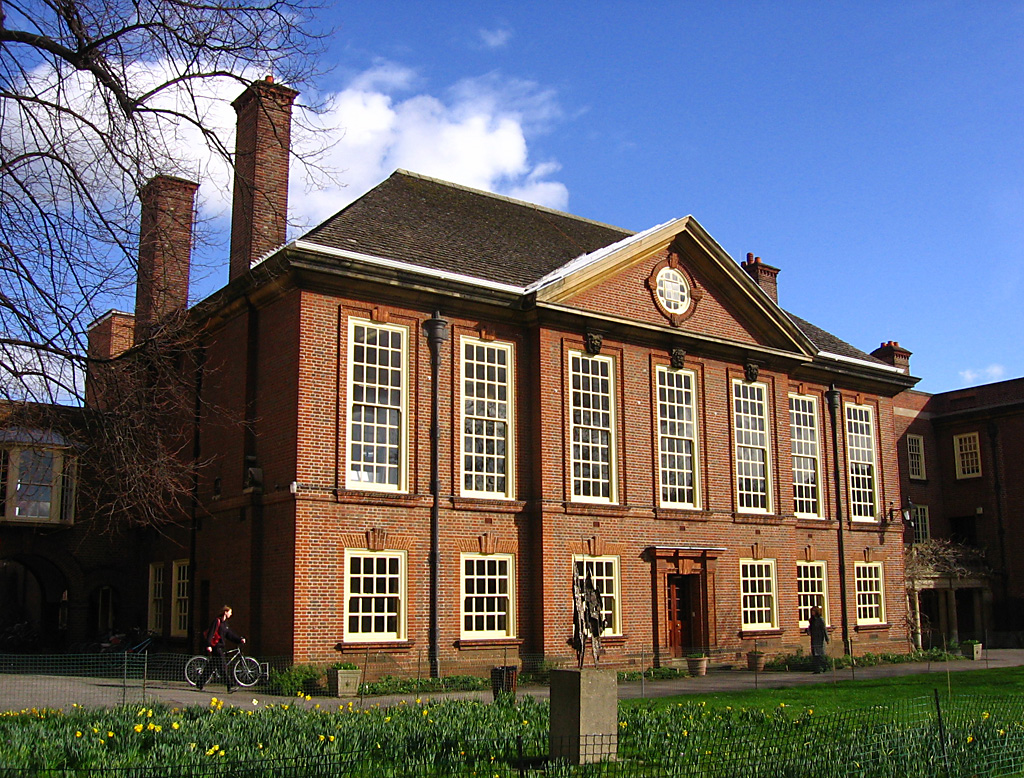
Somerville College, Oxford

During the last day or so, there has been an unusually large amount of military air traffic over Oxford. Less than a minute ago, I saw a 101 Squadron Vickers VC-10 fly overhead, northwards (official site). The VC-10 is fairly unmistakable, due to the engine configuration: two on either side of the fuselage, back near the tail. Last night, we saw at least three large, slow moving transports heading in the same direction. I would have suspected that it was a Boeing C-17 Globemaster, from the 99 Squadron but apparently they only have one of those (official site).

They are probably flying to Brize Norton: the largest airbase operated by the Royal Air Force. It is located just eighteen miles west of here, between Carterton and Whitney. It might be an interesting place to visit at some point.

Quite possibly, the volume of traffic is connected with the recent British announcement that they are pulling forces out of Iraq. With 1,600 troops returning to the UK during the next few months, there must be a lot of gear and people to move around.

Some strategy

Perhaps it would be wise to interrupt regular blogging, while my thesis is coming together. Upon reflection, however, I find that the issue is more that I am not using time efficiently, and less that important tasks are absorbing too much of it. As ‘a’ (and probably ‘the’) major conduit between myself and most of those who are important to me, internet based communication does not seem unimportant. The task, then, is to pare away activities that do not contribute to the completion of this task (itself unlikely to be relevant in five or ten years) and focus upon those that advance towards the goal.

Filling the gaps in chapter two

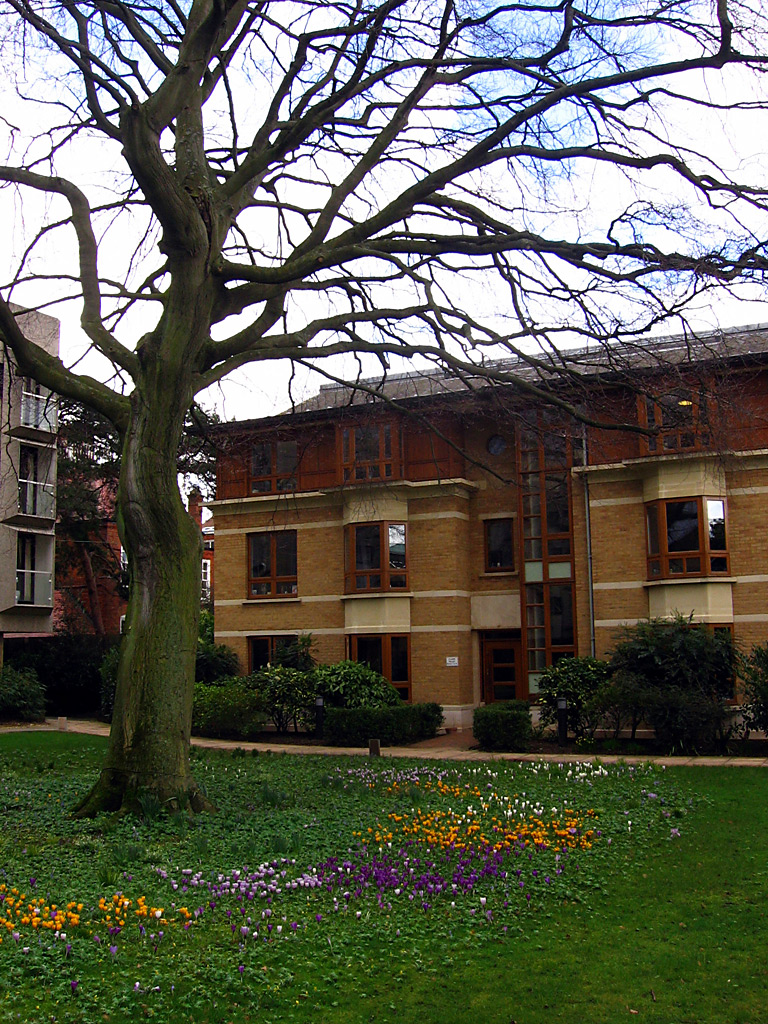
St Anne’s College, Oxford

The conclusion from working on my second chapter is that I have read too much general background material and not enough on my case studies. I am fairly well covered on POPs, since I have done research on them before. Naturally, adding a few more sources would be nice, though there are not really a great many out there. I am also quite well covered on current events relating to climate change, because there has been such a raft of coverage and discussion. While my intention has never been to write a blow-by-blow account of either (how could I possibly do so in 30,000 words?), it is certainly necessary to have a comprehensive understanding of the history, before any important and valid analysis can be done.

As such, I need to fill in my knowledge on recent developments pertaining to POPs, which should not be hugely difficult. Then, I need to shore up my section on the early history of the climate change debate. Aside from the mandatory OUSSG dinner and talk tonight, I suspect this will fill the next 32 hours. Naturally, I am interpreting my promise to Dr. Hurrell of having a second chapter dropped off at Nuffield by Wednesday as having that chapter dropped off, by my own hand, in time for him to read it on Thursday morning.

Policy{hyphen, space, nothing}making

One minor hiccough regarding the thesis has been cropping up continuously of late. One of my key terms has a trio of possible forms, each of which has a certain appeal and a certain problem:

  1. Policy making
  2. Policy-making
  3. Policymaking

I think all three are acceptable English, and my preference vacillates between the three based on the context in which the word is used. When it is being used as the subject of a sentence, the two word version seems more natural: “Consideration of framing issues is important for those involved in policy making.” When it is modifying a noun, either the conglomerated or hyphenated version seems better: “The policymaking process is fraught with uncertainties.”

I should, however, choose a single form to use in the entire thesis, and do so before I need to wade through too many tens of thousands of words and footnotes to set the standard. Preferences, anyone?

I am working on developing presentation standards for the whole thesis. I am told Oxford has some rules of its own, but I am not sure where to find them.

Framing, selection, and presentation issues

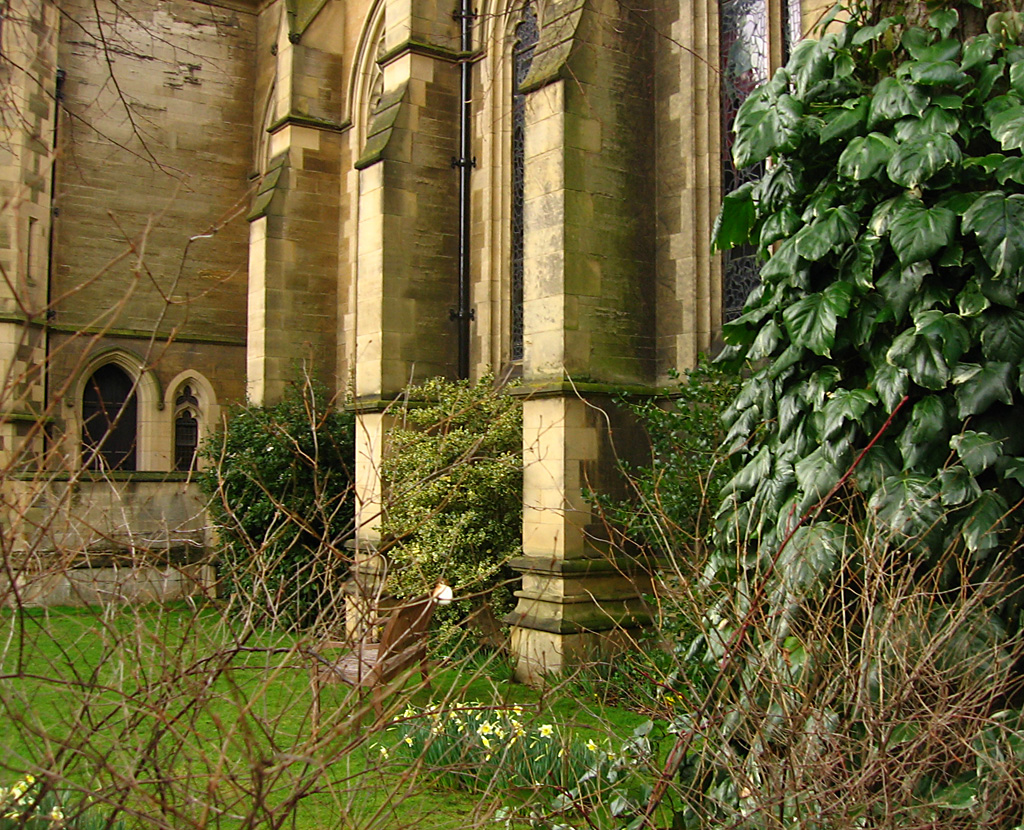
Harris Manchester College, Oxford

One of the major issues that arises when examining the connections between science and policy are the ways information is framed. You can say that the rate of skin cancer caused by a particular phenomenon has increased from one in ten million cases to one in a million cases. You can say that the rate has increased tenfold, or that it has gone up by 1000%. Finally, you could say that an individual’s chances of getting skin cancer from this source have gone up from one tiny figure to a larger, but still tiny seeming, figure. People seem to perceive the risks involved in each presentation differently, and people pushing for one policy or another can manipulate that. This can be especially true when the situations being described are of not comparably rare: having your chances of being killed through domestic violence reduced 1% is a much greater absolute reduction than having your chances of dying in a terrorist attack reduced by 90%.

Graphing

When talking about presentation of information, graphs are an important case. Normally, they are a great boon to understanding. A row of figures means very little to most people, but a graph provides a wealth of comprehensible information. You can see if there is a trend, what direction it is in, and approximately how strong it is. The right sort of graph, properly presented, can immediately illuminate the meaning of a dataset. Likewise, it can provide a compelling argument: at least, between those who disagree more about what is going on than how it would be appropriate to respond to different situations.

People see patterns intuitively, though sometimes they see order in chaos (the man on the moon, images of the Virgin Mary in cheese sandwiches). Even better, they have an automatic grasp of calculus. People who couldn’t tell you a thing about concavity and the second derivative can immediately see when a slope is upwards and growing ever steeper: likewise, one where something is increasing or decreasing, but at a decreasing rate. They can see what trends will level off, and which ones will explode off the scale. My post on global warming damage curves illustrates this.

Naturally, it is possible to use graphs in a manipulative way. You can tweak the scale, use a broken scale, or use a logarithmic scale without making clear what that means. You can position pie charts so that one part or another is emphasized, as well as abuse colour and three dimensional effects. That said, the advantages of graphs clearly outweigh the risks.

It is interesting to note how central a role one graph seems to have played in the debate about CFCs and ozone: the one of the concentration of chlorine in the stratosphere. Since that is what CFCs break down to produce, and that is what causes the breakdown of ozone, the concentration is clearly important. The graph clearly showing that concentrations would continue to rise, even under the original Montreal Protocol, seems to have had a big impact on the two rounds of further tightening. Perhaps the graph used so prominently in Al Gore in An Inconvenient Truth (the trends on display literally dwarfing him) will eventually have a similar effect.

Stats in recent personal experience

My six-month old Etymotic ER6i headphones are being returned to manufacturer tomorrow, because of the problems with the connector I reported earlier. Really not something you expect for such a premium product, but I suppose there are always going to be some defects that arise in a manufacturing process. Of course, being without good noise isolating headphones for the time it will take them to be shipped to the US, repaired or replaced, and returned means that reading in coffee shops is not a possibility. Their advantage over libraries only exists when you are capable of excluding the great majority of outside noise and of drowning the rest in suitable music.

Speaking of trends, I do wonder why so many of my electronics seem to run into problems. I think this is due to a host of selection effects. I (a) have more electronics than most people (b) use them a great deal (c) know how they are meant to work (d) know what sort of warranties they have and for how long (e) treat them so carefully that manufacturers can never claim they were abused (f) maintain a willingness to return defective products, as many times as is necessary and possible under the warranty. Given all that, it is not surprising that my own experience with electronics failing and being replaced under warranty is a lot greater than what you might estimate the background rate of such activity to be.

Two other considerations are also relevant. It is cheaper for manufacturers to rely upon consumers to test whether a particular item is defective, especially since some consumers will lose the item, abuse it, or simply not bother to return it even if defective. Secondly, it is almost always cheaper to simply replace consumer electronics to fix them, because of the economies of scale involved in either activity. From one perspective, it seems wasteful. From another, it seems the more frugal option. A bit of a paradox, really.

[14 March 2007] My replacement Etymotic headphones arrived today. Reading in coffee shops is possible again, and none too soon.