On conspiracy theories

Kasbar, Cowley Road, Oxford

Partly prompted by a Penn and Teller episode, and partly by a post written by my friend Tristan, I have been thinking about conspiracy theories today. On what basis can we as individuals accept or refute them? Let’s take some examples that Penn and Teller raise: the reality of the moon landings, the nature of the JFK assassination, and the nature of the September 11th attacks. It should be noted that this is the worst episode of theirs I have ever seen. It relies largely upon arguments based on emotion, backed by the testimony of people to whom Penn and Teller accord expert status, rather than a logical or empirical demonstration of why these theories should be considered false.

Normally, our understanding of such phenomena is mediated through experts. When someone credible makes a statement about the nature of what took place, it provides some evidence for believing it. Penn and Teller amply demonstrate that there are lots of crazy and disreputable people who believe that the moon landing was faked, some strange conspiracy led to the death of JFK, and CIA controlled drones and explosives were used to carry out the September 11th attacks. That said, it hardly disproves those things. Plenty of certifiably insane people believe that the universe is expanding, that humans and viruses have a common biological ancestor, and that any whole number can be generated by adding powers of two (365 = 2^8 + 2^6 + 2^5 + 2^3 +2^2 + 2^0). That doesn’t make any of those things false.

We really have three mechanisms to work with:

  1. Empirical evidence
  2. Logical reasoning
  3. Heuristic methods

As individuals confronted with questions like those above, we almost always use the third. While those with a powerful telescope and the right coordinates could pick out all the junk we left on the moon, most people lack the means. Likewise, those with a rifle, a melon, and some time can learn the physics behind why Kennedy moved the way he did when he was shot, despite Oliver Stone‘s theories to the contrary. Finally, someone with some steel beams, jet fuel, and mathematical and engineering knowledge can model the collapse of the twin towers as induced by heat related weakening of steel to their heart’s content. Normally, however, we must rely upon experts to make these kinds of judgements for us, whether on the basis of sound technique or not.

Logical reasoning is great, but when applied strictly cannot get us very far. Most of what people call ‘logic’ is actually probabalistic reasoning. Strict logic can tell us about things that are necessary and things that are impossible. If every senior member of the American administration is controlled by an alien slug entity, and all alien slug entitites compel their hosts to sing “Irish Eyes are Smiling” once a day, we can logically conclude that all members of the American administration sing “Irish Eyes are Smiling” every day. Likewise, if all bats are bugs, all non-bugs must be non-bats. Entirely logically valid, but not too useful.

A heuristic reasoning device says something along the lines of: “In the more forty years or so since the moon landing, nobody has brought forward credible evidence that they were faked. As such, it is likely that they were not.” Occam’s razor works on the same kind of principle. This is often the best kind of analysis we can manage as individuals, and it is exactly this that makes conspiracy theories so difficult to dislodge. Once you adopt a different logic of probability, for instance one where certain people will stop at nothing to keep the truth hidden, your probabilistic reasoning gets thrown out of whack.

How, then, should we deal with competing testimony from ‘experts’ of various sorts, and with the fallout of our imperfect ability to access and understand the world as individuals? If there was a pat and easy answer to this question, it would be enormously valuable. Alas, there is not, and we are left to try and reach judgments on the basis of our own, imperfect, capabilities.

PS. For the record, I believe that the moon was almost certainly walked upon by humans, that Oswald quite probably shot John F. Kennedy on his own initiative, and that the airplanes listed in the 9/11 report as having crashed where they did actually did so. My reasons for believing these things are almost entirely heuristic.

Back to the moon? But why?

Apparently, Lockheed-Martin got the contract to serve as prime contractor for a return to the moon, and possibly further travel from there to Mars. Now, when I first heard the ‘back to the moon’ proposal, I assumed it was electoral fluff. How can an agency that decided to scrap such a useful piece of scientific equipment as the Hubble Space Telescope possibly be considering the scientifically pointless mission of putting human beings back on the moon?

I believe that humanity will eventually expand outwards into space. It is advisable due to the small but catastrophic risk of asteroid or comet impact, as well as generally in keeping with an agenda of exploration that I find personally inspiring. The first moon landings were an astonishing demonstration of human ingenuity and American technical and economic might. With present technology, manned spaceflight is a symbolic and political endeavour, not a scientific one. That said, returning to the moon serves no purpose, scientific or political. If we could do it in the 1960s, we can do it again now. Even if you accept the argument that a moon base is necessary for a manned mission to Mars, the enormous question remains of why we should take on such an expedition at this time, with this technology, and the present financial circumstances of the United States.

When it comes to space science, people are very expensive and delicate instruments. Robots might not always work (note all the failed Mars landers), but they don’t require all the food, air, space, and temperature and acceleration control that people do. The things we hope to learn about our solar system and the space beyond are almost certainly better investigated by robots, at this time. And the moon is hardly a profitable place to go looking for new scientific insights. A robot sent somewhere interesting – like Europa – would almost certainly advance science more than sending scores of people to that great airless ball that lights up our night sky and causes our tides.

This plan is especially absurd given the magnitude of public debt in the United States right now. The existing level of federal debt is more than $8.5 trillion, more than $28,000 per person, and the federal budget is sharply in deficit. If we could choose to send people to the moon instead of developing one of the two hugely expensive fighter jets now being rolled out (the F-22 and the Joint Strike Fighter, a $256 billion program), I would be all for it. At least, going back to the moon would do relatively little harm (wasted resources aside). Of course, no such trade-off is being offered. This would be spending over and above the sums already being expended on pricey little projects like the JSF, the DDX destroyer (about $4 billion per ship), and the war in Iraq (more than $300 billion, so far). The comparison to military hardware is a sensible one, since manned spaceflight is, to a large extent, just another massive subsidy to the military aerospace industry. Hopefully, the passing of the mid-term elections will put this white elephant to sleep again.

Related items:

Policy proportionality

Amnesty International display at Blackwell's

I know it’s a theme I have raised many times, but it remains puzzling to me: why are democratic societies so uniquely incapable of accepting the costs associated with terrorism? If you try to circumscribe any kind of dangerous activity, from smoking to extreme sports, you will find plenty of people ready to wave the banner of liberty and claim that the deaths and injuries are worth the costs of the freedom.

If you add up the casualties of all the terrorist attacks worldwide since the end of the Cold War, you arrive at a number that is a small fraction of the number of deaths from alcohol poisoning, from AIDS, from obesity related illness, or from automobile accidents. Heart disease killed 696,947 Americans in 2002, while cancer killed 557,271. About 400,000 died from tobacco usage, while alcohol killed 100,000. And yet there is no call to reorganize society to deal with these horrific threats. We make that choice not because societal re-organization could not eliminate these problems, but because the costs of doing so (or trying to do so) exceed those we are collectively willing to bear to achieve these ends.

In response to a failed two-man terrorist plot in Germany, The Economist claimed that Germany is “immune no more” and that terrorism is sure to “leap up the list” of people’s concerns. Even if the attack had succeeded, it would still be only a blip in the passing into and out of life of the mass of people who we describe as Germany. The same is true of every terrorist plot in history. Yet they have, by contrast, generated shifts in law and power out of all proportion to their lethality or the amount of harm they cause.

Just as terrorists are adept at exploiting the physical infrastructure of modernity to generate and amplify their attacks – coordinating attacks on aircraft over the internet – they exploit the psychology of modernity to generate an emotional impact out of all proportion to the harm caused. The sane response, it seems, is to accept the hundreds or thousands of deaths as a cost we may have to pay in order to continue to live in a free society – just as we accept the deaths from automobile accidents or fatty foods. The point isn’t that we cannot or shouldn’t take precautions (whether we are discussing terrorism or car crashes), but that we should consider them sensibly and in keeping with the actual seriousness and scope of both the threats that exist, and the entities that we may choose to create or empower to deal with them.

Ka-Boom!

A few minutes ago, something happened above me that was exceptionally loud. I was wearing my Etymotic ER6i headphones with the foam eartips, which boast a 35 decibel reduction in ambient sound. In spite of them, the noise was painfully loud for several seconds.

I assume it was a supersonic patrol of figher aircraft, maintaining some defence of London, nearby, and other potential targets. Definitely unnerving.

More security, less freedom

While we can all be very glad this alleged plot was foiled, the new rules on carry-on baggage are going to make travelling long distances by plane truly hellish. Without more information, it is impossible to evaluate how justified they are, but they certainly appear to be quite onerous. No water; no books, magazines, or newspapers; no portable electronics of any kind. Of course, either the restrictions or all duty-free shopping will eventually have to go.

It also seems that all EasyJet flights out of all London airports are cancelled. With my EasyJet flight to Dublin in six days, I wonder what is going to happen. They seem to be offering refunds on tickets. Maybe I should take it, then pay the cancellation fee from the hostel.

Such is the power of terrorism: even when we win, we lose.

[Update: 6:52pm] Both of my current roommates have had to re-schedule flights over this: one to Austria and one to Barcelona. It seems likely that another friend’s trip to Madrid will not be happening, and that yet another friend’s flight to Canada tomorrow will be boring and uncomfortable.

[Update: 11 August] Flights from London to Dublin are back on schedule, according to EasyJet. My friend also made it to Madrid today, after all.

Orbital booster idea

I had an idea several years ago that I think is worth writing up. It is for a system to lift any kind of cargo from a low orbit around a planet into a higher one, with no expenditure of fuel.

Design

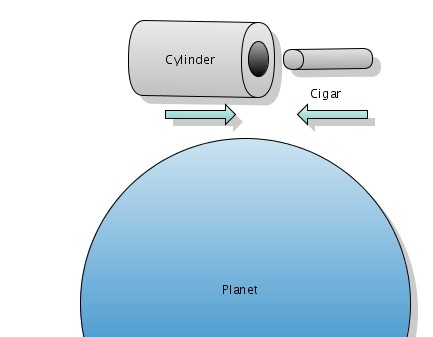
The system consists of two carriers: one shaped like a cylinder with a hole bored through it and the other shaped like a cigar. The cigar must be able to pass straight through the hole in the cylinder. The two must have the same mass, after being loaded with whatever cargo is to be carried. This could be achieved by making the cylinder fairly thin, by making the cigar longer than the cylinder, or by having the latter denser than the former. Within the cavity of the cylinder are a series of electromagnets. Likewise, under the skin of the cigar. Around the cylinder is an array of photovoltaic panels. Likewise, on the skin of the cigar. Each contains a system for storing electrical energy.

In addition to these main systems, each unit would require celestial navigation capability: the ability to determine its position in space using the observation of the starfield around it, as modern nuclear warheads do. This would allow it to act independently of ground-based tracking or the use of navigation satellites. It would also require small thrusters with fuel to be used for minor orbital course corrections.

Function

The two objects start off in low circular or elliptical orbits, along the same trajectory but in opposite directions. Imagine the cylinder transcribing a path due north from the equator to the north pole and onwards around the planet, while the cigar transcribes the same path except in the opposite direction: heading southwards after it crosses the north pole. The two objects will thus intersect each time they complete a half-orbit.

As each vehicle circles the planet, it gathers electrical power from solar radiation using the attached photovoltaic panels. When the two orbits intersect, the electromagnets in the cigar and the cylinder are used so as to repel one another and increase the velocity of each projective, in opposite directions, by taking advantage of Newton’s third law of motion. Think of it being like a magnetically levitated train with a bit of track that gets pushed in the opposite direction, flies around the planet, and meets up with the train again. I warn you not to mock not the diagram of the craft! Graphic design is not my area of expertise. Obviously, it is not to scale.

The orbits
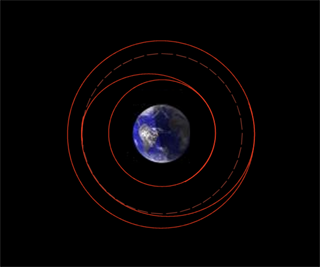
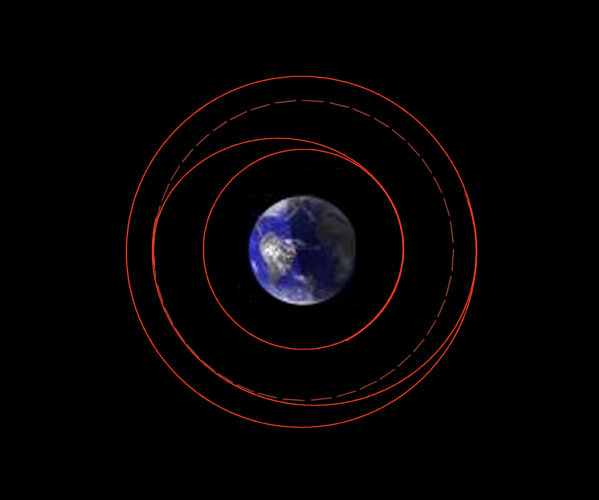
Diagram of successive orbits - By Mark Cummins

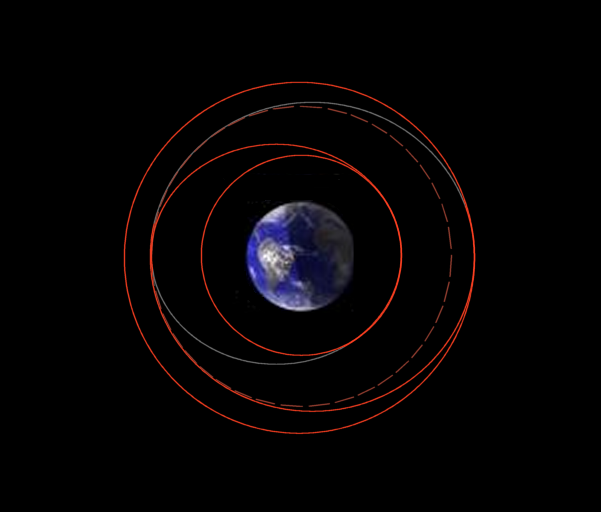
The diagram above demonstrates the path that one of the craft would take (see the second update below for more explanation). The dotted circle indicates where the two craft will meet for the first time, following the initial impulse. At that point, you could either project up to a higher elliptical orbit or circularize the orbit at that point. This process can be repeated over and over. Here is a version showing both craft, one in red and the other in brown. See also, this diagram of the Hohmann transfer orbit for the sake of comparison. The Hohmann transfer orbit is a method of raising a payload into a higher orbit using conventional thrusters.

The basic principle according to which these higher orbits are being achieved is akin to one being a bullet and the other being the gun. Because they have equal mass, the recoil would cause the same acceleration on the gun as it did on the bullet; they would start moving apart at equal velocity, in opposite directions. Because they can pass through one another, the ‘gun’ can be fired over and over. Because the power to do so comes from the sun, this can happen theoretically take place an infinite number of times, with a higher orbit generated after each.

Because each orbit is longer, the craft would intersect less and less frequently. This would be partially offset by the opportunity to collect more energy over the course of each orbit, for use during the boosting phase.

As such, orbit by orbit, the pair could climb farther and farther out of any gravity well in which it found itself: whether that of a planet, asteroid, or a star. Because the electromagnets could also be used in reverse, to slow the two projectiles equally, it could also ‘climb down’ into a lower orbit.

Applications

On planets like Earth, with thick atmospheres, such a system could only be used to lift payloads from low orbits achieved by other means to higher orbits. The benefit of that could be non-trivial, given that a low orbit takes place at about 700km and a geostationary orbit as used for communication and navigation satellites is at 35,790 km. Raising any mass to such an altitude requires formidable energy, despite the extent to which Earth’s gravity well becomes (exponentially) less powerful as the distance from the observer to the planet increases.

A system of such carriers could be used to shift materials from low to high orbit. The application here is especially exciting in airless or relatively airless environments. Ores mined from somewhere like the moon or an asteroid could be elevated in this way from a low starting point; with no atmosphere to get in the way, an orbit could be maintained at quite a low altitude above the surface.

Given a very long time period, such a device could even climb up through the gravity well that surrounds a star.

Problems

The first problem is one of accuracy. Making sure the two components would intersect with each orbit could be challenging. The magnets would have to be quite precisely aligned, and any small errors would need to be fixed so the craft would intersect properly. Because of sheer momentum, it would be an easier task with more massive craft. More massive vehicles would also take longer to rise in the gravity well through successive orbits, but would still require no fuel do so, beyond a minimal amount for correctional thrusters, which could be part of the payload.

Another problem could be that of time. I have done no calculations on how long it would take for such a device to climb from a low orbit to a high one. For raw ores, that might not matter very much. For satellite launches, it might matter rather more.

Can anyone see other problems?

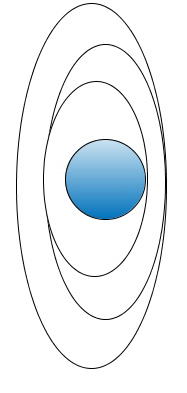
[Update: 7:26pm] Based on my extremely limited knowledge of astrophysics, it seems possible the successive orbits might look like this. Is that correct? My friend Mark theorizes that it would look like this.

[Update: 11 August 2006] Many thanks to Mark Cummins for creating the orbital diagram I have added above. We are pretty confident that this one is correct. He describes it thus: “your first impulse sends you from the first circle into an elliptical orbit. When your two modules next meet, (half way round the ellipse), you can circularize your orbit and insert into the dotted circle, or you can keep “climbing”, an insert into a larger ellipse. Repeat ad infinitum until you are at the desired altitude, then circularize.”

Newsfilter: Vanity Fair on 9/11

There is a Vanity Fair article that is getting a lot of attention right now, about the response of the North American Aerospace Defence Command (NORAD) to the September 11th hijackings. To me, it seems well worth reading, especially for the primary source material that is included. While it is obviously a particular selection of the available evidence, it does demonstrate convincingly that this was not a scenario for which a plan existed, or during which an accurate appraisal of the situation was forthcoming.

I still mean to go see United 93, if it is still playing in Oxford. Would anyone else be interested in going?

Nomenclature

Whoever names Israeli operations in Lebanon must have a real sense of irony:

Operation Peace for Galilee: Israeli invasion of Lebanon in 1982, in support of Maronite Christian militias. Initially presented by Ariel Sharon as a plan to advance 40km into Lebanon, it was apparently always meant to go as far as Beirut.

Operation Accountability: A week-long invasion of southern Lebanon in 1993.

Operation Grapes of Wrath: A series of air and artillery strikes in 1996, designed as an assault against Hezbollah. Admist the 20,000 shells fired into Lebanon was one that killed 118 Lebanese civilians who were sheltering in a UN base.

Regardless of the validity of Israeli arguments about a strong retaliatory response being the only way to prevent future kidnappings and attacks, ongoing Israeli actions appear increasingly out of proportion to their ostensible provocations. Hopefully, some means will be found soon to rein in the situation.

Violence around Israel

As is so often the case, it is only with the greatest of dismay that one can read headlines from the Middle East at the moment. What baffles me is that I cannot see what anyone hopes to gain from this looming conflict. Kidnapping Israeli soldiers is a good way to provoke massive retaliation (or provide justification for attacks planned before the kidnapping). At the same time, what Israel really hopes to achieve through incursions into Gaza and Lebanon is unclear. Almost certainly, there actions are further imperiling the hostages. The only comprehensible reasoning I can come up with is that the Israelis fear that anything less than a massive response to these kidnappings would encourage more.

The prospect of large-scale violence in the region, including considerable loss of life, is increasingly real. I am suspect that covert diplomatic efforts are being made on the part of the United States and others to urge greater restraint upon Israel, though a public condemnation seems pretty unlikely.

The only possible solution in the region is normalized relations between Israel, its neighbours, and a viable Palestinian state comprising the great majority of the West Bank and Gaza. The prospects of that point being reached are in the process of receding far off into the distance. And we can really do is hunker down for more bloodshed, while watching the oil producing nations (including Canada) rub their hands together in greedy anticipation of the further windfall from turmoil-boosted prices ahead.

[Update]: The Economist on this (requires subscription)
Patrick Porter on Israel and Lebanon (via OxBlog)

Lecture in the Taylorian

Graffiti near the Oxford CanalThe lecture today on Canada-US security and defence cooperation went well; it could even be a solid demonstration of the preferability of lecturing over research. I did talk overly quickly, burning through my forty-five minute presentation in just over half an hour, but the questions were good and I think I fielded them pretty well. The fear of going overtime can generate unwanted haste. I did manage to avoid a frequent error I’ve made in the past, namely that of getting lost in my own notes. It’s easier to avoid when you really know the material you’re covering, and the notes are for structure, rather than content.

A presentation on a topic like this is always a political act. On that basis, I think I struck the right note. I took the more truthful bits of the ‘staunch and eternal allies’ premise sometimes hammered upon by Canadian politicians under fire from the US and mixed it with some of the more essential elements of the ‘importance of legitimacy and international law’ scolding that with which we tend to fire back. All in all, I think it was reasonably balanced and candid. Wearing my NORAD pin – with Canadian and American flags on it – probably contributed positively to my ability to represent myself as someone who genuinely wants a friendly and constructive relationship between the two countries, and has considerable respect for both.

Lecturing itself was quite enjoyable, despite the associated anxiety. With a bit more practice and confidence, I think that I could get very good at this, indeed.