On Valletta and Jeffrey Sachs

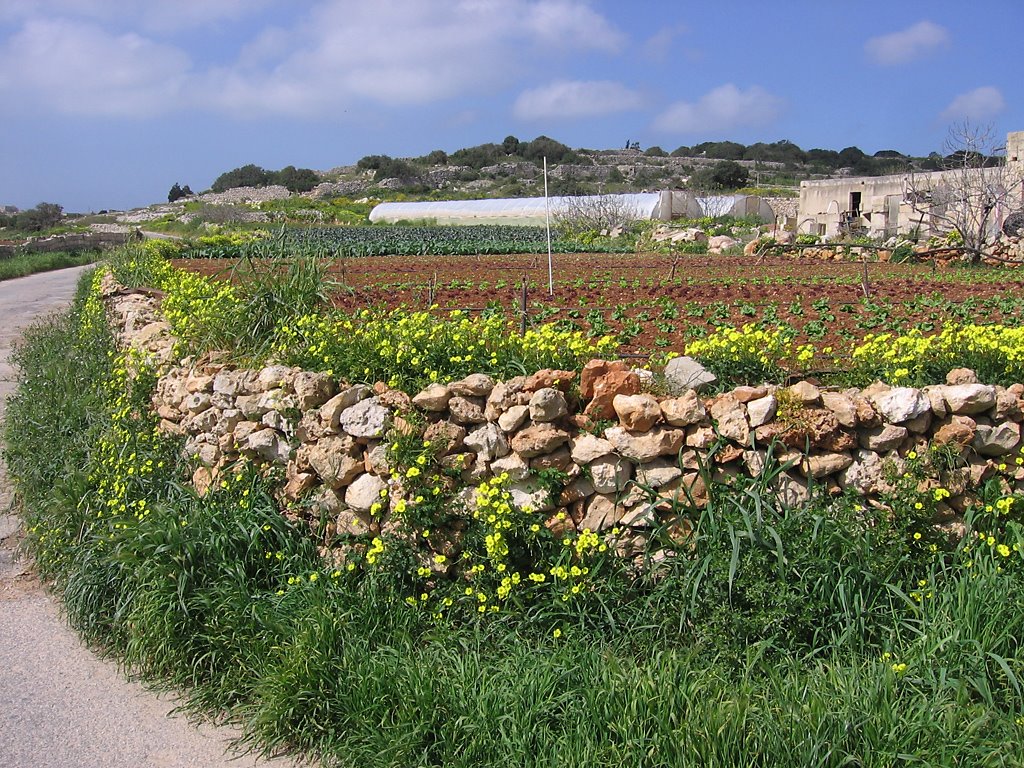
Church of Our Lady of Victory, Mellieha

Happy Birthday Robert Wood

My mother and I visited the fortified port of Valletta today. Aside from walking about in the centre of town, the group also took a boat cruise along the edge of the harbour, which divides into narrow sections like the fingers of two hands. Like Tallinn, Valletta has been subjected to a great many attacks and invasions, from different directions and in different periods. The ongoing strategic importance of a useful pair of islands in the middle of the Mediterranean is thereby demonstrated.

The city itself reminds me a great deal of the quieter parts of Rome. The streets are narrow and flanked by multi-story buildings with shuttered windows. Wild cats are numerous and fearless: sunning themselves and adding to the menace posed to Maltese birds by the many shooting clubs you can hear off in the countryside. The main cathedral is quite an unusual building, with a floor plan markedly different from that of any Christian church I can recall seeing, as well as a profusion of patterned wall sections composed of deep grooves cut in stone.

Today involved much less walking than the first day – a shortfall that it seems will be remedied tomorrow as we walk to and around the old capital of Rabat. I hope that the many photos I took over the course of the boat ride and wandering in Valletta will turn out well.

While I have been in Malta, I have been reading Jeffrey Sachs’ The End of Poverty. While it’s not the most well written book – his excess of exclamation marks is especially annoying – it is nonetheless one that strikes me as extremely important. The idea that we could eliminate the kind of extreme poverty that cuts people off from any chance of improving their lot and that of their children by 2025 is a profoundly inspiring and exciting one. It’s the kind of idea you really wish could take hold within the corridors of power and the hearts and minds of people in the developed world. It’s the kind of project that is enormously more important than any one life, or even the entire history of any one country. The imperative is to act as a collective in a way that humanity has never managed: to conjure the mechanisms by which bold ideas and conceptions of justice can be converted into reality out in the world. To be shown fairly convincingly that we have the power to end untold misery around the globe creates a real obligation to make good on that potential. It’s an effort that I hope to become a part of.

Nervous, trundling day

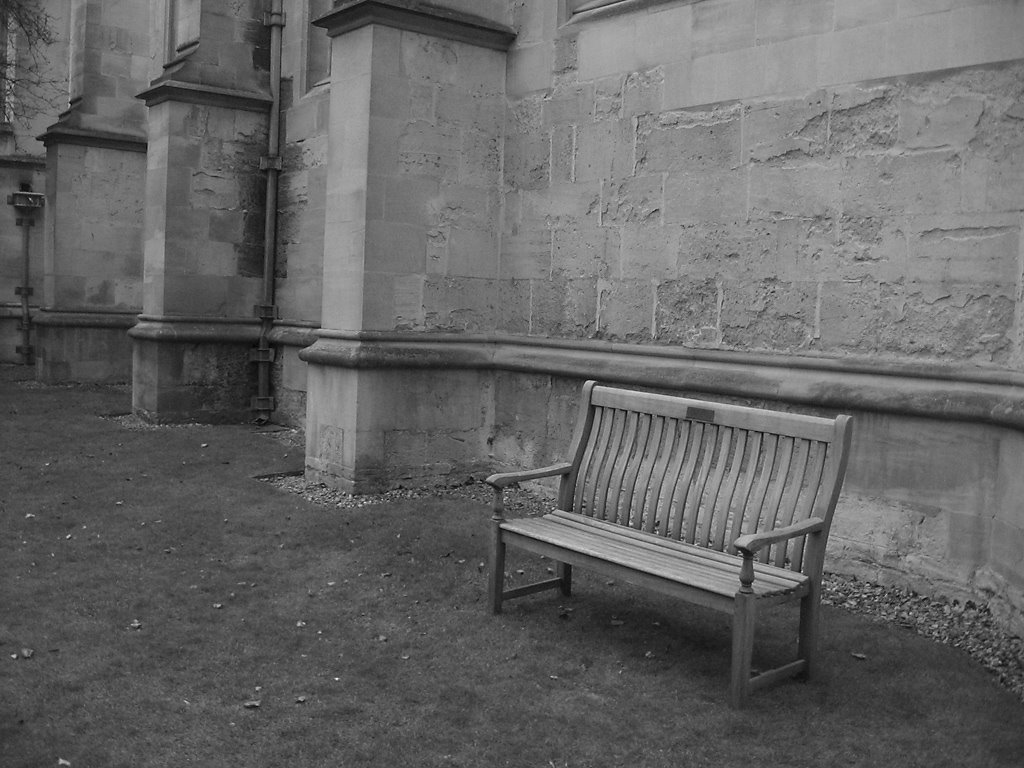
Empty bench, Wadham gardens

On the basis of a highly scientific and statistically valid one-night, one-person study, I wake up feeling much more rested when I sleep with earplugs. I also dream about getting attacked by a huge scruffy black house cat in the woods beside Capilano River.

I spent several hours today in the Oxford Country Library, near Nuffield, reading Hunter Thompson’s The Rum Diary. As you would expect, it’s a fairly ugly book. The kind of thing that stays funny when it’s in the realm of absurd abstraction, yet is always still tinged with the certainly of loss and failure. It’s nice, at least, to just pick up a book and read it, without major pause. You would need to be superhuman to do it with an environmental politics book, but for a 400 page pseudo-autobiographical novel, the pattern fits. Reading Thompson is like taking insurance against the possibility that you’re a hub in the machine that he seems to understand and mostly exist outside of. The danger is that you might see your loneliness reflected in his own.

All told, it’s not the greatest book, and it certainly doesn’t add a lustre to your day. At the same time, Thompson wrote it when he was my age and there is a sense in which you can see the future laid out in it: his future, in particular. You see that in what may be the most notable phrase:

It was the tension between these two poles – a restless idealism on one hand and a sense of impending doom on the other – that kept me going.

Your classic “narrator arrives in a place, things go wrong, he leaves” story, it reminds me of a lot of contemporary fiction. It’s the anti-journey story, where there is no clear end and even the process of travel collapses upon itself.

Spending time in the public library reminded me of one of the great truths of travel. Almost everything about your experience in a city is determined by how many doors you can open, or have opened for you. If all you can muster is the automatic doors at the entrances of libraries and shopping malls, you’re in a pretty bad way. The idea was reinforced as I took a quick walk around the long pool in Nuffield – perhaps my favourite quad in Oxford – and contemplated with appreciation the benefits of position and connection.

Oxford is peppered today with people in green, with top hats and Leprechaun boots. Were it not for my very early morning rise tomorrow, and the importance of being awake and aware subsequently, I might make a foray to see how this de-Christianized celebration of a saint takes place here. I was nervous, at first, to see people walking around with this kind of regalia – images of football related violence and painted fans flickering in my imagination – but when I saw that it was mostly people under fifteen or over thirty-five, my mind was largely put at ease.

I suppose I should spend tonight getting a start on the new Economist, making sure I have a clean shirt, and checking that I can remember how to tie a tie.

Socially accomplished day

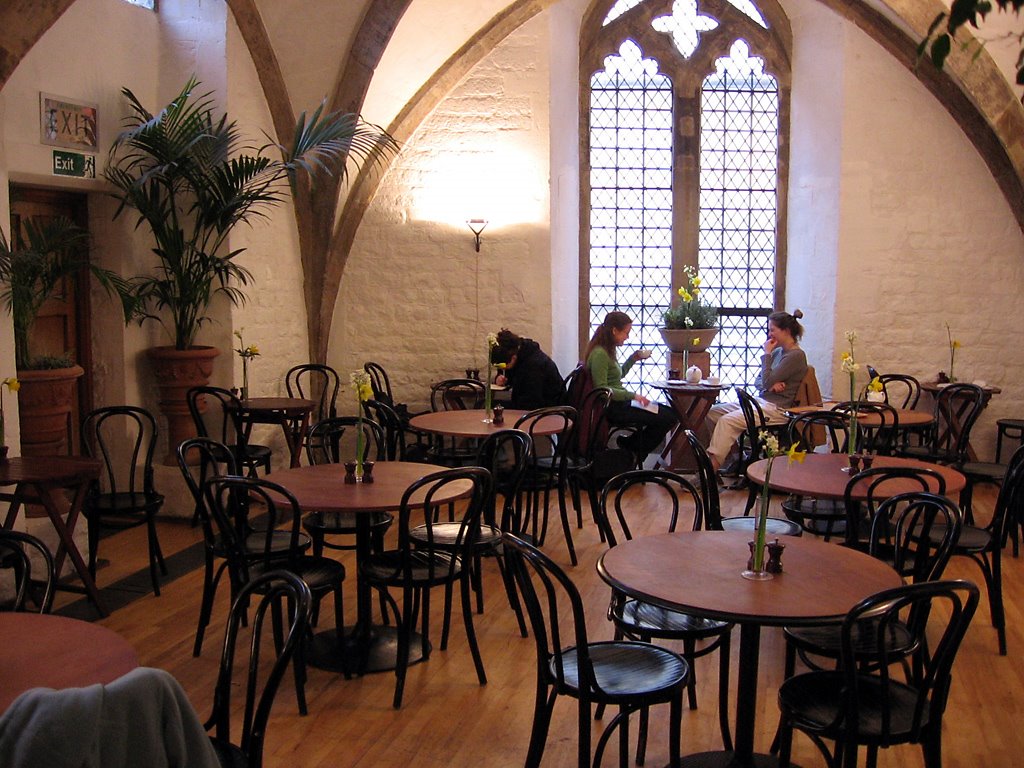
The Vault and Gardens

Happy Birthday Astrid

Good things in the mail

This morning, I was delighted to find a package from Meghan Mathieson in my pidge. Along with a letter, she sent me a vegetarian cookbook published by the British Columbia Ministry of Health and a package of that fieriest of snacks: Kasugai Roasted Hot Green Peas. Covered in a layer of dry Wasabi, they can have an exceptional amount of kick to them. They are just the kind of food that is ubiquitous in Vancouver, but quite unheard of here. Many thanks.

The cookbook, called The Vegetarian Edge is liberally sprinkled with exclamation marks and the kind of statements over-excited camp counsellors might make. For instance, it exclaims: “All right! You’ve decided to go vegetarian” before suggesting how to “Get to THE MAX each day!” It promises to be quite useful, though I have my doubts about whether I could consume the recommended 200-300g of tofu a day. I will provide extra protein in lentil form.

Good things in the evening

Spending some time with Nora, Kelly, and Bryn today was both enjoyable and appropriate, seeing as how I have less than a month left of living in the main site at Wadham. The aspect of the move that I regret most is that it risks further detaching me from social life in the college. Hopefully, that will not prove to be the case.

Social happenings later in the day also went very well. Spending three and a half hours talking with Roz tonight was really excellent. It was the kind of conversation in which you could feel the seeds of a great many future conversations – especially in the areas that I know relatively little about. It’s interesting to see how many of the same ideas come up in IR and literary theory, respectively, and how similar perspectives are associated with completely different people. All in all, it was the kind of conversation that strongly reinforces your sense that you were right in thinking a person interesting, as well as worth knowing better.

I hope I have the chance to see her again before she goes to Italy and I go to Malta.


  • It looks like I will be going to Cambridge for a Wadham exchange dinner on April 4th: the day my mother will be leaving the UK.
  • Seems that image posting is still broken. Sorry.
  • Private, to Meghan: I’m sorry we spent so many days eating spicy curry on potatoes…

Chapter 246: In which Milan demonstrates philosophical ineptitude

In the middle of the afternoon, I made a concerted effort to read the Heidegger paper that Tristan sent me a few weeks ago: The Question Concerning Technology. It was meant to be a contribution to my ‘discretionary reading on environmental politics related matter’ effort. I know it will annoy him to say that I found it mostly incomprehensible – in both approach and diction – but that is assuredly the fact of the matter. Heidegger goes on and on about Greek and the nature of silver chalices. While I am sure the example would be brilliantly illustrative if I had any idea of what he was talking about, it serves no purpose for me. It’s akin, I think, to someone who knows nothing about computers sitting down with a dense text on scripting and the UNIX command prompt.

Just as arcane knowledge of computers alienates you from everyone who does not have it – by stripping you of the ability to communicate as richly as you could if you were alike in ignorance – such knowledge leads to tremendous frustration whenever you deal with someone who has it in the opposite quantity. The computer geek is as frustrating and incomprehensible to the neophyte as the neophyte is to the geek. The knowledge that is a source of pride for the geek is often marked off as unnecessary to the neophyte, for whom it only serves an instrumental purpose: a purpose that can be achieved indirectly, by enlisting the aid of the geek. What enlisting the aid of philosophers means, exactly, I don’t know, but I consider much of philosophy to be marked off in the space of “information for others to deal with.”

This is not necessarily an embracing of ignorance, but perhaps more properly a response to the impossible vastness of knowledge and the sheer variety of dialects in which that knowledge is stored and discussed. It’s paradoxical, but ultimately obvious, that increased understanding of something can actually strip you of the ability to explain it or deal with people who don’t understand it. Attending lectures of someone who has colossal knowledge of a truly obscure field is among the best possible demonstrations of how knowledge is a cage.

Of course, when were talking about the physical sciences, there can be an external referent for expertise. I may not be able to understand what an engineer means when they talk about stress factors or the properties of metals, but I can see whether the bridge stays up or crashes down. Likewise, physicists and chemists can make predictions and develop technologies that demonstrate that their knowledge is – in some sense – correct. What comparable contribution can philosophers or, for that matter, international relations scholars make?

So much of what we do is like the nuances of a traditional Japanese tea ceremony: only those with considerable specific knowledge could ever know whether what was being performed was correct or merely a close approximation. No observer not steeped in the tradition could tell and, in a broad sense, the tradition itself is completely arbitrary. If we had all argued our way to some other equilibrium, it would serve exactly the same role as this one.

Take-home exam and contemplation of dreams

Bikes near the train station

Morning and early afternoon: reading and writing

I am really enjoying The Wind-up Bird Chronicle. As with most fiction, that is a result of the narrator. You need to see their project as valuable, yet not something you could or would do yourself. As such, they are doing you a service by living in that capacity in your stead. You get the results back in neat lines on pages. In good fiction, those results feel a lot like memory. They get overlaid upon your own memory, as though you had thought those things yourself in moments similar to the ones portrayed.

I have been dreaming copiously of late. I can set the countdown timer on my phone for ten minutes, lie down, and dream something – even in the middle of the day. Sleeping for an hour or to, I might have a half dozen dreams: all of which I can remember for a minute or two afterwards, but none that I will remember an hour later. I don’t know if this is just a meaningless phenomenon or whether it represents some kind of ongoing psychological condition. It’s certainly not something that’s normal for me.

It’s nice to imagine that my brain is doing some kind of internal housekeeping or reorganization and, as such, sleeping is not a waste of time. Rather, it will allow me – very soon now – to come at all problems with a piercing new intelligence and command of language and memory.

I read a few chapters of Murakami’s book between reading and writing pages for my take-home test. It’s hard to evaluate the Inuit Circumpolar Conference from the perspective of the principal-agent framework. Firstly, that’s because there isn’t actually a lot of information out there about it. Secondly, the framework seems better suited to institutions with a more defined structure. That said, understanding the ICC is important – for a number of reasons I identify in the latest draft – and it’s probably at least a bit important to understand the extent to which this framework works for it. That makes writing the exam much less of a chore.

During all of this, I listened to Tegan & Sara.

Late afternoon and evening

I met Louise at the train station and spent a while with her getting coffee and then groceries before she went off for dinner with friends and German backpackers and I returned to Wadham to carry on working on my take home exam. Getting it done completely tonight, or even just to the point where it requires only final linguistic and conceptual editing, would liberate tomorrow – a benefit that is not to be sneered at.

I will, after all, have another week’s reading to do for Tuesday and Thursday, as well as writing a manifesto for the Security Studies Group election. Next’s week’s general topic is international society and international law, and the specific question which to which I must prepare and answer is:

What is meant by the concept of international society? In what ways does it represent a challenge to realism?

Thankfully, this is something that I already know at least a bit about. Coming up next in qualitative methods: “Archives, Texts, and Sources,” beginning with “Bonapartism and popular political culture.”

Cartoons and cultural clashes

A quick comment regarding the continuing row about the Danish cartoon depictions of Mohammed. No collective response to an incident becomes this big or carries on this long without some kind of coordination and organization. While the whole situation is clearly based on a great deal of legitimate anger, it is nonetheless sentiment that is being excited and manipulated. That’s not to imply that some kind of global conspiracy is at work, but simply to say that I don’t accept that these protests are spontaneous or free of manipulation. Given their destructive nature, I think it will be instructive to eventually determine what forces have been trying to exploit this issue, through what means, and to what level of success.

As I was discussing with Tristan earlier today, the symbolic character of conflict is an essential dimension for understanding it. It’s one that requires examination both of individual psychology and the ways in which groups of people think. One excellent book I can recall from Brian Job’s security studies class at UBC is Kaufman’s Modern hatreds: the symbolic politics of ethnic war. Those wanting a far better explanation of some of these issues than I can provide should have a look.

Seventeen days until the equinox

Sheldonian head

During our qualitative methods class today, on institutions, Dr. Ngaire Woods made an excellent point. Each of us has a year to become an expert on a particular subject. There are hardly any people in the entire world who ever have the chance to devote such time and attention to an issue and there is a good chance that, at the end, we will know more about our subject than anyone in the world. This underscores both the importance of choosing a topic well and of really committing yourself to writing something excellent. Producing something that will be read by people beyond the examination committee and people kind enough to edit it for me would also be a big advantage.

The institutions section of the qualitative methods course is much better than the scattershot attempt at foreign policy analysis that came before it. That is welcome, especially since I have a take-home exam to write on the course between the 9th and 13th of this month – most inconvenient timing. Hopefully, I will be able to get the thing mostly done next Friday, leaving the weekend relatively unencumbered.

After class, this afternoon, I had coffee with Claire, Josiah, and another of her St. Cross friends who I am embarassed to be unable to remember the name of. Followed that closely was tea with Joelle Faulkner. We tried the Tieguanyin tea that Neal sent. It’s more subtle than I expected, though not nearly so much so as the Jamine Pearl tea that Kate once gave me. I am going to try making it with bottled water, in the knowledge that the amount of dissolved minerals in Oxford tap water is quite substantial.

Hopefully, tomorrow I will be able to finish most of Tarak Barkawi and Mark Laffer’s Democracy, Liberalism, and War, William Connolly’s The Terms of Political Discourse, and what remains of this week’s readings on institutions. I have a paper due for Dr. Hurrell on Wednesday, evaluating the democratic peace theory. I will also have a new issue of The Economist upon which to complete a preliminary read.

I’ve now finished the first book of The Wind up Bird Chronicle and perhaps the first tenth of Democracy in America. I don’t know if it’s an overly self-serving thing to believe, but I don’t think that any kind of reading is irrelevant or a distraction. While there are certainly things that it is more urgent for me to read, to neglect other areas of interest would ultimately be counterproductive and unwise. Neither American democracy nor Japanese literature are even distantly divorced from the question of democratic peace, and good writing is never irrelevant.


25 things I am:Canoeist, geek, webmaster, environmentalist, caucasian,
student, heterosexual, reader, writer, photographer,
Czech, Ukranian, atheist, Oxfordian, skeptic,
liberal, vegetarian, single, Canadian, hiker,
bilingual, healthy, rich, educated, male.

War is a Force that Gives us Meaning

This afternoon, I read Chris Hedges’ War is a Force that Gives us Meaning. It made me wonder whether the wars of my generation: Afghanistan, Iraq, and all the others, have just re-taught lessons learned by other generations before. Much as we might hope that justice or democracy can be spread by such means, it now appears that our hopes were misplaced. What’s worse, perhaps, is the failure of many to understand what’s going on, or even make an honest effort to do so. There has been an absence of inquiry and, even worse, interest in the truth of the matter or, at least, the closest approximation of the truth we can reach. Whatever else the present American administration is guilty of, it has, at many points, been dangerously unhinged from reality – at least in terms of what it presents the public. I don’t mean to take a general commentary and direct it in a cliched and partisan direction, but the world is awash in evidence that war and truth are frequently incompatible.

Similar grim revelations accompany the missed opportunities to curtail bloodshed: Bosnia, the Congo, Rwanda, and elsewhere. These are, perhaps, the strongest reminder that simple pacifism isn’t an adequate answer to the problem of war. We have to wade into the more complex, the more ambiguous, terrain of responsibility and intervention.

Hedges’ many personal anecdotes – both stories of his own and stories acquired from others over the course of a long and distinguished journalistic career – form the heart of the book. Beside them, generalized philosophical reflections about warfare, nationalism, and culture seem to be lacking in poignancy. It is the role of journalism, perhaps, to deliver that poignancy to those for whom an event or conflict is just some distant abstraction: much as the ongoing genocide in Darfur is for almost all of us now.


Citation: Hedges, Chris. War Is a Force That Gives Us Meaning. Oxford: PublicAffairs, 2002.

Alternative Careers Fair

Vines on a wall

The better part of today was taken up attending the Alternative Careers Fair, over in the exam schools. I attended two sessions: the one on ‘Arts’ because it included Philip Pullman and the one on ‘Environment.’ Neither was exactly what I expected. Overall, the experience was interesting – and it was good to meet Mr. Pullman – but it did not assist me in finding employment for the summer. Of course, a ‘careers fair’ is generally meant to have a longer term focus than that.

The arts panel was heavily dominated by Lorraine Platt, a painter who spoke first and for more than twice her alloted length of time. A series of disjointed observations and repeated statements, I didn’t find much that was useful or insightful in her presentation. That said, if I was contemplating a painting career, I might feel differently.

Mr. Pullman spoke last, after a musical therapist, for about twenty minutes. A bespectacled, balding man, I am amused to note that he wore exactly the same shirt as is featured in his portait on his website. His presentation was interesting partly because it seemed to portray an unusually focused life for a fiction author. While he described a number of jobs he has done over the years, none of them involved any writing or any cessation from attempts at novel writing. While you obviously can’t get the sense of a person’s life in twenty minutes, it was nonetheless a vignette of a committed person. Three pages a day, he says, has been his standard from the beginning.

Pullman spoke comfortably and with humour, quite unlike the more overbearing characters who directed the next seminar. His stress upon the importance of writing a good first page, and a good first chapter, is definitely reflected in his books: particularly The Golden Compass, which I consider to have one of the most skillful openings of any book I’ve read. As for motivational advice, he offered the following tidbit: “You need to be slightly insane, really. That’s what kept me going.”

After the session, I spoke with him very briefly and got him to inscribe my copy of Paradise Lost, since it was already signed and represents the only piece of his work I have with me in Oxford. It was amusing to note that, among the group of young women with whom I stood in order to have a book signed, more than half were past or present students of Wadham College. That said, I didn’t recognize any of them.

The environment panel, which I attended after wandering the booths upstairs for a while and speaking with Natalie Lundsteen from the Career Service, included George Marshall and John Manoocherhri. Aside from an evident shared passion for the environment and for their work, the men were quite different. Mr. Marshall spoke with skill, but some hesitation, like someone who has never really enjoyed addressing an audience. He was careful to at least bracket and identify the bits of his short autobiography that might seem presumptuous or vain. His work on tropical forests in the Asia Pacific reminded me of Peter Dauvergne.

Mr. Manoocherhri, in stark contrast, tended towards the bombastic, the arrogant, and the foul-mouthed. While he initially came off as plain speaking, energetic, and direct, over the course of his presentation he became decreasingly attractive. He had a great willingness to pronounce himself expert on a matter, as well as a general mode of speech that was saturated with an over-certainty that diminished his credibility. While he did tell people much of what they wanted to hear (about how we will all have superb jobs in the environmental field), I don’t know if he actually contributed a large amount of usable information. That said, I am still glad to have attended his talk.

Employment possibilities for the summer remain elusive. My three forays to the career service have produced starkly different pieces of advice. I was told, the first time, that I should apply for a job doing consulting or investment banking, because they would help pay down my student debt and they aren’t terribly hard to get into if you can say the right things. The next time, I was told that I absolutely should not apply in those fields and, if I did, I would just get rejected anyway. Instead, it was suggested, I should look for a job related to writing or the environment. Today, I was told that any work I did on the environment or doing writing over the summer would almost certainly be unpaid, and that I should get a job in the college or in a pub in order to sustain myself.

‘Marketing myself’ is just the sort of thing I find difficult, frustrating, and profoundly unappealing. Applying for things requires exerting effort towards no productive end, save overcoming the various obstacles between yourself and a job. It requires a certain kind of distorted self-presentation that frequently borders on being deceptive. I hope I will be able to find some sort of position for the summer without too much of that.

Anyhow, I shall be working on my core seminar essay tonight. Not the most exciting option for a Saturday, by any means, but that which is presently required. Since all copies of the readings that can be withdrawn from the SSL have been, I need to go there at a time when the confined copies are relatively likely to be free. Tomorrow should be better, if I can get a good amount of work done tonight. I am looking forward to coffee with Margaret in the morning.


  • I realize that I never wrote anything about the big birthday party in Wadham last night. This is an intentional response to how bothersome writing anything about the college has generally been. Between people who absolutely do not want to be mentioned and people who are annoyed when they aren’t, the level of diplomacy involved is just beyond what I am willing to put up with at the moment. That said, I was quite glad to meet Seth and I hope the bloggers’ gathering he has mooted comes together soon.
  • My French is seriously slipping, due to total lack of usage. Does anyone know of a good free French news podcast that I could listen to, just to have some exposure to the language? Thanks.

Of blogs and brevity

A quad in Christ Church College, near Merton Street

I have a new rule: at least for the time being. I am going to aim for focused, interesting blog posts that are no more than a few paragraphs. The writing should be better, more people should feel inclined to read it, and I should consequently have more time for academic work, or at least non-computer stuff.

I need to adjust the structure of life so that it involves more reading. Having seminars of 14 to 28 people, it isn’t really necessary to have read anywhere close to the total amount assigned in order to contribute to the discussion. As such, and especially without the possibility of being called upon to present, there is a lack of structural incentive to do a great deal of reading. For me, this might be most easily overcome by making reading a more social experience. The presence of others helps keep me focused and aids in resisting the desire to go and do something else – a desire that always becomes more powerful when the matter I am reading is not particularly compelling.

I started the copy of Haruki Murakami’s The Wind up Bird Chronicle that Tristan sent me for Christmas. Three chapters in, it definitely has the oddity that seems to be characteristic of Japanese film and literature. At the same time, it lays out the oddity in a way that is intentionally structured like a mystery – it’s clear that we’re meant to eventually learn what’s going on.

As always, speaking with Astrid this afternoon was interesting. Her personal policy of not engaging in meaningless chatter over MSN of the “so, what are you up to?” variety is one that frequently proves laudable, particularly when combined with her infrequent forays into that domain. She is in Argentina now, returning to Vancouver in about a month.