
Category: Canada
Anything related to Canada or Canadians
A starting point in grass identification
Grasses create a special challenge when it comes to identifying native plants, and even experienced experts have told me they have trouble with it.
I recently got a useful start from Natasha Gonsalves’ presentation for the Toronto and Region Conservation Authority (TRCA): “Getting to Know Grasses“.
I’m still an absolute beginner, but at least know I know a bit of the relevant anatomical vocabulary and have a sense of the difference between grass and grass-like plants like sedges and rushes.
Carney caving on Keystone
More evidence is emerging that Prime Minister Mark Carney is choosing to ignore what he knows about climate change economics to do precisely the wrong thing. He is thinking of reviving the Keystone XL pipeline.
As a world expert on climate change economics, Carney could tell you that the crucial thing is to avoid locking in inappropriate long-term investments in fossil fuels which we will need to scrap early and which will delay and raise the costs of dealing with climate change. Unfortunately, the political imperative to cater to the planet-wrecking industry has overpowered his expertise, honesty, or integrity. The sad fact is, once built, even the dirtiest projects are politically agonizing to shut down. Carney is ignoring the most elementary requirement of controlling climate change: to stop building the fossil fuel infrastructure that causes the problem.
Related:
A shark from the library
Libraries have been one of life’s joys for me.
The first one I remember was at Cleveland Elementary School. From the beginning, I appreciated the calm environment and, above all, access at will to a capacious body of material. All through life, I have cherished the approach of librarians, who I have never found to question me about why I want to know something. Teachers could be less tolerant: I remember one from grade 3-4 objecting to me checking out both a book on electron micrography and a Tintin comic, as though anyone interested in the former ought to be ‘beyond’ the latter.
At UBC, I was most often at the desks along the huge glass front wall of Koerner library – though campus offered several appealing alternatives. One section of the old Main Library stacks seemed designed by naval architects, all narrow ladders and tight bounded spaces, with some hidden study rooms which could be accessed only by indirect paths.
Oxford of course was a paradise of libraries. I would do circuits where I read and worked in one place for about 45 minutes before moving to the next, from the Wadham College library to Blackwell’s books outside to the Social Sciences Library or a coffee shop or the Codrington Library or the Bodleian.
Yesterday I was walking home in the snow along Bloor and Yonge street and peeked in to the Toronto Reference Library. On the ground floor is a Digital Innovation Hub which used to house the Asquith custom printing press, where we made the paper copies of the U of T fossil fuel divestment brief. This time I was admiring their collection of 3D prints, and was surprised to learn that a shark with an articulated spine could be printed that way, rather than in parts to be assembled.
With an hour left before the library closed, the librarian queued up a shark for me at a size small enough to print, and it has the same satisfying and implausible-seeming articulation.
I have been feeling excessively confined lately. With snow, ice, and salt on everything it’s no time for cycling, and it creates a kind of cabin fever to only see work and home. I am resolved to spend more time at the Toronto Reference Library as an alternative.
Love and a city’s possibilities
‘What does love have to do with it?’ asked the late Pier Giorgio Di Cicco in his 2007 book, Municipal Mind: Manifestos for the Creative City. He was Toronto’s second poet laureate, from 2004 to 2009, and the book is his legacy project from that time. Di Cicco had a passionate, sometimes combustible-seeming connection to Toronto. A practicing Catholic priest, he wore black leather jackets and turtlenecks, smoked cigarettes, and spoke with a fantastic gravelly voice. A cool priest even, cooler than I ever knew from thirteen years of Catholic school. ‘A town that is not in love with itself is irresponsible, and civilly apt for mistakes,’ he wrote. ‘A citizenry is incited to action by the eros of mutual care, by having a common object of love — their city. A town that is not in love with itself will cut corners; lose sight of the common good.’
Love is also something you would be hard-pressed to find in official city statutes, but ask yourself if you love Toronto or whichever city you live in. Often the answer is no: cities are frustrating, but how can we care about something we don’t also love? In a section of Municipal Mind called ‘Restoring the Soul to the City,’ Di Cicco tried to conjure a Toronto that could be — something we could aspire to. ‘Developers are generally not known for their philosophical bent, but for their market enthusiasm,’ he wrote. ‘But it was a developer who told me the truest thing about cities: Speaking of Florence, a place that revitalized a civilization by a standard of civic care and design excellence, my friend remarked, “You know, Florence was already there, before a building ever went up.”
Toronto is certainly not Florence, and those with little imagination will dismiss the poetry about a city as useless, but Di Cicco was encouraging us to dream up an ideal Toronto that could be something to strive for as this place continues to grow and change. It could be about the architecture, but it also could be the sidewalks, more equitable and affordable housing, lusher parks, or ample public washrooms. Is Toronto living up to the city we dream of? From Di Cicco’s point of view, these collective ideals and visions are what make Toronto beautiful, rather than the stuff already built. It’s possible to dream of a better Toronto even while loving the current one. Perhaps it’s the only way to dream.
Micallef, Shawn. Stroll: Psychogeographic Walking Tours of Toronto. Updated Edition. Coach House Press, 2024. p. 15
Contrast with: This uncivil city
Foreward to Stroll
A new, cool style of engaging and enjoying metropolitan realities has recently emerged in Toronto among certain young writers, artists, architects, and persons without portfolio. These people can be recognized by their careful gaze at things most others ignore: places off the tourist map of Toronto’s notable sights, the clutter of sidewalk signage and graffiti, the grain inscribed on the urban surface by the drift of populations and the cuts of fashion.
Their typical tactic is the stroll. The typical product of strolling is knowledge that cannot be acquired merely by studying maps, guidebooks, and statistics. Rather, it is a matter of the body, knowing the city by pacing off its streets and neighbourhoods, recovering the deep, enduring traces of our inhabitation by encountering directly the fabric of buildings and the legends we have built here during the last two centuries. Some of these strollers, including Shawn Micallef, have joined forces to make Spacing magazine. But Shawn has done more than that. He has recorded his strolls in EYE WEEKLY, and these meditations, in turn, have provided the raw material for the present book. The result you have in your hands is a new introduction to Toronto as it reveals itself to the patient walker, and an invitation to walk abroad on our own errands of discovery, uncovering the memories, codes, and messages hidden in the text that is our city.
Foreward from first edition, Toronto, 2010
John Bentley Mays, 1941–2016
Micallef, Shawn. Stroll: Psychogeographic Walking Tours of Toronto. Updated Edition. Coach House Press, 2024. p. 7
New parkland
I’m excited about Toronto’s launch of Biidaasige Park tomorrow. How often does a city get a big new area of green space, and in as geographically and ecologically important a place as a river mouth?
The current extent of the PanWalks Project
Muscle exertion, and drawing by moving, on foot and by mechanical bicycle:
Pandemic walks extentification project
My pandemic walks project has involved a lot of densification: trying to exhaustively make use of all possible routes within a geographic area, acting as a kind of human radioactive tracer running through the city’s circulatory system.
This has been interesting and has led to some nice still and animated art.
At the same time, the whole project was motivated in part by the desire to avoid visiting and re-visiting the same areas during the pandemic. That, combined with pleasant spring weather, has me thinking about reorienting from densification toward extentification, both undertaking new rides to expand the total area explored and working to add days with over 100 km of riding.
I made some maps to get a sense of how long it would take to get beyond the explored region. I added lines to show the distances to places on the outermost edges of the explored area and, in parentheses, added the Google Maps bicycle travel times there from Brentwood Towers:
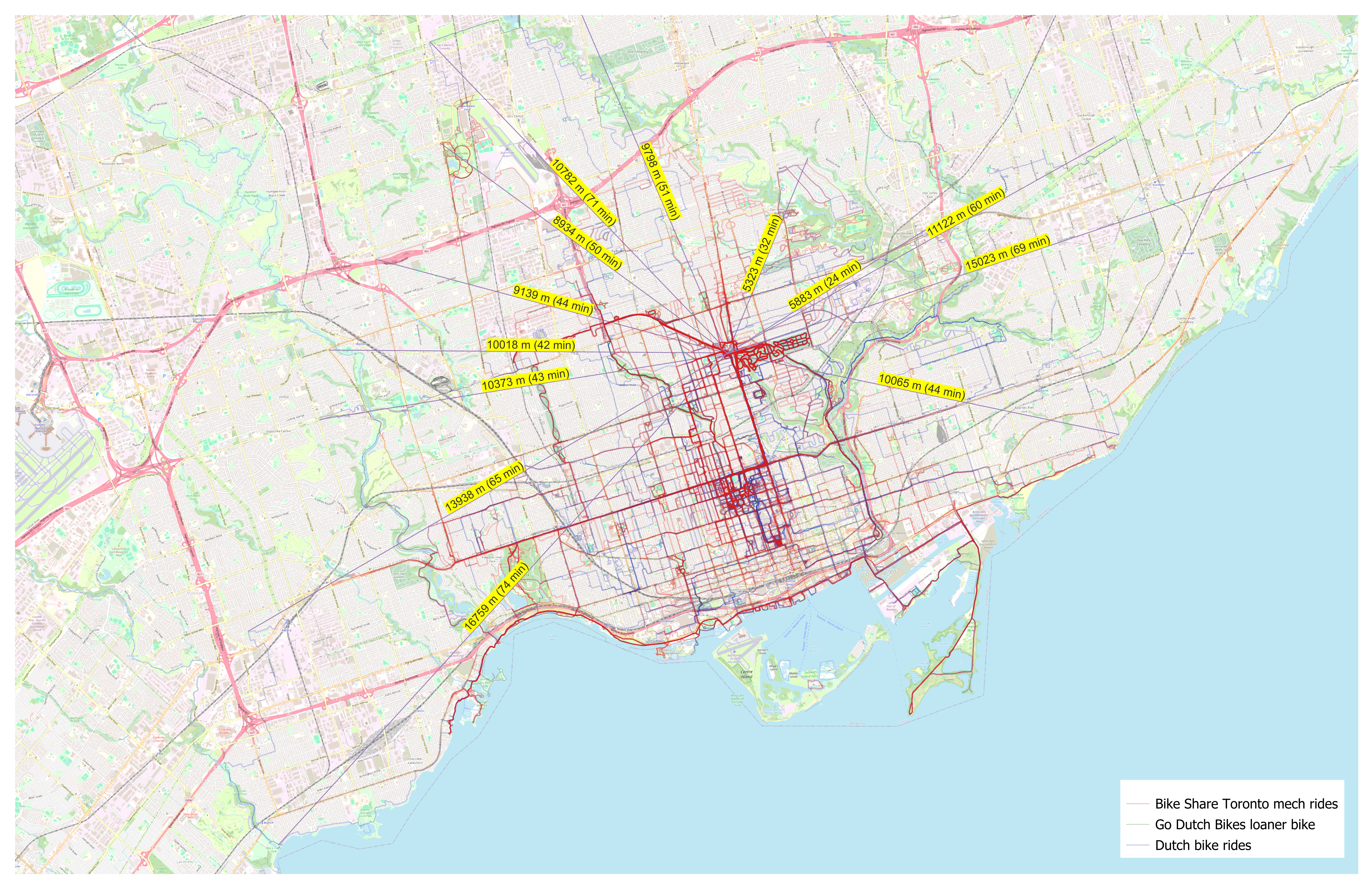
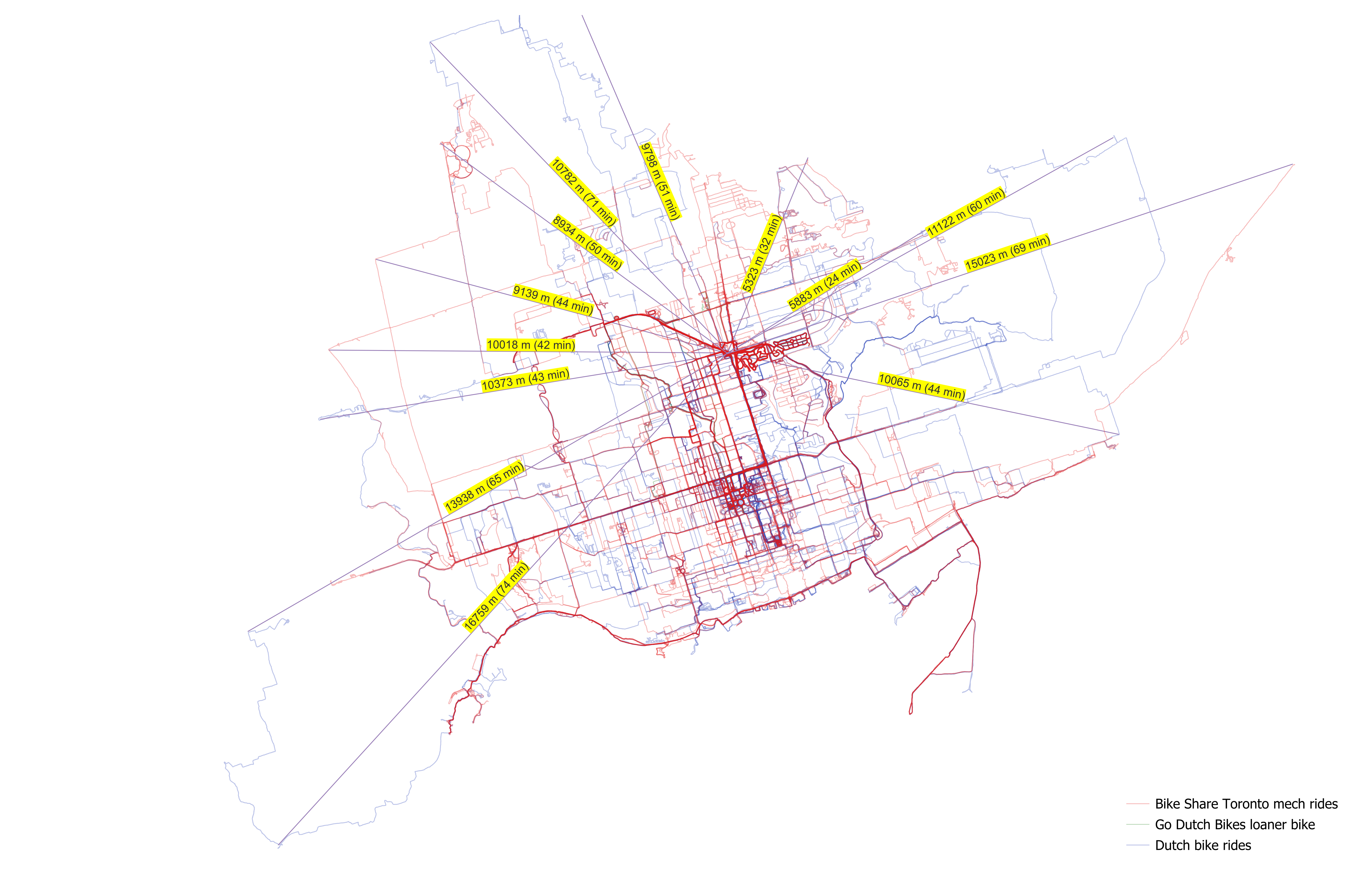
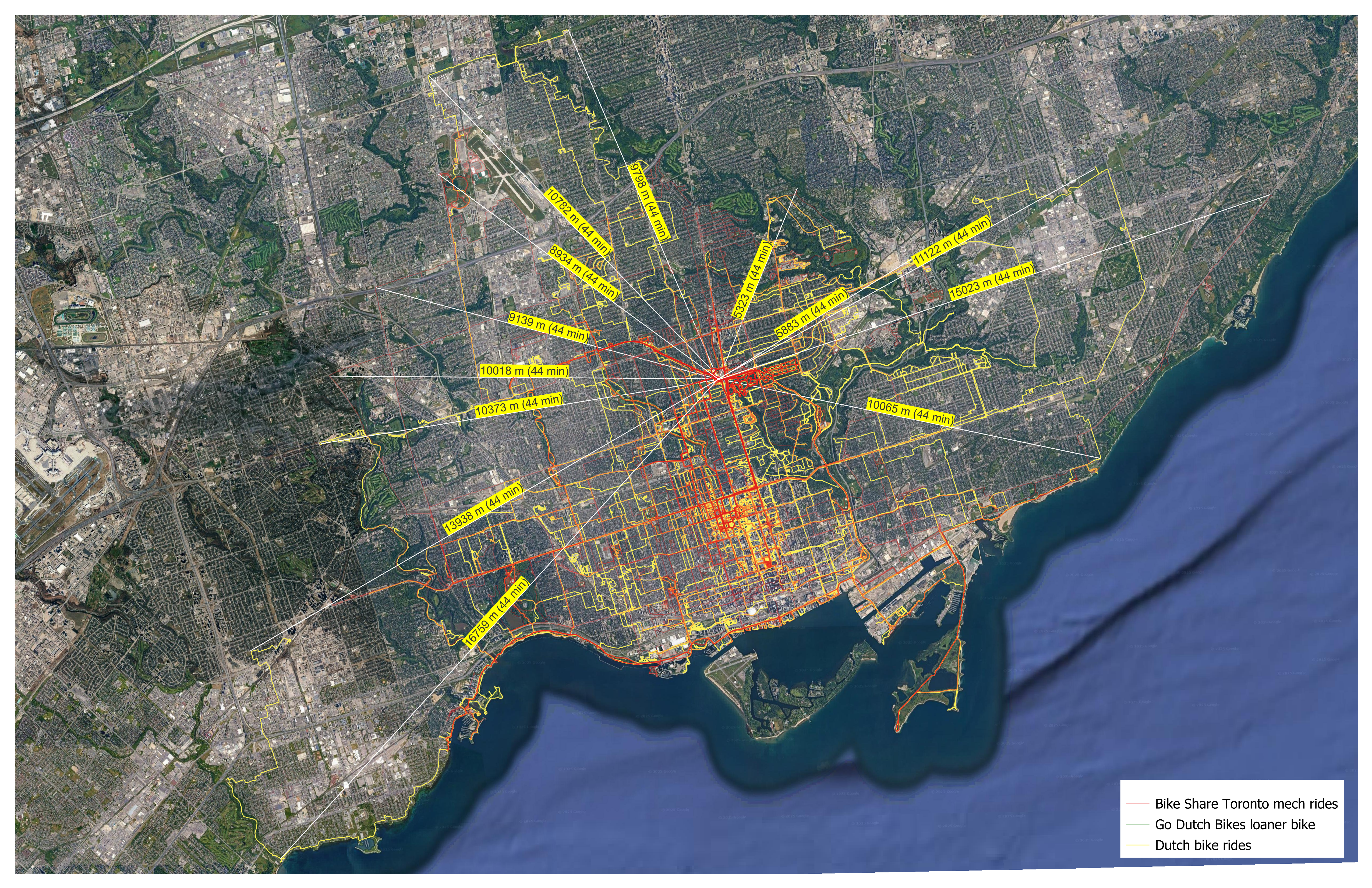
(Sorry the travel times are glitched in the final map; I wanted to make all the lines the same colour and accidentally overwrote the manual Google Maps travel times labels.)
These maps show only analog / mechanical / acoustic bicycle trips, including my year on Bike Share Toronto, my Dutch bike, and the loaner I used while it was being serviced.
I need to go a long way in most directions to get beyond the network: 10–15 km in most directions. The most direct route to new kilometres is northeast, through the Bridle Path and into the areas east of the northwestern branches of the Don.
The 10,000 milli-amp-hour portable phone battery which I bought for the 2015 CUPE 3902 TA strike at U of T had started bulging, so I replaced it. I should be set for day-long extentification weekend excursions now.
P.S. I figured out how to do this in a more automated way using QGIS. First, here is the area of all the rides converted into convex hulls:

And here is a set of automatically-generated spokes radiating in all directions from the centre point of all my rides (which is predictably enough right between home and work):
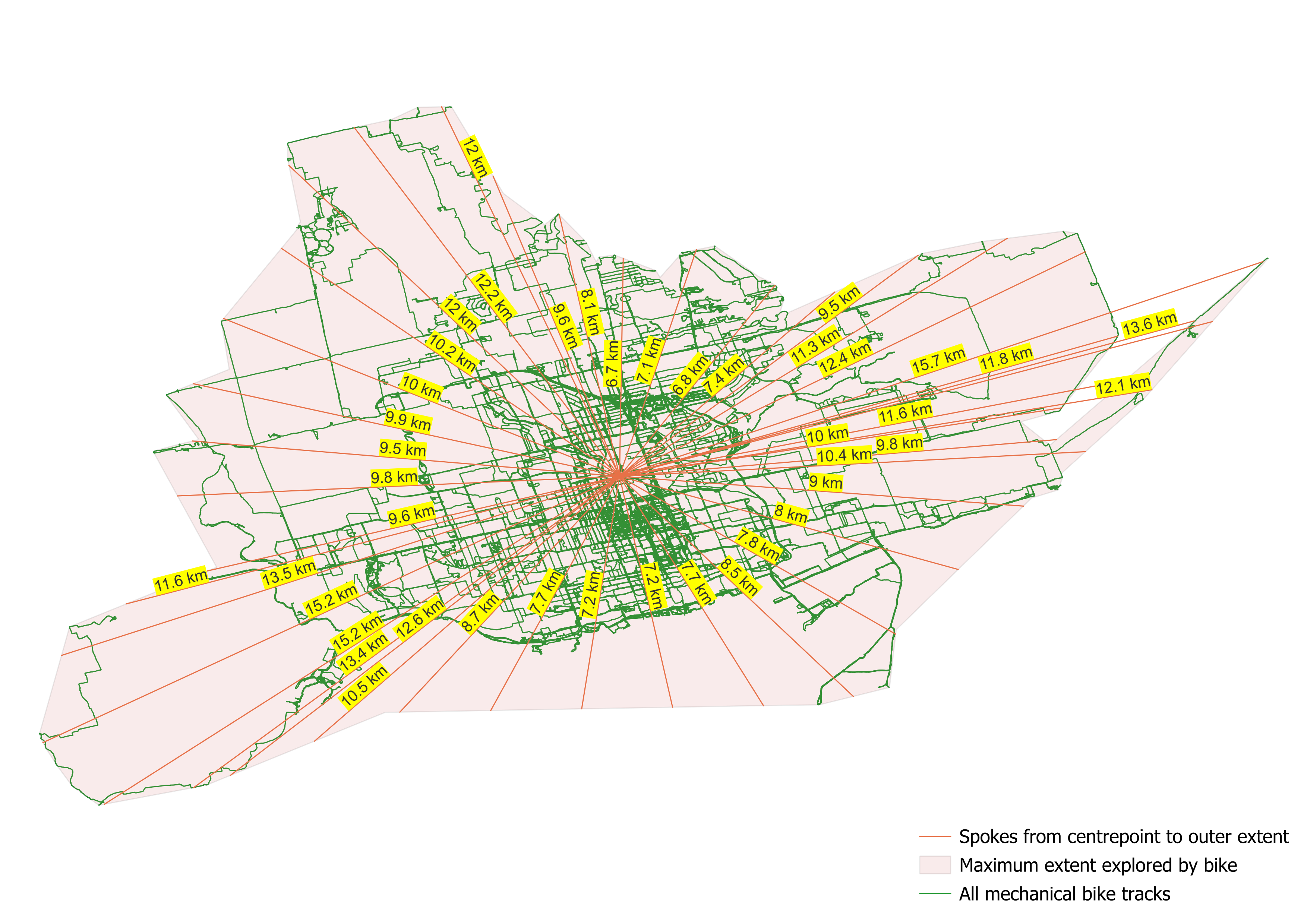
The only buggy element is how it projects spokes out into the lake. Nonetheless, this provides a useful visual guide to how far I need to go to get beyond my total area explored so far by bike.
Canada and the ‘Golden Dome’
Canada’s connection to US ballistic missile defence efforts goes back a long way and is interwoven with our shared history of continental air defence.
Now, Trump is proposing a ‘Golden Dome’ to supposedly make America safer from foreign threats, and Canada is part of the discussions.
Recently, the American Physical Society released a detailed free report: “Strategic Ballistic Missile Defense: Challenges to Defending the U.S.”
The basic weaknesses of the whole concept are simple to understand: it takes drastically more expense and hardware to (possibly) stop one missile than it does for a challenger to build one more missile. As a result, the technology is inherently likely to fuel arms races, as foreign challengers fear their deterrents will lose credibility.
Related:
- Open thread: ballistic missile defence
- Obama changing tack on missile defence
- Robert Gates posturing on missile defence
- Canada and Ballistic Missile Defence
- US security assurances and nuclear weapon proliferation
- Open thread: the global nuclear arms race
- Blair on the fragility of nuclear deterrence
- Consequences of nuclear weapon proliferation
- The military importance of space
- The nuclear razor’s edge
- Unproductive investments that harm the world
- Experiential education on nuclear weapon proliferation
See also my 2005 report: “Common Threats, Joint Responses: The Report of the 2005 North American Security Cooperation Assessment Student Tour“