Our leaders are killing our kids

Oceans of ink have been spilled arguing that social media and smartphones are the reason young people around the world are not doing well.

While there may well be truth to that, to me the whole discussion seems like an evasion of the real issue: we are living in a world where our leaders are killing our kids, because they are unwilling to act on climate change even though it could bring about the end of our civilization. We live in a world where the people in charge are willing to condemn everyone who follows them to torment and destruction, all because they are unwilling to give up the conveniences of fossil fuels. The ‘leaders’ who are doing this are committing history’s most egregious crime against future generations and the natural world, yet our media and society keep treating them as the best of their kind: deserving of praise, wealth, and fancy state funerals when they reach the end.

The lesson that sends to young people is that the system does not value them in any way, and is happy to sacrifice their most vital interests for the sake of further enriching those who benefit from the fossil fuel status quo – which is not just billionaire fatcats, but billions of consumers in rich societies who take it for granted that big trucks and airplanes are the way to get around and who insist on political leaders who pretend to care about climate change, while being privately committed to keep supporting the fossil fuel industry.

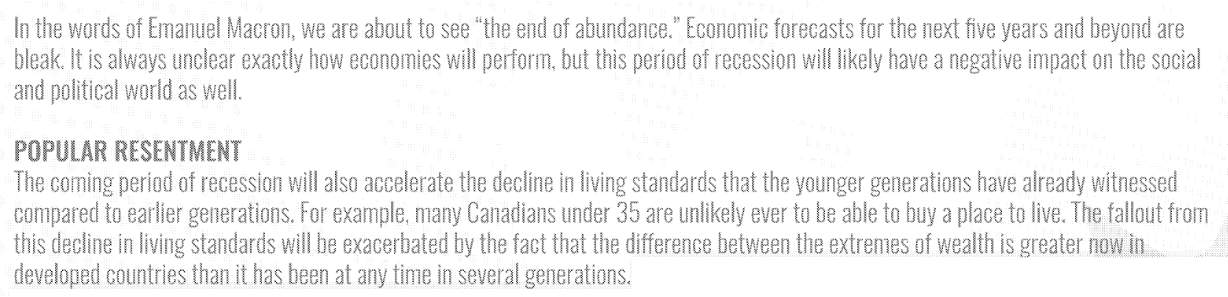
Even the RCMP – an institution that sees itself as an ally (p. 41) of the fossil fuel industry – is warning about how our societal disregard for the interests of the young is fueling instability:

There is a notion of the social contract in which each generation is obligated to consider the interests of those who will come after. This covenant has been totally broken, with the almost inescapable consequence that intergenerational conflict will become more and more severe as the damage we have done to the Earth keeps destroying our ability to provide the well-off with what they feel entitled to.

Related:

New moon walk and celestial navigation

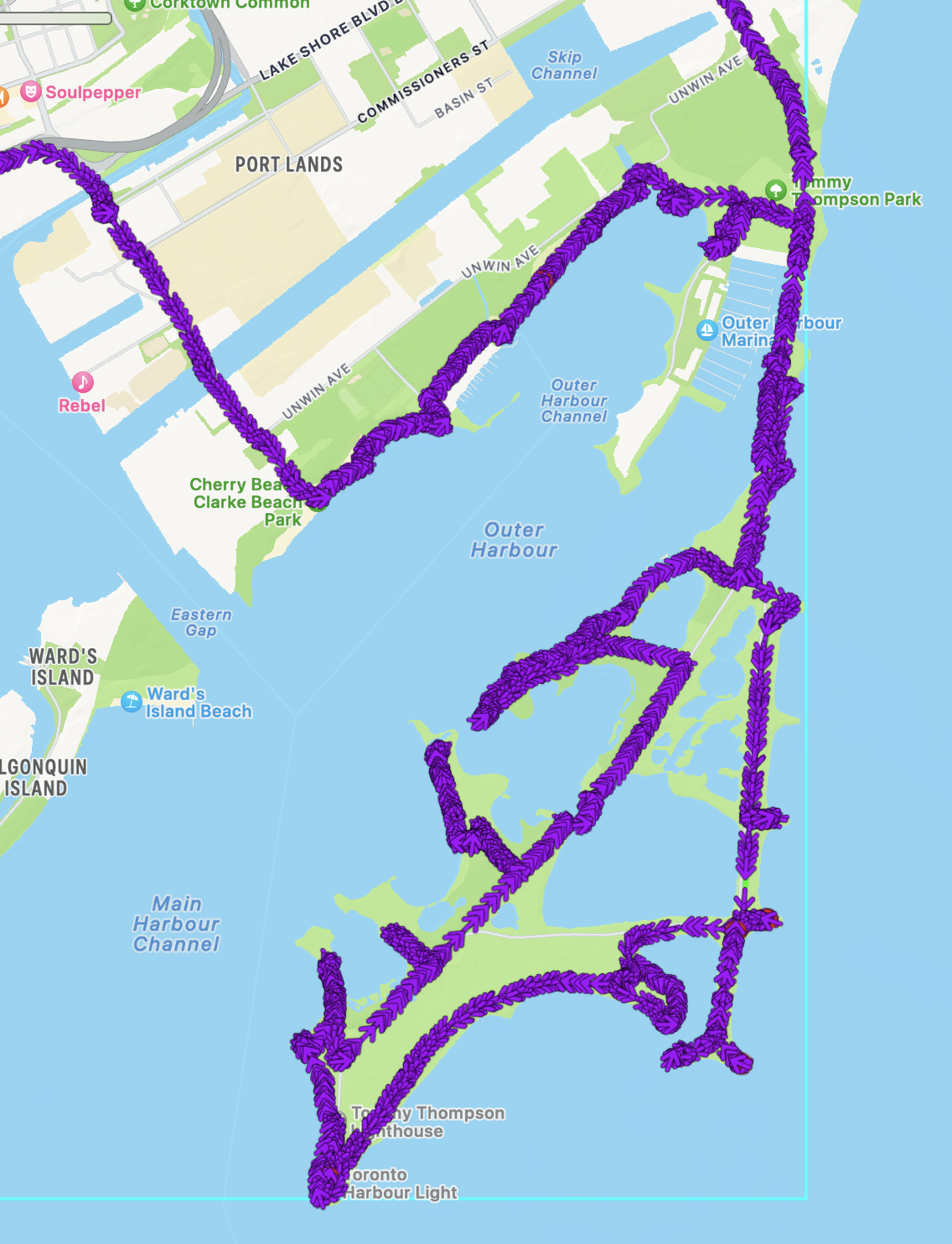
One of the most remarkable walks I have ever taken was around Tommy Thomson Park on November 6th, 2021.

It was the night of a new moon, and I got to the park entrance around 10pm. I decided to use an exhaustive search algorithm to explore the penninsula. I would begin walking around the hand-shaped penninsula clockwise, starting at the ‘wrist’ and visiting each ‘finger’ one by one. At every junction between paths, I would choose the one on the left if I had not already taken it. That way, I would explore every dead end and follow every path.

When I got into the park, lit only by starlight and city light reflected across the water, I began to perceive the stars above me as a gigantic compass. In the eastern sky, I could see just the right shoulder of Orion rising. As I walked around the penninsula, with my eyes having adjusted to hours of darkness, I could see by starlight alone. At one point, I was startled when a darker part of the shadow ahead of me moved and scampered off the path, but in less than a second I understood that it was a surprised skunk who had been taking the same path in the other direction hastily getting out of my way.

As the night went on, more and more of Orion was visible until the whole constellation rose about the horizon and up about 30˚ into the southern sky. The whole experience was an accidental but effective tutorial in celestial navigation. With the city visible, I had help orienting myself, and by keeping track of Orion I could make sense of which direction I was moving within Tommy Thomson Park’s suprisingly hard to navigate layout. It looks simple from the air, but since all the parts are equally low and beside one another, it can be very hard on the ground to know exactly where you are and which direction to go to reach somewhere else.

By 2am I was back at the park entrance. I will never forget what it was like to see by just the stars and the glow of the downtown core about 4 km away across the water, and I will never forget the feeling of when my brain flipped inside out to see the sky like a spherical compass which I was inside of, helping me to orient myself, plot a straight course, and explore.

Canada’s 2023 fires

Oliver Milman writes in The Guardian:

The impact upon the world’s climate will be even more significant than this. According to data from the European Union’s satellite monitoring service, more than 1.7bn tons of planet-heating gases have been released this year by the enormous fires – about three times the total emissions that Canada, a major fossil fuel-producing nation, itself produces each year.

Such huge emissions, eclipsing in a single year any measure, however ambitious, to cut pollution from cars or factories by a country like Canada, are a major drag upon efforts to stem the climate crisis. The majestic boreal forests, much like the Amazon rainforest that now emits as much carbon as it sucks up and is tipping towards becoming a savannah, suddenly appear to be a danger to the world’s climate rather than a key safeguard.

The world has ignored the imperative to stop worsening climate change through fossil fuel use for at least three decades now. The planet is starting to gravely reflect that mistreatment, and doing so in ways that worsen future disruption.

Trudeau knocks a hole in the carbon price

I know they are hurting in terms of popularity, but offering one group an exemption to Canada’s carbon price predictably led to calls for equivalent ‘favours’ (if freedom to wreck the planet is a favour) from everyone.

It’s worth remembering how bad Canada’s total historical climate change record has been:

Liberal government set to miss 2030 emissions targets, says environment commissioner audit

Trudeau’s halt on carbon tax could undo years of his tentpole climate policy

Related:

Some documents from the history of fossil fuel divestment at the University of Toronto

Back in 2015, during the Toronto350.org / UofT350.org fossil fuel divestment campaign, I set up UofTFacultyDivest.com as a copy of what the Harvard campaign had up at harvardfacultydivest.com/.

The purposes of the site were to collect the attestations we needed for the formal university divestment policy, to have a repository of campaign-related documents, and to provide information about the campaign to anyone looking for it online.

The site was built with free WordPress software and plugins which have ceased to be compatible with modern web hosting, so I will re-list the important content here for the benefit of anyone seeking to learn about the campus fossil fuel divestment movement in the future:

Of course, U of T announced in 2021 that they would divest. Since then, the Climate Justice U of T group which developed out of the Leap Manifesto group which organized the second fossil fuel divestment campaign at U of T (after Toronto350 / UofT350) has succeeded in pressuring the federated colleges of St. Michael’s, Trinity, and Victoria University to divest as well.

Canadian oil production expected to cross 5 million barrels per day

Taking into account both the things we are doing right (some carbon pricing, some other efforts) and what we are doing wrong (building more fossil fuel production, transport, and use infrastructure) Canada is still not even moving in the right direction on fossil fuels and climate change: Canada could lead the world in oil production growth in 2024.

The people leading our society are earning a legacy as the worst wreckers and vandals in human history: inheriting a planet that is the sole jewel of life in the solar system, and passing on profound and perhaps inescapable peril to their human successors while simply blotting out most of the rest of life on Earth.

Low feelings

It is hard to say when it began, because the stress and loneliness of the PhD blended into my post-PhD feelings, but it’s quite fair to say that I have been feeling consistently low at least since I learned that I would have to leave my old home in North York in March.

One big contributor is surely the feeling of anticlimax after the dissertation was released. This wasn’t some obscure academic tract about an issue of specialist interest, but a very current-day analysis of humanity’s most pressing problem. I was expecting, or at least hoping for, debate and pushback from people in the activist and policy communities. So far, the most substantial response to what I wrote has been a half-hour discussion with my brother Mica and his wife Leigh when they were visiting Toronto. In the dissertation I express my worry that — even though their aspiration and plan is to change the world — activists get caught up in routine behaviours like marches which occupy their time and effort but do little to change minds or policy. The total non-response to my research so far is a minor bit of additional evidence that activists aren’t generally too compelled by external analyses of their efficacy.

Another dimension is no doubt simple isolation. The layers have been stacking for me in that area: it’s harder to make and keep friends as an adult, it’s harder when you’re no longer a student, and it has become harder as people have pulled their social attention inward to a small group during the pandemic. Getting anybody to attend any sort of event has become substantially harder, and as corollaries the events that do happen have less attendance and energy and there are fewer events.

Another item for this decidedly non-comprehensive list is my sense that most of the people who I know (or, at least, peers and younger people — the dynamics of the affluent and established are different) are not doing well. People seem stymied in achieving the sort of adult lives they want, and especially in finding any sort of work which is psychologically and materially rewarding. It feels like to a large extent our parents got rich and retired, but most of us have never been able to move up into the positions they held at our stage of life. As with housing, there is a feeling that the older and best-off parts of the population have grabbed everything and are keeping it for themselves. This feeling becomes especially embittering when paired with the knowledge that they are actively choosing to hand over a ruined planet to their descendants every time they keep electing leaders who keep the future-wrecking fossil fuel industry going.

It is hard to escape the feeling that I have spent the last 20+ years building up for what I thought would be an intense period of intellectual effort, civilizational re-consideration, and mass political re-organization… and have found myself instead in an epoch where smaller-scale but acute disruptions have monopolized public attention to the point where we seem to be paying even less attention to the big trends than we were 10-15 years ago. It’s very hard to feel optimistic about the future, and it is simultaneously profoundly alienating when society at large is choosing to ignore the existential seriousness of the crisis which we are in. Living among people who are likely to be remembered as history’s greatest wreckers (on the optimistic assumption that anyone will be around with luxuries like paper and literacy to write the history of the present) carries with it feelings of rage and hatred against everything around me: the cars pumping out their fumes in a million lines idling behind red lights, the kaleidoscopic variety in our supermarkets at the same time as we are smashing the Earth’s biodiversity and capacity to support us, the elections that still turn on trivialities even though the consequences of our choices are as serious as death…

Feeling that our civilization is such a disaster is utterly isolating, since our fellow human beings cannot help taking that personally as a criticism and rejection of their own lives and priorities. Meanwhile, it’s impossible to have any confidence in the future. Over the last 20+ years, humanity has shown that we are totally capable of knowing the consequences of our actions and the stakes being played for and still choosing to ruin the world which we inherited. As much as I sincerely delight in the possibilities and experiences of life, I don’t know how to avoid the feeling of being a witness during the time of humanity’s downfall.

Critical Mass Vancouver, July 2023

Milan Ilnyckyj at July 2023 Critical Mass in Vancouver, by @jordanvegbike

By happenstance or grace I ran into the best Vancouver Critical Mass in years when the library ushered me out at 6pm. It was my first bike ride in 11 years, and my first e-bike ride ever, on a rental e-bike available right beside the mustering area north of the old art gallery.

Critical Mass is one of the most brilliant forms of non-violent direct action ever devised. Today’s Vancouver ride showed me the city like I never saw it in 22 years growing up, and felt like the safest bike ride I ever took. Safe in the middle, I never worried about a single car. There were pairs of kids on the back of long e-bikes; dogs in carriers wearing goggles; several audio mixes from portable speakers in different parts of the mass; and a lot of good grace and patience — as well as a great deal of overt support — from pedestrians as well as drivers.