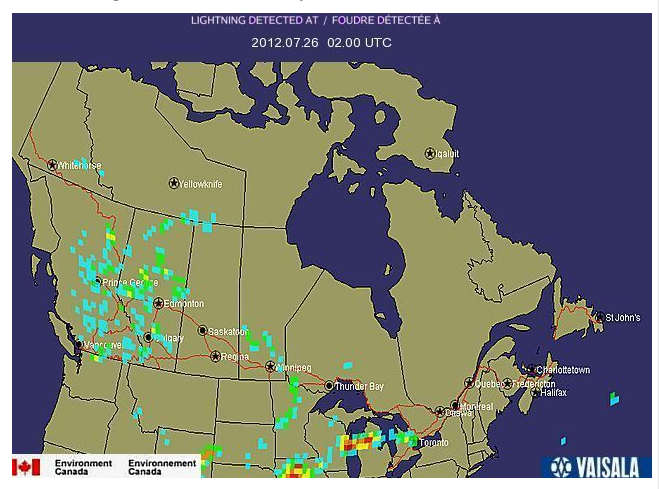
I had had a look at the lightning strike maps for North America, since Toronto has been in the middle of an intense electrical storm for about an hour.
The US and Canadian maps are pretty dramatic:

climate change activist and science communicator; photographer; mapmaker — advocate for a stable global climate, reduced nuclear weapon risks, and safe human-AI interaction

Anything related to Canada or Canadians
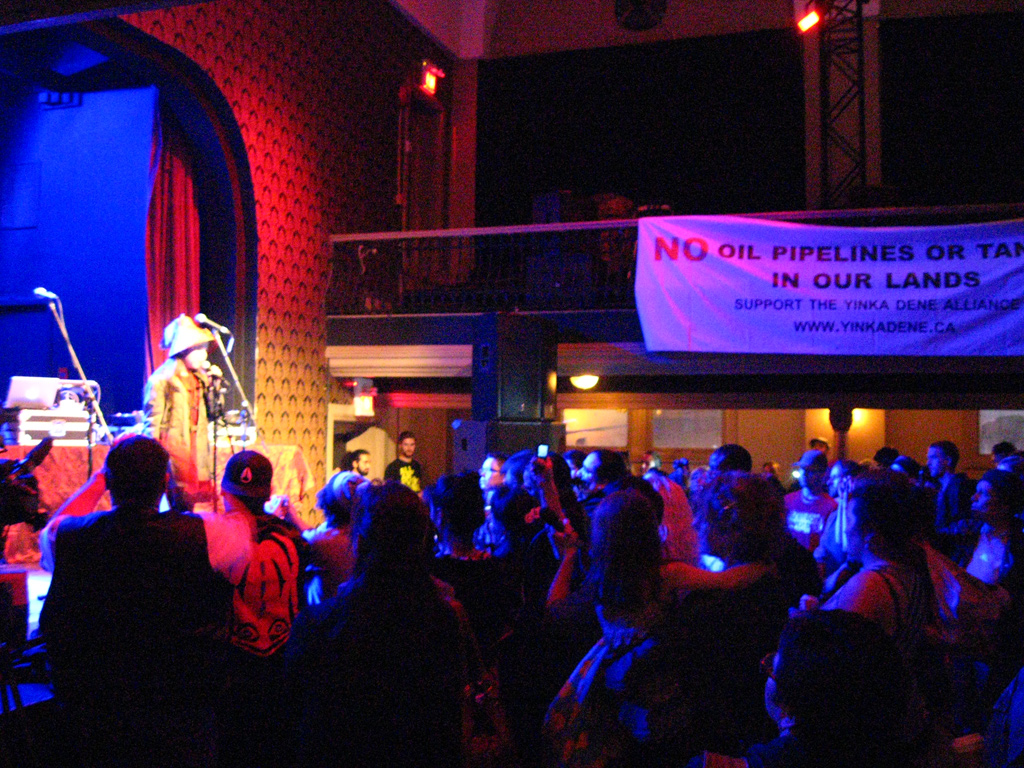
The World Wildlife Fund has put together a beautiful video showing some of what would be put at risk by the proposed Northern Gateway pipeline:
For more information see: Canadiansforgreatbear.ca
I have elaborated a bit on my drug licensing idea:
Drug licenses as an alternative to prohibition
I don’t know how good an idea it really is. As usual, I need people to argue with me.
Following up on rules one and two, it seems appropriate to add a third: “You should probably worry more about being attacked online by your own government than by any other organization”.
This is really an extension of the point about how governments are more dangerous than terrorists and how institutions of armed power need oversight.
Based on the open source intelligence available, we have to assume that governments all over the world are constantly monitoring the activity of their citizens online, for reasons both reasonably benign and exceedingly nefarious. It is worth remembering that even if the official purpose of a surveillance program is acceptable, it can be abused by anyone who gains access to it for purposes that may be very dubious. Hackers and rogue government agents are well positioned to use internet surveillance to rob or blackmail people, for instance. It is also worth remembering that data is not only being monitored in real time; it is also being archived for unknown future purposes.
Tools for privacy
Thankfully, we do have some tools to make this ubiquitous surveillance more difficult to carry out. You probably cannot encrypt your hard drive well enough to protect the contents if government agents grab it, but you can encrypt your online communications sufficiently well to make it at least challenging to decrypt them. The more people streaming gigabytes of data via encrypted HTTPS connections, the less feasible it is to archive and crack internet traffic taken all in all.
You can also use tools like Tor. People should be willing to assert their right to anonymous communication.
It has often been pointed out that order and chaos are one of the more important dichotomies in the universe, with time inevitably breaking things apart into senseless fragments and living things often working to produce order and meaning in themselves and in the world around them.
While it may seem as though order is the supreme goal of politics (perhaps especially in Canada, where “peace, order, and good government” is the credo), people forget that unadulterated order produces rigid structures that shatter when struck or strained. When conditions remain constant, a society that has become rigidly ordered can contiue to function, though it usually starts getting sapped and weakened by the self-interested agents who run it.
When conditions change – however – the vital importance of chaos in politics is revealed. Faced with something new, we need to improvise. We need the organs within society that can handle improvisation – that can perceive the possibilities of a new world, try new strategies for dealing with them, evaluate how those strategies are doing, and carry on with this process of evaluation and experimentation. These organs of improvisation include art, and they include the everpresent contest between the different locuses of power that well-designed societies always include. The civil service spars with politicians; the courts assert their role in interpreting the law and applying constitutional principles; academics try to affect policy; companies try to buy politicians (and some politicians try to be bought!); voters punish incompetence or reward the ability to inspire; civil society groups wax and wane in influence, and change their programs of action.
Just as the 20th century involved change of a magnitude and complexity that defied anticipation, it seems fair to expect the 21st century to have a similar dynamic quality. We are going to need our improvisational abilility and the mechanisms of chaos that keep societies from becoming frozen and immobile. That’s not to say we can or should throw everything away. The reason why the balance of power works as a way of keeping government effective is because the different organs have comprehensible purposes and identities which they perpetuate through time. (Canada’s Supreme Court means something as an institution, as does Health Canada and the CBC and the University of British Columbia.) Similarly, reaching back into our own history is a way to identify strategies that could help us. Historians as well as artists can be organs of improvisation.
All told, I don’t much like where the world is heading. I think our leaders are mostly a mix of the seriously deluded and those who are primarily in it for themselves. I don’t think global society is effectively applying the knowledge it possesses about the world and, to a considerable degree, we are being carried in a dangerous direction by the momentum of selfish and short-sighted choices. If there is hope for the future, it is that creative forces of chaos can disrupt the most damaging patterns of behaviour humanity has developed. That process is necessarily messy and it isn’t clear while it is happening whether things are being made better, worse, or just less familiar. Still, if we are going to make it to 2100 and beyond, we can’t keep doing what we’re doing now.
As far as the atmosphere is concerned, it doesn’t matter if an extra molecule of carbon dioxide (CO2) comes from a recently-felled tree, from a molecule of methane in burned natural gas, from oil burned in an airplane, or from a coal-fired power plant. Regardless of the source, it adds to the already-dangerously-large stock of CO2 in the atmosphere.
This is one reason why commenters miss the point when they say things like: “the oilsands were responsible for seven per cent of Canada’s annual greenhouse gas emissions in 2010, while the entire oil and gas sector produced 22 per cent of Canada’s greenhouse gases in the same year”. While these figures may be accurate, they convey the false notion that these are the only sources of CO2 we need to worry about and that reducing these numbers is adequate for solving the climate problem.
What matter is how much fossil fuel we burn in total across history
These figures only take into consideration the emissions that arise from the process of producing oil and gas. For instance, there is the natural gas that gets burned to make bitumen liquid enough to be processed and transported. The figured do not include the emissions that result when these fuels are burned. This is where most of the pollution actually happens and it is inevitable. Even if carbon capture and storage (CCS) was completely free and available today, it wouldn’t be possible to capture the pollution from vehicles, and that is where most of the oil from the oil sands ends up.
The key factor that will determine how much climate change the planet experiences is how much CO2 gets added to the atmosphere. Burning coal, oil, and gas inescapably contributes to that stock, which is already dangerously large. As such, Canada cannot ignore exports when it considers how to bring its economic activity in line with what the planet can withstand. The entire coal, gas, and oil industries need to be phased out in a rapid way. At the same time, we need to develop whichever carbon-neutral energy sources will sustain us in the future: some mixture of renewable forms of energy like wind and solar, biomass, and nuclear power.
Warming begets further warming
It is important to remember that the indifference of the climate to the source of CO2 molecules extends beyond direct human activities. If we warm the planet so much that the Amazon dries out and becomes grassland, the huge volume of CO2 currently stored in the rainforest will be added to the atmosphere. Similarly, if we warm the permafrost to the point where it melts and releases its gargantuan content of methane (a more powerful greenhouse gas than CO2, though shorter-lived), we will have another large dollop of warming to deal with, and an increased chance of catastrophic outcomes like the disintegration of the ice sheets in Greenland and West Antarctica.
Based on the evidence we have from millions of years of climate data, we know that the climate can be prone to violent swings when provoked. Push it a little bit and perhaps it will naturally return to about where it was before (‘pushing’ here means releasing greenhouse gas pollution). Push it enough, however, and it can tip over into a very different state, like a Coke machine tilted to the point where it falls over. All of human civilization has taken place during times of relative climatic stability. If we radically destabilize the climate, the consequences for human beings everywhere will be dire.
Our choice
To a very large degree, Canadians are missing the point about climate change. It isn’t a matter of deciding whether growth in the oil sands is pushing up the Canadian dollar in a way that hurts manufacturers. It also isn’t a matter of deciding what sort of small carbon tax would make Canada’s emissions acceptable. If we are to preserve a habitable planet for the people who will follow us, all signs indicate that we must get serious about the process of phasing out fossil fuels. Either humanity has a future or the global fossil fuel industry does – not both. That is very unwelcome news in a country that stands to make billions of dollars from fossil fuel exports, but it is the situation in which we now find ourselves.
We can choose to ignore the fact that what we are doing threatens the future habitability of the planet. We can also choose to bet that some future technology will allow us to solve or counteract the climate problem. If we make such choices, we should be entirely clear about what we are doing. If we accept the reality of climate change but choose to plow on heedlessly anyway, we should accept that we are entering into a suicide pact with countries like China and the United States that are doing the same thing. Neither has shown itself to be at all capable of moderating its demand for fossil fuels, and Canada is providing an increasing share of the oil, gas, and coal that fuels their frightening emissions.
If we choose to bet on technological salvation, we should similarly recognize that we are placing bets with lives that are not our own. We are saying that whether people in future generations inherit a planet that permits human prosperity or a planet in which civilization struggles to endure depends on whether some magic new technology appears in time to correct our mistakes – mistakes we now fully understand, but which we have so far refused to stop making.
Every barrel of oil we dig up and burn is another dangerous dart we are hurling at random at the people of the future – people who are already going to suffer substantially from the damage we have already done. We don’t need to choose that kind of irresponsible and selfish behaviour. We can turn our energy instead to building a zero-carbon energy system and an efficient society. Such a society will have a shot at long-term prosperity, which is something that cannot be said for societies that depend on fossil fuels that are ever-more scarce and which are destroying the planet.
Olivier De Schutter, the right to food envoy of the United Nations, recently released a report highlighting how many Canadians suffer from food insecurity. In response, Canada’s health minister Leona Aglukkaq described him as “ill-informed” and “patronizing”.
To me, this response seems like part of a worrisome trend in Canada. Instead of thinking about real problems, our government obsesses over negative media coverage related to those problems. It’s not malnutrition or worsening climate change or tortured detainees that are the problem, but rather critical media coverage on these sorts of issues. Rather than trying to fix problems, effort seems to be disproportionately dedicated to silencing critics and producing counter-spin.
It doesn’t help that opposition parties generally use every bit of negative media coverage as a means of hammering ineffectually at the government. What they need to realize is that our current government is largely an accident arising from the nature of our electoral system. With one party on the right and four on the left (counting the solitary Green), elections tend to favour the more unified ideology.
Just as the government should re-dedicate itself to governing for the benefit of Canadians, the opposition should dedicate itself forming an electable party through one or more mergers.
Today’s report from Canada’s Commissioner of the Environment and Sustainable Development (CESD) has attracted a fair bit of media attention. On climate change, the report argues that Canada lacks a credible plan for meeting our 2020 target of cutting greenhouse gas pollution to 17% below 2005 levels by 2020. This target replaced Canada’s much more ambitious but now abandoned Kyoto Protocol target of cutting to 6% below 1990 pollution levels by 2012.
A few points in response:
1) None of Canada’s climate targets have ever been tough enough to be compatible with a fair global pathway that avoids more than 2°C of warming. In order to stay below the level at which climate change is generally considered ‘dangerous’, Canada and other countries must do much more than has been proposed so far.
2) As the CESD points out, Canada’s existing targets are more notional than realistic. In order to meet them, much more on-the-ground action needs to occur.
3) All of these pollution figures ignore Canada’s huge hydrocarbon exports. The question of how to assign responsibility for a litre of oil or a tonne of coal mined in Canada and sold overseas isn’t straightforward. At the same time, the planet doesn’t care whether the fuel is burned in Canada or in China. Either way, it contributes the same amount of warming to the climate system. If we are to address climate change, exports also need to be phased out.
Once we take into consideration the amount of fossil fuel we are exporting, Canada’s climate change record looks even worse then we only look at our failure to reach our past targets. It can be argued that fuel burnt in China or the United States isn’t our responsibility. This argument isn’t entirely convincing. For one thing, Canada regularly uses the inaction of China and the United States as an excuse to do less about climate change. That position doesn’t seem very credible if we are simultaneously supplying them with large quantities of fossil fuel.
Dealing with climate change requires transitioning the world away from fossil fuel dependence. Continued fossil fuel production is very costly, and delays those efforts. People are going to continue to make excessive use of coal, oil, and gas for as long as they are cheap and their use is unrestricted. At this stage in human history, it makes an enormous amount of sense to simply leave these fuels in the ground. In so doing, we sacrifice the short-term economic value that selling the fuels could provide. At the same time, we gain the opportunity to re-orient our economy and energy system in a way that is compatible with the coming post-carbon world.
Critically, leaving the fuels underground also lessens the harm we are imposing on other people around the world and on future generations. Because of the serious impacts of climate change, fossil fuel production is a fair bit like stealing copper wiring from the houses of other people. It seems profitable to the people doing the stealing, since they didn’t pay to have the wires installed in the first place and they won’t pay to have them replaced. From the perspective of society as a whole, however, copper wire thieves are causing harm while producing no net benefit. Rather than exploiting the economic opportunities that exist because the world hasn’t yet become serious about climate change mitigation, Canada should be investing its efforts and resources into making an effective and efficient transition to a zero-carbon economy with no fossil fuel exports. Firms like Suncor and Syncrude are much like those copper wire thieves. They are profiting handsomely today, but only doing so by imposing frightening costs on all members of future generations. Unfortunately, today’s oil companies are rich and politically influential, whereas future generations are defenceless and silent.
The targets that really matter are global: how much the planet will warm; how much sea ice will melt; how affected global agriculture will be; and how many more people will suffer from extreme weather or shortages of food and water. Canada’s current approach is short-sighted and selfish, to a degree that isn’t entirely obvious if you only look at our domestic pollution reduction targets and our (inadequate) efforts to reach them.
Canada is choosing a future for the world that is characterized by extreme climate instability, with all the human suffering that goes along with that. If we want to choose a different future, we need to accept that the era of fossil fuels is coming to an end, and it is time for us to make a devoted effort to rapidly phasing them out of our energy system.
Simon Fraser University environmental economist Mark Jaccard and others were arrested in White Rock, British Columbia today while blockading coal trains owned by Warren Buffett.
As reported by the CBC, Jaccard considers Canada’s actions on climate change so far “entirely inadequate” and goes on to say:
I now ask myself how our children, when they look back decades from now, will have expected us to have acted today… When I think about that, I conclude that every sensible and sincere person, who cares about this planet and can see through lies and delusion motivated by money, should be doing what I and others are now prepared to do.
Coal exports from North America result in millions of tonnes of greenhouse gas pollution annually. Just the Westshore Terminal, at Roberts Bank, ships over 20 million tonnes of coal per year.