
Endless Canadian delay on climate change mitigation

Fiddlehead ferns

Jim Prentice, Canada’s Minister of the Environment has said that Canada might not impose limits on greenhouse gas emissions until 2016. This is simply preposterous. It makes a mockery of this government’s pledge to cut emissions to 20% below 2005 levels by 2020. It is also hypocritical. This government argued that they could not meet their Kyoto Protocol targets due to the inaction of their predecessors. They argued that the short time left before the deadline would require them to simply shut down Canadian industry and services to homes (See: The Cost of Bill C-288 to Canadian Families and Business) Of course, dallying until 2016 would put whatever government was in charge then in an even tighter bind.

In order to meet this government’s 2020 target, Canadian emissions will need to fall by about 170 million tonnes over the next eleven years: a task equivalent to making the entire province of Alberta carbon neutral. Obviously, waiting until 2016 to begin dooms the project to failure. That ignores the fact that even the 20% target is insufficiently ambitious, when you consider the risks associated with different global emissions pathways and the fact that rich, developed states must lead the way on the transition to low- and zero-carbon sources of energy.

The idea that we could do nothing substantial for another seven years is an affront to ethics, good sense, Canada’s international obligations, and our reputation as good global citizens. If Canada cannot show the leadership or vision necessary to appreciate the risks of unconstrained climate change, as well as the opportunities in moving the energy basis of our society to a sustainable basis, our best hope is that we will be made into a pariah state by our most important trading partners. For Canada to maintain growing emissions for another decade would be shameful, but not a global crisis in itself. For the United States, European Union, China, and Japan to do so would quite probably doom future generations to a world very different from ours. If those states do show the fortitude required to begin the transition to carbon neutrality, they will be quite justified in imposing stiff carbon tariffs against a Canada too blind or selfish to see upon or act as must be done.
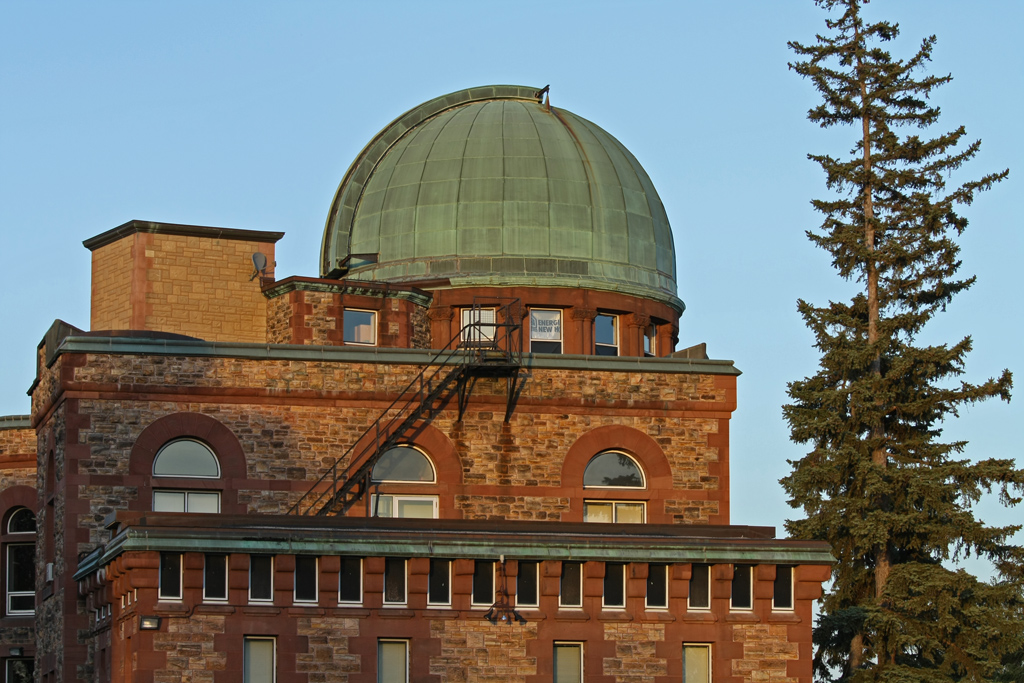

Energy efficiency and Ottawa’s Dominion Observatory

Dominion Observatory - NRCan Office of Energy Efficiency

Wandering around the experimental farm, I ran across one of my new favourite buildings in Ottawa. Natural Resources Canada has an Office of Energy Efficiency housed in an old observatory that would look at home in Oxford, Myst, or a neo-Victorian steampunk fantasy. It has great brickwork, an attractive green copper dome, interesting detailing, and a nice setting uphill from Dow’s Lake. The building is called the Dominion Observatory, and served in that capacity from 1905 to 1974, with a 15″ refracting telescope installed in the main dome.

I will need to find some pretense for getting invited in. I will also need to go back at a time when the lighting is more favourable, and when I have a tripod with me.

Soft rules for the oil sands means harder targets for others

Canadian Goose (Branta canadensis), near the Ottawa River

Environmental Defence has put out a new report on the oil sands that speaks well to both a general and a specific issue. Climate change policy is often about deciding on a total permissible quantity, then haggling over how it gets divided, with everyone asserting that their special circumstances justify lenient treatment. For instance, Canada argues that it should be able to cut its emissions by less than other states because it is large, cold, an energy exporter, etc. By contrast, other states argue for more generous targets on the basis of past action, ongoing extreme poverty, and many other reasons.

Of course, for everyone who gets lenient treatment, someone else needs to pick up the slack, if you are going to meet your targets. What the Environmental Defence report highlights is how giving an easy ride to the oil sands will mean higher costs for everyone else, if Canada is to hit its 2020 and 2050 mitigation targets.* The report – entitled Divided We Fall: The Tar Sands vs. The Rest of Canada – highlights how placing a disproportionate reduction burden on Ontario and Quebec could be harmful for their economic prospects, especially given how greater opportunities for mitigation exist in the fossil-fuel intensive western industries. Also, given the degree to which resource windfalls (in terms of both tax revenues and jobs) tend to accrue provincially, Ontario and Quebec have an even stronger case against allowing a weaker carbon pricing system for hydrocarbon production in Alberta and Saskatchewan.

Domestically, this is just one of the innumerable issues of Canadian federalism. Regional interests generate tensions that can sap the ability of Canada as a whole to achieve good outcomes. Certainly, some provinces will find it much easier than others to recognize and accept the fact that the fossil fuel industry has no long-term future. It’s a one-off bonanza that our legal and moral obligations on climate change will not permit us to fully realize. Instead of continuing to invest in a dead end, Canada needs to get serious about building an economy that can thrive in a low- and ultimately zero-carbon future.

The report is also available in French (PDF).

* It is worth remembering that, while the 2020 and 2050 targets have received much more media attention recently, the original announcement of the current government’s Turning the Corner climate change plan promised that total Canadian emissions would peak no later than 2012. Most people seem to have forgotten about the third promise.

New fuel efficiency standards in the US

Porcupine (Erethizon dorsatum) in a tree, near the Ottawa River

Obama’s decision to extend California-style fuel efficiency standards across the US is a very welcome one, not least because it seems likely that Canada’s government will copy them. The US rules take effect in 2012 and create a federal fuel efficiency standard. The aim is to push the efficiency of the US car and light truck fleet to 35.5 miles per gallon (6.63 L/100km) by 2016: 40% better than now. Such a move is long overdue, given the poor efficiency of the US vehicle fleet, the huge amounts of oil imported by the United States in order to keep them running, climate change concerns, and reasonable doubts about the availability of low-cost hydrocarbons in the near to medium future.

While the new standards are a marked improvement, it is worth thinking about them in context. They will not bring the US up to speed with Australia, China, the European Union, or Japan. Indeed, even in 2020, the planned American standards lag behind where the EU and Japan were in 2002. Given the degree to which North American taxpayers now own the big car companies, it may well have been possible to demand more progressive action from them.

Toughening standards may seem even more prescient if the end of the economic slump brings back high oil prices, as some are predicting. As reported in The Economist, the Saudi oil minister is concerned that a sharp increase in oil prices could slow or stop an economic recovery, while attendees at an OPEC summit apparently expect oil to return to $150-per-barrel territory:

The explanation is simple. Oilmen are worried because they believe that many of the factors behind the record-breaking ascent last year remain in place. Much of the world’s “easy” oil has already been extracted, or is in the hands of nationalist governments that will not allow foreigners to exploit it. That leaves firms to hunt for new reserves in ever more inhospitable and inaccessible places, such as the deep waters off Africa or the frozen oceans of the Arctic. Such fields take a long time and a lot of expensive technology to develop. Worse, new discoveries tend to be smaller than in the past and to run dry faster.

More efficient vehicles make sense as a near-term mechanism for dealing with the linked problems of climate change and energy security, but they are only an incremental step. Rather than being able to rely on increasing the efficiency of an unsustainable practice, we need to alter the basis on which that practice occurs, so as to make it both efficient and sustainable. By all means, we need to increase the efficiency with which vehicles of all kinds transport people and freight, but we must remember that we will only have attained our basic goals when those efficient vehicles operate using zero-carbon, sustainable electricity or sustainably grown, carbon-neutral biofuels as their fuel sources.

The AECL and new nuclear plants in Ontario

It seems that the province of Ontario is leaning towards having Atomic Energy of Canada Limited (AECL) build their new nuclear reactors, provided the federal government provides some additional support. The recent history of the company isn’t very impressive, given their failure to get two comparatively simple isotope reactors to work, and giving the contract to a Canadian company makes it even more likely that Canadian taxpayers and ratepayers will end up subsidizing them.

Perhaps it would be wiser to give the contract to a French, American, or Japanese firm, and let their citizens help pay for our gigawatts. It seems plausible that using a design that is being implemented elsewhere will have price benefits: both in terms of economies of scale and in terms of learning from the experience of those who began building them earlier. AECL’s Advanced CANDU reactor has not yet been fully designed, and probably never will be unless it wins the competition in Ontario, besting France’s AREVA and Westinghouse, from the US.

Climate deniers deciding science funding in Canada

Pink and purple tulips

In yet another demonstration of the ongoing tensions between conservative political parties and science, Prime Minister Stephen Harper has appointed a couple of climate change deniers to federal science funding bodies. One has claimed that “the climate-change issue is somewhat sensational and definitely exaggerated.” The appointments seem likely to worsen the quality of scientific work being done in Canada, putting us further behind the rest of the developed world, when it comes to comprehending and appreciating the characteristics of the world in which we live, and in which important political choices must be made.

This is reminiscent of the appointment of a man seriously invested in the oil sands to the ‘Clean Energy Dialogue’ ongoing with the US. The Conservatives claim that they accept the science of climate change, but they cannot really take it to heart because of the degree to which it fundamentally conflicts with a laissez faire approach to economic regulation.

All we can hope for is for climate change denial to eventually become so patently ridiculous to the electorate that parties that continue to dabble in it seem to be arguing the equivalent of the Earth being flat and orbited by the sun. That may be the only time at which conservative parties have the impetus they need to reform their ideas to be compatible with what we now understand to be the state of the world.

The B.C. election and carbon pricing

From a climatic perspective, it seems that there are two reasons to be glad about the recent electoral victory of the Liberal Party in British Columbia:

  1. Firstly, it shows that carbon pricing (and carbon taxes, specifically) need not mean death at the ballot box. While it is still far too weak, the B.C. carbon tax is at least a progressive example for North America. Some have concluded that it is actually the most effective climate policy in effect on the continent at this time.
  2. Secondly, it shows that an unprincipled stand against carbon pricing can actually cost a party support. This is an essential development, if we are to deal with climate change. Succeeding will depend on carbon mitigation policies enduring and strengthening for many decades. As such, we need to reach the point where the electorate rejects those who would scrap them for non-environmental reasons.

While there are plenty of reasons to dislike both major political parties in B.C., at least this election didn’t prove to be yet another setback for effective climate policy in Canada.

Here’s hoping the US Congress is able to pass a cap-and-trade scheme before the Copenhagen meeting, and that Canada will finally roll out regulations on greenhouse gas emissions nationally.

Ignatieff and climate change

Bridge over the Ottawa River

In sharp contrast to Stephane Dion, who put environmental issues front and centre, the new federal Liberal leader is much more restrained when describing his position on climate change policy. In addition, Michael Ignatieff seems to be going out of his way to show support for ‘the west’ and, by extension, the Athabasca oil sands.

It is possible that this is an electoral ploy, designed to isolate him from the perceived failure of Dion. It is also possible that Ignatieff has the intention of taking significant action on climate change, but has deemed it tactically appropriate to keep it quiet. Finally, it is possible that he thinks such action is either not necessary or not worth the political price he thinks it would involve. For those concerned about climate change, the last is a troubling possibility. If Canada is going to hit the targets established by the current government – much less, stronger targets as advocated by many scientists and NGOs – much bolder governmental action will be necessary, and higher costs will necessarily fall upon carbon-intensive industries.

With the eternal bubble of speculation about elections that accompanies a minority government, what do people think the real Ignatieff agenda on climate change would be, if he is able to bring the Liberals back into government? Would it likely be more or less aggressive if they did so with a majority, as opposed to simply replacing the Conservatives in the perilous minority spot?

More good service from MEC

Once again, I have been reminded of why it makes sense to buy gear from MEC. On Friday, I was cycling along the Ottawa River pathway when I spotted a small beaver lodge in a little wooded area. I stopped, got out my camera (with 70-200mm lens) and approached the lodge, holding my handlebars with one hand.

I stuck around for a few minutes, trying to spot a beaver and snapping photos of birds while I waited. Eventually, I gave up and returned to the path. When I got there, I saw that the cable for my bike computer (which runs down to the sensor) got sheared off by an errant branch.

I went to MEC and, without a question or the need for a receipt, they gave my a replacement sensor, cable, and dock (they are one unit). They even offered to refill my water bottle for me.

Underground coal gasification is no solution

Writing in The Globe and Mail Thomas Homer-Dixon and Julio Friedman put forward a misleading argument about coal. Specifically, they argue that converting it to gas below ground makes it more acceptable as a fuel source, because underground coal gassification “uses an inaccessible, dirty resource for largely clean energy.” This is only remotely true when the technology is used with (as yet non-existent) carbon capture and storage technology. Until such technologies are proven to be safe, economical, and effective, it is not acceptable to contemplate the further use of coal as an energy source.

Simply put, the carbon trapped in coal absolutely must be kept in the ground, if we are to avoid catastrophic climate change. Trumpeting any coal-based technology that will add greenhouse gasses to the atmosphere is simply irresponsible, especially in a developed country like Canada that already has a shockingly high level of emissions.