Provincial exams are very useful

Shoes and map

Speaking with people involved in the Ontario school system, I was surprised to learn that they do not have provincial exams for courses in the last years of high school. To me, this seems like a mistake. Provincial exams provide vital information to university application departments: specifically, they let you gauge how much grade inflation is happening at any particular school. A school where the mean class mark is 90%, but where the mean provincial mark is 60%, is clearly inflating grades. Conversely, a school where the mean class grade is 60% but where students get 90% on the provincial exam clearly has high standards.

Given that individual schools and teachers have a strong incentive to inflate the grades of their students, provincial (or federal) exams seem to be a key mechanism for keeping them honest. Otherwise, there is simply far too much opportunity to call mediocrity excellence, without anyone else being the wiser.

I very much hope B.C. retains the provincial exam system, and that it becomes universal across Canada.

A Canadian coal phase-out

Both The Globe and Mail and The New York Times are reporting on recent comments from Jim Prentice, Canada’s minister of the environment, about phasing out coal-fired electricity in Canada:

“The concept is that, as these facilities are fully amortized and their useful life fully expended, they would not be replaced with coal.”

That is certainly necessary, but may not be sufficient to achieve Canada’s domestic emission reduction targets. Indeed, if the world as a whole is to get onto an emissions path consistent with avoiding dangerous climate change, it will probably be necessary to scrap some existing coal plants before the end of their working lives.

About 18% of Canada’s current greenhouse gas emissions are from coal-fired electricity, with facilities in Ontario (about 25% of the total), Alberta (about 47%), Saskatchewan, Nova Scotia, and New Brunswick.

More disclosure for Canadian mining

Pigeons eating

Due to a recent federal court ruling, a long-standing disclosure exemption for the mining industry has been repealed. Previously, mining firms were not obliged to determine and disclose the toxic compounds present in their waste rock and tailings ponds. Apparently, environmental groups have been seeking to get rid of the exemption for sixteen years. American firms have had to obey similar disclosure rules for a decade now.

Data going back to 2006 will be made available on Canada’s National Pollutant Release Inventory (NPRI).

2007 Canadian emissions data

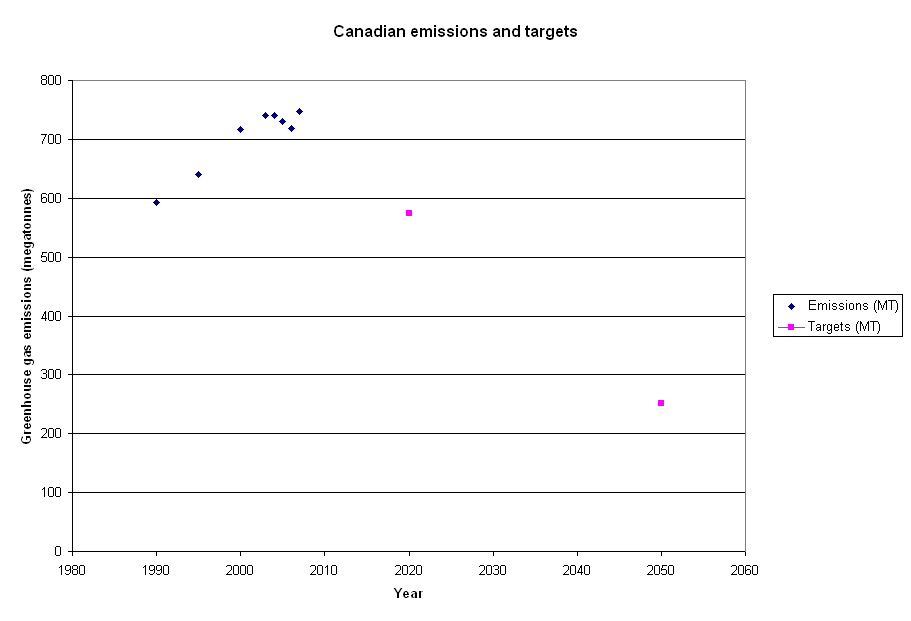
Back in May 2008, the figures for Canada’s 2006 emissions were released. They were made into a graph for a previous post. Now that the 2007 figures are available, the chart can be extended to show the 4% jump in emissions, putting Canada 26.2% above its 1990 level of emissions and 33.8% above its Kyoto Protocol target. In order to meet our target of cutting to 20% below 2006 levels by 2020, we will need to cut Canadian emissions by around 170 MT during the next eleven years.

Canadian 2007 GHG emissions and targets

The causes of the increase are also described:

“Between 1990 and 2007, large increases in oil and gas production – much of it for export – as well as a large increase in the number of motor vehicles and greater reliance on coal electricity generation, have resulted in a significant rise in emissions.”

Between 1990 and 2007, emissions rose by a total of 155 million tonnes (MT). 143 of those were from energy industries, including transportation and the oil sands. By contrast, residential emissions have basically been flat since 1990.

Canadian parliamentary voting records online

The voting records of Canadian MPs are being made available online. For instance, here is the voting record of Paul Dewar – NDP representative for Ottawa Centre. Things are still in an introductory state and the system hasn’t become as useful as it could potentially be. Nonetheless, it is a nice step forward towards a system in which constituents can easily and effectively monitor what their representatives are doing.

New Democrats disappointing on climate change

In the past, I have expressed my disappointment with the poor environmental positions adopted by the New Democratic Party (NDP) – most significantly, their oppositon to effective carbon pricing. In the lead-up to the election in British Columbia, I have been joined by a number of respected environmental groups, including The David Suzuki Foundation, the Pembina Institute and Forest Ethics.

Simon Fraser University economist Marc Jaccard has also criticized the NDP climate plan, arguing that it would be ineffective and would cost 60,000 jobs.

Dubious ‘Clean Energy Dialogue’ appointment

Squirrel in hail

If Canada’s government was serious about having a Clean Energy Dialogue with the United States, it probably would not have appointed a former oil sands executive to head one of the three working groups. According to DeSmogBlog, the appointee – Charlie Fischer – has 500,000 shares in Nexen, a firm that owns 7% of Syncrude, a major player in the Athabasca oil sands. That is about as clear a conflict of interest as a participant in a ‘Clean Energy Dialogue’ could have.

The logic of subjecting the oil sands to the same carbon price as the rest of the economy is very strong. Firstly, it means that low-cost emissions reduction opportunities in the sector will be realized. Secondly, with an appropriately set carbon price, it will help discourage economic activities that have negative value, once the effects of climate change are taken into account.

The logic gets even stronger when you consider a future integrated North American carbon market: the bigger the market, the more opportunity there is for a single clear price signal to induce the lowest-possible cost emissions reductions throughout the economy.

Deep packet inspection in Canada

The Office of the Privacy Commissioner has created a new website. In addition to the commissioner’s blog, there is now a website devoted to deep packet inspection, announced here.

Deep packet inspection is quite a profound modification of how the internet works. All information passed across the web goes through a number of machines. In the classic version of this arrangement, they just forward the information to the next link without giving it any consideration. With packet inspection, the datastream can be monitored by those intermediate machines, including the ones at a user’s internet service provider (ISP) between their computer and the rest of the internet. Given that the computers of your ISP see all your traffic, having them implement deep packet inspection raises some especially serious questions. That is especially true given that they may be vulnerable to attack by malicious actors, and may be willing to cooperate with requests from governments, even if those requests are illegal.

The technology could have good uses, like stopping viruses and worms. It could also have many malicious ones. Companies could use it to block competition, by making the internet discriminate against their existing rivals and new startups. It could also be used for data mining, eavesdropping, and censorship. Personally, I would prefer an internet without it, and I am glad to see that it’s something Canada’s official privacy official has been devoting a fair bit of attention towards.

Are Canadian banks too big?

Mixed media on a Toronto wall

So far, Canada’s banks seem to have fared will in the financial crisis. Unlike in the United States, they are few and relatively forcefully regulated. The current Wikipedia article on Canada’s banks is generous with praise: “Banking in Canada is widely considered the most efficient and safest banking system in the world, ranking as the world’s soundest banking system according to a 2008 World Economic Forum report.” It’s possible that this is a fundamentally superior form of financial regulation. At the same time, it’s possible that this crisis just wasn’t the sort that would test the viability of the big Canadian banks, and that another crisis could.

Given the extreme difficulty of dealing with banks too big to fail, should Canada break up the big banks that exist presently? Would doing so increase the security of the financial system, or diminish it? Also, if Canadian banks should be broken up, when should it be done?

Oil sands, game theory, and jobs

Clothes for sale, Toronto

If we are going to prevent catastrophic climate change, every major country in the world will need to have policies that put a price on carbon and encourage the transition to a low-carbon economy. If the range of estimates for safe concentrations is approximately right (350 – 550ppm, very broadly), such policies will need to be in place within a period of years to, at most, decades. In such a world, projects like Canada’s oil sands would be enough to make the state permitting them an international pariah. It seems quite legitimate to expect harsh trade sanctions against a state that is so blatantly ignoring the need for the world to cut emissions, once many other states have seriously begun to do so. Given that I don’t think Canada has the stomach to be another North Korea, it seems like we would eventually give in to pressure to bring our policies in line with those of the United States and our other allies and trading partners.

As such, there are two possible long-term outcomes that can be envisioned. Either catastrophic climate change will occur or Canada will be forced to cut emissions like everybody else. In the former case, I suppose our current climate policies are not hugely relevant. If the rest of the world doesn’t get its act together, human civilization will probably snuff itself out. In the latter case, further investment in the oil sands will just increase the medium-term economic losses associated with the abandonment of the project. Such investment will also make it more and more politically difficult for the government of Alberta to support sane climate policies, turning it into more and more of an active ‘spoiler’ in domestic climate change negotiations between different levels of government.

Unfortunately, the ‘bite’ in this analysis doesn’t come into effect for some time, probably beyond the political horizons of most Canadian policy-makers today. As a further consequence, it is very hard to get people to take such long-term considerations into account. That being said, if a large majority of Canadians came to understand the issue in these terms – that we are pouring effort into a project that will ultimately need to be abandoned – the political landscape might shift considerably. The discussion may then be less about jobs now versus climatic stability in the future, and more about directing the ongoing development of the economy towards jobs that will still be viable in ten years, instead of ones that will be extinguished along any effective path to a sustainable future.