Listeria and the food system

The ongoing listeriosis outbreak in Canada is evidence of how broken out primary food system is, particularly insofar as meat is concerned. Producing billions of clones in packed conditions is dangerous enough, particularly if you simultaneously marinate them in growth hormones and antibiotics. Marrying that with a food system where every step of the production chain is concealed from consumers increases the risk.

What is most astonishing to me is the result of a poll conducted by The Globe and Mail on their website. Asked: “Has the listeriosis outbreak damaged your opinion of Maple Leaf products?” 38% of respondents said “no.” Perhaps this demonstrates the degree to which we are not aware of the shortfalls of our food system and food regulation, to the point where we accept this kind of occurrence as an inevitable consequence of food production.

More people should read Michael Pollan’s The Omnivore’s Dilemma. A safer, healthier food system is entirely possible. It will not, however, emerge while people are still happy to accept a dozen Canadian deaths (and counting) as part of the cost of having “pre-packaged meat products” available for purchase.

Stories of this kind sometimes makes me wonder whether personal vegetarianism is actually a selfish choice. Opting out of the system can be seen as an inferior alternative to agitating for change. After all, it was basically consumer demand that produced the emergence of organic and local food options. It is only when a mass market demand exists for healthy, safe, natural, and sustainable meat and seafood that systemic change could become possible.

More on food, health, and the environment:

Emily also wrote a post on this previously.

Bill Gates and the oil sands

In the past, I have been impressed by the philanthropy of Bill Gates. Now, after spending billions of dollars combating poverty and infectious disease, he seems to be flirting with investments that would counteract his earlier goals. Along with Warren Buffet, Gates recently toured the Athabasca oil sands, supposedly in search of investment opportunities.

We are now at a juncture in time where we understand the magnitude of the threat posed by climate change, as well as the growing role the oil sands are playing in Canada’s greenhouse gas emissions. It is simply immoral to assert that just because a resource is under your feet, you can exploit it regardless of the harm that does to others. While it is theoretically possible that future technologies will reduce the harm caused by oil sands extraction and upgrading, such technologies do not exist today and cannot serve to justify the destruction that is ongoing.

If Gates does decide to invest, he will be adopting a deeply hypocritical position with respect to good global citizenship and the challenges facing the global poor. The IPCC and others have stressed that it will be many of the world’s poorest people who suffer most from climate change. Projected impacts include droughts, famines, storms, and the increased spread of some infectious diseases. Hopefully, the actual sight of boreal forest being stripped mined and rendered toxic through greenhouse-gas-spewing industrial activities will put him off the investment idea.

Climate change and the limits of Canadian sovereignty

Thesis: Canada is free to enact more stringent climate policies than the United States, but not free to enact less stringent ones.

Argument:

  1. As long as little is being done in the United States, American corporations are not concerned about being made uncompetitive with foreign firms because of climate change policies.
  2. If the United States did adopt a serious climate policy (a national cap-and-trade plan with auctioning, perhaps, or a carbon tax), those firms would suddenly be very concerned about losing business to firms not thus restrained. This is especially true in sectors with high emissions per dollar’s worth of output. This includes heavy industry, the petroleum sector, and so forth.
  3. These firms will lobby the American government to pressure its trading partners to adopt comparable policies.
  4. These firms will find many supporters in Congress who think similarly. Politicians will also be fearful of domestic job losses and the relocation of production to foreign jurisdictions with less stringent rules.
  5. In the case of Canada, legal vehicles through which this might occur include the North American Free Trade Agreement (NAFTA) and the World Trade Organization (WTO). Potentially, other agreements pertaining to transboundary pollution might play a role.
  6. If taking a legal route fails or is not desired, it is always possible for the US to put enormous trade pressure on Canada. 85% of Canadian exports go to the United States and even illegal trade blocking moves by the US can be so painful as to force a surrender (as with softwood lumber).
  7. No Canadian government will be willing to sacrifice access to the American market, even if avoiding it requires a considerable loss of face.

As such, there seems to be a decent change that if a new administration in the United States adopts a relatively strong national climate change mitigation policy, some version of the events above will lead to the introduction of a comparable regime in Canada. Of course, the ability of even an Obama presidency with Gore as a climate czar to get emission regulations through Congress cannot be taken for granted, largely on account of the short-term interests of the selfsame corporations mentioned above.

Comments? Counter-arguments?

On patriotism

Having been exposed once again to the summer light show outside parliament, I find myself thinking about patriotism once again. It seems to me that you can approach it from two different directions. In the first case, you develop a list of virtues that a country might possess. These could include a good human rights record, international generosity, the rule of law, and so forth. You then evaluate any particular state on the basis of your pre-existing preferences. The alternative is to simply assert the unique value of a particular state, as derived from its history and so forth.

The first approach strikes me as far more valid. It is absurd for someone to assert the superiority of their country in a non-comparative fashion, or without relation to particular characteristics which establish a state as worthy or unworthy of admiration. Admiring states as means to desirable ends has a fundamentally liberal quality, while the alternative is mythical, with a distinct whiff of fascism.

In general, love of country seems more dangerous than beneficial. We can certainly admire states that do a good job of advancing human welfare, but we should value the states only as vehicles to those ends, not as inherently valuable entities. The doctrine of “my country, right or wrong” seems unacceptable in a world with so much experience of nationalist war and state sponsored moral outrages.

Human Health in a Changing Climate

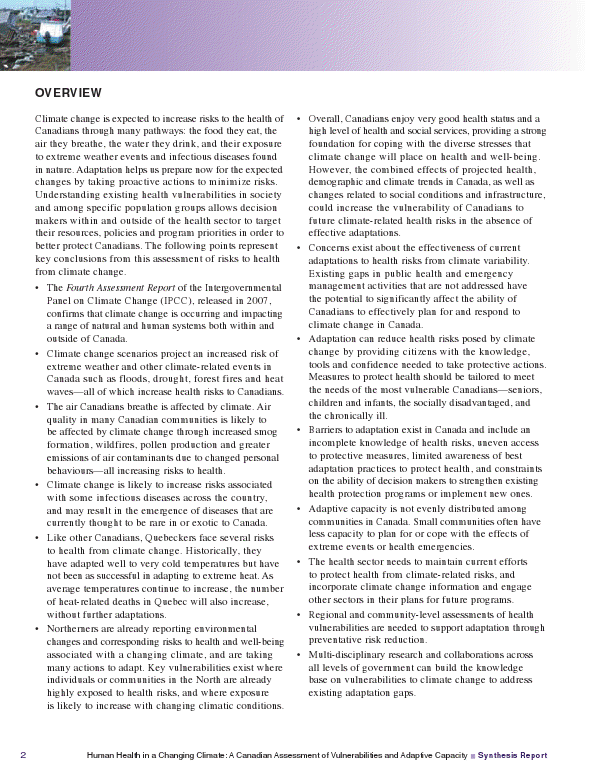
Health Canada has followed up the climate change impact assessment carried out by Natural Resources Canada with a report of their own: Human Health in a Changing Climate: A Canadian Assessment of Vulnerabilities and Adaptive Capacity. For some bizarre reason, they have decided not to post it on their website. Rather, it is available through email upon request. To simplify matters, here it is:

When I have the chance, I will merge them all into one file and post it.

[Update: 19 August 2008] Here is the whole thing as one 9 megabyte PDF: Human Health in a Changing Climate: A Canadian Assessment of Vulnerabilities and Adaptive Capacity.

[Update: 1 January 2012] Here is just the overview page as an image file.

Greyhound bus security

Having spent much of the last week waiting for or riding on Greyhound buses, all the news stories about the man who was beheaded on one caught my eye. Some people are calling for airport-style screening procedures for buses. There are at least two reasons for which this is inappropriate.

The first concerns the mobility of buses. With a plane under their control, hijackers can fly to distant states that might assist them. The only way to stop them is to shoot down the plane, killing everyone on board. Buses are comparatively easy to stop. You can shoot out the tires, put spiky strips across the road, or simply block the route with something heavy. Nobody is likely to escape to sunny Cuba on a hijacked bus. Another element of mobility is multiple stops. Bus companies would need to (a) put security at every permitted stop (b) only allow people on at big bus stations or (c) allow some unscreened people aboard buses. Someone determined to commit a violent act on a bus could take advantage of (c), while (a) and (b) would seriously inconvenience people at many smaller stops.

The second is that someone in control of an ordinary plane can kill a lot of people. They can certainly kill everyone on board. They can also kill many people on the ground. Similar risks do not exist in relation to buses. At the very most, someone with a machine gun or explosive device could kill most of the people on board. There is no clear situation where being on a bus increases the amount of harm a person can do. Someone who wants to kill a particular person can do it at least as easily off a bus as on it; the same is true for someone who just wants to kill people at random.

There is certainly a certain risk of violence on board a bus, but that does not mean that excluding weapons is a sensible use of resources. For one thing, it would increase bus fares substantially and require the redesign of bus stations. For another, it isn’t clear that it wouldn’t simply displace any violence that was to occur to a different venue. Living among humans naturally entails risks, which we can mitigate to greater or lesser degrees in various ways. Reducing risk always involves some kind of cost: sometimes in money, sometimes in freedom. The level of news coverage this incident is receiving highlights just how slight a risk this actually is. The kind of risks that make the news aren’t the sort to worry about, since they are rare by definition. It’s the stuff that is too common to constitute news that you really need to fear: things like domestic violence and heart disease, for instance. Screening bus passengers is not an intelligent use of our resources.

Green bonds in Canada

Emily Paddon, one of my friends and classmates from Oxford, is involved in a scheme to create green bonds in Canada. The initiative, which is part of the Action Canada Fellowship, aims to create a “government-backed financial instrument designed to engage the public by raising capital to accelerate renewable energy production.” The aim is to eliminate more than 25 million tonnes of carbon dioxide equivalent by 2020, at a cost of between $1 and $13 per tonne.

Innovative financing mechanisms will be a very important part of the transition to a low carbon economy. It will be interesting to see when the full details of this become available, and even more interesting when the bonds are available for purchase. Those aiming to both save for the future and help to save the future should take note.

Cacophony

This morning, Emily, my mother, and I all woke to what sounded like somebody upstairs using a jackhammer on a hardwood floor. The whole house was vibrating, saturated with squealing and rattling noises.

A few minutes of pyjama-clad inquiries led me to the neighbour involved with the noise: “Oh, we’re just cutting some beams in the basement.”

Brain-thoughts, at that moment: “First thing in the morning? On a Saturday? With what sounds like an misfiring chainsaw?”

Promises of ‘just a few more minutes’ secured, back-to-bed trundling.

Brain-thoughts, just before returning to sleep: “Those aren’t the beams holding up this building, are they?”

Oh, it is too hot here…

Back from Montreal

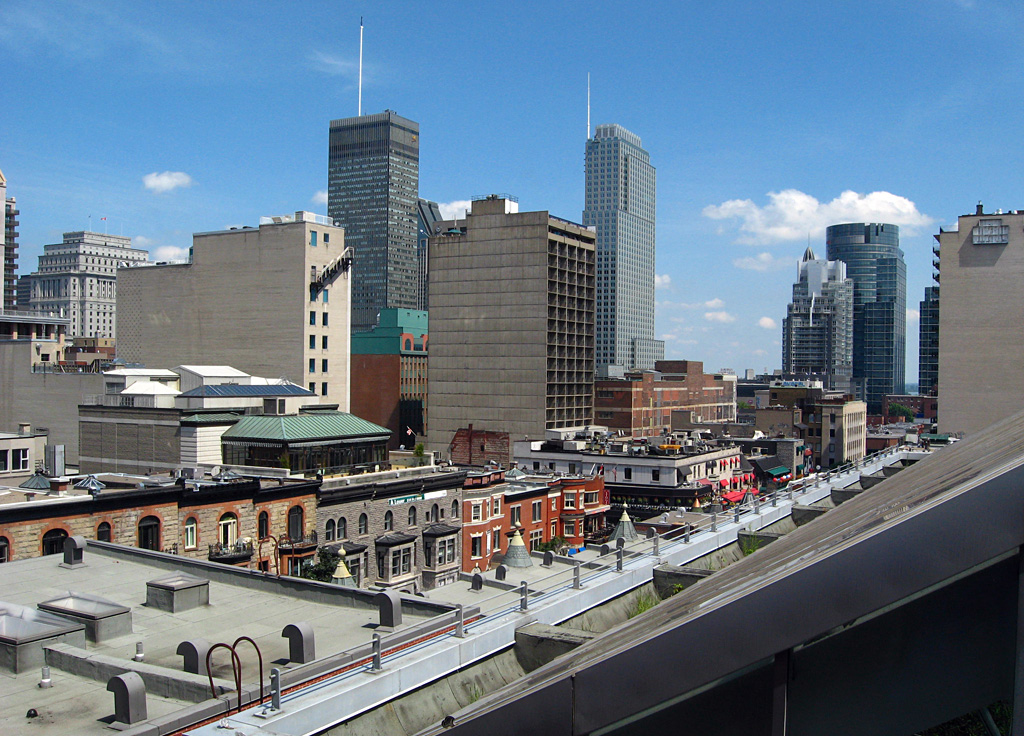
Downtown Montreal

Emily and I passed a most enjoyable weekend in Montreal, with ongoing Just For Laughs Festival events punctuated by tasty food and visits to the fine arts museum, botanical gardens, and ‘Insectarium.’ The last of those is especially worth a look, for those with a bit of a scientific or naturalist bent. The giant beetles are impressive, and the colony of leaf cutter ants is especially immersive – largely on account of how it is not contained by glass.

I haven’t spent an appreciable amount of time in the city since I was at l’Universite de Montreal for the French Language Bursary Program in 2003. Now that my youngest brother is starting university at McGill in September, I am hoping to spend more time in the lively and entertaining metropolis.

[Update: 8:45am] Here is Emily’s account of the weekend.