Exploring eastern Ottawa

Bizarre statue

Yesterday, I went for a lengthy wander in the parts of Ottawa east of the Canal. That is where you can find the Saudi Embassy, the house of the British High Commissioner, and the main DFAIT building. It was only yesterday that I fully realized what that building resembles: a certain evil red robot of web comic fame. The similarity is especially evident when you look at the DFAIT building from a vantage point quite far to the west, such as the bridge I cross to work each day.

While reading The Economist on the grass across from that building, I saw a convoy of five black SUVs with hidden lights whizz by, along with four police cruisers. Given my location, it may have been the Prime Minister heading home. If so, I wonder when the whole motorcade song and dance began.

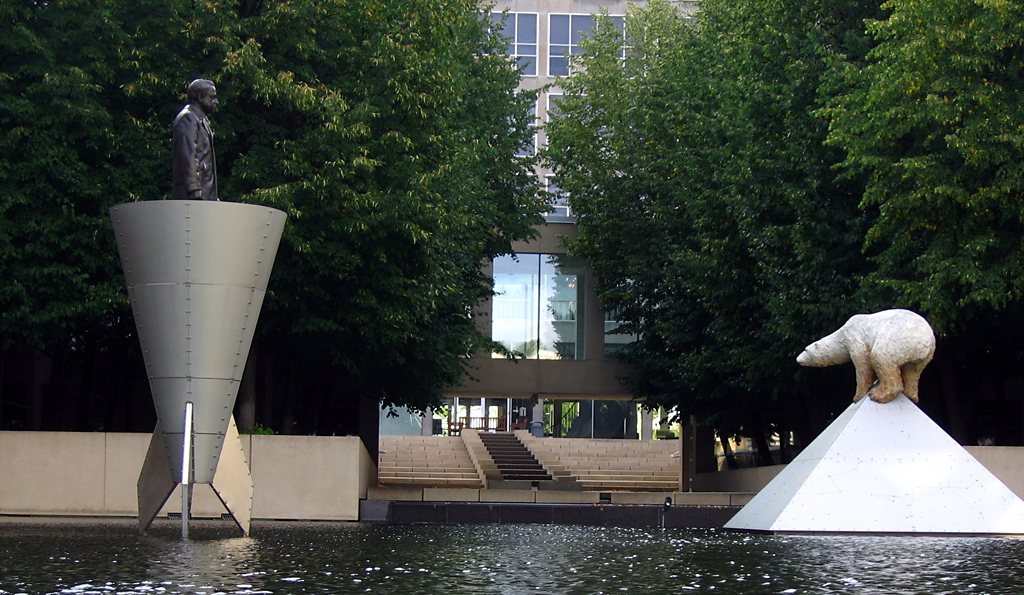
I also happened across quite an unusual building. Located on a little island, it looks very much like some of the architecture in Aeon Flux. Apparently, it was originally intended to be a new city hall for Ottawa, but it was decided after construction that it is too far from the centre of town. As such, it is now mostly empty, aside from some supplementary DFAIT offices. I think they should give it to Environment Canada. In the middle of the complex is a large, square, shallow pool. In the middle of that is a polar bear, awkwardly perched on a white pyramid. The bear is looking across at some kind of evil overseer, who is standing inside the bottom half of a rocket ship. Clearly, this piece of art demonstrates that the building was meant for us.

The area also includes a number of other large and seemingly abandoned government facilities. It suggests that not all of Ottawa is an efficiently clicking bureaucratic machine, and makes you wonder a bit about why they are planning to build yet more structures deeper in Gatineau.

Grist for the mill

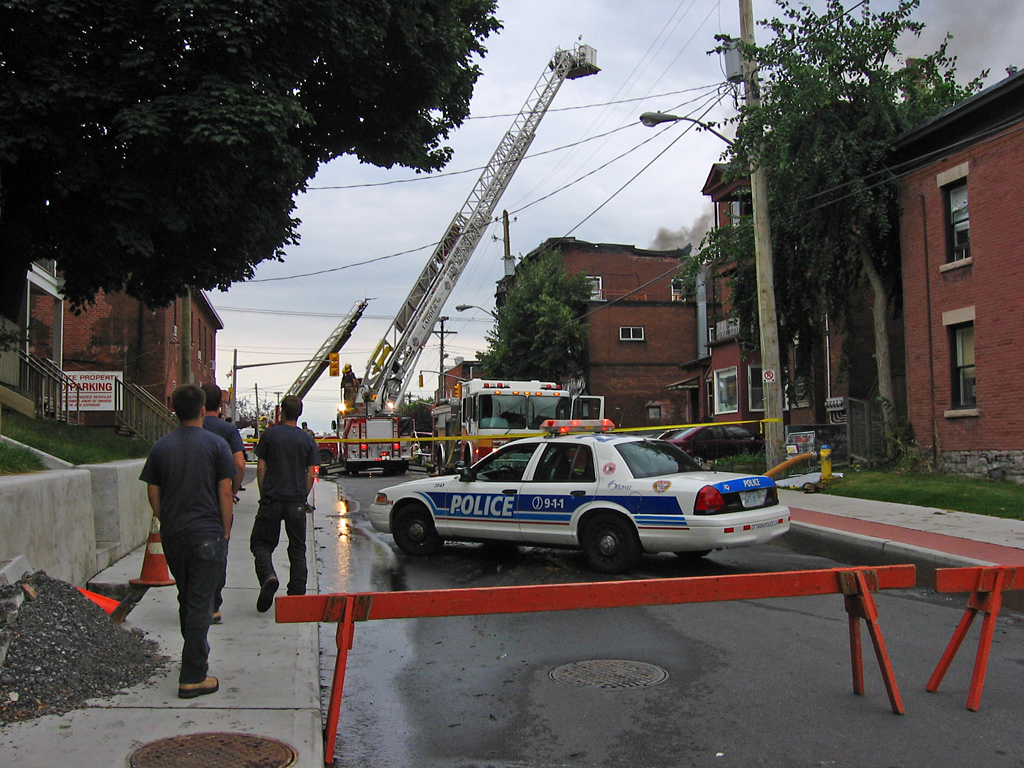
Fire at Booth, near Somerset

Here is an interesting article about the ongoing debates about ethical food and climate change: “The Eat-Local Backlash.” Such articles demonstrate how fiendishly complicated it can be to make personal environmental decisions. Questions about which of two options has the lesser environmental effect can rarely be definitively answered, not least because there are so many different types of environmental effects, ranging from air and water pollution to climate change and loss of biodiversity. This article is from a site called Grist, which has recently joined the ranks of those I consult most frequently and read most carefully. Their analysis isn’t always terrific, but the place has a lot of life.

Indeed, the site itself demonstrates the benefits of aggregation (one argument against local food). Rather than having the attention of a few hundred people spread between a few dozen environmental blogs, each getting a couple hundred hits a day, this provides a much more concentrated conversation. I encourage those interested in environmental issues to join and start commenting.

McIntyre and NASA data

SAW Gallery, Ottawa

There is a lot of talk in the media about how Steve McIntyre – an amateur scrutineer of climate statistics – found an error in data released by NASA. Specificically, it was mistankingly believed that data that had not been corrected for urban heat effects had been. This data pertains only to the United States and the correction implies that about 0.15 ºC of the observed warming there was just a statistical error. In itself, this would not get much attention. What does get attention is that this changes the rankings of the hottest recorded years in the United States. Rather than 1998 being the hottest recorded year in the United States, 1934 now wins. Many news sources are treating this data revision as though it demonstates a serious flaw in the overall quality of our climate understanding.

The Fourth Assessment Report of the Intergovernmenal Panel on climate change is based on a far broader collection of data than just NASA data pertaining to just the United States. As such, their overall conclusion that is barely affected by this change. Likewise, the worldwide figures for hottest years still cluster in the last decade. The report’s Summary for Policy Makers explains:

Eleven of the last twelve years (1995–2006) rank among the 12 warmest years in the instrumental record of global surface temperature (since 1850). The updated 100-year linear trend (1906 to 2005) of 0.74°C [0.56°C to 0.92°C] is therefore larger than the corresponding trend for 1901 to 2000 given in the TAR of 0.6°C [0.4°C to 0.8°C]. The linear warming trend over the last 50 years (0.13°C [0.10°C to 0.16°C] per decade) is nearly twice that for the last 100 years. The total temperature increase from 1850–1899 to 2001–2005 is 0.76°C [0.57°C to 0.95°C]. Urban heat island effects are real but local, and have a negligible influence (less than 0.006°C per decade over land and zero over the oceans) on these values.

This information is based on a broad collection of sources including satellites and ground stations around the world. It also incorporates evidence from ice cores and other historical indicators of temperature and greenhouse gas concentrations. What the McIntyre situation demonstrates is the degree to which perceived anomalies are seized on by people with pre-determined agendas to either support or refute the overall climate change consensus. While the data is not a statistical threat to that consensus, it does have the ability to foster doubt in the general public and among policy-makers, especially when presented out of context.

Having people out there scrutinizing the data is excellent, and a good check against the proliferation of misleading information. At the same time, it is necessary to be rigorous in our thinking about how one new piece of information affects the overall picture. Likewise, it is important to remain aware of the degree to which individual agendas influence how information is processed, and what responses it evokes.

Hollywood physics

Canadian flag

Deficiencies in movie physics can be good fun to dissect and mock, but a recent paper suggests that they are less benign. “Hollywood Blockbusters: Unlimited Fun but Limited Science Literacy” suggests that the absurdities that abound in popular films actually weaken the people’s ability to understand how the world works. The paper concludes that:

Hollywood is reinforcing (or even creating) incorrect scientific attitudes that can have negative results for the society. This is a good reason to recommend that all citizens be taught critical thinking and be required to develop basic science and quantitative literacy.

Specific issues discussed in the paper include projectile motion, Newton’s laws, impulse, buoyancy, and angular momentum. Certainly, some films underplay the dangers of high falls and similar phenomena – as well as playing up the dangers of things like automobiles spontaneously exploding.

Personally, I would prefer a world in which movies portrayed all the sciences in realistic and accessible ways. Unfortunately, such films are in perpetual danger of being ignored in favour of flashy absurdities like the The Core or the egregious recent Star Wars films.

Reading these entertaining reviews is a good after-the-fact vaccine.

Quite staggeringly popular in this manor, squire

Interesting Ottawa facade

So I curtailed my Walpoling activites, sallied forth, and infiltrated your place of purveyance to negotiate the vending of some cheesy comestibles.

One thing I miss about England is the cheese. While there are equally good premium cheeses in Canada, the average quality of normal cheese is much better over there. The store brand will include Cheshire, Wensleydale, Cheddar, Double Gloucester, Red Leicester, and others and they will all be a lot more enjoyable than the standard can’t – tell – if – this – is – Cheddar – or – Mozzarella variant that seems to sell best by bulk here.

When I return to graduate (eventually), I will have to make a point of enjoying them.

The acid sea

American embassy, Ottawa

One frequently neglected consequence of rising global concentrations of carbon dioxide is increasingly acidic oceans (though it has been mentioned here before). Since the Industrial Revolution, the world ocean has absorbed about 118 billion tons of anthropogenic CO2: half of total human emissions. Every day, another 20-25 million tonnes are being absorbed.

Before the Industrial Revolution, oceanic pH was about 8.179. Now, it is at 8.104. By 2100, it is projected to be 7.824. Because pH is a logarithmic scale, that is a bigger change than it seems to be. At the projected 2100 concentration, the shells and skeletons of corals, molluscs, and phytoplankton with aragonite shells begin to dissolve within 48 hours. James Orr et al, writing in Nature provide many more details:

In our projections, Southern Ocean surface waters will begin to become undersaturated with respect to aragonite, a metastable form of calcium carbonate, by the year 2050. By 2100, this undersaturation could extend throughout the entire Southern Ocean and into the subarctic Pacific Ocean. When live pteropods were exposed to our predicted level of undersaturation during a two-day shipboard experiment, their aragonite shells showed notable dissolution. Our findings indicate that conditions detrimental to high-latitude ecosystems could develop within decades, not centuries as suggested previously.

The effect of more acidic oceans on aragonite is part of why the Stern Review projects that coral reef ecosystems will be “extensively and eventually irreversibly damaged” at less than 450 ppm CO2 equivalent and less than 2°C of warming. Given how critical coral reefs are to overall oceanic ecosystems – including key commercial fish species – this should be of concern to everyone.

It is very hard to project what the consequences of all this will be. As with so many other climatic phenomena, the net impact for human beings probably has to do with the relative strength of positive and negative feedbacks and the corresponding resilience of ecosystems. What is certain is that the only way to prevent acidification is to signficantly cut CO2 emissions.

Thirty days in

Parliament of Canada

One month has passed since I arrived in Ottawa. Since then, I have found somewhere to live, furnished it, learned the basic layout of the city, and become settled in my job. The most notable thing I have not done is make any friends. I know people at work and there are people who I knew before who I now hang out with here, but there is nobody of my age outside work who I have met here and now interact with socially. That is a big change from Oxford, where you are immediately immersed in a collection of social circles: college, program, department, clubs, etc.

The process of acclimatization must continue, in areas that are as important but not as urgent as finding somewhere to live. With at least eleven months left here, it is a wise area in which to invest.

Data storage

SAW Gallery, Ottawa

This evening, I was at an art gallery watching 8mm, Super 8, and 16mm films shot 25-40 years ago. Most of them were not in pristine quality, but still quite viewable. Afterwards, I got into a conversation with someone who works in archival film storage for the federal government. Contemporary society is generating far more data than ever before. At the same time, virtually nothing is stored at archival quality. An 8mm video or a 35mm negative will be fine in forty years if stored at controlled temperature and humidity. Even dumped in a box in someone’s attic, it is still likely to be comprehensible. The same is not true for how we store data today.

Basically, you have optical and magnetic storage. Optical includes CDs and DVDs, and is further divided between mass releases CDs (which are pressed into metal) and personally made CDs (which rely on dyes exposed to lasers). Neither is really archival. It is quite possible that your store-bought DVD will not work in twenty years. It is quite likely that your home-burned DVD will not work in five.

In terms of magnetic storage, you have tapes and hard drives. Many companies have learned to their detriment that poorly stored magnetic backup tapes can be useless. As for hard drives, they are vulnerable to physical breakdown, viruses, exposure to magnetic fields, corrosion, and other factors.

While is is likely that the products of my early fumblings with Ilford Delta 400 in high school will be intelligible in forty years, it is a lot less likely that my digital photos from Paris will be. That’s ironic, of course, given that the first ones can only be copied imperfectly and at a notable expense, while the latter can be copied perfectly for a few cents a gigabyte.

While some information exists in the form of so many copies that is will likely never be lost (ten thousand unsold copies of Waterworld on laserdisc), there is reason to fear that personal data being stored in the present era will likely be lost before people born today have grandchildren. While that has certainly been the norm for generations past – who would be lucky to have their lives recorded as a birth in a parish register, a marriage, and a death – it seems rather a shame given how cheap and ubiquitous data creation and storage has become.

[Update: 11 August 2010] I forgot to mention it earlier, but one potentially robust way to back up digital files is to print them on paper.

Heat: How to Stop the Planet from Burning

Ottawa wooden sculpture

During the past two years, I have been reading about climate change for several hours every day. During that span of time, I have read dozens of books and hundreds of articles. Quite possibly, none were as thought-provoking as George Monbiot’s Heat: How to Stop the Planet from Burning. If you are at all serious about understanding the issue of global warming, it is essential reading. He may not be right (indeed, it would be far preferable for him to be wrong) but he will definitely make you think.

His project is an ambitious one. Having decided that global temperatures must not be allowed to rise by more than 2°C on average, he works out what that would mean for Britain. Since British emissions per capita are way above the world average, a fair system would require much heavier cuts there than elsewhere. Canada’s per-capita emissions are even worse.

Here is a smattering of what he says will be required by 2030:

  • A power grid dominated by renewables and natural gas plants with carbon capture and storage.
  • Dramatically, dramatically tightened building regulations – making most houses either ‘passive’ in their non-use of heating or cooling or capable of producing their heat and power from piped-in hydrogen, possibly supplemented by solar.
  • Most private automobile travel replaced by a buses or non-motorized transport, both within and between cities.
  • An end to cheap air travel: no more low cost flights, with massive total cuts in the number of both short and long-haul flights.

The last is the result of a complete lack of alternative technologies that can deliver the kind of emission reductions required. Even if all other emissions were cut to zero, growth in air travel would make that one sector break his total limit by 2030.

Suffice it to say, Monbiot is not in the main stream of this debate. The Stern consensus is that climate change can be dealt with at moderate cost. Even if Monbiot’s ideas are entirely possible, in terms of engineering, one cannot help but doubt that any political party in a democratic state could successfully implement them. The impulse to defend the status quo may turn him into a Cassandra.

In fifty years, it is possible that people will look back at this book and laugh. Alternatively, It may be that they look back on Monbiot as one guy who had approximately the right idea while everyone else (Gore and company included) were in denial. The answer seems to depend upon (a) whether emissions need to be cut as much and as quickly as he thinks and (b) how bad it will actually be if they are not. It is pretty easy to do the math on the first of those, at least for any desired greenhouse gas concentration or temperature change. The latter is harder to assess. Regardless of which proves to be closer to the truth, this is a book I wholeheartedly endorse for anyone trying to keep abreast of the climate change issue.

Diesel and axles

Every morning, I get woken up at 6:30am as the first major rumblings of morning traffic overwhelm my earplugs. You would expect this to be a negative feature of my new dwelling, but it is actually quite a wonderful one, in its way. You see, I get woken up, look at my phone, and realize that I can sleep for another hour and a half and still have time to shower, eat breakfast, and be at my desk by 9:00am.

Even when I went to sleep just two hours before the truck-induced waking, having those ninety minutes feels like a luxury.