Something New Under the Sun

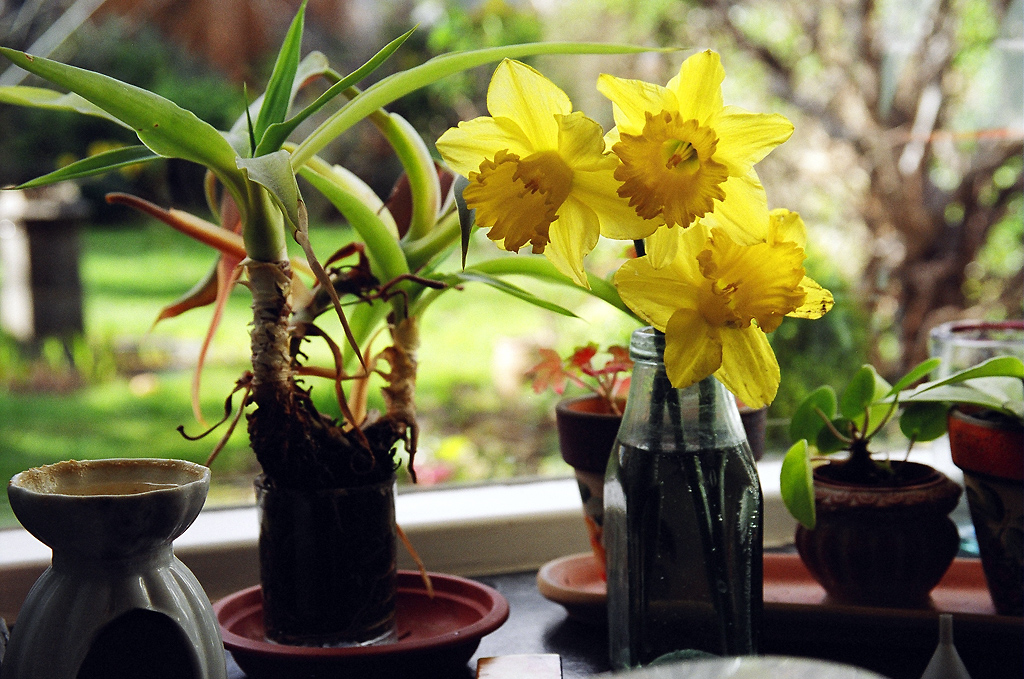
Flowers in a window, London

Happy Birthday Zandara Kennedy

Extensively footnoted and balanced in its claims, John McNeill’s Something New Under the Sun is an engaging and worthwhile study of the environmental history of the twentieth century. It covers atmospheric, hydrospheric, and biospheric concerns – focusing on those human actions and technologies that have had the greatest impact on the world, particularly in terms of those parts of the world human beings rely upon. People concerned with the dynamic that exists between human beings and the natural world would do well to read this volume. As McNeill demonstrates with ample figures and examples, that impact has been dramatic, though not confined to the twentieth century. What has changed most is the rate of change, in almost all environmentally relevant areas.

The drama of some documented changes is incredible. McNeill describes the accidental near-elimination of the American chestnut, the phenomenal global success of rabbits, and the intentional elimination of 99.8% of the world’s blue whales in clear and well-attributed sections. From global atmospheric lead concentrations to the depletion of the Ogallala Aquifer, he also covers a number of huge changes that are not directly biological. I found his discussion of the human modification of the planet’s hydrological systems to be the most interesting, quite probably because it was the least familiar thing he discussed.

Also interesting to note is that, published in 2000, this book utterly dismisses nuclear power as a failed technology. In less than three pages it is cast aside as economically non-sensical (forever dependent on subsidies), inherently hazardous, and without compensating merit. Interesting how quickly things can change. The book looks far more to the past than to the future, making fewer bold predictions about the future consequences of human activity than many volumes of this sort do.

Maybe the greatest lesson of this book is that the old dichotomy between the ‘human’ and the ‘natural’ world is increasingly nonsensical. The construction of the Aswan High Dam has fundamentally altered the chemistry of the Mediterranean at the same time as new crops have altered insect population dynamics worldwide and human health initiatives have changed the biological tableau for bacteria and viruses. To see the human world as riding on top of the natural world, and able to extract some set ‘sustainable’ amount from it, may therefore be unjustified. One world, indeed.

Perseid shower peaks tonight

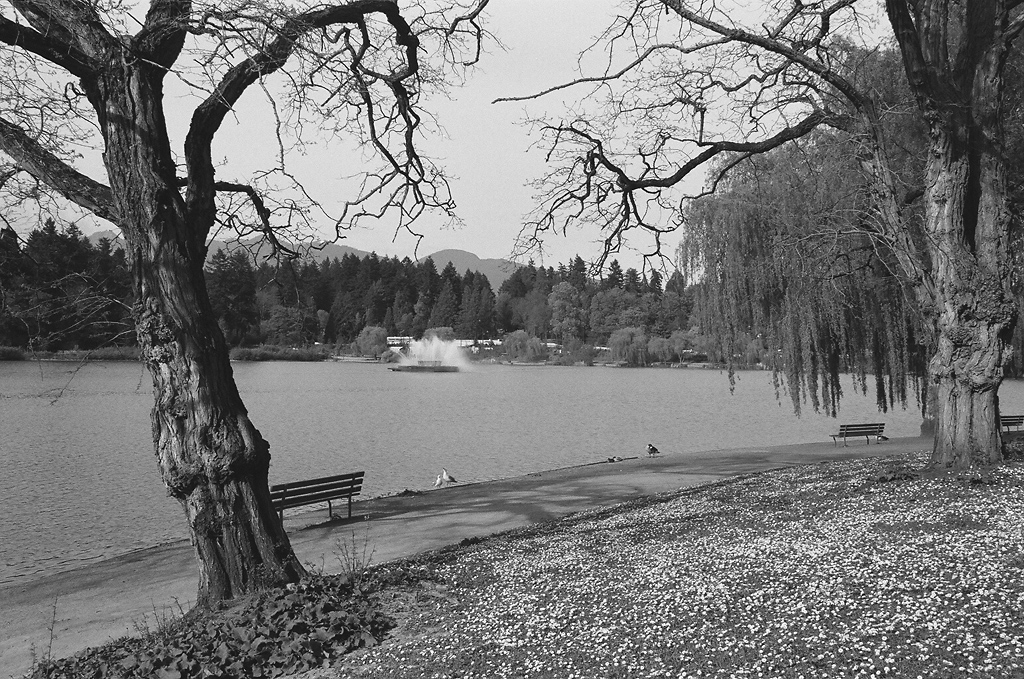
Lost Lagoon, Vancouver

Taken during a walk with Astrid in late April 2005, this photo shows Lost Lagoon in Vancouver’s Stanley Park. Nearby, to the southeast, is Vancouver’s central urban district. Equally close, to the north and through the park, is the southern end of the Lions Gate Bridge to North Vancouver.

In an announcement particularly relevant to those who live outside of big cities, the Perseid meteor shower will reach its peak of intensity tonight. Generated from dust and fragments from comet Swift-Turtle, the Perseid shower occurs annually. The comet in question was discovered in 1862 and is notable for being the largest object that regularly approaches the earth.

The best time to see the shower is in the hours immediately before dawn, but there should be more than eighty meteors per hour visible to the naked eye for most of the night, for those in reasonably dark places. Because of the way in which the planet rotates, the rate at which the meteors appear is about twice as high right before dawn as it is shortly after sunset. This is because, at that time, the particular part of the planet’s surface where you are is both hidden from the sun and facing in the direction of its the planet’s around the sun. Because of that combination, the most visible collisions with material from the comet will occur.

The shower is called the Perseids because the meteors appear to be coming from the constellation Perseus. Those who are going out to watch may find it worthwhile to familiarize themselves with how the constellation looks and where in the sky it appears.

If anyone has a particularly dramatic experience, I would be glad to hear about it here. I continue to look up with dismay at the thick rain clouds over Oxford.

[Update: 13 August 2006] On account of the constant presence of rain clouds blocking the sky and reflecting back city light, I saw not a single meteor. I hope others did better.

Reading and Sin City

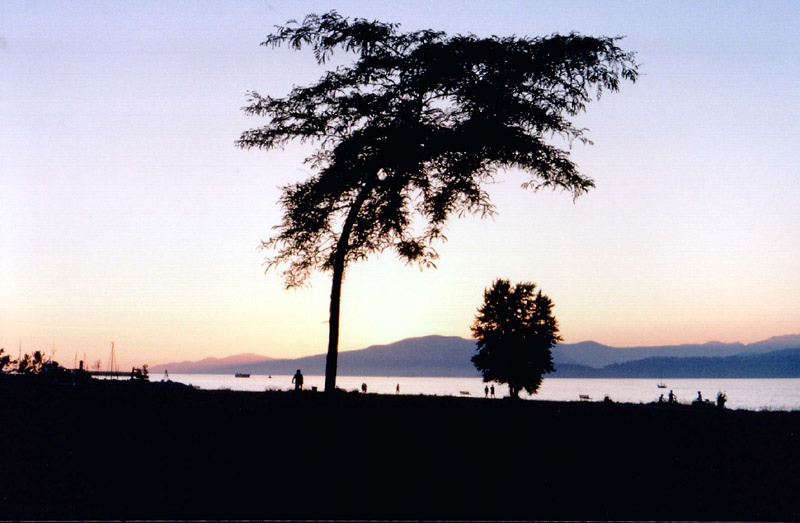
Vanier Park at sunset

I called the repair centre today and they said that a technician hasn’t even looked at my dust-laden digicam yet. They say they have a backlog of several weeks. As such, we are going to have to see how long I can keep finding suitable photos of the day in my archives. Within the collection that lives on my hard drive, most of the good photos have already been put online somewhere or other. Apologies to those diligent few who may have already tracked these down.

This photo was taken during the summer after my first year at UBC. It was taken in Vanier Park, near the Vancouver Planetarium.

Aside from zipping around on a number of administrative projects, today largely comprised sedate reading. I am two thirds of the way through John MacNeil’s Something New Under the Sun: An Environmental History of the Twentieth Century. I picked up a surplus hardback copy from the county library in excellent condition for £1. Mostly, it is familiar reading, though it may be useful to have a source to which so many stories I might tell in the thesis can be attributed.

Later in the evening, I watched Sin City with Kelly. The atmosphere of the film was definitely well-assembled, with good cinematography, costumes, and general verisimilitude. The plot is a triptych of very classic revenge tales: all bound up with underlying assumptions about roles people play and the duties that attach to them. Actually, the extent to which these stories are so automatically comprehensible makes you question the bases according to which you assign social expectations.

The most startling moment was near the end, when I finally realized why one character was so familiar looking; she is the same woman who played Rory in the many episodes of Gilmore Girls that I watched with Nick’s sisters over the years. Not quite the same as seeing the farmer from Babe become the hardbitten chief in L.A. Confidential, but a somewhat similar instance of contrast. To say more risks ruining plot elements. In essence, the film is well worth seeing. Because of the heavy visual focus, it would probably have been especially worthwhile to see in theaters.

Cabin Fever Redux

Mathias at the first Cabin Fever

I don’t know who took this photo, but it is probably my favourite from the original Cabin Fever retreat, in the summer of 2005. Organized by Tristan, those 5 days were probably the best of that summer. Most fortuitously, he is planning a redux, to take place during the time when I will be in Vancouver. If enough of the friends who I really want to see are going along for the three days (September 10-12) I shall make a point of doing so. Surely nobody who went the first time can deny the appeal of a repetition?

I very much hope the thing will come together. To devote three of my eighteen days in Canada to such a venture seems most worthwhile, provided people who I really care about choose to come along.

More security, less freedom

While we can all be very glad this alleged plot was foiled, the new rules on carry-on baggage are going to make travelling long distances by plane truly hellish. Without more information, it is impossible to evaluate how justified they are, but they certainly appear to be quite onerous. No water; no books, magazines, or newspapers; no portable electronics of any kind. Of course, either the restrictions or all duty-free shopping will eventually have to go.

It also seems that all EasyJet flights out of all London airports are cancelled. With my EasyJet flight to Dublin in six days, I wonder what is going to happen. They seem to be offering refunds on tickets. Maybe I should take it, then pay the cancellation fee from the hostel.

Such is the power of terrorism: even when we win, we lose.

[Update: 6:52pm] Both of my current roommates have had to re-schedule flights over this: one to Austria and one to Barcelona. It seems likely that another friend’s trip to Madrid will not be happening, and that yet another friend’s flight to Canada tomorrow will be boring and uncomfortable.

[Update: 11 August] Flights from London to Dublin are back on schedule, according to EasyJet. My friend also made it to Madrid today, after all.

Travel plans and an old photo

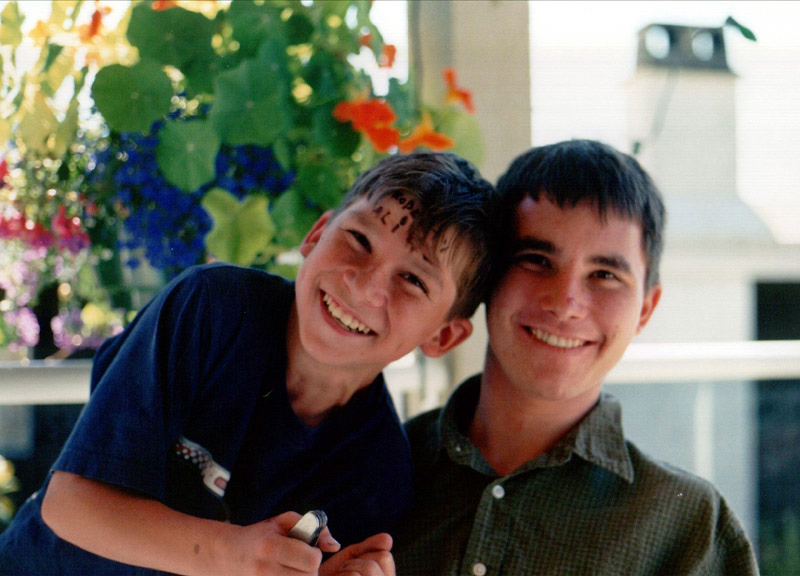
Milan Ilnyckyj, age 16

Since my camera is still off in Stoke-on-Trent going through dust rehab, I am unable to produce new photos of the day. My stock of recent images has also been exhausted, as a slew of photos of high voltage towers might have indicated. For the next while, I will therefore use much older photos as photos of the day, with some explanation of why they are interesting.

This photo was taken of my by Kate’s friend Lucas, the morning after her seventeenth birthday party, on Mount Stephen Street, in Victoria. Given that the photo is six years old (27% of my whole life), I think I look remarkably similar. Eight months after this photo was taken, I started my undergraduate program at UBC. This is a period I think back to again and again because it strikes me as the point at which almost everything that has happened since became fairly obvious. That is to say, the probable course for the next decade or so was laid out.

With regard to the period after the M.Phil, there is enormously more doubt. Almost everyone has advised against me going straight into a PhD program. After six consecutive years of university education, attaching another four to six right on seems like a tall order. As for what could be done during a lapse, the obvious options are to work (somewhere interesting) and travel. To work for a year and a half or so, then travel for six months, is an idea with considerable appeal.

The travel plan would be a great arc across the Eurasian landmass: from coastal China through southeast asia to India, then up to Turkey, Russia, and through Eastern and Central Europe. Incorporating Africa, and perhaps Australia and New Zealand, would also be a big plus. One of the three planks of my eight year plan is to travel to at least every major area of the world. With only North America and Western Europe firmly under my belt, that leaves a lot of wandering to be done.

Canada trip

On the matter of the return to Canada, it seems quite likely that I will be able to see most of my friends in the area over the course of the nineteen days. On my last Saturday in Canada: the 16th of September, I am planning a gathering at my parents’ house in North Vancouver of a style akin to my departure and graduation parties. People should be sure to mark it on their calendars.

Vancouver visit: September 6-23rd

Cows and power lines

Happy Birthday Dad

Contrary to my expectations, it seems that I will be returning to Vancouver between the two years of my M.Phil after all: between the 6th and the 23rd of September. I am naturally very excited about the prospect of seeing my brothers and parents, as well as friends in Vancouver.

People who are likely to be around should leave a comment or send me an email and we can sort out times to meet. Having some kind of general gathering for friends of mine in North Van is also a very strong possibility.

An hour ago, I thought it would be summer 2007 before I saw Vancouver again. Now, I will be there in less than a month.

Summer days

High voltage tower

With nine days left before I go to Dublin, I am pondering how the time can best be spent, and what sort of spurs I might use to ensure that most of it is used productively. At the very least, I should finish the latest tranche of work for Dr. Hurrell, as well as the bits of thesis reading I am in the process of completing already. More ambitiously, it would be nice to finally finish with the eternal fish paper. I need to de-scale and clean it: removing more than 20% of the total words, while rebalancing a few things. Working with it is much like trying to handle a piece of machinery in the dark that was once very familiar to you, but now continuously surprises you a bit with things that are not where you remember them being, sections with purposes that elude your comprehension, and a general loss of intuitive understanding.

As I am sure more seasoned veterans of the grad school experience could have told me in advance, life is rather less productive overall when it isn’t particularly structured. The absence of the need to discuss readings at particular times tends to make them languish on your shelves. Likewise, the absence of any deadline for the completion of research or papers tends to leave the ideas lingering in dusty corners of the hard drive or the brain. This is the basic reason why the protagonist of Good Will Hunting is wrong to chastise people for spending money on graduate education when they could just use the local library for free. The problem isn’t fundamentally one of information access, but rather of human motivation.

Today, I also wrote a batch of messages to people who I have, at one time or another, had substantial contact with, but with whom I now exchange very little information. Such people have at least temporarily become as constellations in my personal firmament. Indeed, I very often find myself imagining their response to a particular project and idea, then altering my own positions and actions on the basis of their simulated contribution. Exchanging a letter with them every month or so is probably an excellent accompaniment for that process; it will, at the very least, keep them from drifting too far off themselves, as I keep writing lines for them to speak.

PS. Mica has a new music video up. People are encouraged to discuss it on his blog. In many ways, it is unlike anything he has made before.

PPS. While my digital camera is off in dust rehab, I am operating off the stock of photos I have taken previously. Apologies if they are not particularly topical, current, or interesting.

Climate change and nuclear power

Locks on a gate

Among environmentalists these days, the mark that you are a hard-headed realist committed to stopping climate change is that you have come to support nuclear power. (See Patrick Moore, one founder of Greenpeace, in the Washington Post.) While appealing in principle, the argument goes, renewable sources of energy just can’t generate the oomph we need as an advanced industrial society – at least, not quickly enough to get us out of the hole we’ve been digging ourselves into through fossil fuel dependence.

I am sympathetic to the argument. A good case can be made for employing considerable caution when dealing with something as essential and imperfectly understood as the Earth’s climatic system. Nuclear power is strategically appealing – it could reduce the levels of geopolitical influence of some really nasty governments like Iran, Saudi Arabia, and Russia. It is appealing insofar as carbon emissions are concerned, though it is not quite as zero-emission as some zealots claim, once you take into account things like fuel mining and refining, transport, and construction. It is appealing insofar as it can generate really huge amounts of power, provided we can find people who are willing to have reactors in their vicinities.

The big problem, obviously, is nuclear waste. Nuclear reactors produce high level radioactive waste, as well as becoming radioactive themselves over the course of time. The scales across which such waste is dangerous dwarf recorded human history. Wastes like Plutonium-239 will remain extremely dangerous for tens of millennia. As The Economist effectively explains it:

In Britain only a few ancient henges and barrows have endured for anything like the amount of time that a nuclear waste dump will be expected to last—Stonehenge, the most famous, is “only” 4,300 years old. How best, for example, to convey the concept of dangerous radiation to people who may be exploring the site ten thousand years from now? By that time English (or any other modern language) could be as dead as Parthian or Linear A, and the British government as dim a memory as the pharaohs are today.

In fairness, we have some reason to believe that future generations will be more capable of dealing with high level radioactive waste than we are. There is likewise some reason to believe that we can bury the stuff such that it will never trouble us again. Much of it has, after all, been dumped in far less secure conditions. Chernobyl remains entombed in a block of degrading concrete, and substantial portions of the Soviet nuclear fleet have sank or been scuttled with nuclear waste aboard. (See: One, two, three) Off the coast of the Kola Peninsula near Norway, 135 nuclear reactors from 71 decommissioned Soviet submarines were scuttled in the Berrents Sea during the Cold War. In addition, the Soviet Union dumped nuclear waste at 10 sites in the Sea of Japan between 1966 and 1991.

In the end, I don’t find the argument for long-term geological storage to be adequate. We cannot make vessels that will endure the period across which these materials will be dangerous. As such, I do not think we can live up to our obligations towards members of future generations if we continue to generate such wastes – though that is unlikely to matter much to politicians facing US$100 a barrel oil. Pressed to do so, I am confident that a combination of reduction in the usage of energy and the development of renewable sources could deal with the twin problems of climate change and the depletion of oil resources. The short term cost might be a lot higher than that associated with nuclear energy, but it seems the more prudent course to take.

All that said, I very much encourage someone to argue the contrary position.